The Fire Eater

The Fire Eater by Jose Hernandez Diaz

Review by Lauren Davis

What happens when a poet eats the moon? Who knew this was a question to be asked? I work at an indie bookstore in Washington state. I read California writer Jose Hernandez Diaz’s debut chapbook of prose poems, The Fire Eater, between helping customers. I had to do so mindfully, because I found myself saying aloud, repeatedly, God damn this is amazing. People generally frown upon employees cursing in their workspaces. But Diaz’s language is so good, so surprising, I failed to keep my voice measured.

I tumbled down a rabbit hole. I did not grab for a crude edge to hold onto. Instead I let myself freefall, because this descent into Diaz’s work is a gift.

In recent years Diaz has graced the poetry scene with work in publications such as Poetry Magazine, American Poetry Review, and The Nation. A 2017 National Endowment of the Arts Poetry Fellow, his work pulses at the borders of genre. Poetry or prose? Allegorical? Narrative? Absurdist? To read the thirty-eight poems in The Fire Eater back-to-back is to experience the heat of a newly created world. Diaz’s recurring images create a crescendo of madness and angst. He invents characters such as the fire eater, the mime, the man in the Pink Floyd shirt, and the skeleton. They go to the moon, to Downtown Los Angeles, to deserted islands. They bring us back answers, or they never return at all.

Herein lies Diaz’s genius. His metaphors are so open, so strange, so blindingly bewildering that readers may insert their own stories, traumas, beliefs, and find personal truths within these pages. Am I overselling? Perhaps, but I doubt it.

Take for example the opening of the poem “Moon,”

A man woke up on the surface of the moon. He didn’t float away. He sat on the pale floor. He pulled out a cigarette and took a drag. He saw the earth in the distance. It looked like a blue and green tennis ball, only significantly larger.

Is this a man displaced, resigned to his fate? Or someone who has broken past the barriers of his mind—spiritually and mentally? Is this addiction? Longing? I choose not to decide for myself, because tomorrow I may wake and find another answer here.

In a society of predictable symbols and wordplay, here we have a poet melting the walls. If you read any debut poet in 2020, read Diaz. The scald is worth it.

Jose Hernandez Diaz is a 2017 NEA Poetry Fellow living in Norwalk, California. His debut chapbook The Fire Eater is forthcoming from Texas Review Press on February 14, 2020. His work appears in publications such as Poetry Magazine, The NationNew American WritingNorth American Review, Poetry Northwest, The Progressive, Witness, and in The Best American Nonrequired Reading anthology. He tweets at @JoseHernandezDz.

You can pre-order The Fire Eater at:https://www.tamupress.com/book/9781680032086/the-fire-eater/

Lauren Davis is the author of the chapbook Each Wild Thing’s Consent (Poetry Wolf Press). She holds an MFA from the Bennington Writing Seminars, and her poetry and prose can be found in publications such as Prairie Schooner, Spillway, Qu, Hobart, and Lunch Ticket. Davis is a bookseller and writing instructor at The Writers’ Workshoppe and Imprint Books in Washington state.

Risa Denenberg is the curator at The Poetry Cafe.
She is a co-founder and editor at Headmistress Press and has published three full length collections of poetry, most recently,
 slight faith (MoonPath Press, 2018).

Lauren Davis

Lauren Davis is the author of Home Beneath the Church, forthcoming from Fernwood Press, and the chapbook Each Wild Thing’s Consent, published by Poetry Wolf Press. She holds an MFA from the Bennington College Writing Seminars, and she teaches at The Writers’ Workshoppe and Imprint Books. She is a former Editor in Residence at The Puritan’s Town Crier and has been awarded a residency at Hypatia-in-the-Woods. Her work has appeared in over fifty literary publications and anthologies including Prairie Schooner, SpillwayIbbetson Street, Ninth Letter and elsewhere.

BOYS

Boys by Daniel Edward Moore

Review by Lauren Davis

“…where a man’s wound is, that is where his genius will be. Wherever the wound appears in our psyches, whether from alcoholic father, shaming mother, shaming father, abusing mother, whether it stems from isolation, disability, or disease, that is precisely the place for which we will give our major gift to the community.”
― Robert Bly, Iron John: A Book about Men

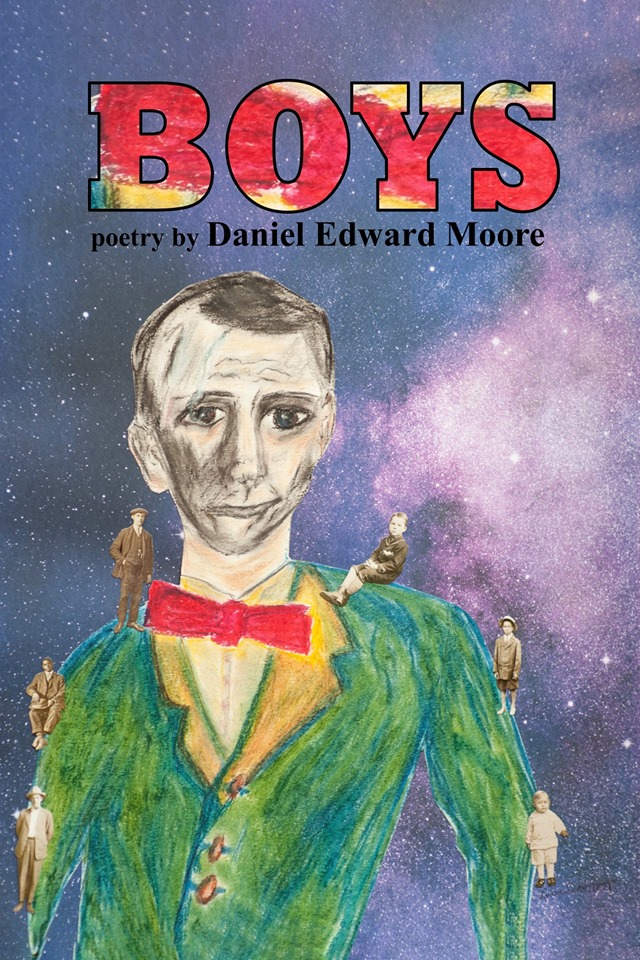
The cover art of Daniel Edward Moore’s debut chapbook Boys will make you instinctively take a deep breath. It warns you that you are about to descend not into flat reality, but further into one man’s psyche with all its spirals and shadows. The cover reminds me of a David Lynch piece—part surrealist daymare, part hypnotic and dark nostalgia. What makes this art even more powerful is that Moore’s wife, Laura Coe Moore—the woman who likely knows Moore best—created it.

It seems fitting, then, that the first poem would be “The Architect’s Son,” a piece where “Leather is the love, you thought was a hand,  /  she said was a dragon’s tail.” An unnerving juxtaposition of rage and fathers and baseball gloves—we have entered the world of boyhood. And this is how we move forward as readers, into the darkness that will show us the light.

It is hard, while reading Boys, to come up for air. This is not a criticism. Instead, these poems create a landscape that so perfectly encapsulates what I can only imagine to be a frightful appointment—to be raised a boy in a society of anger and expectations and “Never Enough.” These are poems where the religions that are meant to give direction create their own trauma and end up leading us further away from our truth.

The universal father, a bloodied Jesus, the boy—together these personas create a peculiar type of trinity. And in doing so, they form a faith more likely to restore the soul, “a cathedral of gnashing teeth.”

The title poem (originally published in Hot Metal Bridge), in its violence and restraint, encapsulates the innate spiritual struggle weaved throughout the entire chapbook. The poem begins:

It sounded like
boys in the woods
kicking a dying wolf.

They called him faggot
and his eyes
rolled to heaven.

They called him hungry
and his face
ate the earth.

Moore’s exploration of queerness against the backdrop of brutality is a long look at “men wearing crowns of bloody tiaras” while “rejecting the soul of a boy.” So when the chapbook closes with the last line, “birds become hymns of smoke,” we are reminded that even in the worst of circumstances there is hope that we can rise above our struggles.

It is apt that one poem in Moore’s chapbook would be dedicated to Paul Monette, author and gay activist who died from AIDS. Monette once said, “Go without hate, but not without rage; heal the world.” Moore’s work exemplifies this quote.

Boys does not deny suffering. It does not deny the gift of anger, “like all religions based on blood.” Instead, it celebrates it. And in celebrating the darkness within us, we have the chance to be transformed.

Publisher: Duck Lake Books (November 29, 2019)

Daniel Edward Moore is an award-winning poet whose works have appeared in literary journals such as American Literary Review, Columbia Journal of Arts and Literature, Spoon River Poetry Review, Rattle, Mid-American Review, December and many others. His chapbook Boys is forthcoming from Duck Lake Books in December 2019. His full-length collection Waxing the Dents was a finalist for the Brick Road Poetry Prize and will be published by Brick Road Poetry Press in February 2020.

Risa Denenberg is the curator at The Poetry Cafe.
She is a co-founder and editor at Headmistress Press and has published three full length collections of poetry, most recently,
slight faith (MoonPath Press, 2018).

Jeff Santosuosso

Body of Water Anniversary Interview with Lauren Davis

Lauren Davis: Your debut chapbook Body of Water was published on November 2, 2018. Congratulations on its one-year anniversary! When did you first start to put this manuscript together?

Jeff Santosuosso: Some elements of that book are ten years old, while the most recent, the title poem, is about a year old. That gave me a theme. I generally don’t think in terms of a single-themed work, so that focus was welcome. From there, I browsed my body of work to find similar elements and to tell a story with the chapbook.

LD: In one or two sentences, can you describe the function of a poetry chapbook?

JS: Short story with no overt plot. A flip book of words.

LD: Can you tell me a little bit about how you found your publisher?

JS: I found the publisher via a message board, CRWROPPS and via a referral from another poet. CRWROPPS is a great tool for writers looking for submission opportunities and other things. Clare Songbirds Publishing House is a fine little outfit in upstate New York. They did not require me to presell any chapbooks, as others do, nor did they require a submissions/reading fee. Writers work directly with management.

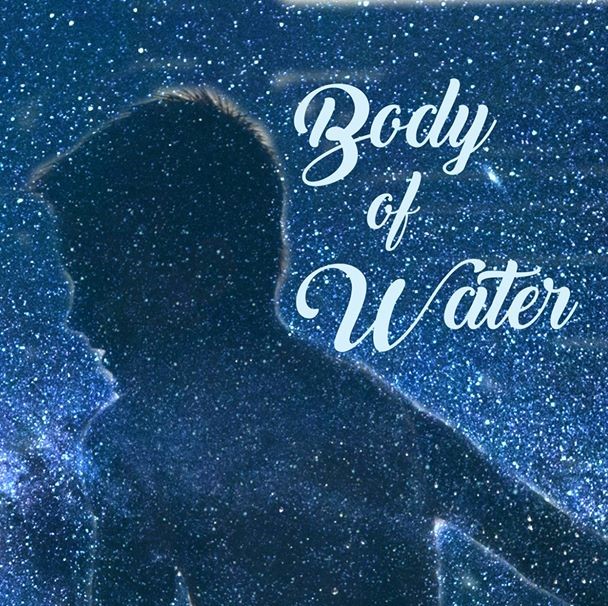
LD: Your cover is absolutely stunning. Did you provide this image for Clare Songbirds Publishing House?

JS: I love it too! I’ve received many compliments on it and have forwarded them to CSPH. The artist is Angela Yuriko Smith. She did that on her own, presumably having read all or part of the manuscript. In any case, the result is stunning!

LD: What was the editing process like with your publisher?

JS: Easy. Simple email exchange, quickly reverted by the publisher. High marks for that!

LD: And has your relationship to these poems changed any now that they’ve been out in the world?  

JS: Not so much, though I’m fascinated by the feedback I get, what reaches and connects with people. My son read one of them for a college public speaking course and recorded it. Gives me the chills!

LD: That must have been a very special experience, to witness that. Tell me what poem you think best represents this collection.

JS: Probably the title poem and also “The Blue.” The first because it’s personal. The second because it’s universal. I grew up about five miles from Walden Pond, read the book in high school and have always credited it with lasting impact on my outlook. That poem is very introspective, almost a mood poem for me. Separately, I was prompted by the poet and teacher Matthew Lippman to write a poem about the sea/ocean. (What? Yeah, that’s never been done before, I’ve got such a fresh perspective. Uh-huh.) Anyway, that poem is historical and global, a sweep of a piece, if you will. For me, then, the two relate to our personal, internal, finite relationship with water and our universal, external, infinite relationship with it. I’ll always have a soft spot for “New Jersey Nighthawks,” which I wrote on a ski trip when I was reading a lot of Kerouac.

LD: What are you working on now?

JS: Ha! Come to think of it, more than I expected: an adaptation of one of the books of the Bible. A collaborative poetry work with a good friend, inspired by another. A totally killer video collage of Anglophones from all over the world with their luscious local accents reading “Jabberwocky.” Oh, and a novel about tennis, second chances, and redemption that’s finished. What’s the definition of “finished”?

LD: Do you have any advice for poets who are putting together a chapbook manuscript? 

JS: Look for a theme. Look for alignment between your theme and what the editor seeks. Have the book tell a story or have some arrangement, narrative or otherwise. Follow the publisher’s guidelines.

Jeff Santosuosso is a business consultant and award-winning poet living in Pensacola, Florida. His debut chapbook, Body of Water, was published at Clare Songbirds Publishing House. He is Editor-in-Chief of panoplyzine.com, an online journal of poetry and short prose.

Lauren Davis is the author of Each Wild Thing’s Consent (Poetry Wolf Press). She holds an MFA from the Bennington Writing Seminars, and her poetry, essays, stories, and fairy tales can be found in publications such as Prairie SchoonerAutomata ReviewHobart, and Ninth Letter. Davis teaches at The Writers’ Workshoppe in Port Townsend, Washington.

Risa Denenberg is the curator at The Poetry Cafe.
She is a co-founder and editor at Headmistress Press and has published
three full length collections of poetry, most recently, “slight faith” (MoonPath Press, 2018).

Interviews: A New Feature at The Poetry Cafe!

Big thanks to all who have been following The Poetry Cafe Online and reading our reviews of poetry chapbooks. I continue to receive chapbooks from near and far, and am amazed at the quality of what I am reading. I am forever grateful to guest reviewers: Sarah Stockton, Jerri Frederickson, Siân Killingsworth and Lennart Lundh who have written such superb reviews. I’m always on the lookout for new reviewers, so please get in touch if you are interested.

Today, The Cafe is opening a new reading room for interviews with authors of poetry chapbooks. We’re starting with Lauren Davis’s review of Jeff Santosuosso’s chapbook, Body of Water. Take a read and enjoy the winding path through the process and rewards of writing.

This means we are open for your interviews too. Please contact me if you want to pitch an interview with your favorite chapbook poet!

Contact me at: risa@thepoetrycafe.online