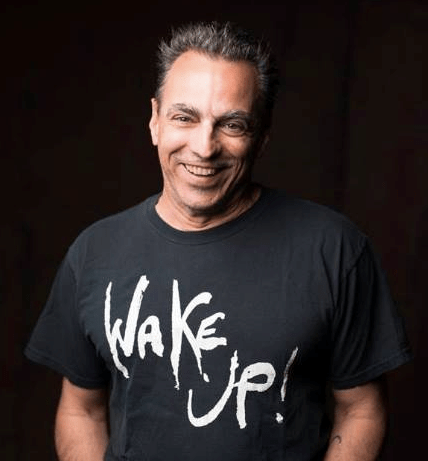
Frank Jude Boccio, author of Mindfulness Yoga, is an ordained zen Buddhist dharma teacher and creator of an approach to yoga postural practice based upon the Buddha’s teachings on mindfulness. His writing has appeared in many yoga and Buddhist journals and anthologies. This is his first poetry review to be published outside of Goodreads! http://www.mindfulnessyoga.net
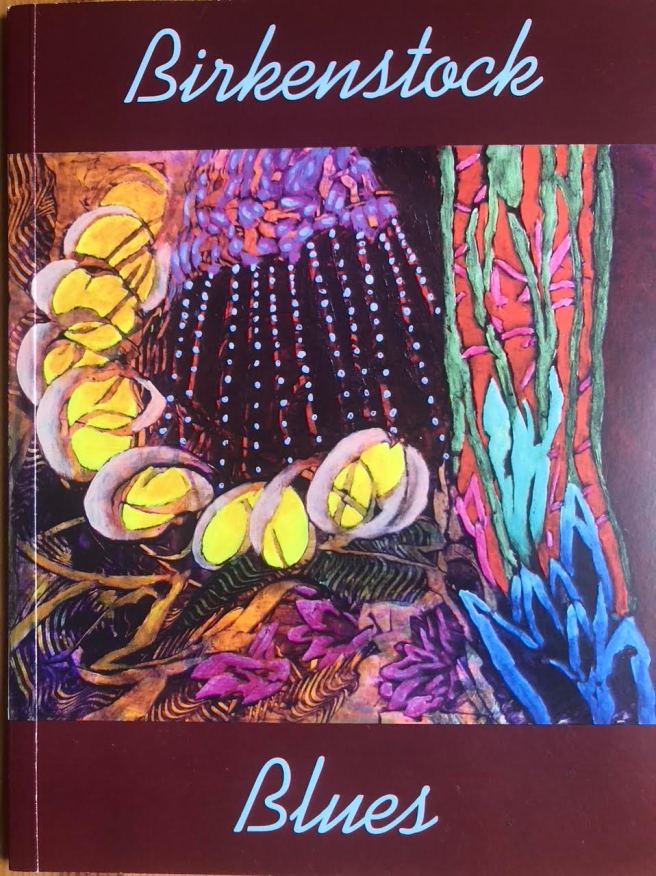
In 2019 Presa Press (Rockford, MI) published Jefferson Carter’s eleventh book of poetry entitled Birkenstock Blues. I don’t know the background and why he did it, but Carter was moved to buy back his rights and self-publish the volume this year with a much better cover and with three additional poems. It just goes to show you that sometimes, indeed, if you want something done right, you have to do it yourself!
Up front, I must disclose I know Carter. He was a regular in my Sunday Mindfulness Yoga class and I – and some of my teachings – have been alluded to in several poems found in his previous volumes, Get Serious: New & Selected Poems (Chax Press, 2013) and in Diphtheria Festival (Main Street Rag Publishing Company, 2016), which has a cover blurb from me: “The poet Carter reminds me of is Billy Collins, but a mordant, twisted, even punk Collins.” And the poems found in Birkenstock Blues certainly bear that out. Tucson, Arizona’s previous mayor, Jonathan Rothschild, says “[Carter] has long captured life’s subtleties with humor, irony, and a touch of charming cynicism that brings home truths we recognize with a knowing wink.” Anyone who has known a cynic – or harbors an inner cynic – knows that within the heart of any cynic abides a romantic nursing their wounds – or a cocktail. Or both.
Case in point: the opening three poems all paint a picture of his marriage, the deep love and respect hiding in plain sight behind the dry and — there’s that word again — mordant wit. In “Life Partner,” Carter tells us how, “for convenience” he and “the woman formerly known as” his wife have numbered their arguments. Anyone who has been in a long-term relationship understands how couples recycle the same arguments again and again. And as all good art does, the universal is made explicit through the personal: “Number 5, you left / hair in the sink again.” “Number 13, you don’t listen to me.” Carter’s honest riposte to that one is “But I do. I just don’t agree.” How can you read this and not find the affectionate warmth of the familiar? The conclusion to this poem – as in many of his others – ends with a jolt that evokes the mic drop of a punch line or a slap across the face. It’s in this way that Carter reveals the subtleties and truths of the mundanity of daily life.
Carter also writes honestly and revealingly about aging, which is refreshing in our youth-obsessed culture. In “Fugly,” the poem that refers to the Birkenstocks of the book’s title, he shares the time-honored ritual of a man used to being dressed by his wife, only here it’s the costume of an “old hipster doll” with:
Straw fedora, brand-name t-shirts from the thrift store, Bermuda shorts, black dress socks & scuffed wingtips.
I read that description and almost spilled my bourbon, laughing at the image provoked in my mind’s eye. Then he drops the lines:
I don’t mind, playing child to your mother, finally getting why old men sometimes call their wives Mother.
Those lines evoke earlier eras fraught with the mashup of the tenderness and creepiness of that dynamic.
Another thing I appreciate about Carter’s poetry is how quick and penetrating he is to see and hear possibilities in places of mis-cue, mis-hearing and misunderstanding. The title of his chapbook, Diphtheria Festival, was the result of his googling Dipthera festiva, a black and white moth. Google responded, “Did you mean Diphtheria Festival?” Just now, writing that, I laughed yet again! But Carter uses something like that to create a truly wonderful poem, making art from happenstance. And he does it again in Birkenstock Blues in the poem “Advocate” which begins:
I’ve misread her job title: conservation advocate, not conversation advocate. How we talk!
And so opens a meditation on the environment, a major concern for Carter as he has long advocated and volunteered for Sky Island Alliance, a locally based environmental organization here in Tucson, Arizona.
This concern is also front and center in Carter’s poem, “The Book Of Extinctions,” (inspired by Extinct Species of the World, Jean Christophe Balouet, New Holland Publishers Ltd., 1990) which includes this quote from that book,
more than 100 species a day will have disappeared by the end of the century.
I don’t want to spoil it, but I’ll say that for a short poem of only 15 lines, the ending once again draws a breath and creates a deep pang in the heart with an image that has deep resonance. I love it!
I could go on but I won’t, other than to say that Jefferson Carter mines a special kind of art in his poetry. There’s nothing pretentious about his work. And neither is there anything trite. He writes a kind of poetry that captures real moments of life, snapshots of small particularities that shed light on the human condition. He’s a yogi and a bad seed curmudgeon, and in that mix is a small, not grandiose, creative treasure I value very much.
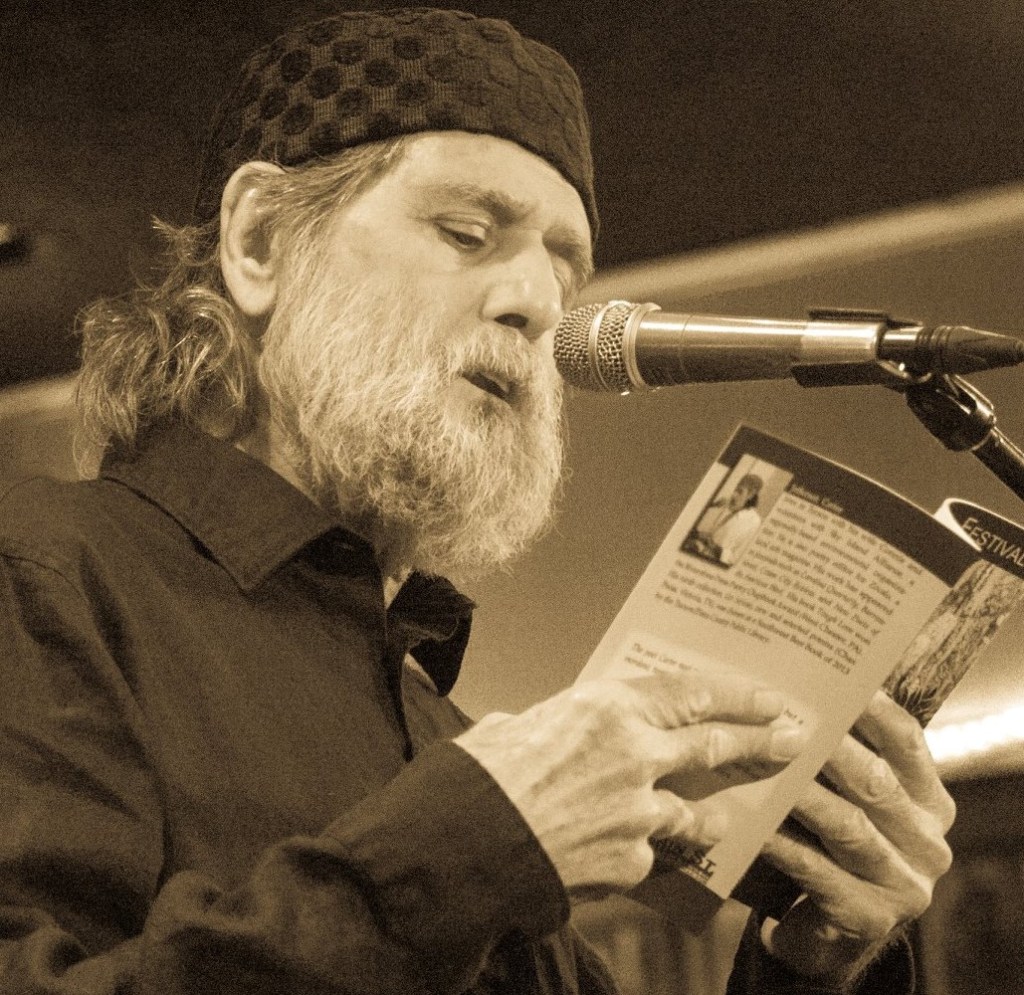
Jefferson Carter has poems in such journals as Barrow Street, Cream City Review, and Rattle. Chax Press published Get Serious: New and Selected Poems, chosen as a Southwest Best Book of 2013 by the Tucson/Pima County Public Library. In 2019, Presa Press released his eleventh collection, Birkenstock Blues. He lives in Tucson, Arizona with his wife Connie. He’s a passionate supporter of Sky Island Alliance, a regionally-based environmental organization.
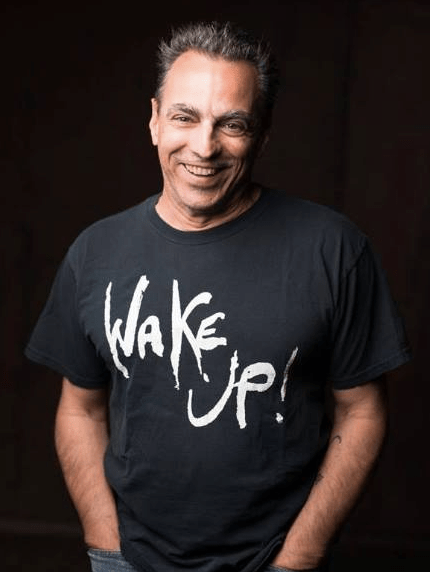
Frank Jude Boccio, author of Mindfulness Yoga, is an ordained zen Buddhist dharma teacher and creator of an approach to yoga postural practice based upon the Buddha’s teachings on mindfulness. His writing has appeared in many yoga and Buddhist journals and anthologies. This is his first poetry review to be published outside of Goodreads! http://www.mindfulnessyoga.net
Sister poet Trish Hopkinson sent me a PDF of her very tiny chapbook (called a microchap), Reconstructed Happiness (Origami Poems Project, 2020). You know Trish from her Daily Digest posts that arrive in your inbox, chock-full of information vital to poets; and if you don’t, you should the join the other 16,000 people who do.
I want to tell you about Trish’s book, but first I have to give a shout-out to the Origami Poems Project, whose motto is: Helping the world, one Free microchap at a time!.
The project was established in 2009 and seeks to publish free e-versions of microchap books that you self-assemble, using origami technique. This is brilliant. Learn to fold! (Another motto of this group.) At the website you’ll find this explanation: A microchap presents poems on a single sheet of paper. The paper folds origami-style into palm-sized booklets containing 6 pages of text. Below is a view of the folded microchap printed on Landscape setting:
These little books are designed and published in PDF form, with full-color covers, and with folding directions included. Submissions are free through Submittable, and will re-open in September. They graciously accept donations to keep the “always free” spirit alive.
Back to Trish Hopkinson’s microchap, with the sheepish admission that I didn’t fold it correctly, but I loved it anyway. Reconstructed Happinessenfolds three poems. In “My Matter,” the word matter is bisected into its concrete meaning (as in, “anything that has mass and volume”) and its use in the abstract-concrete sense (bear with me here) of to be relevant or important, sometimes referred to as “material.” The poem reaches for the concept of “we are stardust,” in many forms: dust, pollen, “a dove’s blurred wing,” or dirt “caked beneath toenails.” It ends with string theory:
Pressure peels threads from my skin, unravels
Into streams of floating string.
The title poem is an “erasure in reverse of Ferlinghetti’s “I Am Waiting.”” It is an anaphora of “I am’s” that includes “I am my typewriter” (of course), along with “I am anarchy.”
The final poem in this series is “Offspring.” I read it as an ode, but it may be interpreted in a number of ways, as a good poem often can be. These lines drew me in,
My tendrils pull me taut tether me heavy to the dirt
where I can’t pull free from root or worm.
You can download Trish’s microchap (and many others) and try your hand at origami. If you decide to submit your work, read their instructions carefully first. Not every chapbook earns the right to be a microchap!
Trish Hopkinson is a poet, blogger, and advocate for the literary arts. You can find her online at SelfishPoet.com and provisionally in Utah, where she runs the regional poetry group Rock Canyon Poets and folds poems to fill Poemball machines for Provo Poetry. Her poetry has been published in several lit mags and journals, including Tinderbox, Glass Poetry Press, and The Penn Review; her third chapbook Footnote was published by Lithic Press in 2017, and her most recent e-chapbook Almost Famous was published by Yavanika Press in 2019. Hopkinson will happily answer to labels such as atheist, feminist, and empty nester; and enjoys traveling, live music, and craft beer.
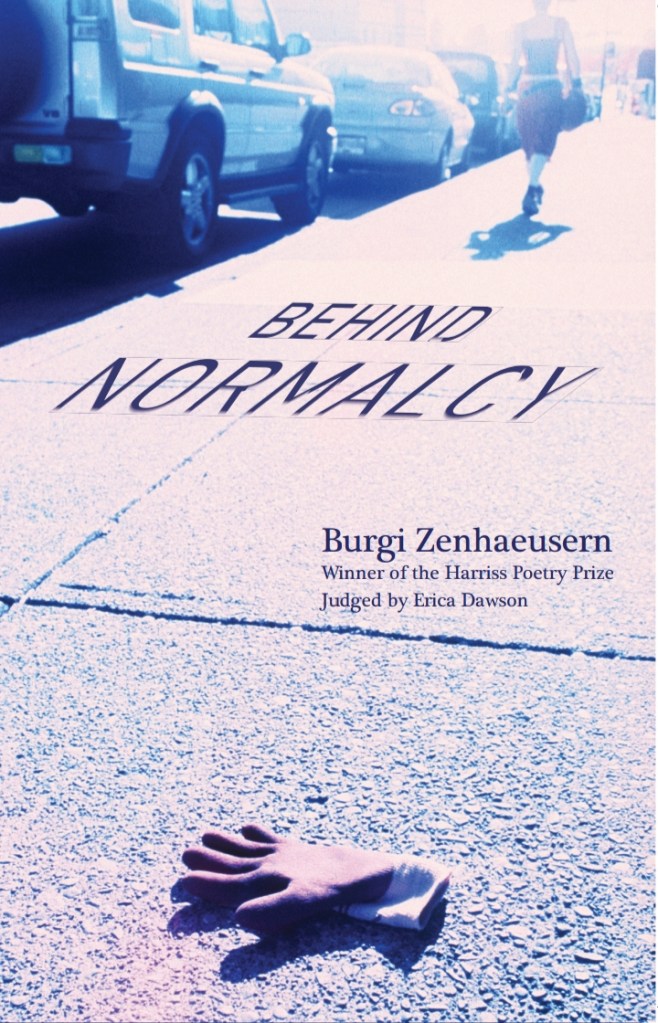
Behind Normalcy (CityLit Press, 2020)–a smartly written exploration of what hides behind the quotidian–is Burgi Zenhaeusern’s debut chapbook, winner of the Harriss Poetry Prize. Ordinary animals and things become imbued with an undercurrent of violence, like the checkout plastic bag that longs “to choke something / along the creek” and the great blue heron with a “graceful dagger” beak. In Zenhaeusern’s universe, we learn to be wary, like the deer in Rock Creek Park with:
. . . a vague sense of danger that lets you hesitate there on the side of the road like dusk gathering shape.
I was curious about the background of Behind Normalcy, so I reached out to the author to have a conversation through email.
Nancy Naomi Carlson: First of all, congratulations on the publication of Behind Normalcy! What does this publication mean to you vis-à-vis how you view yourself and your writing career?
Burgi Zenhaeusern: Thank you very much, Nancy Naomi! The gratification of being able to hold a book of my own is still sinking in, after many months. And I mean holding as in holding the object of my efforts, as if I had been kneading dough for a long time, and now my hands are tired, but satisfied—a sense of accomplishment and validation after all. Though I have been writing intermittently for very long, I didn’t come to poetry until about fifteen years ago, in my mid-forties. I had finally relearned to take my aspirations at least as seriously as I had been taking everybody else’s. In that sense, the chapbook is a culmination and an immense boost to continue no matter what. Especially as, with my late start, age has become a real factor, both in terms of working time left (I’m rather slow) and in how unfavorably age is perceived, even more so in the absence of a formal career (writing or otherwise). I was fortunate enough to have the choice not to pursue a salaried career. It is a whole other debate how good an idea that was, and one I periodically have to settle with myself. But it is without question what I wanted, even fought for.
NNC: Let’s talk about the title. How did this title come to you? Were there other titles you considered?
BZ: The title didn’t change from submission to publication. For a while, I thought I might reconsider. Then I forgot. By now, it has come to represent this book. I like the idea of taking a title from a fragment within the manuscript, sending the reader on a treasure hunt of sorts, which is what I did. The phrase “behind normalcy” appears in the poem “aubade/s,” which can be read in vertical columns as well as horizontally. It appears in the first such column: “behind normalcy a dark June day fattening.” Quite ominous. I felt ominous when I wrote that poem, still do for that matter. For the book I wanted a less definite phrase. And I’m happy with the choice, considering how nicely it corresponds with the cover, my photographer friend Alan Sirulnikoff’s image. Gregg Wilhelm at CityLit Press did a beautiful design job integrating it, heightening the suggestiveness of both title and image. And like so much of what has been written before the pandemic, “behind normalcy” has gotten an additional ring to it.
NNC: From what you’ve said, I know you didn’t write this book overnight. How long would you say this book was in the making?
BZ: In some aspects, it was written over the last decade, as the successor to abandoned manuscript attempts. It’s actually a much condensed version of The Pilferer, my latest full-length manuscript. In another aspect, all my life? I’ve been writing with breaks for very long. As a child I used to draw stories about elves and fairies, and the like—half drawn, half written. I wish I were as prolific and confident now as I was back then. By the time I came to the US from Switzerland, I had begun a novel, dropped it, began another, dropped that one too, and eventually stopped writing. It took realizing that I didn’t have to write in German and prose to find my way back to writing and a sense of vocation. Shifting from German to English shifted my writing from prose to poetry. My journey as a writer is very much a linguistic one as well. And then again, Behind Normalcy began with emigrating to join my husband over twenty-five years ago. Most of my poems echo my life since then, how I’ve come to call the US home. They explore becoming/being White (growing up in Switzerland I didn’t know I was White, everyone in my world was White at that time), unfettered self-identification, the privilege of being welcomed.
NNC: I’m struck with the richness of sound found in these poems, like this particular line about the great blue heron: “lunge after lunge against an ever urging need.” How does sound fit into your writing process?
BZ: Oh, I love sound. And rhythm and phrasing for that matter! Thank you for remarking on this line! It took years to write, the whole poem did. There was precision, absolute focus, and fluidity in the heron’s hunt. Any beauty originated in that alone, nothing else. Hunger is not a metaphor. I knew that from the start, but couldn’t convey it for the longest time. Usually, with sound I proceed intuitively, unless it’s jarring or draws too much attention to itself like an unintended rhyme for example. I don’t usually write in rhymes. I work with echoes. But I don’t plan them. I’m more attuned to rhythm and phrasing. As soon as a poem begins to take shape I read it out loud, make changes until I can read it without stumbling. And if I like it I might just go on reciting it for sheer joy. Until the next day happens, and the next. It all has to do with breathing. I used to play the recorder quite seriously, briefly considered becoming a musician even. A wind instrument teaches you to breathe and how to manipulate breathing for the sake of phrasing. That is how I revise and how I read, my own writing and others’.
NNC: Some would classify some of these poems as “experimental” in terms of form and syntax? Can you talk more about this experimental tendency?
BZ: I do enjoy playing with a text’s potential. Though form for me is rarely a poem’s original stimulus, nor a goal by itself. I just play around until I find a fit, and sometimes the answer is an object poem. It was the poet Molly Spencer who first noted this tendency and encouraged me to explore it. I’m very grateful to her for that! The other eye-opener was watching and hearing Tyehimba Jess read from his work, Olio, at the fantastic Lannan Center for Poetics and Social Practice at Georgetown University in Washington, DC. What he does in Olio is simply amazing! I still remember how liberated I felt after his reading. I also like how the idea of play engages the reader differently. With explicitly interactive texts, the weight and importance of input from writer and reader is nearly the same. I mean it quite literally when I tell the reader “you are a poem’s lungs.”
NNC: Who are some of your literary influences? Any Swiss writers?
BZ: Since my focus had been on fiction for so long, ever since I’ve started writing poetry I’ve been trying to catch up with reading it, which includes the more traditional canon. But, my fascination is with what is being published now in the English speaking world. I’m pretty much out of touch with the Swiss and German literary scenes. As a writer I very much live and work where I am. Also, influence for me is usually temporary. It all flows into one big pool of wonders and possibilities. I’m inspired by so many writers. And the more I read the better my inner ear becomes. And my English language ear cannot get enough practice, believe me! I compare influence to dancing along others on the dance-floor. No matter the style, if they’re good, their dancing goes into my step.
NNC: Do you think your Swiss background has influenced your writing?
BZ: Difficult to say. I mean a lot of it has more to do with being a foreigner than with being Swiss per se. Cultural aspects come to mind, meaning that for a lot of things I lack contextual fluency: I came here with another country’s memory and consciousness. Google is my go-to place. A dictionary definition is a helpful crutch. But, so much of a word’s aliveness comes from its use, from growing up with it. And then there is the question of what sort of English is my English. Am I parroting, appropriating? Lots of pitfalls along the way. On many levels I felt I had to be reassembled when I started out in the US, similar to my pomegranate poem in Behind Normalcy. Ultimately, some part of me has never fully crossed. It hovers above the two worlds like a tree branching across the ocean. Foreignness—its outer manifestation in my accent—is a potential and a difficulty. I try to harness it. The question is finding my specific place in this web I now call home and speak from it.
NNC: You’re also a translator. How does the process of writing your own poems compare with the process of translating a poem?
BZ: Translation is a rare, always enriching foray from my usual practice of writing poems. When I translate, I’m in two languages at once, at least at first, something that doesn’t happen when I write my own poems. And I’m forced to step outside of myself, following another poet’s lead, like accompanying a soloist, if only in the sense of making a poem in another poet’s voice. I see translation as an ultimate act of reading. I don’t think my approach for translating a poem versus writing my own overlaps. The processes set out from opposing directions. It’s only during last revisions and fine-tuning that I use the same strategies for both, to improve flow for example: when the translated poem has been lifted into its target language completely, and I don’t have to constantly go back and forth to compare patterns, line-breaks, etc. I’ve never translated my poetry, nor written any in German, and the idea doesn’t appeal to me. And until it does, I won’t. But I love reading translated work of others, especially when I can follow the original.
NNC: What role does family play in your writing?
BZ: My writing has been largely autobiographical so far. In that sense family has provided important source material: the relationships, memories, and in my case motherhood. Family is stories, the ones I tell myself and how their telling changes over time. Family means rootedness for me, my origins, and what I make of them. Nothing is static, and hence everything is continually worth coming back to. Who knows where it goes. I suspect I’ll always write something or other about motherhood though. To watch my kid discover life and me learning alongside him is a never ending source of wonder.
NNC: What are some of your future writing projects?
BZ: While I hope to continue (after all, questions of place and Whiteness remain as relevant as ever) I’m no longer sure about how. Though I don’t have existential worries right now, I feel profoundly interrupted. The paradigm has shifted. Meanwhile, I’m still sending out The Pilferer, reading as much as I can, and writing the occasional review. My latest project began before the pandemic. It picks up threads from my previous work, including Behind Normalcy, and it implies some research. But for now, new poems are down to a trickle and the project lies dormant. I hope to pick it up soon.
BZ: Thank you again, Nancy Naomi, for your questions. I’ve greatly enjoyed trying to answer them.
Burgi Zenhaeusern is the author of Behind Normalcy (CityLit Press, 2020), winner of the 2019 Harriss Poetry Prize. Her work appears in various online and print journals. She volunteers for a local reading series and lives in Chevy Chase, MD. Find more at burgizenhaeusern.com
Nancy Naomi Carlson
Nancy Naomi Carlson, poet, translator, essayist, and editor, has authored 10 titles (six translated). An Infusion of Violets (Seagull Books, 2019), her second full-length collection of poetry, was named “New & Noteworthy” by the New York Times. A recipient of two NEA literature translation fellowships, she was a finalist for the Best Translated Book Award, and the CLMP Firecracker Poetry Award. An associate editor for Tupelo Press, her work has appeared in such journals as APR, The Georgia Review, The Paris Review, and Poetry. www.nancynaomicarlson.com
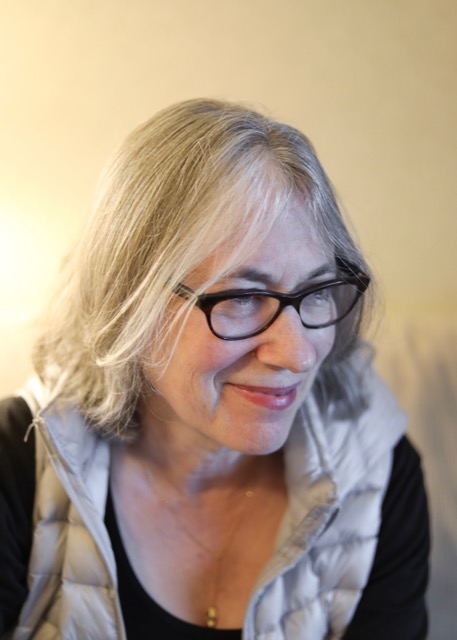
Mary Ellen Talley is a former speech-language pathologist. Her poems have appeared widely in publications including Raven Chronicles, Flatbush Review, and Banshee, as well as in several poetry anthologies. Her poems have received two Pushcart nominations. Book reviews by Talley appear online and in print journals, such as Compulsive Reader, Crab Creek Review, Entropy, Sugar House Review and Empty Mirror. Her chapbook, “Postcards from the Lilac City,” was published in 2020 by Finishing Line Press.
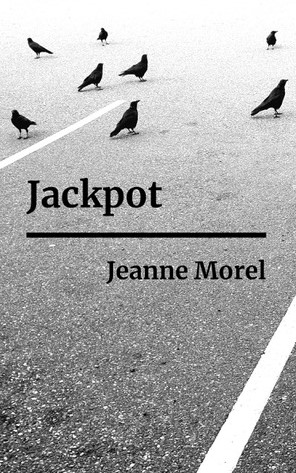
Jeanne Morel’s second chapbook, Jackpot (Bottlecap Press, 2020), travels within a map of language and place. With mentions of North America, Parisian fountains, and the Mekong River in the rainy season in the first poem, “Birthday Parties are Pluperfect,” I knew I was in for an exploration of semantics and quotidian nostalgia.
For instance, which meaning of “pluperfect” is Morel addressing? If birthday parties are pluperfect, are such annual celebrations a grammatical reference to the past perfect tense, or should we choose the other meaning—that such celebrations are more than perfect? Morel presents an ambiguous choice. In several poems, Morel lists options for possible word meanings for readers to ponder. Many poems, adjacent or elsewhere, resonate with one another and it was fun to find and return to recurring details.
Morel does not plunge head-on into serious topics; she jumps in and out to surprise and delight, then moves onward. With sardonic vernacular, the first poem informs: “Upstream is where the shit begins.” The poem ends tongue-in-cheek:
Lordy, what an outfit If you wear that, no one will take you seriously Not this Christmas
Not the day after that either & out of the sky dropped a billion butterflies! Shimmering like olive trees, only orange and purple –
Take this to the boss and best of luck
This chapbook’s thirty pages of inventive grammar in experimental free verse include the incidental as well as the substantive. We come across maps, rats, insects, Winnie-the-Pooh, planets, storage containers, and ice cubes, as well as politics, planets, nuclear bomb testing, astronomy, geometry, logic, and bits of colloquialisms. A bartender shows up as insects crawl over the fence in “Longer than the Wrong Road,”
The saloon doors slap behind me. Butterflies flood the underworld. Where do you come
in?
In a recent conversation, Jeanne shared that “Many of my poems involve movement – and/or lack of movement. Many, like the first poem, collage multiple locations and times. I’m intrigued by what Kwame Dawes calls ‘the tension between the here and the there’ […] and the collage of memories.”
Morel is not a poet of abstract language, metaphor, or message. “I don’t think about images,” she said. “I think of gathering […] I follow sound. I don’t write into ideas or messages.”
Morel’s poems are not linear. Her lines hop, skip, and jump thematically but also remain circular as threads return and reverberate throughout. The box-contained poem “Splintering Tiny Soup Bowls Up Into the Sky,” opens up “Grounded in a place you can’t see,” like nested “Russian dolls comet-ing / across the sky.” As Morel goes about her poetic gatherings, she weaves in tidbits of information, such as “Prussian Blue, the color invented by / accident.”
Regarding poets important to her, Morel said, “I go to Marvin Bell for inspiration. He said art is a way of life, not a career. He advised students to read poets who don’t write the way they do. Some of my favorite poets are Richard Hugo and Philip Levine, even though my poetry isn’t anything like theirs.”
Several poems touch upon serious concerns, such as the U.S. nuclear testing in 1962 in “A-Bombs Over Nevada” or the reactions of an Iraq War veteran in “Given the Conditions.” Morel’s touch is light while offering information, insight, and juxtaposition. For example, she mixes “lullaby sun” with the “slung fences” of the WWII internment camp in the sonically lovely poem, “Purple Over Tule Lake.”
Although these poems are not personal, the reader may infer snippets about the speaker/poet with her references to a student visiting during office hours, yellow roses outside a kitchen window, or the presence of a cat. In “An Unsuitable Home for a Cat,” Morel refers to the serious issue of nuclear waste at Hanford, Washington:
Richland wives in glasses including Marge
Oh, don’t worry
about that – my mother in law cracked
when I fretted about radiation wafting
over after Fukushima
My buddy cat black dances
In “The Next Day I Was Almost Done with Dinner When a Student Came & Pulled Up a Chair,” Morel writes,
Sounds like a circus spectacle – a jester jostling for power in the aisle of the commuter bus. The medium is the message; the freeway the periphery; the bleats a form of saccharine.
In “Map,” Morel parses lists of words for parts of speech and idioms. She also throws in an assignment, as “Write a letter to a relative explaining the verb – to map. Mail it / to the president .” Assignments likely come naturally to her. Although she has been involved in refugee and resettlement work, she presently teaches as an adjunct professor at Seattle Central College and Bellevue College in Washington state. When asked about the impact of her teaching, Morel said, “My writing helps my teaching. It feeds my teaching.”
Few of Morel’s poems stay within the justified left. The margins meander in sentences or phrases, sometimes ending a short line with an article, which tends to create a pause. In more conventional poems, I might find this distracting, but distraction is part of experimental poetry, as it is in life. She also uses numbers, dashes, bullets, brackets, slashes, & ampersands and employs random segues, spare punctuation and semantic word play, often eschewing capitals or periods. An example of this is found in “Nobody Cares What Color My Coat is.” The poem begins with image and map:
I wrap myself in an alphabet for stormy weather
& head across the pass map-less & w/o a hat and yet some days I can’t
leave the house unless I’m dressed in blue jeans, a black t-shirt, You have too many consonants & vowels in your name
[the real estate woman smirked
Morel addresses issues of our current situation in “Crawl City,”
When you are obsessed is no time for pleasantries
the television of all night convenience shops
a monitor monitoring our every move above the cash register
while rats race labyrinths / in the space between
your hairline and your fine plucked brows
This chapbook is a tall refreshing glass of water. Or perhaps a glass of wine? The title poem (also the last poem), “Jackpot,” presents “salmon, sagebrush // & Syrah.” There’s honest humor: “The only major / state of grace ka-ching / ka-ching.”
I noticed the circular juxtaposition with the first and last poems. The first poem, “Birthday Parties are Pluperfect,” begins with ascent,
Why did the balloon float over the fence? / wind – helium & a string let loose – All the fences in North America are at right angles with one another.
Then “Jackpot,” ends with descent:
Perchance your lucky
number–drop a deep blue blossom on the carpet swirl/ watch it fall a stranger
Morel seems to be telling us that life is both a gamble and a roller coaster. She presents numbers and mathematics which give us odds that are less than we might predict. Perhaps we’re just in it for the ride. Sometimes we hit the “Jackpot!”
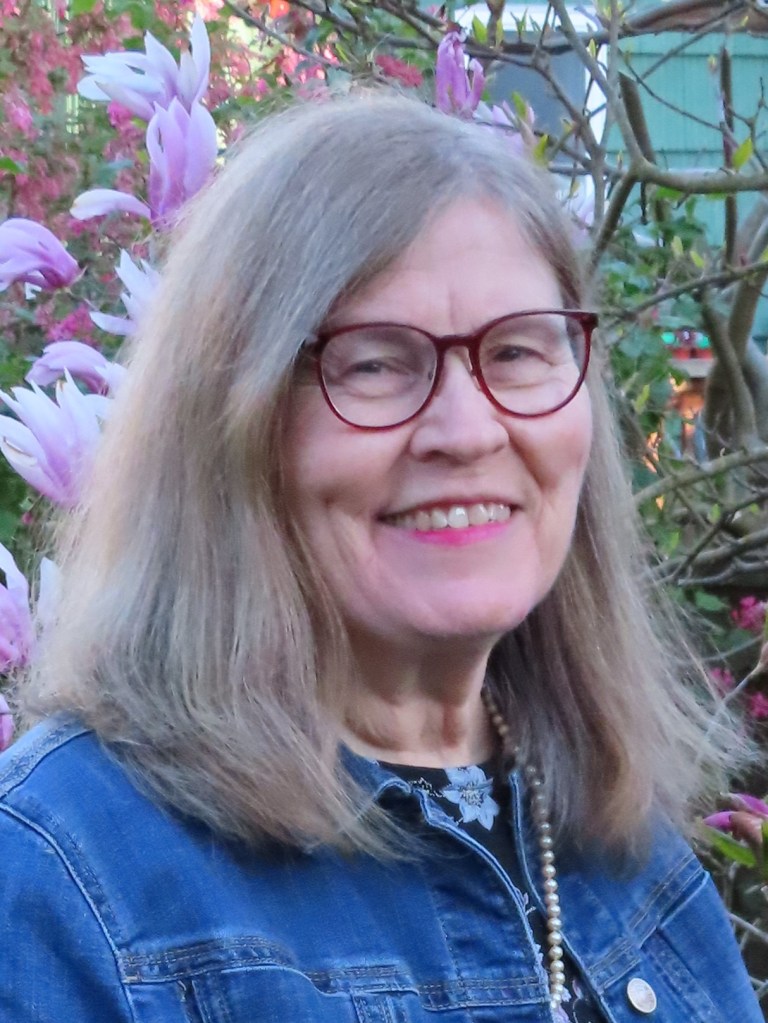
Jeanne Morel is the author of two chapbooks, Jackpot (Bottlecap Press) and That Crossing Is Not Automatic (Tarpaulin Sky Press). She holds an MFA from Pacific University and has been nominated for a Pushcart in both poetry and fiction. Her poetry has been published in great weather for MEDIA, Phantom Drift, Dunes Review, and other journals. She lives in Seattle where she teaches writing and is a gallery guide at the Frye Art Museum.
Mary Ellen Talley is a former speech-language pathologist. Her poems have appeared widely in publications including Raven Chronicles, Flatbush Review, and Banshee, as well as in several poetry anthologies. Her poems have received two Pushcart nominations. Book reviews by Talley appear online and in print journals, such as Compulsive Reader, Crab Creek Review, Entropy, Sugar House Review and Empty Mirror. Her forthcoming chapbook, “Postcards from the Lilac City,” will be published by Finishing Line Press.
Nancy Naomi Carlson, poet, translator, essayist, and editor, has authored 10 titles (six translated). An Infusion of Violets (Seagull Books, 2019), her second full-length collection of poetry, was named “New & Noteworthy” by the New York Times. A recipient of two NEA literature translation fellowships, she was a finalist for the Best Translated Book Award, and the CLMP Firecracker Poetry Award. An associate editor for Tupelo Press, her work has appeared in such journals as APR, The Georgia Review, The Paris Review, and Poetry. www.nancynaomicarlson.com
A whole body of literature exists that focuses on the body. Indeed, one might make the assertion that all literature does so, in one way or another— enraptured body, dying body, panicked body, betrayed body, and, as in the case of Life, One Not Attached to Conditionals by Laura Cesarco Eglin (Thirty West Publishing House, 2020), body as betrayer.
Because I, too, have gone through, and written about “the cancer experience,” I was particularly drawn to this chapbook. I was curious to see how cancer could be the subject of a collection of poems without it spreading into all aspects of what makes a book cohesive and alive, i.e., a sense of tension between themes, linguistic risks, and tone (to name a few). Cesarco Eglin contrasts her subject matter’s doom and gloom with the urge to live her still-young life despite the ever-present shadows. The dark humor infused in these poems also underscores the seriousness of their themes. For example, in “Articulating the Changes in My Body,” Cesarco Eglin, a fine translator herself, compares her scars to Morse code:
I’m thinking about the Morse code as a possible alphabet to get through, to get by, to translate.
She then gives a graphic representation of Morse-code-as-scar.
It’s easy for poems about illness to veer off into sentimentality or self-absorption, but Cesarco Eglin masterfully negotiates the geography of living an unconditional life, despite her multiple bouts with melanoma, and despite the need “to guard [each] new spot ‘like a hawk.’” In this pandemic year, many of us are directly experiencing the need to be extra-vigilant to avoid contracting the virus, which makes this new chapbook of poems particularly relevant. Cesarco Eglin can never escape “the doctor’s voice in [her] head: it will come back.” She reminds us that “there is no vacation from being alert.” Indeed, in an existential stance to confront the absurdity of the human condition, she instructs us on how to take control of the uncontrollable, and writing is her chosen strategy. She offers us this wisdom:
One scar, then another; that’s two lines already: a couplet written in five months, a couplet that promises to be the beginning of a lifetime of poetry.
Melanoma, her muse, has provided her with the motivation to be “aware of any little change in color, shape, texture, dimension, state, mode or mood of any mole or stain or spot on [my] body.” Cesarco Eglin, who was born in Uruguay and is fluent in Spanish and English as well as other languages, is open to melanoma teaching her the language of the body—learning it well enough to eventually call herself “a native speaker.” She’s trying to learn to embrace her scars, and compares them to bridges, as she brilliantly transforms the threatening juxtaposition of “bridge” and “attempt” to a life-affirming choice:
Many bridges, an attempt to keep me in one piece; an attempt to keep me alive long enough to cross them all.
In these days of COVID-19, we could all use something to help us cross these bridges—something to remind us to keep believing there are still “skies and wonders.”
The Reviewer posed some questions to the author about her book:
Nancy Naomi Carlson: What about Life, One Not Attached To Conditionals is uniquely suited to the chapbook form?
Laura Cesarco Eglin: I felt that a shorter form would suit Life, One Not Attached to Conditionals as a way to, at least in language, be able to finish the cycle, end the struggle psychologically, intellectually, and emotionally. Intense, short, and move on to life, one not attached to conditionals.
NMC: I notice that “translation” is one of the themes of Life. How did your work as a translator (and an author who is translated) impact your writing this chapbook?
LCE: Experience translated into language. Poetry as a means to question, challenge, and rearrange thoughts and experiences. Translation as a form of reading deeply, analyzing.
NMC: Writing about illness seems to be a tried-and-true genre, but is also an emerging one, as the landscape of disease is ever-shifting. Were you influenced by other writings on this topic?
LCE: More than influenced on writings on this particular topic for this particular chapbook, I would say that I am always influenced by all the books I read. I think that goes without saying. But there are two books in particular that I’d like to highlight. They deal with overcoming a loved one’s death or suicide: Ghost of by Diana Khoi Nguyen and Instead of Dying by Lauren Haldeman.
NMC: Can you say something about your wonderful title (e.g., how it came about; when, in the process of writing, it came to you…)
LCE: The title comes from a line in “Recovery,” a poem in Life, One Not Attached to Conditionals. I did not set out to write a poetry collection about having melanoma and skin cancer repeatedly and what that meant. I was writing poems and they, understandably, had that focus. The process of editing, rereading, changing, rewriting brings new perspectives, and when I read that line I perceived that it encapsulates the compass, as well as the power I think language has.
Laura Cesarco Eglin is a poet and translator. She is the author of three collections of poetry: Calling Water by Its Name, translated by Scott Spanbauer (Mouthfeel Press, 2016), Sastrería (Yaugurú, 2011), and Reborn in Ink,translated by Catherine Jagoe and Jesse Lee Kercheval (The Word Works, 2019). She has also published three chapbooks: Life, One Not Attached to Conditionals (Thirty West Publishing House, 2020), Occasions to Call Miracles Appropriate (The Lune, 2015) and Tailor Shop: Threads, co-translated with Teresa Williams (Finishing Line Press, 2013). Her poems, as well as her translations (from the Spanish, Portuguese, Portuñol, and Galician), have appeared in a variety of journals, including Asymptote, Modern Poetry in Translation, Eleven Eleven, Puerto del Sol, Copper Nickel, Spoon River Poetry Review, Arsenic Lobster, International Poetry Review, Tupelo Quarterly, Columbia Poetry Review, Blood Orange Review, Timber, Pretty Owl Poetry, Pilgrimage, Periódico de Poesía, and more. Cesarco Eglin is the translator of Of Death. Minimal Odes by the Brazilian author Hilda Hilst (co•im•press), winner of the 2019 Best Translated Book Award in Poetry. She co-translated from the Portuñol Fabián Severo’s Night in the North (EulaliaBooks, 2020). She is the co-founding editor and publisher of Veliz Books.
Nancy Naomi Carlson, poet, translator, essayist, and editor, has authored 10 titles (six translated). An Infusion of Violets (Seagull Books, 2019), her second full-length collection of poetry, was named “New & Noteworthy” by the New York Times. A recipient of two NEA literature translation fellowships, she was a finalist for the Best Translated Book Award, and the CLMP Firecracker Poetry Award. An associate editor for Tupelo Press, her work has appeared in such journals as APR, The Georgia Review, The Paris Review, and Poetry. www.nancynaomicarlson.com
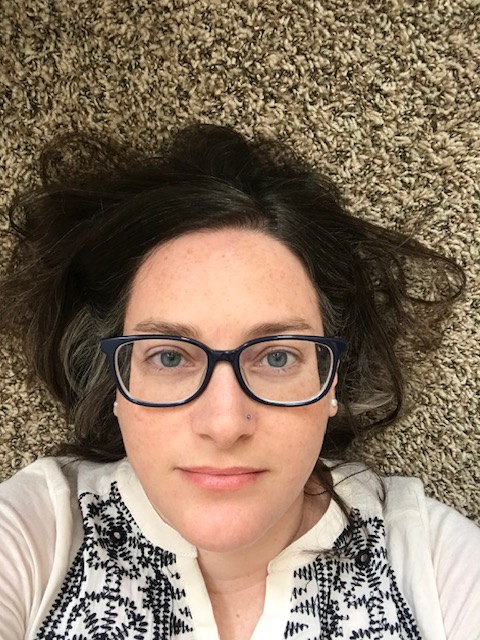
Risa Denenberg is the curator at The Poetry Cafe Online.













 The Poetry Cafe