Inclined to Riot

Inclined To Riot by KMA Sullivan

Review by Michele Bombardier

Artists and poets have grappled with the relationship between life and art for millennia.  KMA Sullivan, in her collection Inclined to Riot (Sibling Rivalry Press, 2019), brings timely and current considerations to this conversation. These poems smolder with passion, longing and fury as the poet considers art and compares it to her experience as a woman,

in a land where peace equals a naked woman
on her knees
milking a goat
where a river of pink babies
is called the source of life
I am not a woman at tea
the same as still life with pear

We don’t need to be told that the art the poet is viewing is by a male artist. We feel it. These poems center defiance to the male gaze and idealization of women across time and in different art forms.

The poems in Inclined to Riot are written without punctuation, no capitalization except “I”, and are mostly in short lines and in first person. The capitalized “I” rightly draws attention to itself, a statement of assertion.  Sullivan uses the steady rhythm of short lines to effectively amplify emotional intensity, as in the poem “here”:

a glass box of broken limbs
face worn away
I can still ride this horse
glow at night
like red light on egyptian blue
I was born to be luminescent
a stampede
here
forced down on one knee
held by my hair
that languid boy
cast a shadow even in relief
even in fragments
mouth open, nostrils flared
I am nomad, moon goddess, carbon smear
if wings sprouted from my face
I would not fly back

Sullivan writes in her post notes that her visits to nearly sixty galleries and art spaces in Europe and the US influenced the poetry in this collection in which they offered a “conversation” with her inner life. Sullivan grew up with an art historian mother and this deep exposure to classical art is reflected in her poems. These are more than ekphrastic poems; Sullivan draws on our collective knowledge of famous art pieces and expands on it as she challenges long-held feminine ideals of virtue, beauty, domesticity. She writes:

the cubists got it right
we are all this fractured form
but we make it down the stairs
with our pieces tumbling
choose among milkmaid and saint
and slotted spoon

I find myself teaching these poems in workshops, especially to show how Sullivan masterfully combines lyrical and narrative poetry with aspects of language poetry, how she layers image upon image to build intensity. As in the poem “armature”, Sullivan writes:

rodin offers joan of arc
her head of sorrow
in ecstasy
among twigs on fire
I refuse to sit for my portrait
become a placeholder
a fragment of a door

Each line packs a powerful punch. Teachers of poetry would benefit from using Inclined to Riot in their armamentarium as a book that uses many craft devises to amplify emotion and power. This book is both timely and timeless with its contemporary and feminist examination of art that has endured.  I am glad for this collection that not only questions our relationship to self and art but are poems of feminist empowerment using a kaleidoscope of images that linger in the mind’s eye.
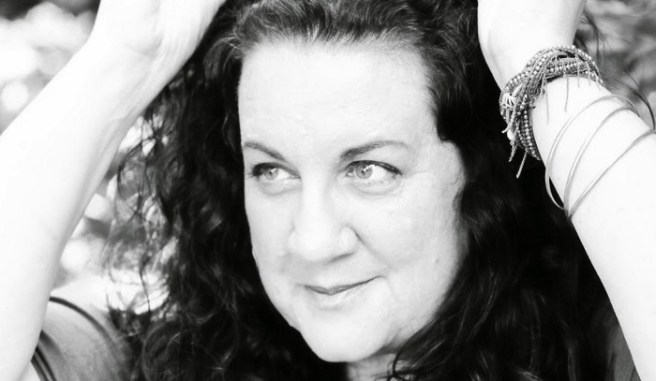
KMA Sullivan is the author of two poetry collections: Inclined to Riot (Sibling Rivalry Press, 2019) and Necessary Fire, winner of the St. Lawrence Book Award (Black Lawrence Press, 2015). Her poems and essays have appeared in Boston ReviewThe RumpusSouthern Humanities ReviewForklift, OhioThe Nervous Breakdown, The Offingdiode, and elsewhere. She has been awarded residencies in creative nonfiction and poetry at Virginia Center for the Creative Arts, Vermont Studio Center, and Summer Literary Seminars and she is the coeditor-in-chief of Vinyl and the publisher at YesYes Books. KMA received an MFA in poetry from Virginia Tech; in earlier years she earned degrees in philosophy from Trinity College and Boston College and raised five children with her partner of 35 years. She is the cofounder of YesYes Healing Garden, an acupuncture and Chinese Herbal Medicine in Portland, OR. KMA believes in the power of art and literature to improve the lives they engage.
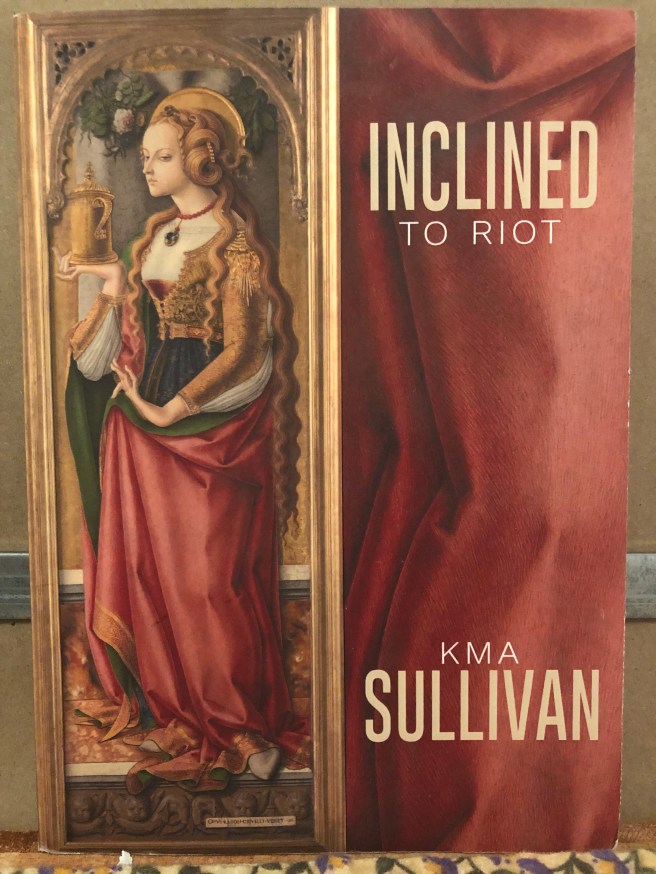

Title: Inclined to Riot
Author: KMA Sullivan

Publisher: Sibling Rivalry Press
ISBN: 978-1-943977-58-1
Library of Congress Number: 2018960662
Publication Date: 05/29/2019
Retail Price: $15.95
5.83 x 8.27” Paperback; 66 Pages
Distributed by Ingram and Sibling Rivalry Press


Michele Bombardier’s debut collection, What We Do was a Washington Book Award finalist. Michele is a Hedgebrook and Mineral School fellow and the founder of Fishplate Poetry, which offers poetry workshops while raising money for medical care for refugees in the Middle East and elsewhere. She earned her MFA in poetry and works as a neurological and developmental specialist SLP. Her work has been published in Alaska Quarterly Review, Atlanta Review, Bellevue Literary Review and many others.


Risa Denenberg is the curator at The Poetry Cafe.

Michele Bombardier

Michele Bombardier

Michele Bombardier’s debut collection, What We Do was a Washington Book Award finalist. Michele is a Hedgebrook and Mineral School fellow and the founder of Fishplate Poetry, which offers poetry workshops while raising money for medical care for refugees in the Middle East and elsewhere. She earned her MFA in poetry and works as a neurological and developmental specialist SLP. Her work has been published in Alaska Quarterly Review, Atlanta Review, Bellevue Literary Review and many other journals.

Alexis Rhone Fancher & Arya F. Jenkins

America Has No Place for Grief: A Conversation with Alexis Rhone Fancher
by Arya F. Jenkins

Arya F. Jenkins: In State of Grace: The Joshua Elegies (KYSO Press, 2015) and The Dead Kid Poems (KYSO Press, 2019), you write unflinchingly about the loss of your son, an only child, who was only 26 when he died from cancer. Your other collections, Junkie Wife (Moon Tide Press, 2018) and How I Lost My Virginity to Michael Cohen and other heart-stab poems (Sybaritic Press, 2014) are brash explorations of female sexuality and power. How, if at all, did writing about sex prepare you for writing about death and loss? And where does the theme of female empowerment, a constant in your work, fit into the process of grief? 

Alexis Rhone Fancher: I’m not sure writing about sex prepared me to write about grief and loss, so much as it emboldened me. I was raised to believe I could do anything, and that my opinion mattered. I have always owned my personhood and my sexuality. Sadly, in today’s increasingly puritanical America, I am still in the minority. I am often called “brazen” when to me, I’m just being honest.

Much like sex, America has no place for grief; we have a “sweep it under the rug” philosophy. Out of sight, out of mind. Thus all the platitudes, the “he’s in a better place” or “he is at peace.” Instead of embracing our loss and experiencing our grief, we ignore it and soldier on, leaving a hollow place inside that can’t be filled, and we don’t know why.  

AFJ: “Death Warrant” in State of Grace is about the callousness of others in the face of your loss. How did you deal with the dismissal of the life of your son by a judge in a court of law? And that of the friend who thought two weeks after the death of your son that you should be “over it,” mentioned in another poem? How does one respond to that? 

ARF: “Death Warrant” and “Over It” are two of my most commented upon poems. Readers are horrified by these two women’s thoughtlessness and cruelty. Both poems quote verbatim what was said to me. The judge’s words brought a gasp from the packed courtroom. I was too shocked to do anything except flee. As I left, a woman caught up with me and put her arms around me, sobbing. Her kindness made the moment bearable. But even now, over 13 years later, I can’t relive that day without tears. It’s the unthinking/unthinkable cruelty, tossed off like it’s nothing..

The judge looked over the warrant.
“He’s in the hospital, you say?”
“Yes, your honor.
Terminal cancer.”
“Good,” she said. She handed the
paperwork back to the bailiff.
“Then he won’t be driving
without a license,
out there endangering others.”

ARF: When P., the woman in “Over It” who, two weeks after my son’s death, asked me if I was “over it yet,” her sheer heartlessness astonished me. I really did want, for just one moment, to trade places, to pretend it was her only child who died, and ask her if she was “over it yet?” Instead, I wrote the poem. 

Two weeks after he died,
a friend asked if I was “over it.”
As if my son’s death was something to get
through, like the flu.

AFJ: In “When I Buried My Son I Became Someone Else” in The Dead Kid Poems, you talk about coming to terms with mortality. Can you speak more to the final line of a couplet in that poem, “I’ve dumbed down my dreams,” and how grief has dumbed down your dreams?

ARF: Like me, two of my closest friends have lost a child. We call ourselves members of a club that no one wants to belong to. We all agree, once you’ve lost a child, nothing really fazes you. You’ve nothing more to lose. No matter how bad the news, you’ve had worse. And dreams? What dreams? The natural order is forever disturbed. There is no putting it right. 

AFJ: One of the things that stands out for me in The Dead Kid Poems is how the death of a loved one, the lesson of mortality, does not appear to be something we can pass on to familiars, try though we may, so grieving has a double edge and the one grieving a double burden—to bear the first unimaginable loss, and along with that, to accept that others close to her cannot deal either with her pain or the awareness of what it means to lose someone you love. Has that realization become easier for you? 

ARF: When my son became ill, I noticed a curious thing. Friends and family divided into two camps, those who came closer, and those who pulled away. Some family members deserted me, while friends I barely knew showed up for every hospital stay, every set back. The aha! moment was when I realized that it was nothing personal. That people were reacting not to me and my son’s tragedy, but to Death itself. Some caress it, others can’t face it. Better to turn away, pretend it doesn’t exist. From those who stuck around, and shared the grief, I learned that I share best as a poet. And the more personal my poems became, the more readers “got” what I was saying, and often shared back. It’s almost like my openness gives people permission to share their own truths. And that makes my sadness easier to bear. 

AFJ: In “Cruel Choices” in The Dead Kid Poems, you talk about the need to create a make-believe world—one where your son is married to a “beautiful Iranian model with kind eyes and they live in London with their twin girls who visit every summer”—to coexist alongside the one of terrible realities that, for all the pain they cause, the one grieving must hold onto, as it makes up the true remnants of memory.

ARF: I wrote “Cruel Choices” during a moment of envy–my husband’s two daughters were both in town and he and they were out together every night. I have no relationship with my step-daughters. It’s a mutual decision. That particular night I created a world where life was fair, and each of us had one child. My husband’s “cruel” choice as to which one to keep. I imagined what life might have been like if my son hadn’t died, if his girlfriend had chosen to keep those babies, if they’d moved to London. . . . If if if. A person could drown in them. Writing my truth means to dive into those memories, and remain there as long as possible. I can’t stay down too long; it’s a bad neighborhood. The trick is to open the portal just enough, then remember to shoot back up.

AFJ: The terrible binds placed on you by grief—can you speak more to that? 

ARF: Terrible, yes, but necessary if I’m to get to what matters. Grief rips some people apart. I watched my maternal grandmother will herself to die when my mother was dying. “It is unnatural for a mother to outlive her children,” I remember her saying. I was 20, and didn’t understand until my own son was dying and her words came back to me. But unlike my grandmother, grief made me stronger. I chose life. I chose to honor my son and his memory by writing State of Grace: The Joshua Elegies, and The Dead Kid Poems. I wanted to hold his place on the earth. 

Poet and photographer Alexis Rhone Fancher has work published in over 200 literary magazines, journals, and anthologies, including Best American Poetry, Rattle, Hobart, Verse Daily, The MacGuffin, Plume, Tinderbox, Diode, Nashville Review, Rust + Moth, Nasty Women Poets, Wide Awake: Poets of Los Angeles and Beyond, among others. Her photographs have been published worldwide. Her books include: How I Lost My Virginity to Michael Cohen & other heart stab poems, Enter Here, and the autobiographical, Junkie Wife. Her chapbook, State of Grace: The Joshua Elegies was released in 2015, and its companion, The Dead Kid Poems, published in May, 2019. EROTIC, a volume of her new and selected erotica, will be published in 2020 by New York Quarterly. A nominee of multiple Pushcart Prizes, Best Small Fictions, Best Micro-fiction, and Best of the Net awards, Alexis is poetry editor of Cultural Weekly.

The Dead Kid Poems was reviewed at The Poetry Cafe, by Sarah Stockton

Arya F. Jenkins is a Colombian-American poet and writer whose work has been published in numerous journals and zines, most recently, IO Literary Journal, Rag-Queen Periodical, and The Ekphrastic Review. Her poetry and fiction have been nominated for the Pushcart Prize. Poetry is forthcoming in Poetica Review. Her poetry chapbooks are: Jewel Fire (AllBook Books, 2011), Silence Has A Name (Finishing Line Press, 2016), and Love & Poison (Prolific Press, 2019). Her short story collection Blue Songs in an Open Key (Fomite Press, 2018) is available here: www.aryafjenkins.com.


Risa Denenberg is the curator at The Poetry Cafe.