Our Lady of The Flood

Our Lady of the Flood by Alison Pelegrin

Review by Diane Elayne Dees

The entire region around New Orleans embodies a certain sensibility, born of geography and weather and a unique heritage that is hard to define and even harder to translate. When I first moved to the city decades ago, I was both curious about and amused by the many “Our Lady” names of schools and churches. “Can you imagine what their fight song is?” an acquaintance once asked when we drove past Our Lady of Prompt Succor School.

After you’ve lived here a long time, though, Our Lady of Prompt Succor, Our Lady of Good Counsel, Our Lady of Perpetual Help, and Our Lady Star of the Sea (which we called “the tuna fish church”) all become part of the sometimes bizarre linguistic landscape of the city.

I’ve also lived through many Louisiana hurricanes and floods, so I approached reading Alison Pelegrin’s Our Lady of the Flood with relish, and I was not disappointed. In this collection, Pelegrin skillfully cuts through the difficulty of cultural translation with a collection of poems that puts the region’s eccentricity in the colorful and sometimes absurd context that it deserves. Moreover, she does it—often with delicious humor—by using language that gives new life to the tasks and customs that are part of daily life in and around New Orleans.

The collection opens with the eponymous poem, “Our Lady of the Flood”:

Some saints are untouchable behind glass,
but you ride in open boats
with mildew on the edges of your gown,
a calm commander of the Cajun Navy’s fleet.
Your devotees worship outside
in a circle of ruined pews,
no incense but bug spray

This is a perfect introduction to the parade of “Our Lady” poems that are to come, as well as the other poems in Our Lady of the Flood, which include an ode to ambrosia (“confection snubbed by food snobs as a [. . .] meringue of shame”), a meditation on local bridges, and a commentary on the removal of New Orleans’ Lee Circle statue of General Robert E. Lee.

Hurricane Katrina, as one might expect, is an ongoing theme in Pelegrin’s collection. In “Anything We Want,” she expresses the longing of all Louisianans who were displaced by the 2005 storm:

They won’t quit asking, What do you want?
I want to be somewhere besides Mississippi
with its highway that splits fields
of cotton and soy and blackbirds.
I want art supplies and to read a book
in my old bed, to ride the streetcar by myself

//

I want my mom to say something
in the Walmart, where we have gone to spend
a gift card from some church
on anything we want.

And in “Quicksilver”:

[…] quicksilver visions wrinkle
and then they vanish. But
this water is absolute. It remains,
though the hurricane is over.
I have studied from my exile
in this hotel room, witnessed
rooftop rescue, the folly
of mammoth sandbags. This water
is no silvered mirage. It clings like tar.
It swallows everything we are.

The “Our Lady” poems are a special treat. “Our Lady on the Half Shell” celebrates “Bathtub Madonna, Lily of so many gardens, Queen of Heaven in a scalloped shell [. . .]”:

White-washed, with marble chips, or pansies, at your feet,
you have many faces in New Orleans—so many incarnations—
alabaster, hand-painted Creole or coffee or midnight skin,
your ghost eyes peering out and you motionless

And then there’s “Our Lady of ‘No Regerts’ ”:

Our Lady of No Regerts, prevention of bad tattoos
must be your side hustle, a part-time ministry,
because, queen of inky heaven, with respect,

a few too many permanent atrocities
have escaped your intervention

My personal favorite is “Our Lady of Whatever,” in which the poet fantasizes about being one of the many Ladies revered in New Orleans.

So many lakes. So many Ladies of the Lakes.
Maybe I could be Lake Pontchartrain’s Lady
of the Longest Bridge, Lady of Cicada Tea Parties,
of Lighthearted Marvels, of Sand Mandalas,
Reduced to Cerulean Ash. Our Lady of Shrinky Dinks.

A special gem in this collection is Pelegrin’s “Soliloquy against a Kudzu Backdrop”:

 Audience of none, superstition dictates
that I peek through the kudzu curtain
like a starlet before making an entrance
and speaking yet again on the theme
of ignorance observed in waking life.
I would like to believe these are actors I see—
rednecks so loud in their stupidity
that rather than being frightened by their antics
I find myself waiting for the punchline

//

How can we be
so different when the same trees
rustle in all of our dreams?

It isn’t easy to move readers beyond the clichéd images of jazz bands, wrought iron balconies and roaming alligators, to the sometimes painful, sometimes hilarious, and always evocative images that represent what life is really like in New Orleans and its outlying regions. But in Our Lady of the Flood, Alison Pelegrin provides a charmingly authentic portrait of a culture that is like no other in the nation.

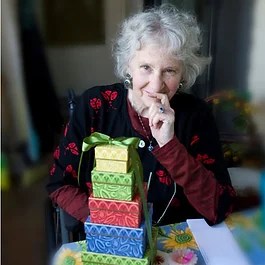
Alison Pelegrin’s latest collection, Our Lady of Bewilderment, is forthcoming from LSU Press in 2022. Other books include Waterlines (LSU 2016), as well as Hurricane Party (2011), and Big Muddy River of Stars (2007), both with the University of Akron Press. Pelegrin is the recipient of fellowships from the National Endowment for the Arts, the Louisiana Division of the Arts, and the Louisiana Board of Regents. She is Writer-in-Residence at Southeastern Louisiana University. 
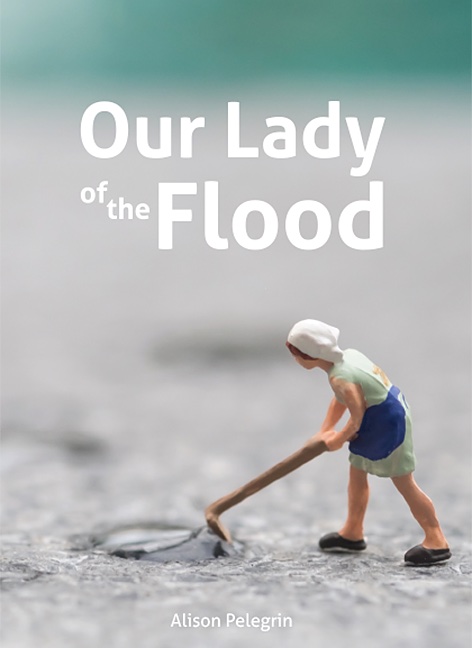

Title: Our Lady of the Flood
Author: Alison Pelegrin
Diode Editions
ISBN: 978-1-939728-16-6
28 pages, $12.00


Diane Elayne Dees is the author of the chapbook, Coronary Truth (Kelsay Books) and two forthcoming chapbooks, I Can’t Recall Exactly When I Died, and The Last Time I Saw You. Diane, who lives in Covington, Louisiana—just across Lake Pontchartrain from New Orleans—also publishes Women Who Serve, a blog that delivers news and commentary on women’s professional tennis throughout the world. Her author blog is Diane Elayne Dees: Poet and Writer-at-Large.


ABOUT THE PRESS: Diode Editions is an independent press based in Doha, Qatar and Richmond, Virginia. Editor-in-Chief Patty Paine founded the press in 2012 as an offshoot of Diode Poetry Journal. To date, the press has published 37 titles of poetry, chapbooks and poetry-related nonfiction works and hosts yearly book and chapbook contests.

Risa Denenberg is the curator at The Poetry Cafe

Slow Dark Film

Slow Dark Film, by Lynn Strongin

Review by Risa Denenberg

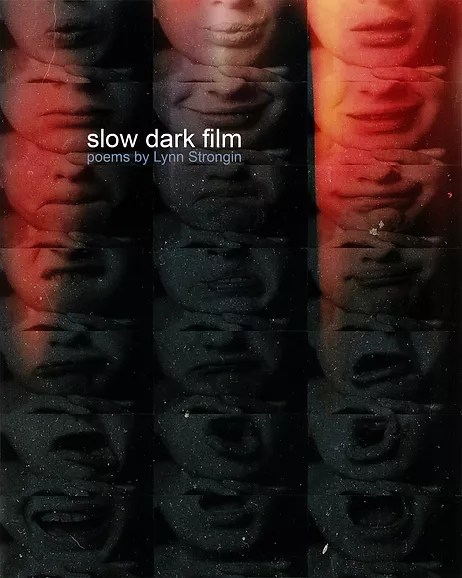
I’ve been a fan of Lynn Strongin’s work since 2014 when she submitted a manuscript to my press, Headmistress Press. I immediately fell in love with her poetry. In fact, Headmistress has published two of her poetry collections: The Burn Poems in 2015 and A Bracelet of Honeybees in 2016. So I was interested in reading her newly released chapbook, Slow Dark Film (right hand pointing, 2021). I’m happy to report that it has the same powerful, idiosyncratic, playful language and fascinating narrative that is found in the poetry and prose she has been publishing for decades.

Strongin’s work is often autobiographical, ranging from childhood when she was hospitalized with polio, to in-between years when she traveled extensively, and on to present day, where she suffers the debilitating late effects polio. Similar to other collections, Slow Dark Film follows a narrative line comprised of the poet’s lived experience. Also similar to other works, her lesbian lover is right by her side.

In the first poem, “LUMINOUS,” Strongin provides a map of the territory the reader is entering, when she reports, “Asylum, forever mine.” This is an artifact persistently embedded in the poems.

The slow dark film of the title is both a recollection from childhood and a gauzy scrim that forms a backdrop through which the poet’s story is shaded. The memory is of the “slow dark painterly-grained film[s]” that were shown to “Children twelve & under” who were “Wheeled in/ to our asylum.” Years exist in this metaphor of so few words—the excruciatingly slow movement of time and the bleak darkness of her surroundings.

The charm in the writing is how Strongin can travel from asylum to Elysium using her vivid imagination and agility with language. In the poem, “IT INTERRUPTS,” Elysium is paradise, but also a harbinger of death:

Stamen & pistil, flowering,
The earth is procreation:
Creation. In a cradle, the bee cups honey
            The longed for, the filmed over, a deep caress
            The last word is always loneliness.

Images—such as the dark film—repeat throughout these poems, conferring a dream-like effect. In “YOUR WORDS,” there is an image of a ladder which repeats in later poems:

I am going through a life-change
            that has ladders                   of grieving

I think of the biblical story of Jacob’s ladder when I read this, one of so many associations Strongin’s words invite me to imagine.  In “I KNEW I WAS,” the ladder reappears:

I comfort myself
With castles
Teeth-eaten by wind
Like raggy lace. These ladders, they do not lead
Out of the flesh.

Another repeated narrative is found in poems addressed to “YOU”—the delicately unnamed lover, as seen in “WHAT IS THIS”:

Many tiny upheavals in our lives
Have made them remote: yet what is this, you
            coming toward me with an embrace lowered eyes,
            sorrowing El                 Greco face?

Or this, in “GHOST OF DAWN”: “By the time you bathe me/ Morning’s gone.”

In Slow Dark Film there are many weighty metaphors of illness and death, such as in “DEFEAT”:

I make my dark nest,
I lay my bright dress
To rest.

And in the last poem in the book, Strongin returns to the original image of the film:

IF LIFE is a sadness that unspools, a slow dark grain
My rising up is my bending
Down in a dancer’s position.

Slow Dark Film unspools a quiet narrative, leaving me with much to wrestle with, and reminding me of the Dickinson poem, “After great pain, a formal feeling comes.”


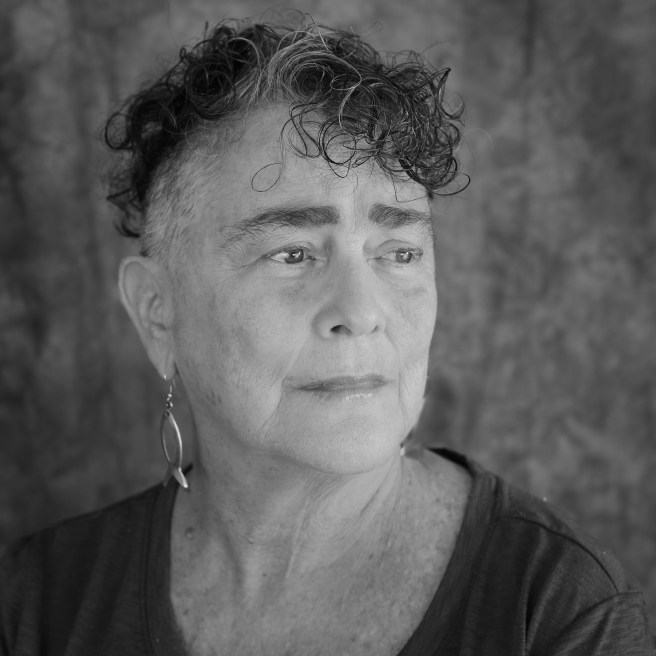
Lynn Strongin’s homeland is America. Her adopted country Canada. She has twelve books, work in over forty anthologies, and has been nominated for a Lambda Award and the Pulitzer Prize in literature.


Title: Slow Dark Film
Author: Lynn Strongin
Publisher: right hand pointing
, 2021


Risa Denenberg lives on the Olympic Peninsula where she works as a nurse practitioner. She is a co-founder of Headmistress Press and the curator at The Poetry Cafe Online. Recent publications include slight faith (MoonPath Press, 2018), and Posthuman, finalist for the 2020 Floating Bridge Chapbook Prize.


Risa Denenberg is the curator at The Poetry Cafe.

The Moment of Greatest Alienation

The Moment of Greatest Alienation, by Issam Zineh

Review by Risa Denenberg

On first glance, I couldn’t decide if the poems in Issam Zineh’s The Moment of Greatest Alienation were about sex, clothed in its many garments, or if the work uses sexual interstices as a metaphor for any number of other life-and-death matters. Of course both are true, a truth that I find delicious. Although tangling with bodily union, no important matters seem to be absent in this collection—the work is the poet’s universe revealed.

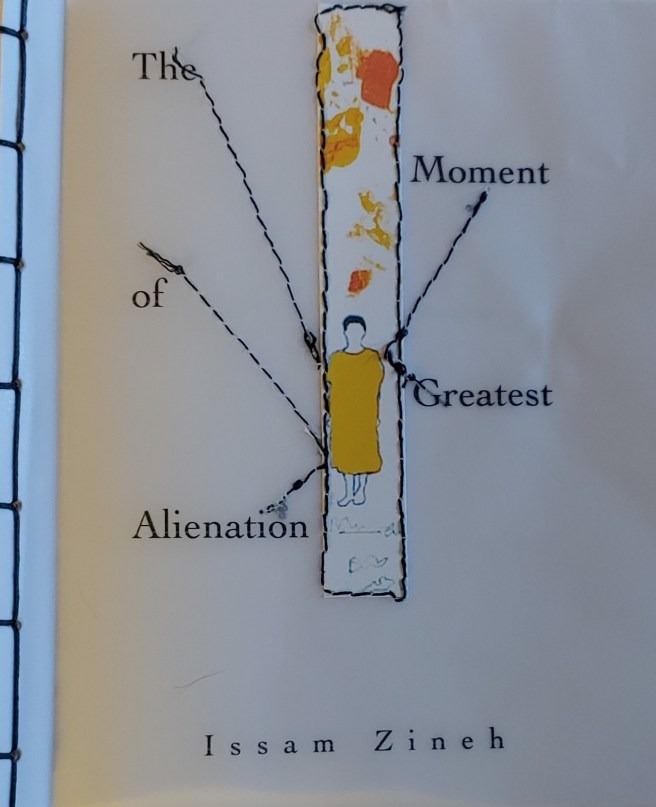
The book itself is an art object. I’ve long been impressed with these limited-edition, hand-made/hand-bound micro chapbooks designed by Sara Lefsyk for Ethel Micro Press. The Moment of Greatest Alienation is a petite six by seven inches with a hand-sewn spine and a cover embossed with art and stitches, resembling a spider web, to the words of the title. The cover invites reading.

Then there are the poems. From the first lines in this chapbook, in the poem, “Metaphor is the Momentum Between Gestures,” we find a lyrical high bar that Zineh jumps over again and again throughout this work.

Answering the poem’s title, he says,

& I am Coptic

you are Christ, my heart a slit lamb, punctured,
slick at the throat. The alchemist’s optic

obsession: stuff to gold & never back.

Later in the poem, we find the story to be about an illicit affair.

. . . proud we pulled it off, proud of our disgrace.
We will smile. There will be nothing left
to do except go home
& make love in separate beds

Because I work in the medical arena, I have a particular fondness for poet-scientists and the way poetry can be looped into a scientific description of anything. In “Coefficients of Friction,” we find measurements of friction, body against body:

The physicist in me
with polymers mated against steel thrust

washer geometry, in all my traction, grip, and desire,
is trapped in the wrong version of eternity.

You are valuable and dimensionless.
Load and velocity.

There is a rewarding effort involved in following the syntax here. And, as I did, you may need to look up a few scientific concepts in this poem, such as washer geometry. But then you have the benefit of learning something new about how volume is measured, for example, if you want to calculate the volume of your lover.

The poems in The Moment of Greatest Alienation are the work of a poet who is erudite, deeply knowledgeable in numerous fields of the arts and academy, but who also pays astute attention to the political nature of everything he comes into contact with. Much is discovered in the “Notes.” For example, here is where we learn that the poem “Adagio includes titles from compositions by Bach, Barber, Copland, and Schnittke.” And I would add, all are folded seamlessly into the poem.

There are several poems that reckon with human tragedies caused by political inequity. In the notes, we learn that, in the poem “Plastic Bag,” Zineh “hopes to memorialize Òscar Alberto Martínez Ramírez and his 23-month-old daughter, Valeria, who drowned in June 2019 trying to cross the Rio Grande.” In stark contrast with Zineh’s relative safety, the poem begins with the line, “I will tonight, god willing, sleep like a/ baby,” but goes on to describe how such horrific events affect him:

I will dream, the recurring one in
which you wrap me in your arms
and drag me to the bottom of the
lake, hold me underwater until I
either drown or wake.

In “Eight Parables to Keep You Safe, Defy Aging, & Banish Evil,” there is an amalgam of so many disparate substances, so much active and passive energy, that reading it gives me the dizzying sensation that all energy is matter and all matter is simple one version of reality pressing against another —and yet, there is an incoherent sense of order in the coupling. In the final parable, titled “8. The New Originals,” a narrative line wanders and then coheres with the line “all relationships are the same in the beginning,” –with its nod to Tolstoy’s Anna Karenina– and continuing in the next stanza:

We still miss each other sometimes. We look for things that are irretrievable in these minor folds of solitude. We fire, we flood, we famine. We don’t know much of petal or stamen, the easiest of metaphors, the easiest sounds the tongue can make. And still, God has set up its system. Proteins are synthesized and sent to correct destinations. The awfully beautiful things of the body go on happening. 

The poem “Ars Poetica” is an epithalamium—a poem in honor of a wedded couple. It starts with “I am married on a cliff,” but leads to a premonition of cracks in a marriage:

The guests have arrived. We walk down one
path at once, hating for now, everything that blooms,

knowing this is a small part of the introduction,
an even smaller part of the conclusion.

I suppose it is this sort of brutal honesty that I find so delicious in this book.


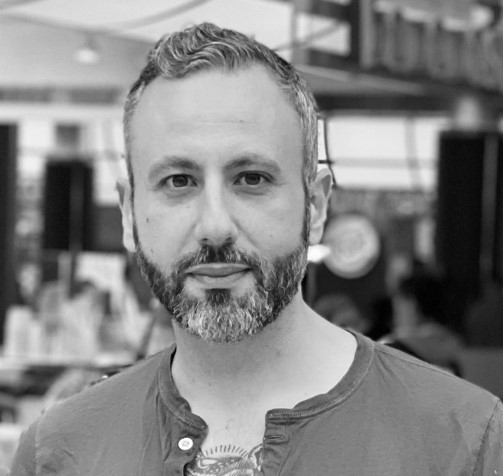
Issam Zineh is a Palestinian-American poet and scientist. He is author of Unceded Land (forthcoming, Trio House Press) which is an Editors’ Selection and finalist for the Trio Award for first or second book, and the chapbook The Moment of Greatest Alienation (Ethel Press, 2021). His poems appear or are forthcoming in AGNI, Guernica, Pleiades, Tahoma Literary Review, Tinderbox, Guesthouse, Glass (Poets Resist), Lunch Ticket, Poet Lore, and elsewhere.


Title: The Moment of Greatest Alienation
Author: Issam Zineh
Publisher: Ethel Zine & Micro Press, 2021
Book Design: Sara Lefsyk
39 pages $9.00


Risa Denenberg lives on the Olympic Peninsula where she works as a nurse practitioner. She is a co-founder of Headmistress Press and the curator at The Poetry Cafe Online. Recent publications include slight faith (MoonPath Press, 2018), and Posthuman, finalist for the 2020 Floating Bridge Chapbook Prize.


Risa Denenberg is the curator at The Poetry Cafe.