Music Speaks

Music Speaks, by Bill Cushing

Review by Charles Farmer

Anyone who has spent time making a mixtape understands there is an undercurrent of autobiography threading the song selections. Whether the tape’s intention is to woo a crush or introduce bands to the uninitiated, mixtapes tell the curator’s story.  Bill Cushing’s handsome Music Speaks reads as a reverently annotated playlist, a love letter honoring the music and artists who have provided the soundtrack to his life. While some curators might be more concerned with showcasing their eclectic, rarefied tastes, Cushing’s poems are never pedantic or pretentious; they are tender homages—sometimes exuberant, other times more subdued, depending on their subject—that reveal a mutual appreciation for music and the written word.

So often, critics argue about the use of the word poetry, whether it can be used in a discussion about music. Here, there is no hierarchy, only a mutual appreciation.

Music Speak opens with “On Modest Mussorgsky’s ‘Bydlo,’ ” a response to a piece from Mussorgsky’s 1874 suite, Pictures at an Exhibit, the composer’s sonic interpretations of Viktor Hartmann’s pictures. The piece is especially significant to Cushing as listening to his father’s 1960 LP of Fritz Reiner’s recording of the suite is among Cushing’s formative musical experiences. Mussorgsky’s own work captures the trudge and resiliency of a wagon team, its oxen bearing a load of hay; Cushing’s poem captures the solemnity of music and the picture. There’s something admirable, something worth celebration as

Beast and wagon pass,
processional,
as if solemn
and then recede
slowly
out of sight

Music and images combine as the processional offers its own percussion, a “rhythmic hammering, / dull thunder / as hooves pound the earth”; the organic beat causing the ground to move “to the sound / of these hardened / timpani.”

This opening poem establishes the origins of Cushing’s lifelong relationship with music, a connection that blossoms and intensifies as he moves on from his father’s LP and discovers jazz— the focus of most of Music Speaks. Cushing’s poems conjure images of iconic Blue Note album covers, nightclubs both suspicious and sophisticated, bartenders gracious with heavy pours, the sounds of aural abandon that fueled The Beat Generation.  Jazz, Cushing says in “Jazz Salvation,” is “my country’s / only true art.” It transcends “geometric” pop and “classical’s calculus.” Jazz is “our chance / to dance / in a stereotomy of confusion,” and “a road to refuge— / becoming our savior / from too many / mundane days.”

When he was young, Cushing’s heart was elsewhere. In the fourth grade, “Rock and roll was my world,” he says in, “’Music isn’t about standing still and being safe.’” Cushing, like countless others, eventually discovered Miles Davis’s cataclysmic catalog, its re-imaging of music’s possibilities. Describing his first encounter with Davis, Cushing speaks in the language of revelation:

[…] you brought me back
to music
I walked all the way home

Miles
from that train station
my head pounding with sounds
frantic-fast as the subway

Cushing also writes in awe of Charlie Parker (“Listening to Bird”), who staccato pulse is replicated in two-line bursts:

He founds places
in his search for every note

not imagined:
leaving chromatic gravity,

breaking confines,
shooing up into infinity;

And the in “Ode to Nina Simone,” whose own musical journey resembles Cushing’s, as she “[left] beloved Bach behind.” Anyone who’s seen Simone’s fiery set in 2021’s documentary Summer of Soul will recognize the goddess in Cushing’s poem, who’s “transforming us with blues, boogie-woogie / using training in classics to quash rage.”

Elsewhere in Music Speaks, Cushing writes about the effortless suave of Eubie Blake, whose “long fingers, doing what few can hope to, / creating perfect stops,” propelled classics like “Raggin the Rag” and the essential “Memories of You.” Also subjects of affection are: the contemporary, almost genre-less band, Too Many Zooz (“Three spheres of instruments—percussion, sax, / and trumpet: brass, reed, and skin—become / a discussion of brash banging fun); Dire Straits’ Mark Knopler, who’s always been more than a rock ‘n’ roller; and the recently departed and greatly missed Leon Redbone, eternally cool “decked out in black, Ray-Bans perched on / a Syrid nose,” / “ageless as a harvest moon.” Music Speak fittingly closes with “So Long, Dr. John,” a poem-as-obituary for the late, inestimable Dr. John,

Most interesting is Cushing’s poem to jazz pianist Marcus Roberts, “Singing with Both Hands,” a testament to the mystery behind the creative process. We can try to quantify and analyze creativity, dissect the muse, but creation remains a mystery. Considering the source of Robert’s virtuosity, Cushing asks, “With eight-eight steps to choose, / how do the pianist’s hands / decide which to use?” It could be that “each acts alone: one as the heart” while “the other wanders free.” Yet for of all this analysis, search for a behind-the-scenes explanation, the answer could be a simple, “Or not”—perhaps there is no conscious choice; perhaps it’s a matter of mystical surrender.

Music Speaks is a welcome to addition to my home, where I am often torn between devoting my time and heart to poetry and music. Here, my loves coalesce; there is no guilt trip. The collection succeeds as a testimony to music’s and poetry’s ability to breathe life into the everyday, where notes and words comfort, clarify, confirm, and reassure what it means to be alive.


Bill Cushing has lived in Virginia, New York, Pennsylvania, Missouri, Florida, Maryland, the Virgin Islands and Puerto Rico, and currently lives in California. As an undergrad, he was called the “blue collar” poet by classmates at the University of Central Florida because of his years serving in the Navy, and working as an electrician on oil tankers, naval vessels, and fishing boats. Bill earned an MFA in writing from Goddard College in Vermont and has recently retired after more than 20 years of teaching English at East Los Angeles and Mt. San Antonio colleges. Bill was named as one of the Top Ten Poets of L.A. in 2017, and in 2018, he was honored as on the ten poets to watch in L. A. His 2019 book, A Former Life, was released by Finishing Line Press and recieved the Kops-Featherling International Book Award. He won the San Gabriel Valley Chapbook Competition with Music Speaks.


Title: Music Speaks
Author: Bill Cushing

Published by author, printing at‎ lulu.com (October 2, 2019)
32 pp $25
ISBN: ‎ 978-0359827015


Charlie Farmer is a Georgia poet and professor who loves his wife, Erin, his daughters, his friends, his cats, his students, his books, his LPs, and everything else a poet should love in life.


Risa Denenberg is the Curator at The Poetry Cafe.

Jar of Plenty

Jar of Plenty, by Ruelaine Stokes

Review by Cheryl Ceasar
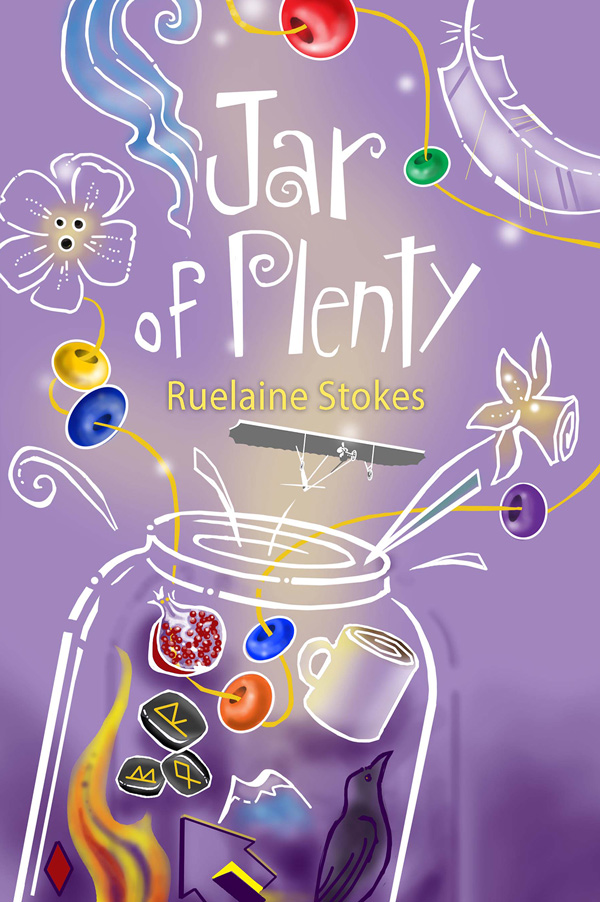
Cover Art by Barbara Hranlovich

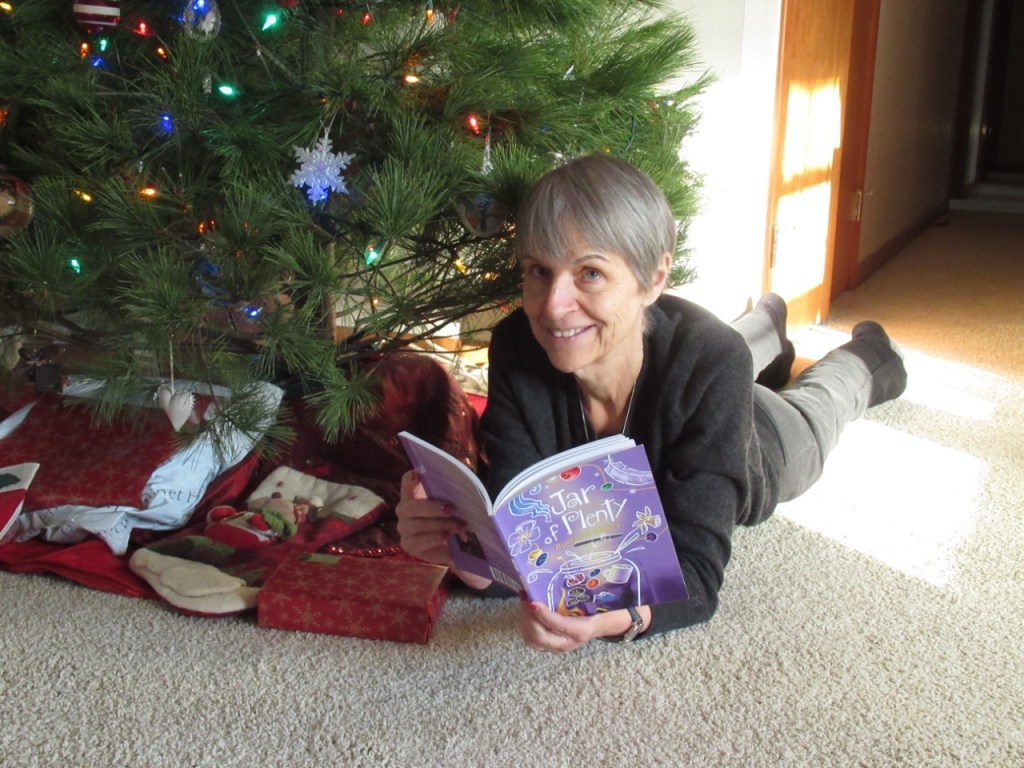
As a child, I dreamed of exploding gift boxes. Not the tame ones you see online, those which simply unfold—although they can be quite lovely. I wanted to find a box that would spray its marvelous contents into the air like the novelty cans that unleash coiled snakes, but with no danger of a chipped front tooth or a poke in the eye. When I opened a manila envelope from my friend Ruelaine Stokes a few days before Christmas, I finally got my wish. The book Jar of Plenty is not only a gift, but a reminder of what a gift can mean.

Start with the cover art by Barbara Hranlovich. On an indigo-chakra background, a white-outlined jar is releasing beads, runic stones, flowers and feathers. An opened pomegranate discloses its secret rubies. A cup of coffee in a plain white mug flourishes its artisanal swirl of foam. A wise raven lifts its beak as flames flicker and steam rises. It recalls the childhood pleasure of plunging my hand into a cookie tin full of variegated buttons.

Open the book; the gifts continue to stream out. Ruelaine draws on her own gift, her talent, to fashion these small parcels of delight. Like a smiling hostess, she guides us through the rooms of her various names, arising from her deep self.

Rue: a street or a regret
Lynne: like a brook or small pool, from her father’s friend
Stokes: from her ancestors, as in the line, “Keep the fire burning,” from her poem, “The Story of a Name”

Alongside black-and-white photos, she introduces her family: The grandfather who fell like Icarus from the sky in “Sailing through Time”; the pretty mother who fled to Tijuana with the priest in “Hard Times for Free Spirits”; the Monster who “sits by the door” and tells the writer she was “never designed to fly” in “Monster”; and then, the writer herself, out the door and flying.

Ruelaine picks up the ordinary artifacts of our lives, one by one, to show their marvels. Here is a pomegranate with its seeds: “each translucent / each bearing the fate of the world,” in “I remember the far-off sky, blue and blazing.” Here are memories of the senses, vividly evoked in “Yellowstone”:

the low moan of the wind  
the hungry grass
the gray stones

I think the gift she is sharing is this: the gift of attention. Attention to every small object, attention to our movements through the world. In “The Priest of Coffee,” the passing of the cup becomes a sacrament, reminding us that every sharing of food or drink is a potential communion.

As I read, another gift appears: a series of meditations, or perhaps a liturgy. Before the Communion comes the reading of the Lessons. “I am turning my sorrows into water,” she writes, with wisdom, in “Intangible Effects.” In “The Poet’s Prayer” is the artist’s petition to the universe: “let me cast these notes / into the wind.” And, the poem, “From the Book of Common Prayer,” grants absolution: “wash my heart and call me clean / the hard time is over.”

A real gift is a moment of connection, passed between outstretched hands. Ruelaine’s life so far has been gifted to poetry, and especially to the local poetry scene in Lansing, Michigan. For decades she has worked here as an “architect of reality”–her own phrase—building the structures, readings, and workshops that bring poets together for a moment of communion. What a joy to find a collection of such moments made tangible and lasting, an artifact of her life’s gift.


Ruelaine Stokes is a poet, spoken word artist, teacher and arts organizer based in Lansing, Michigan. She has a BA in English literature from Stanford University, an MA in English literature from Michigan State University, and an MA in Teaching from the School for International Training in Brattleboro, Vermont. She worked for many years teaching English as a Second Language at Michigan State University, Lansing Community College, and in community ESL programs. She has also taught classes in English literature, Poetry, Women’s History and Writing. For many years, she has organized poetry performances, readings, open mic events and workshops within Mid-Michigan. She is currently the president of the Lansing Poetry Club.


Title: Jar of Plenty
Author: Ruelaine Stokes
Published by Author, 2019 (Printing Services at Michigan State University Libraries)
pp. 74    $15
ISBN is 9780578339085

Cover Art: Barbara Hranlovich


Cheryl Caesar lived in Paris, Tuscany and Sligo for 25 years; she earned her doctorate in comparative literature at the Sorbonne. She teaches writing at Michigan State University. Some of her COVID-era poems appear in Rejoice Everyone! Reo Town Reading Anthology, and in The Social Gap Experiment, both available from Amazon. Her writing and artwork will appear soon in Words Across the Water, a joint anthology by the Lansing Poetry Club and the Poets’ Club of Chicago. With co-editor Ruelaine Stokes, she is gathering a volume of reminiscences of the Lansing poetry scene in the 70s and 80s.


Risa Denenberg is the curator at The Poetry Cafe.
Meg Files

Meg Files is the author of the novels Meridian 144 and The Third Law of Motion, Home Is the Hunter and Other Stories, The Love Hunter and Other Poems, Writing What You Know, a book about taking risks with writing, and a poetry chapbook, Lit Blue Sky Falling. Her novella, A Hollow, Muscular Organ, has just been published. She has been a Bread Loaf fellow and the James Thurber Writer-in-Residence at The Ohio State University. Find more at megfiles.com.

Keep the Singing

Keep the Singing by Liza Porter

Published by Finishing Line Press
Review by Meg Files

For years, in college workshops, I’ve admired Liza Porter’s poems and essays for their urgent willingness (need?) not only to face but to interrogate tough and troubling material. “To be an artist means never to avert one’s eyes,” said filmmaker Akira Kurosawa. In her new chapbook, Keep the Singing, Porter’s eyes look deeply into memory, loss, love, and grief in this elegy to her sister — even if at times those eyes must have been blurred by tears, as mine were.

The short opening poem, “Sister,” introduces the sisters’ intimacy:

Sometimes when I think of O’Keeffe
I see
rusty orange petals
and myself
at twelve
going to you in the night
when the blood came.

It also introduces us to the flower motif running through the book. In “The Vigil,” flowers are placed in her sister’s hands “as she lies on the table / after the women wash her body,” and then on the fourth day, they are gone. In “Sing a song for her leaving,” years later, the poet searches for signs of her sister’s soul in the world without her and tries to convince herself with spring, new grass, and “persimmon blossoms, bright orange / as the sun when it sets …” In “Going Home,” just after the death, the unfairness, the bitterness, and the anger (rage?) drive the imagery:

I remember my grandmother’s sweet peas along the back fence
lavender and pink and white, and the ghost-yellow lawn that never
quite thrived, you could have flamed the whole fucking thing with a
single smoking match.

Then in “Cremation,” this time the flowers are only carved on the pine box and then burned, and the poem cries out the torment of absence, with others’ false comfort when they say,

… she still lives in our hearts they say she’s in the Light they say
in the Light they say in the Light. Fuck the Light.

Near the book’s end, in “Poem for Edie on Thanksgiving,” Porter tries to console herself with an image of blue flowers in her sister’s spirit’s hands and apologizes for not letting her go “as smoke from a fireplace floats into the sky.” But no, she comes to know that she cannot, nor should she, for the work of poetry, the loss and the love require “this eternal questioning.” This mystery. In “The time you have,” the making of art is the way to “withstand / our world’s dive into darkness.”

Of course, it’s not enough for the artist to declare the willingness to look at tough material. It is the careful craft of these poems that lend them their unsentimental grace. It is imagery such as “sudden clouds rubbing the sky with charcoal shadows” in “The Therapist.” It is the symmetry of stanzas. It is the haunting anaphora of “When a sister leaves” in “Elegy in Blue.” It is the small details that are “insignificant unless we listen with more than / our ears” in “The Music.” It is Porter’s attention to details that render the poems so movingly attentive to life.

“A Sort of Sigh” brings the poet a farewell visitation. And it is the final poem in this provocative, evocative elegiac collection that move at last to “the memory of a face / as bright as that moon when darkness falls,” to a fully present sister who “will always track the light.”


Liza Porter’s chapbook Keep the Singing was published by Finishing Line Press in November 2021. Her chapbook Red Stain (Finishing Line Press 2014) was finalist for both the 2015 Arizona New Mexico Book Award and the 2015 WILLA Award (Women Writing the West). Her work is published widely in journals and anthologies. Porter received the 2009 Mary Ann Campau Memorial Poetry Fellowship from the University of Arizona Poetry Center. She was founding director of the Other Voices Women’s Reading Series at Antigone Books in Tucson, Arizona. Three of Porter’s essays have been listed as Notable Essays in Best American Essays. www.lizaporter.com


Title: Keep the Singing
Author: Liza Porter
Publisher: Finishing Line Press, 2021
ISBN: 978-1-64662-641-0
31 pages, $14.99


Meg Files is the author of the novels Meridian 144 and The Third Law of Motion, Home Is the Hunter and Other Stories, The Love Hunter and Other Poems, Writing What You Know, a book about taking risks with writing, and a poetry chapbook, Lit Blue Sky Falling. Her novella, A Hollow, Muscular Organ, has just been published. She has been a Bread Loaf fellow and the James Thurber Writer-in-Residence at The Ohio State University. Find more at megfiles.com.


Risa Denenberg is the curator at The Poetry Cafe Online.

Make for Higher Ground

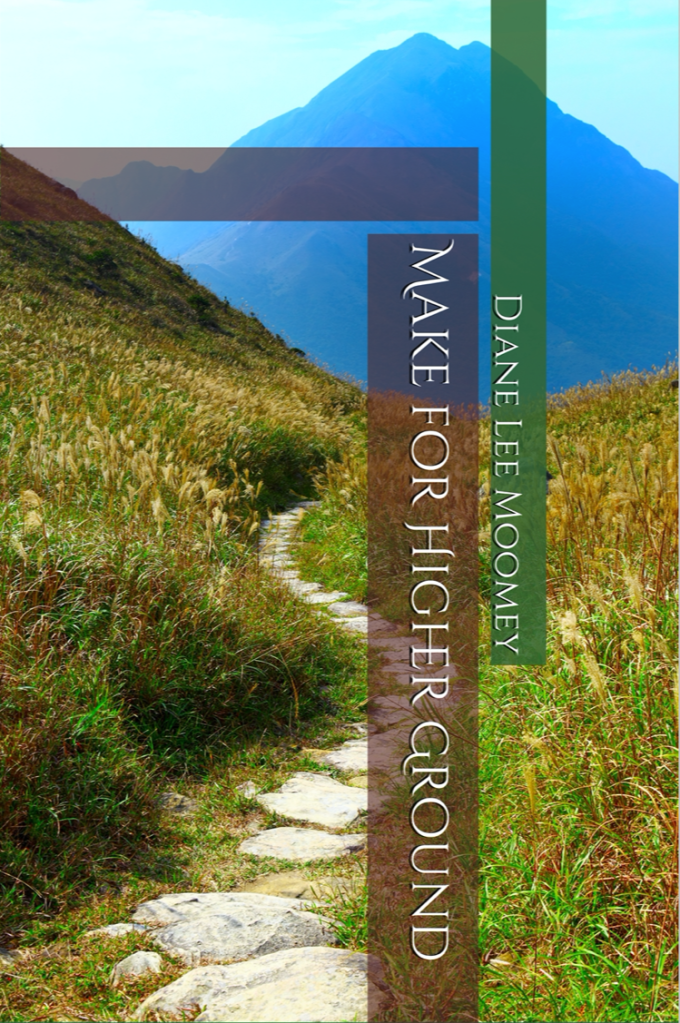
Make for Higher Ground, Diane Lee Moomey

Published by Barefoot Muse Press
Review by Laura Schulkind

Diane Moomey is one of those masterful form poets who uses structure to challenge boundaries. Her new collection, Make for Higher Ground (Barefoot Muse Press, 2021), does just that. Throughout, it is evident she has drawn on I Ching: #57, Penetrating Influence, which she speaks of in the introduction and riffs on in the opening poem, as the collection both offers a path to higher ground, and persistently urges us to take it.  

Her path begins with “Small Wild Things,” a group of poems that leads us into the high grasses that lie just beyond the road. In the poem, “in tall red grasses once,” “she finds “a nest / not far from where we’d parked the Chevy.”  She creates similar images in “Wearing Snakes,” where she finds sleek snakes, “In summer’s green beside the fence, / by long stems my father’s mower doesn’t / reach,” and in “Time Share at the Country Club,” where she imagines wild cats in the forest abutting the golf green:

So now you’ll bide your time
until the dusk, hiding in the rough.
I pack my clubs and seek the car, slam
the trunk. You hang around, shadowed. Eyes:
it’s your turn, now. You’ve waited long enough.

In juxtaposing human activity and wildness, she urges that we not forget our connection to the wild—even as we mow and drive and golf and stay indoors with the radio blaring. As she concludes in “Chaparral,”

turn up the radio,  
blot out the yucca and the sage,  
the calls
of all that’s feral. You know the wild
is out there. Sometimes
that’s all you need.

From there, she takes us to our beginnings in a section titled “Tap Roots”— suggesting we can’t get much of anywhere without understanding our origins — such as in “The Other Attic,”

I’d only need a ladder. I’d reach
and push that square aside, unseal
that other attic—not the one
that holds our bedrooms—and reveal
what must be hidden! Once inside
I’d open trunks and boxes, pry;
so certain that I’d found the place
where all the family secrets lie.

The intimate details of these poems, as in “Her Screen Porch,” also convey a loving eye.

the wicker chair with yellow chintz
that curved to fit her, cabbage roses curved
around her; mother’s mother.

This gentleness suggests we can cherish where we came from without getting trapped there.  In “Carousel,” she considers her own mother’s choices, and in so doing perhaps explains her own:

crimson wheel is spinning
‘round a center of mirrored tesserae, flashing
tails and faces, scent of cotton candy.
You could get off. You may have wanted something
else: the purple unicorn, that pearly
horn, the tail swept high across an arching
back, a gilded halter. Instead, the grey mare.  

Now grounded, the book offers us “Fractals,” a series of poems on how to navigate a dangerous world. Here we find perfectly placed at the middle of the book, “Water Above Water Below,” (a riff on I Ching “#29 —Danger”), which gives us these final lines:

The lamps are going out, dear
one by precious one and it’s for us
to choose to live in darkness or, blind
and trembling, make for higher ground
and set ourselves alight.

Then, in the last two sections she suggests a way out of the darkness. In the series called “Coming Up For Air,” the poems remind us to find delight in the world we have. In “Kiss Kiss, 2020,” dear friends embrace amid the pandemic:

Tomorrow afternoon we’ll meet outside
your house. I’ll squeeze Purell into my right
palm and gently stroke your left cheek;
you’ll do the same for me, from lip to ear.

In “Pandemic Picnics, a Proposal,” she plans: “We’ll take a fender each. I will reach across / with love and gloves / to pass you opener and Anchor Steam.”  And in “At the Dollar Bins,” she delights both in the treasures that can be found there and the fun of rummaging for them:

She’ll gather not
because she must eat crumbs or take
whatever comes, or lick the final
jelly from the jar and not
because somebody somewhere may
be starving. Gather, glean—to keep
or give away—because something  
in this skirt, that sequined vest,
those purple gloves, is still alive.  

In “Lights Above the Poles” she adds, and ends, with love.  A gorgeous series full of sky and light, these poems tell stories that remember, long for, miss, and sustain love. “Ode, with Wings,” almost soars off the page:

I loved you in the air, the air. You wore
new wings, and in your father’s plane so proudly
lent, you flew me upside down. Because
I loved you there, all skies belong to you—

Importantly, there is nothing saccharin here. The last poem, “Deciduous—ballad for Tim,” ends ominously:

Making coffee, breaking camp—
we do this well together,
but whitecaps, winds and lowered skies;
promise heavy weather.

And that’s the point. Higher ground is not a panacea; it isn’t even a place. It is a way of being in the world that Moomey gently urges in this compelling collection.

Diane Lee Moomey has lived and wandered around the US and Canada, and now dips her gardener’s hands in California dirt. She co-hosts a monthly Poetry series in Half Moon Bay. A regular reader at San Francisco Bay Area poetry venues, her work appears, or will soon appear, in Light, The MacGuffin, Mezzo Cammin, Poetry Magazine.com, California Poetry Quarterly, Caesura and Red Wheelbarrow, and has been nominated for two Pushcart prizes. She has won prizes and Honorable Mentions in the Sonnet and Creative Non-Fiction categories of the Soul Making Keats Literary Contest, and in the Ina Coolbrith Circle.


Title: Make For Higher Ground
Author: Diane Lee Moomey
Publisher: Barefoot Muse Press
ISBN-13: # 9798509619205
Page count: 62
Price: $10.95


Laura Schulkind has two chapbooks with Finishing Line Press, The Long Arc of Grief (2019) and Lost in Tall Grass (2014). Her work also appears in numerous journals, and published pieces can be found on her website, www.lauraschulkind.com.

Versions of this review have also appeared in Poetry Letter No. 4, 2021 of the California State Poetry Society and Compulsive Reader.


Risa Denenberg is the curator at The Poetry Cafe Online.