

Song of North Mountain by Morgan Golladay
Published by Old Scratch Press, 2024
Reviewed by Nadja Maril
Writers begin their journey towards publication at very different times in their lives, some in high school, others after retirement. Is there a right time to begin sharing one’s poems with the world? Perhaps the answer can be found in the quality of a writer’s first poetry collection.
The Song of North Mountain, a debut chapbook by Morgan Golladay, demonstrates the combination of wisdom and excitement of a new guest at the literary dinner table. Golladay takes us on a journey through seasons and times of her childhood home in Virginia, located between the Blue Ridge and North Mountains in the Shenandoah Valley. Golladay’s poems transport us to the foothills of Appalachia, a region that is rapidly changing as our planet warms. Her poems capture the stark beauty and breathtaking colors of the valleys, meadows, rivers, and ridges, as seen in the poem “Spring on the Mountainside.”
Out on the Devil’s Throne
careful briars show green,
warming, like me, in the heat of the sun. Redbuds languish,
eagerly waiting to erupt,
to be first, to show true color
to this mountain.
I trust in their uncompromising cycles, that spring follows winter
as night follows day.
The redbuds beckon me up the mountain.
Black and white images found throughout the book are original drawings by Golladay, who began the formal study of art in her fifties, preceding her launch as a poet. Expressing oneself in more than one art form is not unusual for poets; her work makes me think immediately of William Blake who so skillfully combined art and poetry in his nature-focused work.
Recently, I had the opportunity to interview Golladay who expressed great enthusiasm for trying new artistic practices. She described an experiment she conducted ten years ago with a friend she met in an acrylics workshop. Both artists had completed seventy-five black and white sketches in seventy-five days and they challenged each other to add poetry to those sketches. Golladay said she decided to combine the two art forms to learn whether the sketch informed the poem or vice versa. “Black and white sketches require a lot of different elements to be effective,” she explained. “Think of the illustrations of Rockwell Kent, the engravings of Durer, sketches of Michelangelo, Picasso, Mayer. For me, it was a steep learning curve.”
The Song of North Mountain is divided into four sections each aligned with one of the four elements: Fire, Air, Water, and Earth. In the fifth century BC, the Greek philosopher Empedocles proposed that the opposing forces of love and conflict upon these four elements create the diversity found in nature. Golladay has chosen these elements as the structure for her poems, highlighting these opposing forces rather than the seasons, which are more typical in nature poetry. Here, the cycle begins with Fire where most of the poems have a connection to light, brightness, and sometimes drought. This section is followed by Air, Water, and Earth.
The home of her ancestors, Golladay’s North Mountain is rich with history and memories. Many of the poems are informed by the changes wrought by time and aging. This poem, found in the Earth section and titled “Family Lines,” begins:
The lots are overgrown with weeds, brambles, saplings jutting through loose stones
that mark lost foundations.
Someone once lived here.Someone planted those surviving daffodils, that stray lilac.
Sunday dinners, visitations, funerals,
jam-making, weddings, and scrubbed floors celebrated the families that lived here.
(Their footprints are found
when the yard is tidier.)
But the rubble remembers the sweat and the labor, the daffodils recall the hands that planted them.
“Under the Locusts,” found in the Air section, zeroes in on a particular farm. The sense of loss and resignation in this poem is poignant as it documents how the land changes as small farms begin to disappear.
Long after the farm was abandoned,
the evidence of thousands of hoof-falls showed among the locusts. Roots
stood stark and barren, surrounding dirt worn and blown away. Strange shapes, mystical and druidic in their formation,
reared from the dirt, submerging, reappearing several feet away.
There are many poems here about animals, some include humans as well. The poem, “Little Swimmer,” found in the Water section, portrays a venomous snake; another poem in this section is about a stodgy turtle. In our world of cellphones, computers, fast moving cars, and technologies that link global industries and people within seconds, I enjoyed the opportunity to retreat to basic relationships between a harmless reptile and a human. The poem, “A Moment of Grace,” is one of my favorites. It ends with the lines:
We spoke in silence,
thanking each other for dappled sunlight, ripe berries, and a moment of grace.
When writing about the loss of her own ability to climb a tree or the cutback of train service to the region, Golladay accepts her changing world with pensive resignation. She more often focuses on wonders that still exist and can still be found if you closely watch, smell, touch, and listen. Song of North Mountain conveys the rhythm of place that is clearly close to the poet’s heart, a sense she ably shares with her readers.

Artist and poet Morgan Golladay’s first published poem was awarded Third Prize in the 2021 Delaware Press Association Communications Contest. Much of her work is reminiscent of her native Shenandoah Valley, its people and places. A graduate of the University of Mary Washington, Golladay’s career included almost 40 years as a volunteer and staff member for several non-profit organizations. In 2024, the Delaware Press Association awarded her the first and second prize for short stories and an honorable mention for poetry. Her first book of poetry, The Song of North Mountain, is a National Book Award nominee. Golladay currently resides in Milford, Delaware. She is tall, left-handed, and blue of eye. Everything else is subject to change.
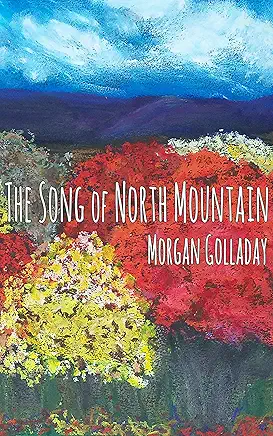
The Song of North Mountain
Morgan Golladay
Published by Old Scratch Press, 2024

Nadja Maril’s chapbook Recipes from My Garden, a compendium of poems and short essays centered around herbs, a kitchen garden, and family memories, was published by Old Scratch Press, in September (2024). Maril’s prose and poetry has been published in literary magazines that include, Lunch Ticket, Spry Literary Review and Across the Margin. A former journalist and editor, Nadja has an MFA from Stonecoast at the University of Southern Maine. To read more of her work and follow her weekly blog posts, visit https://nadjamaril.com/
Risa Denenberg is the curator at The Poetry Cafe Online.
 The Poetry Cafe