Geri Mendoza Gutwein

Geri Mendoza Gutwein, Ph.D., professor emerita of English at HACC, Central Pennsylvania’s Community College taught English, creative writing, and Native American Literature there for many years. A Pushcart Prize nominee, she is the author of three chapbooks of poetry: Every Orbit of the Circle, The Story She Told, and An Utterance of Small Truths.

Deborah Bacharach

Deborah Bacharach is the author of Shake & Tremor (Grayson Books, 2021) and After I Stop Lying (Cherry Grove Collections, 2015). Her poems, book reviews and essays have been published in Poetry Ireland Review, New Letters and Poet Lore among others. Find out more about her at DeborahBacharach.com.

Bite Marks

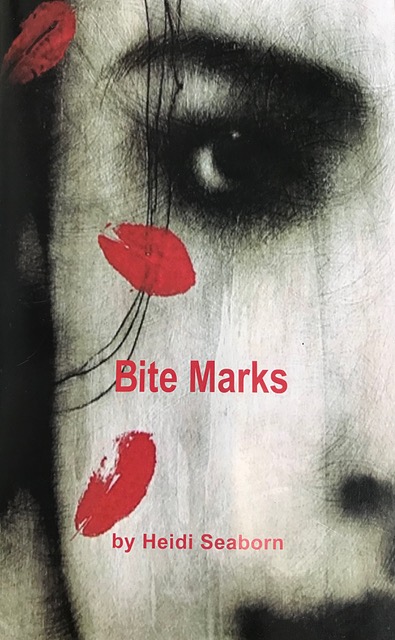
Bite Marks, by Heidi Seaborn
Winner of The Comstock Review Chapbook Award, 2020

Review by Deborah Bacharach, Christine Dooley Ellis,
Geri Mendoza Gutwein, and Olivia Loftis

Heidi Seaborn wrote poetry as a teenager, stopped after college, and then came back to it just where Bite Marks is set, in mid-life where, as she writes in “In Menopause I Lose My Sense of Direction,” it’s “Such a muddle this middle this road failing to fork or cloverleaf.” The speaker may feel lost, but Seaborn has been rushing forward with two full-length collections and three chapbooks, this one winning The 2020 Comstock Review Chapbook Award. In Bite Marks, Seaborn is not afraid to plunge straight into the taboo, whether it is menopause, women’s relationship to their beauty, or death looming, and she does so with a delightful cheekiness.

Many taboo subjects get air time in these poems—vaginas, affairs with married men, violence against women—but Seaborn focuses in on menopause. “That was menopause the butcher said” begins the first untitled poem. It’s a forced menopause brought on by a hysterectomy, and clearly the word choice “butcher” instead of “surgeon” lets the reader know the speaker feels attacked and dehumanized. 

Seaborn returns in several poems to the dehumanization surrounding menopause and how it ties to women losing their beauty. In “In the Mirror” she writes:

I blanket my body
in bedclothes, in the tall
meadow grass. Come look!
I’ve already disappeared.

The speaker who flaunted her gorgeous body as a young person, now, post-menopause, hides herself. Seaborn provides a double meaning: the speaker both protects herself and yet internalizes what happens to women as they age—they disappear. Meadow grass is alive, so this is not a condemnation of wrapping up; more so, it’s an acceptance. The speaker provides some beneficence to herself in the softness, but ironically, she is still juxtaposing this body in a blanket with the body in a bikini, earlier. She recognizes that she has internalized becoming a disappeared one. Her work speaks to our impermanence.

These poems look at impermanence, our impending death, with a sense of hopelessness and wonder. They remind us “we all grow long and tired” (“Cresting Bone”) and that we are as perishable as a radish (“The Perishable Nature of a French Breakfast Radish”).

In a poem titled “To Do Before You Die,” the speaker is riding a bike up a mountain:

where deer nibble long grass where now I climb slowly
asking nothing of the trees or of this dog day in August

but everything of me
pedaling Mt. Constitution 2399′
 
to its peak where I arrive thirsty for the glittering expanse 
of the Salish Sea and hungry for the knuckle ride down. 

The poem is rich with detail of the natural world “where deer nibble long grass,” so the first thing the speaker is telling us to do before we die is notice the world around us. The tone also tells us to approach death full of confidence and joy, “hungry for the knuckle ride down.” 

Seaborn captures the tonal range of late mid-life. From great confidence, like above, to the heartbroken, like when the speaker carries “severed / lilacs by the             armful / as if an    injured / child” (“The Neighbors Request a Tree Removal”), to the intimate “I need to sound you, know / your fathoms. Know we’re truly sisters” (in, “I’m in Conversation with the Sea”), to the most surprising and delightful—cheeky self-mocking. When the speaker says, “Recently I asked my oldest son and his wife about baby names. / They are not pregnant,” I laughed out loud. I appreciate how much fun Seaborn has making fun of herself. In “When the Stars Align,” she writes:

In my dreams, I am leaping off
a star and then I’m a starfish sparkling in a turquoise sea— 
a celestial cleansing for a woman
who just wanted to have sex most of the time. 
Skirt hiked over my hips. My ass, mooning the universe. 

The poem integrates three tones: the dreamy, lovely lyric with the gentle floating imagery of a starfish in a turquoise sea—so perfect as to be almost too much; the blunt frankness of “just wanted to have sex most of the time,” a voice that calmly wades into the taboo; and then the delightful self-mocking of a speaker who sees herself now not as that dreamy starfish but as the ridiculous, the mooning ass. As Seaborn takes on menopause and women enjoying their beauty, she brings the reader with her with this wink and a nod at her fallibility.


Heidi Seaborn is the author of [PANK] 2020 Poetry Award winner An Insomniac’s Slumber Party with Marilyn Monroe (2021), Give a Girl Chaos (C&R Press/Mastodon Books, 2019) as well as chapbooks, Finding My Way Home and Once a Diva. Her work has recently appeared in American Poetry Journal, Beloit Poetry Journal, and Copper Nickel. She is Executive Editor of The Adroit Journal. www.heidiseabornpoet.com.


Title: Bite Marks
Author: Heidi Seaborn
Award: The Comstock Review Chapbook Award, 2020
Publisher: The Comstock Review, 2020
ISBN: 978-1-7337051-2-7
48 pages $16.00


Reviewers’ Note: This review was written collaboratively by the International Women’s Writing Guild book review course, taught by Deborah Bacharach, Spring 2022. I picked Bite Marks for our class project because I have reviewed Seaborn’s two full-length collections and expected this chapbook to be just as fulfilling in theme, structure, and craft. Seaborn was kind enough to donate electronic copies of her book to our class.


Deborah Bacharach is the author of Shake & Tremor (Grayson Books, 2021) and After I Stop Lying (Cherry Grove Collections, 2015). Her poems, book reviews and essays have been published in Poetry Ireland Review, New Letters and Poet Lore among others. Find out more about her at DeborahBacharach.com


Olivia Loftis studied Writing, Literature, & Publishing at Emerson College. They appreciate the value that a strong author-editor relationship brings to the creative process. Olivia enjoys live music, trying new recipes, visiting local landmarks with friends, and doing their best not to fall off their Chicago Manual of Style–branded skateboard.


Christine Dooley Ellis is a writer living in South County, Rhode Island, lands of the Narragansett. She writes with Grace Farrell’s Writing on Ninigret Pond and is a Muse and the Marketplace Literary Idol finalist. 


Geri Mendoza Gutwein, Ph.D., professor emerita of English at HACC, Central Pennsylvania’s Community College taught English, creative writing, and Native American Literature there for many years. A Pushcart Prize nominee, she is the author of three chapbooks of poetry: Every Orbit of the Circle, The Story She Told, and An Utterance of Small Truths.


Risa Denenberg is the curator at The Poetry Cafe Online.

How to Make Pancakes for a Dead Boy

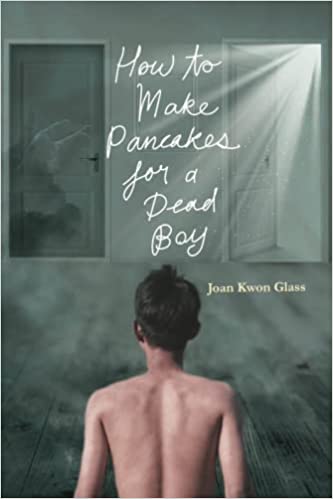
How to Make Pancakes for a Dead Boy, by Joan Kwon Glass

Harbor Editions, imprint of Small Harbor Publishing, 2021
Cover art by Jen Stein Hauptman, Design by Claire Eder

Review by Risa Denenberg

If you haven’t lost someone close to you to suicide—and I haven’t—you can only imagine the range of emotions you might feel all at once: fury, wild grief, shame, guilt, regret, fear, deep affection, and how difficult it would be to give language to such complex feelings. Joan Kwon Glass translates these emotions into devastating poems in her chapbook, How to Make Pancakes for a Dead Boy. Harder to imagine is the death of a child by suicide; and yet these poems are dedicated “For my nephew Frankie, who died by suicide at age 11.”

In the eponymous poem, Glass mingles the ordinary, the wished-for, the memory, and the reality of her nephew’s death into the facade of simple instructions:

First, crack the egg
into a sinkhole of grief.
Measure the ingredients,
then stir until the lumps
no longer resemble bullets. 

A suicide may seem to come without any warning; seen more clearly in hindsight, there are almost always signs. Glass notes evidence of her nephew’s thoughts of suicide in the first poem, “Red Flags.”

He asked his grandmother about heaven twice
in one week, specifically whether pain
disappears or if we carry it with us.

When signals are misinterpreted, a death by suicide is tinged with unspeakable regret. There must have been something that could have, should have, prevented this tragedy.  In “What I Regret,” Glass mourns the lost opportunities, the “should haves.”

I should have filled your arms with a blooming
bushel of your favorite candy … 

I should have asked: What do dream of holding?
Before it’s too late, tell me what your heart wants.

Although they circle around the death of one boy, the poems in How to Make Pancakes for a Dead Boy also circle time and distance, culture and history, the way families try or fail to hold on to one another. In “Chuseok 추석,” a traditional Korean holiday is viewed simultaneously across generations and distances. Starting with “Today my uncle and his wife will visit / my grandparents’ tomb in Korea / the way they do every year,” Glass repeats this ritual of remembrance at a distance,

I think of my nephew’s grave in Troy, Michigan,
7,400 miles from my grandparents’ tomb,
his headstone flush to the ground.

The uncle and his wife, “leave trays stacked high / with persimmons and powdered tteok” while Glass regrets what she is unable to do for her nephew. “If I could go back, I would claim a summit / and build him a tomb.”

In “Keeping Watch,” are these mournful yearnings:

Frankie, if you were still alive, I’d shrink my world down
and keep watch. Grandma and I would set up camp

in your bedroom, bring a small light and leave it on all the time.
Even at night, you’d be the only thing in view.

Eventually I would see what needs to be fixed.

Remembrance may induce us to enact rituals of bringing back the dead that rely on tradition and belief. In “I Ask the Pearl Diver to Bring You Back from the Dead,” divers produce “creatures that grief pulls from deep airless places.” In an illusion that seems to be real,

You swim toward me,
race the [diver], and she almost beats you to the shore.
You look up at me like a field of canola opening in the sun.

Glass moves on, as she must, while holding on to her ever-present grief for her nephew. The language in these poems grows more and more lyrical as the poems progress, seeming to reflect the lyricism allowed by the passage of time. I love these lines from “Nocturne for Lost Sons,” where collections of mourners see “the boys coming home / in the dark,”

If they arrive, we will unthread their lips and nurse them
or lay forkfuls of lasagna on their tongues.
We’ll tell them their rooms are just as they left them.
When dawn comes, all of it will burn away.
We hold on as long as we can, hoping
the last sound we hear will be
of their sneakered-feet coming towards us,
dribbling balls or peddling bicycles
from wherever they’ve been.

The grief in these poems is as relentless as their beauty. But in “Taking My Daughter Out for Smoothies,” the focus shifts to acts of redemption for the living. In the car, in line waiting for smoothies, Glass admits that she spends this time hoping for “anything that will keep you / close to me a bit longer.” Parents may spend hours with a teenager feeling unseen and unheard, aware that no “14 year old girl believes that her mother / has answers to any of her questions.” Patience pays off when her daughter says out of the blue: “I have been thinking a lot / about God lately … Like when I pray, how do I even know if he is listening.”

Once on a long plane ride, I sat near a mom and a boy who was about the age of Glass’s nephew. The mom was tired, clearly wanted to zone out, flip through her magazine. The kid was enthusiastically trying to explain something to her about something—I don’t remember what—and she was pretty much ignoring him. It made me want to say to her, “Listen now. He may not want to talk to you later.”

In “How to Make Pancakes for a Dead Boy,” Glass is listening as hard as she can.


Joan Kwon Glass is the biracial, Korean American author of NIGHT SWIM, winner of the 2021 Diode Editions Book Contest, & is author of three chapbooks (Harbor Editions & Milk & Cake Press). Joan is a Brooklyn Poets mentor, poet laureate of Milford, CT & poetry co-editor of West Trestle Review. She is a proud Smith College graduate & has been a public school educator for 20 years. Her poems have appeared in Diode, Rattle, The Rupture, South Florida Poetry Journal & many others & have been nominated for the Pushcart Prize & Sundress Anthology Best of the Net. She grew up in Michigan & South Korea, & lives in Connecticut with her family.


Title: How to Make Pancakes for a Dead Boy
Author: Joan Kwon Glass
Publisher: Harbor Editions, imprint of Small Harbor Publishing, 2021
Cover art by Jen Stein Hauptman

Cover design by Claire Eder
pp.  44     $12
ISBN: ‎ 978-1735909097


Risa Denenberg lives on the Olympic peninsula in Washington state where she works as a nurse practitioner. She is a co-founder of Headmistress Press; curator at The Poetry Café Online; and an avid book reviewer. Her most recent publications include the full-length collection, slight faith (MoonPath Press, 2018) and the chapbook, Posthuman, finalist in the Floating Bridge 2020 chapbook competition.


Risa Denenberg is the curator at The Poetry Cafe.

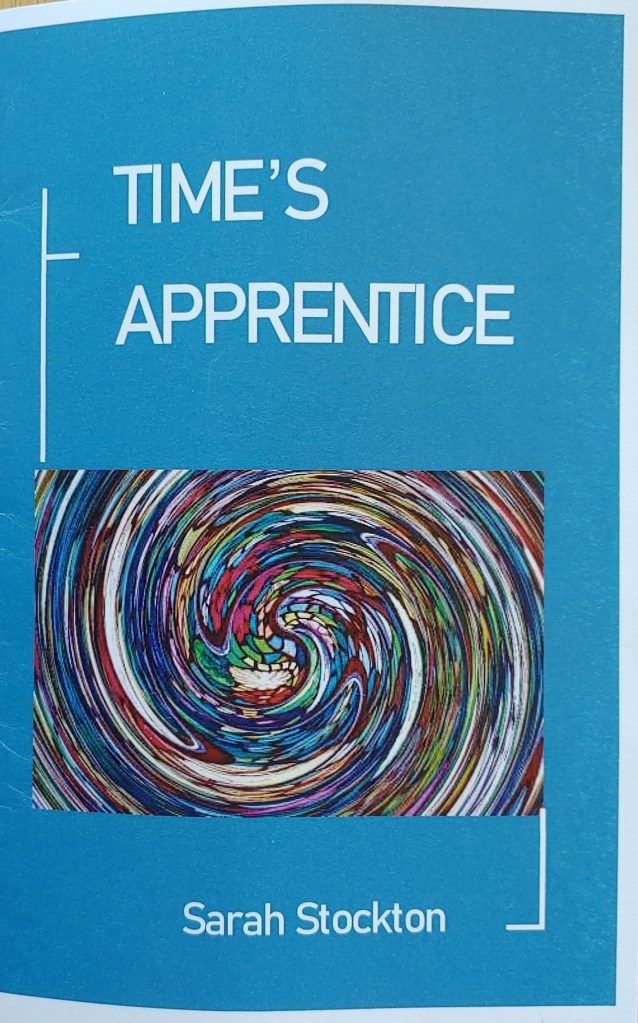
Time’s Apprentice

Time’s Apprentice, by Sarah Stockton


Published by dancing girl press & studio, 2021
Cover design by Kristy Bowen
Review by Risa Denenberg

I looked forward to reading Time’s Apprentice, knowing the author Sarah Stockton, as I do, who is a curator extraordinaire of the journal River Mouth Review where, in every issue, she places a set of striking poems by different poets next to one another into a collage of shared meanings. And, as I write book reviews for RMR, I wanted to have a chance to have my say about this chapbook.

I mention Sarah’s curator talent, because it is equally present in Time’s Apprentice. It is no simple task to seam together a life in its many facets in a way that signals to the reader that no one facet deserves all of the attention. There are memoirs that do this, of course, but a small collection of poems, if done well, can also bring a rich and many-sided life into view. A braid of living strands run through these poems, creating the kernel of a whole life—strands of time, seasons, and cycles. Attention to sequencing of poems in a collection—a dilemma all poets struggle with—is a talent she possesses.

Some of the poems here are dreamy. My favorites are the three poems titled “From the Diaries,” which are epistles to Anais Nin—a French-Cuban-American diarist, essayist, novelist, and writer of short stories and erotica. I also read Nin’s “The Diary of Anais Nin,” back in the day. These poems are subtitled “Dawn,” “Noon,” and “Dusk,” and begin with “Dear Anais—”. Scattered through the collection, they mark a cycle of returning to the inner life. Written as unsent letter in a diary, they are the keepers of emotion-laden secrets. In “From the Diaries: Dawn,” she says, “Remember exchanging those lists of past lovers? / I left a few names out—revisions forthcoming.”

And in “From the Diaries: Noon”:

I fell overboard in disgrace. The houseboat leaks
but your diaries are still safe. I’m banned
from the docks until I pay the rent.

And in “From the Diaries: Dusk,” the letter writer asks, “Do you think it is time for me to go?” and implores, “please come back, / write me into your story.”

I love the allegorical meanings that I find in these poems (“fell overboard,” “pay the rent,” “revisions”) offering insight into the writer’s dreams, but with many possible interpretations.

There are poems harking back to childhood, such as “What Grandmother Ruth Taught Me” (“Take a raw egg and cup it / in your finger-painted hand.”), or “Summer’s Mouth” (The summer my parents / abandoned us, each other.”). A reminiscence about a father now grown old in “The Sailor’s Daughter,” gives this report: “My father has become a small boy demanding attention, tacking / across the lanes in search of whatever he forgot.”

Another facet here is chronic illness. In “Chronic,” the word becomes a metaphor for all the difficulties of a life.  Chronic is: “endless cups of bitter leaves,” “a transmogrification,” an “internet hoax,” “a chronic liar,” a “phase of aging.” Seeking explanations for what underlies chronic illness in “The Placenta Effect,” Sarah posits wide-ranging, often crank theories from her own research:

I’ve been studying the historical records of
hypochondriacs and wondering if my
religious doubts are a factor that only
medication or a thorough confession can
abate. Like every sick person I’ve cast
my symptoms wide over the internet, chasing
down desperate strategies, ludicrous
theories that at first, for a time, seem to
loosen the binds […]

Other poems evoke Sarah’s grown children. In “So Far Away,” the loneliness that a mother can feel once a child is thoroughly launched is expressed this way,

My daughter calls to say she has had an unexpected encounter
with a green iguana. I live in the north. She is far away.

As she talks, I look up iguanidae, knowing my textual knowledge
won’t persuade her to move back home, regardless of the facts.

“Whoever Goes First,” is a not-so-gentle reminder that we all will die, and those of us getting older should be planning for death, including having serious discussions with partners and children. I so appreciate this no-nonsense take on aging and death. And although, “we say that we hope to go together / (like all lovers do)” it is also wise to know that things may not go as we hope:

but secretly each wants to be
the first to cross
death’s unknown threshold
like a child at a new school
who looks back, hesitant, the goes on

comforted by the presence of the beloved
still standing at the dimming gate.

And lest I give short shrift to odes to the natural world in Time’s Apprentice, I will mention that there are “coyotes / down by the duck pond,” “one last naked swim in perfect / golden water, one last fling,” and “a swirling tidepool” with “kelp infused water.” In the poem,“In Every Season, A Shade of Blue,” there are “clusters of morning glory,” which are “bursting / bruised berries.” This ode to blue continues,

blue kisses the jelly fish’s tentacles
            struts across the western jay, shades
                        into mussel, whale, parrot, frog

It is rare to find so much depth in so few poems. I think you’ll like this small book that covers so much territory so well.


Sarah Stockton is the author of the chapbook Time’s Apprentice (dancing girl press, 2021) and Castaway, forthcoming in 2022 with Glass Lyre Press. Her poems have appeared in wide-ranging publications including EcoTheo Review, Glass Journal, Psaltery & Lyre, About Place Journal, Rise Up Review, and many more. Sarah has an extensive background in university teaching, workshop facilitation, freelance writing and editing, and is the author of two books on spirituality and spiritual direction. Whether reading, writing, studying, or teaching, poetry has been a part of Sarah’s life for over 40 years.

Title: Time’s Apprentice
Author: Sarah Stockton
Publisher: dancing girl press & studio, 2021

Cover Design: Kristy Bowen

Price $8.00


Risa Denenberg lives on the Olympic peninsula in Washington state where she works as a nurse practitioner. She is a co-founder of Headmistress Press; curator at The Poetry Café Online; and an avid book reviewer. Her most recent publications include the full-length collection, slight faith (MoonPath Press, 2018) and the chapbook, Posthuman, finalist in the Floating Bridge 2020 chapbook competition.

Interview with John Whitney Steele

John Whitney Steele, author of The Stones Keep Watch, in conversation with Randal A. Burd, Jr.

EXTRA! Read a review of The Stones Keep Watch.

Randal A. Burd: I was honored to have the opportunity to interview the poet, John Whitney Steele, author of recently released The Stones Keep Watch (Kelsay Press, 2021) to discuss his work. I was drawn to his work because of my love of poetry that demonstrates humble introspection as well as astute observation. Steele’s work does both exquisitely. When asked to identify his muse, he is quick to name his spiritual practice of yoga and Zen and his love of nature as his primary inspirations.

Burd:. Where does The Stones Keep Watch fall in your poetry career?

John Whitney Steele: I started writing poems in high school and took a poetry writing class during my first year of college. Then I pretty much gave up on writing for the next four decades as I pursued my career as a clinical psychologist, mindfulness instructor, and yoga teacher. It wasn’t until 2015, when I enrolled in the MFA Creative Writing program at Western Colorado University, that I began writing in earnest. A year later, when Blue Unicorn was the first journal to accept one of my poems and the editor later nominated it for a Pushcart Prize, my poetry career got a boost. This year, Kelsay Books’ publication of my first collection, The Stones Keep Watch, catapulted me into what I have found to be the most challenging aspect of my role as a poet: building a website, promoting myself on social media, setting up a Zoom reading; in short, going public.

BURD: I had read that you came to writing poetry later in life. What first inspired you to write poems?

STEELE: I’m not sure what first inspired me, but as an extremely shy, introverted child, I was so socially withdrawn that the natural world and books were my closest companions. I was an avid reader of fiction and lapped up the poetry we studied at school and the bible stories I was exposed to at Sunday school.

During high school I took up guitar, sang folk songs and wrote a few poems. My social isolation may have contributed to my need to express myself through music and poetry. The feedback I got from my creative writing professor, the poet, Frank Davey, during my first year in college, gave me a sense that I had some talent.

Though I thought about pursuing creative writing and supporting myself as an English teacher, I doubted my ability to flourish in either field and decided instead to major in psychology. During grad school, my involvement with a Sufi community awakened my interest in Rumi’s poetry. By the time I had turned 40, I had left the Sufi path and become deeply involved in yoga and Zen. This led me to start reading Japanese haiku and Tang dynasty poets.

When I started offering meditation classes, I read some of Mary Oliver’s poetry, which was relevant to what I was teaching. My long-neglected urge to write kept resurfacing and I experimented with haiku. When I turned 60 and started to think seriously about retirement, I was haunted by Mary Oliver’s question: “What is it you plan to do with your one wild and precious life?”

I had long regretted neglecting poetry. It was clear to me that I wanted to give it another try. I started by auditing an undergraduate creative writing course at CU Boulder. Though I started writing poems again and received some good feedback, the workshop format of the class provided no instruction in craft.

Searching online I found the MFA program at Western Colorado University, one of the few programs that focused on writing formal verse. Although the tuition fees gave me pause, I decided it was now or never, and took the plunge. And that has made all the difference. [NB: line from “The Road Not Taken,” Robert Frost.] I wasn’t thinking about publishing. I simply wanted to learn how to write, but one thing leads to another and here I am.

BURD: Who or what is your muse now? I noticed that climate change is a common theme throughout your book, along with some political commentary. Is that what continues to drive you?

STEELE: My inspiration comes primarily from two sources: my love of nature and my spiritual practice, rooted in yoga and Zen. I’d rather sing songs of praise than write about climate change and politics. However, my angst and grief in relation to our inadequate response to the climate crisis has been driving me.

I love the natural world and my instinct is to preserve it. But the population explosion, the demand for constant economic growth, and the catastrophic destruction of the ecosystems and habitats we and other species depend upon is taking us in the opposite direction. And so, I felt compelled to write about the climate crisis and the politics of denial. Now that The Stones Keep Watch is behind me, I’d like to move on to other themes.

BURD: Do you write your poems to facilitate change outside (in the world) or change inside (in the reader)? Do you personally find writing poetry to be a cathartic process?

STEELE: I write because I am fascinated by words, the incantatory power of repetition, rhythm, rhyme, assonance, alliteration and so on. As much as I would like my words to facilitate change in the hearts of readers and to see that change ripple out into the world, it is certainly not in my mind when writing poetry. Writing is cathartic for me. It makes me more alert and responsive to myself and the world, gives me the ability to articulate my feelings on the deepest level, and as Frost so famously said, a well-wrought poem ends “in a momentary stay against confusion.”

BURD: Who are some of your favorite poets? Which poets have influenced your writing?

STEELE: In addition to poets I have already referred to, my short list of favorites must include the likes of Shakespeare, Milton, Blake, Wordsworth, Keats, Shelley, Coleridge, Hopkins, Dickinson, Whitman, Millay, Yeats, Frost, Jeffers, Larkin, Heaney, Rilke, and Merwin, not to mention the countless contemporary poets whose work I admire.

As for the poets who have influenced my writing, it’s hard to say. Some have told me my poems resemble those of Jeffers. Others have mentioned Keats, Wordsworth, Frost, Snyder and Charles Wright. But it seems to me that the body of literature contained in The King James Bible has been my biggest influence.

BURD: I notice your style in this collection is a mixture of classical and contemporary. It is often said that traditional forms, rhyme, and meter are unfairly shunned in today’s literary circles. Have you had difficulty placing some of your more traditional pieces in poetry magazines?

STEELE: No, not really. Though it has required a lot of research to find publications that welcome formal poetry, plus a thick skin and dogged determination in the face of multiple ‘no-thank-you’ responses from editors, I have managed to find good homes for most of the poems I have sent out.

BURD: What is your process for writing poems? Is it deliberate and scheduled or as the inspiration comes?

STEELE: I don’t schedule writing time. I write as the inspiration comes. However, there is definitely something deliberate about my process. I make writing my top priority, set aside plenty of unstructured time for it, read the work of other poets and follow up on every lead that my muse offers.

Inspiration is most likely to come while walking in nature, practicing yoga, doing zazen, or upon waking from sleep. Once I get started on a poem, the muse grabs me by the collar and won’t me let me go. I wrestle with it day and night. New ideas bubble up in my sleep or while out walking or practicing yoga or doing the dishes, and I jot down notes or go straight to my laptop to revise whatever poem I am working on.

I find my participation in weekly poetry feedback sessions with a group of poet friends is a strong motivator. I do my best to bring a new or revised poem to every meeting. If a week or more goes by without starting a new poem or continuing to finesse an older one, I worry that my muse has abandoned me or I have abandoned her. I start to doubt myself, wonder if I have somehow lost the knack of writing and think that I’ll never experience the joy of writing another poem. Almost every poet I talk to encounters similar cycles of monsoon and drought.

BURD: How long did it take for this book to come together?

STEELE: I wrote the poems over a period of five years, along with many other poems that don’t fit into the theme of this book. I pulled the poems together over the course of a couple of months and then sent my manuscript to a few publishers. A couple of months later, an acceptance email from Kelsay Books showed up in my inbox.

BURD: I notice your back cover has blurbs from poet laureates of three different states. Were these blurbs hard to obtain? What was the process?

STEELE: I wanted to ask Joanna Macy, an environmental activist, author of twelve books, and scholar of Buddhism, general systems theory, and deep ecology, but I had no personal connection with her. However, I remembered that a friend who teaches environmental leadership at Naropa University had helped organize a workshop Macy had given. When I contacted my friend, she told me that at age 92, with declining health, Macy is saving her energy for the work she values most and is no longer accepting requests for book reviews or blurbs.

Then, I thought of Jane Hirshfield, a poet who writes at the intersection between poetry, the sciences, and the ecological crisis, but I couldn’t find any way of contacting her. So, I reached out to three prominent poets I have met and whose work I admire. Fortunately, all three said yes, and sent wonderful blurbs that gave me new perspectives on what I had written.

BURD: The Stones Keep Watch is published. The reviews are trickling in. What is next for you?

STEELE: My full-length book, Shiva’s Dance—a collection of sonnets about yoga, which more closely resembles the songs of praise I want to be writing—was accepted by Kelsay Books last summer and scheduled for publication in the spring of 2022. After having had no nibbles from the contests and publishers I had been offering the manuscript to for over two years, I was quite relieved to get the good news from Karen Kelsay.

I am currently working on memorizing as many of the sonnets as I can in preparation for a promotional video in which I will be performing yoga poses as I recite poems from the collection. I will soon be working on sending the manuscript out to book award contests and reviewers and setting up reading events.

After being distracted from creative writing over the past couple of months by my efforts to promote my chapbook, I am looking forward to setting aside more unstructured time in the hopes that I will be inspired to write new poems. As for what I will write, I have no idea. My muse has a mind of its own!


John Whitney Steele is a psychologist, yoga teacher, and assistant editor of Think: A Journal of Poetry, Fiction and Essays.  He is a graduate of the MFA Poetry Program at Western Colorado University. His poetry and book reviews have appeared in numerous print and online journals. Born in Toronto and raised among the pines and silver birches of Foot’s Bay, Ontario, John now lives in Boulder, Colorado where he often encounters his muse wandering in the mountains. John can be found at johnwhitneysteelepoet.com. 


Randal A. Burd, Jr. is an educator and the Editor-in-Chief of the online literary magazine, Sparks of Calliope. His poetry has received multiple awards and has been featured in numerous literary journals, both online and in print. Randal’s 2nd poetry book, Memoirs of a Witness Tree, is now available from Kelsay Books and on Amazon.


Risa Denenberg is the curator at The Poetry Cafe.

The Stones Keep Watch

The Stones Keep Watch by John Whitney Steele
Published by Kelsay Books, Cover Design by Shay Culligan
Review by Randal A. Burd, Jr.

EXTRA! Read an interview between John Whitney Steele and Randal A. Burd

“The poetry of earth is never dead.” This observation by British Romantic poet John Keats has been oft repeated by countless poets, celebrated and obscure, since the 1817 publication of his poem, “On the Grasshopper and Cricket.” But this sentiment has not been expressed more deliberately, nor with more consistent passion than by another John—poet John Whitney Steele—in his first collection, The Stones Keep Watch.

This collection drew me in from the outset. The cover photograph is of Hawk Tower, a stone castle-like structure built in the early 20th century by the poet Robinson Jeffers. The structure is shaded from bright sunlight by surrounding trees which is a good match for the photographic style of the author. And, while you wouldn’t go wrong judging this book by its cover, the poems inside reward the high expectations it sets.  Steele has spoken of coming late to writing poetry and he wastes no time digging into subject matter he feels passionately about.

The first poem in the collection, “Listen,” calls the reader to attention and implores them to listen as they are taken through a slide show of vividly described settings. Anxiety concerning climate change becomes apparent in the next poem, “Grinnell Glacier,” where the speaker kneels in prayer “knowing nothing lives forever,” speaks of “the silent sorrow of silver ice,” and laments to the glacier that “it’s too late to save you.” The poem goes on to describe the fallout from the glacier’s catastrophic disappearance.

The climate change theme bleeds seamlessly into the next poem, “Light from the Stars that Died,” which mentions “melting ice” and “rising tides,” in the first two lines. Water and melting ice continue to be motifs in almost every poem, from the lake habitat of the great blue heron to the extinct war elephants of Hannibal sucking up water from the underworld and spraying it in the clouds. “Buddha Said” speaks of the “paralyzed panic of ice cap meltdown,” and “Posterity” mentions melting permafrost. These poems are not a call to action; they are the primarily the speaker’s grieving the end of nature itself as a foregone conclusion–the unavoidable consequence of past inaction.

The permafrost is melting now,
releasing long held secrets:
fifty-thousand-year-old wolf pups
perfectly preserved, reindeer
killed by anthrax, disinterred.

This collection does not instill a call for increased environmental awareness or greater conservation, as much as it imposes a tone of paralyzed panic that impending doom from climate change is certain to be coming. However, it does raise related political concerns. The speaker posits it is already too late for Grinnell Glacier, and describes humanity as a collection of terminal patients preparing to do “the last things done by humans.” After all, “the sixth extinction can’t be turned around.” And yet, the following phrase: “If nothing’s done, and soon…,” suggests the speaker in “Great Blue Heron” perhaps has not entirely given up on saving the human race.

In “What’s Required,” the speaker laments what he seems to believe is the imminent end of democracy in a nation “roiled by a would-be tyrant.” He asks himself if he can “shake off inertia, do what’s required,” confessing that he has considered political assassination before dismissing that notion with a reflection on Caesar and Ghandi. Moving on the more immediate hazard of a wasp nest in the yard, he ironically speaks of his injured wife and how “everything she says is dramatized.” Water enters again as a motif when the speaker gets the hose to flood the wasps’ nest, repeatedly hoping they drown, then has a twinge of regret over having possibly drowned “an entire community.”

The Buddha said,
The world’s on fire.

How much more so

now.

And yet

we still deny it.

What more does it take?

This collection’s strengths include: vivid imagery; the speaker’s passions, both intense and authentic,  and verse that seems both traditional and yet, also contemporary. The collection does display some hyperbole as it covers hot-button issues frequently seen in contemporary poetry. I think it unfortunate when readers embrace or reject a collection based on the ideology it appears to champion, although I am sure this happens far too often. Despite the doomsday message, the speakers in Steele’s poems come across as likable individuals with whom readers can empathize. The poems do an admirable job at putting the poetry of earth on display, in all its magnificence.  Finally, I love poetry that demonstrates humble introspection as well as astute observation, and Steele’s work does both exquisitely. The Stones Keep Watch is a collection worth reading from a poet who surely has more to come.


John Whitney Steele is a psychologist, yoga teacher, and assistant editor of Think: A Journal of Poetry, Fiction and Essays.  He is a graduate of the MFA Poetry Program at Western Colorado University. His poetry and book reviews have appeared in numerous print and online journals. Born in Toronto and raised among the pines and silver birches of Foot’s Bay, Ontario, John now lives in Boulder, Colorado where he often encounters his muse wandering in the mountains. John can be found at johnwhitneysteelepoet.com. 


Title: The Stones Keep Watch
Author: John Whitney Steele
Publisher: Kelsay Books, 2021
35pp $16.50
Cover design by Shay Culligan


Randal A. Burd, Jr. is an educator and the Editor-in-Chief of the online literary magazine, Sparks of Calliope. His poetry has received multiple awards and has been featured in numerous literary journals, both online and in print. Randal’s 2nd poetry book, Memoirs of a Witness Tree, is now available from Kelsay Books and on Amazon.


Risa Denenberg is the curator at The Poetry Cafe Online.

Music Speaks

Music Speaks, by Bill Cushing

Review by Charles Farmer

Anyone who has spent time making a mixtape understands there is an undercurrent of autobiography threading the song selections. Whether the tape’s intention is to woo a crush or introduce bands to the uninitiated, mixtapes tell the curator’s story.  Bill Cushing’s handsome Music Speaks reads as a reverently annotated playlist, a love letter honoring the music and artists who have provided the soundtrack to his life. While some curators might be more concerned with showcasing their eclectic, rarefied tastes, Cushing’s poems are never pedantic or pretentious; they are tender homages—sometimes exuberant, other times more subdued, depending on their subject—that reveal a mutual appreciation for music and the written word.

So often, critics argue about the use of the word poetry, whether it can be used in a discussion about music. Here, there is no hierarchy, only a mutual appreciation.

Music Speak opens with “On Modest Mussorgsky’s ‘Bydlo,’ ” a response to a piece from Mussorgsky’s 1874 suite, Pictures at an Exhibit, the composer’s sonic interpretations of Viktor Hartmann’s pictures. The piece is especially significant to Cushing as listening to his father’s 1960 LP of Fritz Reiner’s recording of the suite is among Cushing’s formative musical experiences. Mussorgsky’s own work captures the trudge and resiliency of a wagon team, its oxen bearing a load of hay; Cushing’s poem captures the solemnity of music and the picture. There’s something admirable, something worth celebration as

Beast and wagon pass,
processional,
as if solemn
and then recede
slowly
out of sight

Music and images combine as the processional offers its own percussion, a “rhythmic hammering, / dull thunder / as hooves pound the earth”; the organic beat causing the ground to move “to the sound / of these hardened / timpani.”

This opening poem establishes the origins of Cushing’s lifelong relationship with music, a connection that blossoms and intensifies as he moves on from his father’s LP and discovers jazz— the focus of most of Music Speaks. Cushing’s poems conjure images of iconic Blue Note album covers, nightclubs both suspicious and sophisticated, bartenders gracious with heavy pours, the sounds of aural abandon that fueled The Beat Generation.  Jazz, Cushing says in “Jazz Salvation,” is “my country’s / only true art.” It transcends “geometric” pop and “classical’s calculus.” Jazz is “our chance / to dance / in a stereotomy of confusion,” and “a road to refuge— / becoming our savior / from too many / mundane days.”

When he was young, Cushing’s heart was elsewhere. In the fourth grade, “Rock and roll was my world,” he says in, “’Music isn’t about standing still and being safe.’” Cushing, like countless others, eventually discovered Miles Davis’s cataclysmic catalog, its re-imaging of music’s possibilities. Describing his first encounter with Davis, Cushing speaks in the language of revelation:

[…] you brought me back
to music
I walked all the way home

Miles
from that train station
my head pounding with sounds
frantic-fast as the subway

Cushing also writes in awe of Charlie Parker (“Listening to Bird”), who staccato pulse is replicated in two-line bursts:

He founds places
in his search for every note

not imagined:
leaving chromatic gravity,

breaking confines,
shooing up into infinity;

And the in “Ode to Nina Simone,” whose own musical journey resembles Cushing’s, as she “[left] beloved Bach behind.” Anyone who’s seen Simone’s fiery set in 2021’s documentary Summer of Soul will recognize the goddess in Cushing’s poem, who’s “transforming us with blues, boogie-woogie / using training in classics to quash rage.”

Elsewhere in Music Speaks, Cushing writes about the effortless suave of Eubie Blake, whose “long fingers, doing what few can hope to, / creating perfect stops,” propelled classics like “Raggin the Rag” and the essential “Memories of You.” Also subjects of affection are: the contemporary, almost genre-less band, Too Many Zooz (“Three spheres of instruments—percussion, sax, / and trumpet: brass, reed, and skin—become / a discussion of brash banging fun); Dire Straits’ Mark Knopler, who’s always been more than a rock ‘n’ roller; and the recently departed and greatly missed Leon Redbone, eternally cool “decked out in black, Ray-Bans perched on / a Syrid nose,” / “ageless as a harvest moon.” Music Speak fittingly closes with “So Long, Dr. John,” a poem-as-obituary for the late, inestimable Dr. John,

Most interesting is Cushing’s poem to jazz pianist Marcus Roberts, “Singing with Both Hands,” a testament to the mystery behind the creative process. We can try to quantify and analyze creativity, dissect the muse, but creation remains a mystery. Considering the source of Robert’s virtuosity, Cushing asks, “With eight-eight steps to choose, / how do the pianist’s hands / decide which to use?” It could be that “each acts alone: one as the heart” while “the other wanders free.” Yet for of all this analysis, search for a behind-the-scenes explanation, the answer could be a simple, “Or not”—perhaps there is no conscious choice; perhaps it’s a matter of mystical surrender.

Music Speaks is a welcome to addition to my home, where I am often torn between devoting my time and heart to poetry and music. Here, my loves coalesce; there is no guilt trip. The collection succeeds as a testimony to music’s and poetry’s ability to breathe life into the everyday, where notes and words comfort, clarify, confirm, and reassure what it means to be alive.


Bill Cushing has lived in Virginia, New York, Pennsylvania, Missouri, Florida, Maryland, the Virgin Islands and Puerto Rico, and currently lives in California. As an undergrad, he was called the “blue collar” poet by classmates at the University of Central Florida because of his years serving in the Navy, and working as an electrician on oil tankers, naval vessels, and fishing boats. Bill earned an MFA in writing from Goddard College in Vermont and has recently retired after more than 20 years of teaching English at East Los Angeles and Mt. San Antonio colleges. Bill was named as one of the Top Ten Poets of L.A. in 2017, and in 2018, he was honored as on the ten poets to watch in L. A. His 2019 book, A Former Life, was released by Finishing Line Press and recieved the Kops-Featherling International Book Award. He won the San Gabriel Valley Chapbook Competition with Music Speaks.


Title: Music Speaks
Author: Bill Cushing

Published by author, printing at‎ lulu.com (October 2, 2019)
32 pp $25
ISBN: ‎ 978-0359827015


Charlie Farmer is a Georgia poet and professor who loves his wife, Erin, his daughters, his friends, his cats, his students, his books, his LPs, and everything else a poet should love in life.


Risa Denenberg is the Curator at The Poetry Cafe.

Jar of Plenty

Jar of Plenty, by Ruelaine Stokes

Review by Cheryl Ceasar
Cover Art by Barbara Hranlovich

As a child, I dreamed of exploding gift boxes. Not the tame ones you see online, those which simply unfold—although they can be quite lovely. I wanted to find a box that would spray its marvelous contents into the air like the novelty cans that unleash coiled snakes, but with no danger of a chipped front tooth or a poke in the eye. When I opened a manila envelope from my friend Ruelaine Stokes a few days before Christmas, I finally got my wish. The book Jar of Plenty is not only a gift, but a reminder of what a gift can mean.

Start with the cover art by Barbara Hranlovich. On an indigo-chakra background, a white-outlined jar is releasing beads, runic stones, flowers and feathers. An opened pomegranate discloses its secret rubies. A cup of coffee in a plain white mug flourishes its artisanal swirl of foam. A wise raven lifts its beak as flames flicker and steam rises. It recalls the childhood pleasure of plunging my hand into a cookie tin full of variegated buttons.

Open the book; the gifts continue to stream out. Ruelaine draws on her own gift, her talent, to fashion these small parcels of delight. Like a smiling hostess, she guides us through the rooms of her various names, arising from her deep self.

Rue: a street or a regret
Lynne: like a brook or small pool, from her father’s friend
Stokes: from her ancestors, as in the line, “Keep the fire burning,” from her poem, “The Story of a Name”

Alongside black-and-white photos, she introduces her family: The grandfather who fell like Icarus from the sky in “Sailing through Time”; the pretty mother who fled to Tijuana with the priest in “Hard Times for Free Spirits”; the Monster who “sits by the door” and tells the writer she was “never designed to fly” in “Monster”; and then, the writer herself, out the door and flying.

Ruelaine picks up the ordinary artifacts of our lives, one by one, to show their marvels. Here is a pomegranate with its seeds: “each translucent / each bearing the fate of the world,” in “I remember the far-off sky, blue and blazing.” Here are memories of the senses, vividly evoked in “Yellowstone”:

the low moan of the wind  
the hungry grass
the gray stones

I think the gift she is sharing is this: the gift of attention. Attention to every small object, attention to our movements through the world. In “The Priest of Coffee,” the passing of the cup becomes a sacrament, reminding us that every sharing of food or drink is a potential communion.

As I read, another gift appears: a series of meditations, or perhaps a liturgy. Before the Communion comes the reading of the Lessons. “I am turning my sorrows into water,” she writes, with wisdom, in “Intangible Effects.” In “The Poet’s Prayer” is the artist’s petition to the universe: “let me cast these notes / into the wind.” And, the poem, “From the Book of Common Prayer,” grants absolution: “wash my heart and call me clean / the hard time is over.”

A real gift is a moment of connection, passed between outstretched hands. Ruelaine’s life so far has been gifted to poetry, and especially to the local poetry scene in Lansing, Michigan. For decades she has worked here as an “architect of reality”–her own phrase—building the structures, readings, and workshops that bring poets together for a moment of communion. What a joy to find a collection of such moments made tangible and lasting, an artifact of her life’s gift.


Ruelaine Stokes is a poet, spoken word artist, teacher and arts organizer based in Lansing, Michigan. She has a BA in English literature from Stanford University, an MA in English literature from Michigan State University, and an MA in Teaching from the School for International Training in Brattleboro, Vermont. She worked for many years teaching English as a Second Language at Michigan State University, Lansing Community College, and in community ESL programs. She has also taught classes in English literature, Poetry, Women’s History and Writing. For many years, she has organized poetry performances, readings, open mic events and workshops within Mid-Michigan. She is currently the president of the Lansing Poetry Club.


Title: Jar of Plenty
Author: Ruelaine Stokes
Published by Author, 2019 (Printing Services at Michigan State University Libraries)
pp. 74    $15
ISBN is 9780578339085

Cover Art: Barbara Hranlovich


Cheryl Caesar lived in Paris, Tuscany and Sligo for 25 years; she earned her doctorate in comparative literature at the Sorbonne. She teaches writing at Michigan State University. Some of her COVID-era poems appear in Rejoice Everyone! Reo Town Reading Anthology, and in The Social Gap Experiment, both available from Amazon. Her writing and artwork will appear soon in Words Across the Water, a joint anthology by the Lansing Poetry Club and the Poets’ Club of Chicago. With co-editor Ruelaine Stokes, she is gathering a volume of reminiscences of the Lansing poetry scene in the 70s and 80s.


Risa Denenberg is the curator at The Poetry Cafe.