S.M. Tsai spent many years doing archival research and writing, then turned to 9-5 jobs for a new learning environment. Her poetry appears or is forthcoming in Ricepaper Magazine,Blue Unicorn, and the chapbook Bubbles and Droplets: 10 Poems of 2020. She lives in Toronto with her plants.
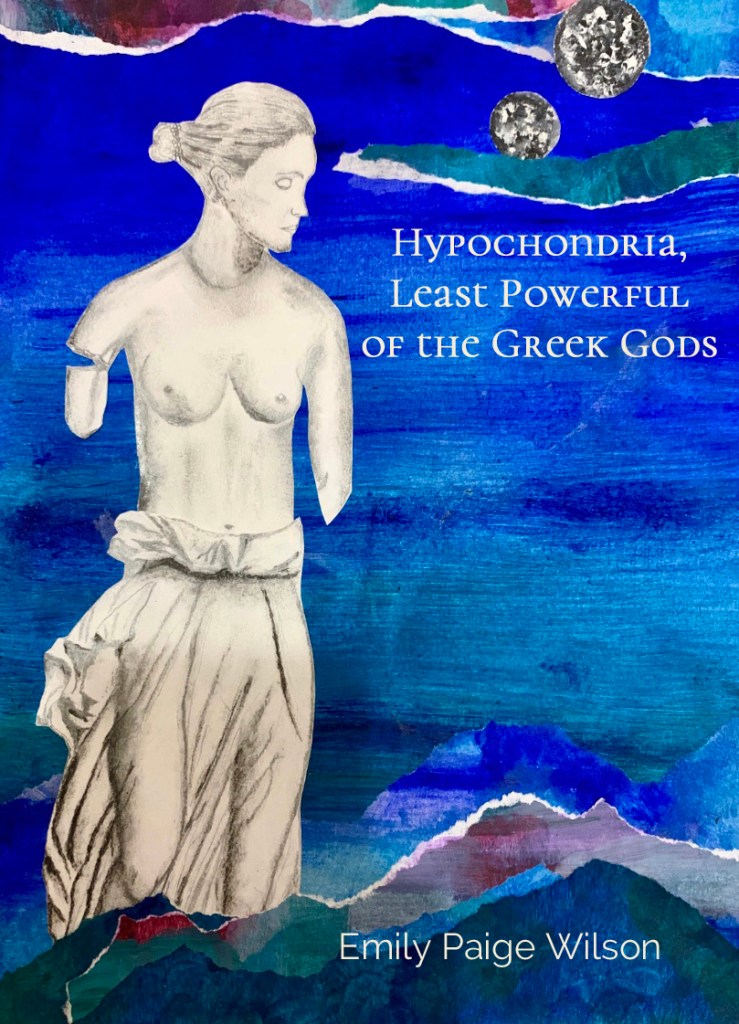
Hypochondria, Least Powerful of the Greek Gods by Emily Paige Wilson, Glass Poetry Press, 2020.
Review by Emily Mohn-Slate
What if hypochondria is not about fear but rather love? In her chapbook, Hypochondria, Least Powerful of the Greek Gods (Glass Poetry Press, 2020), Emily Paige Wilson observes in harrowing yet loving detail the secret truths a body can hold. Wilson’s chapbook investigates illness anxiety disorder, also known as hypochondria, which is worrying excessively that you are or may become seriously ill. This chapbook also explores language, power, and empathy in poems that exhibit a range of formal and sonic play. As someone who has suffered from chronic migraines for most of my life, I found myself nodding and underlining while I read as Wilson articulates the weight of invisible pain—mental, emotional, and physical—and its ability to fray not only one’s sense of self, but also one’s relationships with others.
Hypochondria, Least Powerful of the Greek Gods is framed by a series of concise poems titled “A Treatise of Hypochondria.” These poems use archaic spelling and capitalization (i.e. “Vapours”), which roots the reader in a time when doctors relied on the outdated theory of the “four humours.” The first of these poems, “A Treatise of Hypochondria (i),” serves as a prologue poem, and ends, “our Ancestors / rising / to make Complaints.” These lines ground us in the stereotypical image of the hypochondriac as merely a world-class complainer, while they also nod to how we are all bound by our ancestors’ genes. This framing begs the question: how far have we really come over the last few centuries in our understanding of women’s illnesses in particular? The next poem, “I Am Constantly Seeking Reassurance,” is a first-person lyric that introduces the anxiety of the speaker and considers the limits of others’ support in the face of her illness:
xxxxxxxxxxxxxxxxxMy boyfriend can only xxxxxxxxxxreassure me
so many times before trees grow in his ears, xxxxxxxxxxxtheir roots forming his red beard.
One of Wilson’s poetic gifts is an uncanny ability to render emotional complexities via imagery. Here, the leap from narrative into image evokes a visceral, physical limit to the boyfriend’s empathy; the trees, trunk, and roots seal his ears against the speaker’s legitimate complaints. We begin to understand the isolation and loneliness felt by the speaker—a double insult to contend with—the way even those who love her most are closed off to her reality.
“Hypochondria, Least Powerful of the Greek Gods” is the first poem of a series that serves as a second layer of nesting dolls, which situate the human speaker’s concerns in a larger mythological framework. Wilson’s tacking back and forth between humans and the gods draws out tensions around ideas of power and agency in the world. One would think that the god-figures would be able to exercise more authority than the human speakers, but that is not always the case. In “Hypochondria, Least Powerful of the Greek Gods (i),” we see Hypochondria from a distance as the poem is narrated from a third person point of view. In these poems, Wilson gives us the god adapted for our modern time with sharply funny lines like, “Hypochondria once had lunch duty with Hades and he told her, ‘That’s some thorough grief you have.’” She is a complex, human-esque version of a god whose favorite color is beige: “She lets the other gods think it’s because she’s boring, but she loves it—this, the first color clouds turn when they finally let the light in.” Wilson’s speakers are always fighting to turn toward the light, toward connection, even in the midst of impossible odds.
One of the specters haunting this collection is the legacy of women’s pain being seen as insidious or dismissed as mere hysteria. In the second poem of the series, we see the risks of being a woman, even as a god: “Hypochondria was once called a slut by a satyr because she wears barely-there dresses drawn from river water and weeds, but she needs to see her body clearly.” She wears thin dresses in order to see her body clearly for a purpose that is her own, not to entice men; but again, her intentions and her body are misinterpreted. Hypochondria “wishes she could treat pain like a coin purse—something spare, sparse, to be exchanged for something else,” but instead she has to bear it again and again. Gender also shapes our understanding of pain and our acknowledgement of it as real. We see this in the poem, “Hypochondria and Her Estranged Half-Brother Sisyphus,” in which “Hypochondria knows he’s never taken her / symptoms seriously, the panic she’s attracted, / aches born less in the bones than the brain.” Sisyphus responds, “I hold my pain in a way others can believe. / See how it fits neatly in my hands. So visible and clean.” Boyfriends, family members, and doctors minimize and ignore her pain, as in “My Doctor Told Me There was Nothing There.” The speaker says, “They didn’t know how practiced I’d become / in distraction—deeming every discomfort / unworthy of concern.” Here, her secret pains are articulated against the forces that would silence her. And, we experience the way pain is subjective, shifting, and unknowable for others. It takes a new doctor who had to “hold me / down while she checked the wreckage of the cysts / on my Bartholin glands,” apologized while she “milked blood / and pus from the thin skin of my labia, /gentle yet firm as if she had mouths to feed.” In the world of this book, and we are to understand, in the larger world, it is rare for the hypochondriac to be believed. What if the girl who cried wolf is telling the truth? Who will help her then?
In this collection, Wilson often lifts up the curative powers of language itself. Language is crucial to our ability to connect with others, to rise out of the murk of loneliness. But especially for the hypochondriac, language is also the locus of deep misunderstanding and damage. One of the most compelling aspects of this chapbook is the tension between the limitations of language that the speaker faces within each poem, while the language of the poem on the page is lush, precise, and exhibits transformative properties of observation and sonic beauty. In “On the Wall,” Wilson pursues a fuller understanding of language and reality: “In ancient Egypt, /only scribes were allowed to write—the belief that putting a word on paper was to summon the thing itself.” This is an argument for language’s power to create something real in the world beyond expressing an idea; this tangible power names why many fear sharing certain truths, and would prefer silence. The poem ends: “I’m not interested / in the etymology of a word, but the entire / music behind it. Not the origins, / but the tambourine.” It matters that the speaker is not interested in parsing the word; she wants to experience it—to hold it up to her ear and play each word, through the tidal waves of loss and silence.
The collection’s first epigraph, by Fleetwood Mac, is “I have no fear; I have only love.” These poems stare fear directly in the face with the gaze of love. The second epigraph, “I did not fear them until I wanted to be afraid,” by Sabrina Orah Mark, frames hypochondria in terms of wanting; the speaker has agency and has decided to feel fear. This agency is no small thing; combined with love, it amounts to the exact opposite force needed to dispel the silencing and pain caused by the dismissal of the speakers’ own pains throughout the collection. The final poem, “A Treatise of Hypochondria (iii),” lays out a bridge to another place from where we have come: “persist in all that / Pain and / Patience.” We trust that the speaker will continue carving a path forward, with god-like strength in her vulnerability, through mythology, music, and the force of her own will and love.
Emily Paige Wilson is the author of the forthcoming full-length collection Jalubí (Unsolicited Press, 2022) and two chapbooks: Hypochondria, Least Powerful of the Greek Gods (Glass Poetry Press, 2020) and I’ll Build Us a Home (Finishing Line Press, 2018). Her work has been nominated for Best New Poets, Best of the Net, and the Pushcart Prize. Connect with her at www.emilypaigewilson.com and @Emmy_Golightly.
Emily Mohn-Slate is the author of THE FALLS, winner of the 2019 New American Poetry Prize (New American Press), and FEED, winner of the 2018 Keystone Chapbook Prize (Seven Kitchens Press). Her poems and essays have appeared in AGNI, New Ohio Review, Muzzle Magazine, Tupelo Quarterly, The Adroit Journal, and elsewhere. She teaches high school English by day and poetry workshops by night for the Madwomen in the Attic at Carlow University.
Risa Denenberg is the curator at The Poetry Cafe Online
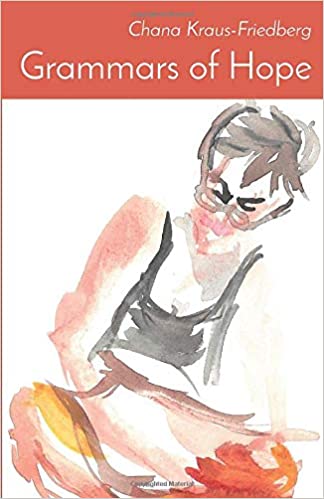
As a friend, I encouraged Chana Kraus-Friedberg to enter her chapbook Grammars of Hope (Finishing Line Press, 2021) into the Mark Ritzenhein Emerging Poet contest, and I was not surprised when she won first prize!
“Grammar” has a hard sound: grasping, grinding. Few admit to loving this field of study. We, as members of this select club, see it as the skeleton holding up the flesh of words, the skin of imagery. There is no language without grammar. A modal auxiliary like “may,” in the title poem, indicates a whole universe of possible futures for a friend’s young niece. I am reminded of Steinbeck’s East of Eden, and the Chinese servant Lee who works for years to find the best translation of the Hebrew word timshel, spoken by God to Cain. Did God say, “Thou shalt triumph over evil.”? That would be merely a statement of a predetermined future. Did He say, “Do thou triumph”? That is only a command. Lee finally concludes that God told Cain, “Thou mayest triumph over evil,” and that in the word “may” lies all the greatness of the human struggle. Likewise, Chana sees a great field of possibilities before her young heroine:
But I like to imagine your niece’s grammar as more hope than mistake, as though she’d been shown two limited paths and refused them both. That’s not enough, and it can’t be all there is, she might (one day) say. May there be…? There may be better ways.
But Chana is also a lover of words themselves, for their colors, smells, or moods, as in the poem “Authorial Intent”: “sickening” has an adamant, exceptional sound, / with that hard solid K in the center.
Or in “Sometimes You Ask Me,” where she reflects of the common phrase “what the day holds”:
I imagine it like a pair of cupped hands waiting to be filled.
This chapbook’s title, then, is important for at least two reasons. Words of Hope would have been merely banal. And the plural form lets us know that the author is the product of no one grammar, language or culture; she lives and finds her hope while moving between them.
In revealing these worlds, Chana shares a history that few of us will find familiar. She begins with her ultra-Orthodox Jewish childhood in Brooklyn, early becoming aware that her response to other girls is not the “normal” one, is not something that people speak of. “Brooklyn Lust” tells the poignant story of her “tender, insistent ache,” while standing behind a classmate, breasts pressed against her back, braiding her hair. Chana takes us through her life nearly to the present, to the years of COVID and Brett Kavanaugh. We hear of romances following her coming out–some with presumably real people, others with historical figures like Emma Goldman that she meets on library shelves. But we also follow her to Twelve Step meetings:
I didn’t know it would feel like that, all that pain with no drugs to put on it –
//
But I’m grateful for this chair I’m sitting on. I know if I stop being grateful what happens
With each new piece, the identity of the poet continues to take shape before us.
Chana’s writing is highly literate but never affected. It is strong and always searching. There is no lazy or pretty phrase. We feel that the poet is exploring the words, feeling the sounds, finding the meaning along with us. I can see her looking back, bemused, at the lines that have come from her. It’s the same expression that I see on poet Stevie Smith, with her cognomen of “peculiar”– the same wry shaking of the head. In the poem “Authorial Intent,” Chana concludes:
But lately I wonder how a sentence survives in the wild. I could take it outdoors in my pocket, speak it and see all the words strung together like small shining orbs: and I’d know what I meant, why I’d placed them that way. I’d know I’d said it.
I can’t guess what you’d hear.
Chana shares the puzzle with us and invites us to join the experiment. It’s an invitation worth accepting.
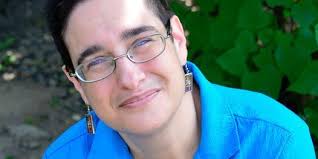
Chana Kraus-Friedberg is the winner of the 2020 Ritzenhein Emerging Poet Award. She grew up in an ultra-Orthodox Jewish community in Brooklyn, New York. Since leaving that community at the age of 20, she has earned a Ph.D in archaeology from the University of Pennsylvania and an MS in Library Science from the University of North Carolina-Chapel Hill. She currently lives with three feline companions in Lansing, Michigan, where she is a health sciences librarian at Michigan State University. This is her first chapbook.
Cheryl Caesar lived in Paris, Tuscany and Sligo for 25 years; she earned her doctorate in comparative literature at the Sorbonne. She teaches writing at Michigan State University. Some of her COVID-era poems appear in Rejoice Everyone! Reo Town Reading Anthology, and in The Social Gap Experiment, both available from Amazon. Her writing and artwork will appear soon in Words Across the Water, a joint anthology by the Lansing Poetry Club and the Poets’ Club of Chicago. With co-editor Ruelaine Stokes, she is gathering a volume of reminiscences of the Lansing poetry scene in the 70s and 80s.
Risa Denenberg is the curator at The Poetry Cafe Online.
Cheryl Caesar lived in Paris, Tuscany and Sligo for 25 years; she earned her doctorate in comparative literature at the Sorbonne. She teaches writing at Michigan State University. Some of her COVID-era poems appear in Rejoice Everyone! Reo Town Reading Anthology, and in The Social Gap Experiment, both available from Amazon. Her writing and artwork will appear soon in Words Across the Water, a joint anthology by the Lansing Poetry Club and the Poets’ Club of Chicago. With co-editor Ruelaine Stokes, she is gathering a volume of reminiscences of the Lansing poetry scene in the 70s and 80s.
Sylvia Byrne Pollack, a scientist turned poet, has published in Floating Bridge Review, Crab Creek Review and Clover, among other print and online journals. A two-time Pushcart nominee, she won the 2013 Mason’s Road Literary Award, was a 2019 Jack Straw Writer and will be a 2021 Mineral School Resident. Her debut full-length collection Risking It is published by Red Mountain Press (2021.)
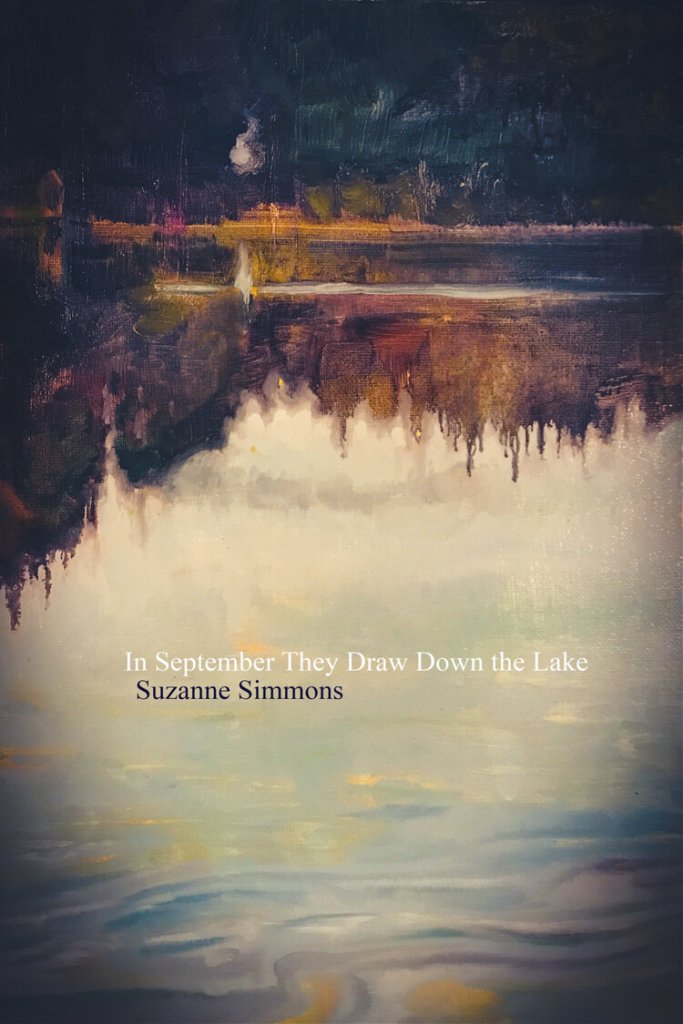
In September They Draw Down The Lake, by Suzanne Simmons
Review by Bill Rector
I do not know Suzanne Simmons, except by way of her chapbook, In September They Draw Down The Lake (Alexandria Quarterly Press, 2020). This is fitting, as her work derives its tension from the distance, emotional, physical, and temporal, that exists between herself and others.
The second poem in the book, “Commute,” concludes:
The train streaking beside us blows its whistle, years ago. We’re almost there.
Are we? The last poem in the collection is the echo she hears in the “shivery tunnels” of loons’ cries:
They cut through my dreams. Wake me. Do you hear them? You on your shore?
The book is divided into three, untitled sections. The initial section focuses on loss and its constant companion, regret. The first loss is that of her mother, who had a glass eye, in which the author sees herself disappear. In “Self Portrait,” she writes:
I fell out of you and rolled
Then, the loss of a lover/husband:
(I don’t miss you.) I miss air. (I don’t miss you.)
The second section is about her third loss, which is that of her son, who has autism. “Nursery rhyme” concludes with this wrenching sequence:
Normal health baby
At six, he asked Mommy, please kill me. Smeared feces on the dinosaur wallpaper. Came at me with teeth and eyes wild, clawing.
Rocking, rocking, rocking.
A later poem, “Coded” shows a family torn apart. The poem begins during a parent-teacher conference, in which the poet is sitting in a child-sized chair, and ends:
My husband begins crawling for the door. Seventeen years pass. I’m sitting in a child-sized chair. I’m about to speak.
The heroine of the third section of the book is the lake near which the poet lived and perhaps still does.
It was sweet when you held me up. Sweeter still when I dove to your bottom. Thanks for lapping and churning and the mornings when you lay under the mist silent. I was furious every winter when you froze.
One might expect the body of water to express, through the many forms available to metaphor, a form of reconciliation.
Not so. Here in “Long Night,” is this:
Cold stuns the lake onto glass. Portal moon.
[ … ] Hunger Moon, and one called crust.
This is the moon of the unfuckable. Between my boots and the rutted earth, a skin of ice breaks.
This book is skillfully written and worth reading for that reason alone. Its actively beating and, at times, raw and raging heart, is representative of our times.
Editor’s note: There is an introduction to In September They Draw Down the Lake, written by Ilya Kaminsky, author of Deaf Republic, which concludes with these words: “In a time of so much crisis, what a pleasure to read this kind, loving, beautiful work.”
Suzanne Simmons’ poems, essays and photographs have been published in the NYTimes, Fifth Wednesday, Rattle, Smartish Pace, The Baltimore Review and numerous other journals. Her chapbook In September They Draw Down the Lake was released by Alexandria Quarterly Press in 2020. Visit her at www.suzannesimmons.net.
Bill Rector is a retired physician. He formerly edited the Yale Journal of Humanities in Medicine. His publishing credits include a full-length poetry collection entitled, bill, through Proem Press, and five chapbooks: Lost Moth, about the death of his daughter, which won the Epiphany magazine chapbook competition; Biography of a Name (Unsolicited Press), relating the death of Jimmy Hoffa to contemporary American culture; Brief Candle (Prolific Press), a series of sonnets in modern idiom about selected characters from Shakespeare; Two Worlds (White Knuckle Press), relating the transcendent to the ordinary, which the editors called one of the most beautiful collections they have published; and most recently, Hats are the Enemy of Poetry (Finishing Line Press).
Elijah B Pringle, III, Artivist. A former Training Specialist and Director of Training, currently on sabbatical, is focusing his time on writing and editing. He is an advisor for Moonstone Art Center and a poetry editor for ToHo Journal. Elijah has appeared on Stage, Radio and TV and was one of the hosts for Who Do You Love? a talk show on PhillyCam created by Warren Longmire to discuss writers. He has been published both nationally and internationally. Elijah comes from a strong tradition of educators and has facilitated numerous workshops. He is finishing pre-production work on his play “Should Be …”
I’ll start with a disclosure: Lauren Davis and I are friends and often share our poetry with one another. The first review at the Café was my review of Davis’s chapbook, Each Wild Thing’s Consent, and Lauren has been a guest reviewer on this site. In The Poetry Café Guidelines For Reviewers, I say,
I am not at all reluctant to publish reviews of books from poets known to the reviewer, as long as the review is credible.
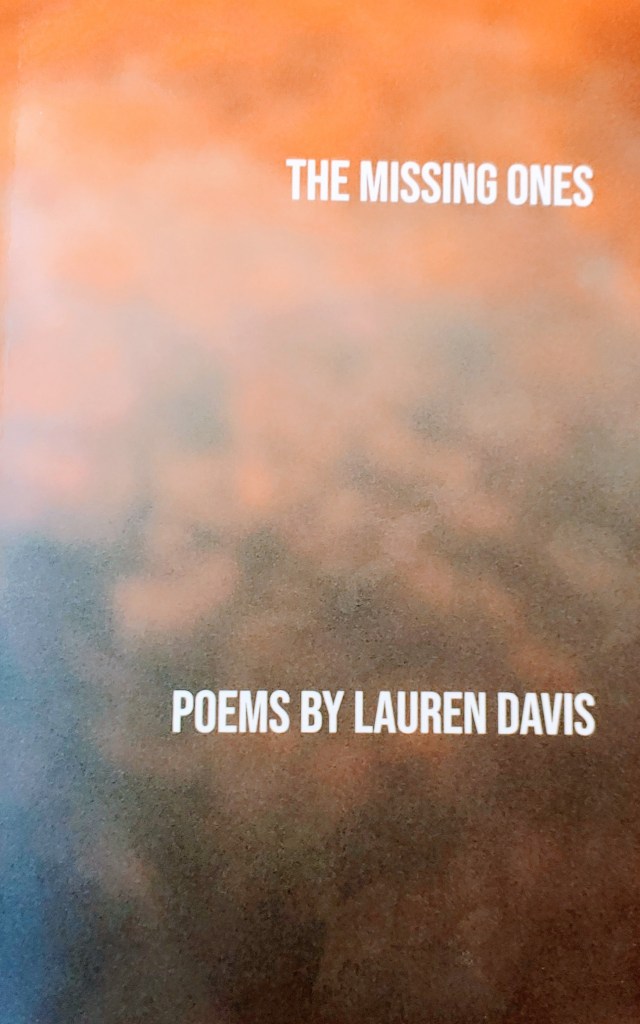
Reader, I promise, credibly, that I am besotted with The Missing Ones, and would urge you to order one of the limited press run of 40 copies, if any were still available. But it appears they are all gone. Befitting the poems, they have disappeared.
The Missing Ones (Winter texts, Limited edition, 2021) by Lauren Davis,is a tour de force narrative of persons lost at sea. More specifically persons lost in the glacial-fed, crystal-clear body of Lake Crescent, a lake which reaches a maximum depth of over 1000 feet, is algae-free due to the water’s nitrogen content, and has an average temperature of 44 degrees. Davis’s interest in the stories of these lost lives is also compelling to me as we both live on the Olympic Peninsula, near this iconic lake. Davis’s poetry is equally enthralling, and a remarkable lyrical match for the story she tells in these poems.
In the book’s preface the reader learns,
On July 3, 1929, Russell Warren picked up his wife, Blanch … They drove U.S. Route 101 along Lake Crescent towards their home in Port Angeles, Washington. They’d promised to celebrate the Fourth of July with their sons. But the couple did not arrive home. The two boys never saw their parents again.
In the poem, “Seven Thousand Years Ago,” the story’s history opens,
The earthquake cut a drowned country xxxxx for us to rest. In these depths, God laid out a marriage bed.
The first poem in the book, “Blanch Says,” starts with the line, “There are dangers / in deep waters no one / speaks of.” The enormity and terror of nature as it unfolded and continues to evolve on the Olympic Peninsula is rendered skillfully in these lines. As humans struggle to stay relevant on mother earth, nature plods on, on her own course. In “The Missing Ones,” Blanch is an iconic symbol of that struggle when her voice says,
There is a stain on the rock unfolding. I drink the lake,
All of it. I make it mine.
And in “What Makes the Lake So Thirsty,” the plot thickens,
We are not the only mislaid ones. They rest at separate depths. // We are the republic of secrets and missing person cases. I wore my least favorite dress to our death. The lake floor is a reversed sky,
And yet, there is a life in the depths, and in “Things That are Pleasing,” Blanch’s voice lists some of them,
Beardslee trout dancing. A rainstorm I hear but cannot feel. The small of winter in hidden splits. My husband’s eyes in the depths.
Now I must tell you something about Beardslee trout: they are a species of rainbow trout that are endemic to and live only in Lake Crescent. If this piques your interest, read more at The Native Fish Society. It is this detail, among others gleaned from the long history of the lake, that deepen the emotional resonance of these poems.
Blanch also has her complaints. In “Things that Irritate,” she lists some of them:
Candy wrappers that float into my bedroom. Friends who do not say goodbye after they are found. Long weeks without rain. Divers that swim past my outstretched hand.
And there are also “Rare Things,”
Minutes that I do not miss my sons. Green herons. Decades without new bodies.
Blanch’s voice tells her story in “I’ll Tell you What Happened,” a narrative of drowning that is precise and terrifying, and yet redemptive at the same time.
This is how it feels to drown: You’ll try not to inhale, but you will.
Water will fill the lungs. When your beloved drifts by you will be unable to reach your hands to him. Just try to move a single muscle. Your eyes will
stay open. Your husband has something to tell you— you can sense it in the cold. Wait until you are both done drowning. Then build a new home.
The details here are stunning, make me want to believe in this afterlife of the drowned dead. I grieve for Blanch and the others when she says, in “When the Lady of the Lake Comes to Stay,”
Russell, we have a visitor and nothing to offer— no cake, no coffee.
Let us share our home with its many rooms of water.
These poems are not at all sentimental. I am not a sentimental person. And yet, even at the fifth reading of them, I have cried.
Why would I review a book that is currently out of print? In part because I want you to remember the name of the poet. Lauren Davis. The poet has other books for you to buy and you will find her poems on the internet in many places. You will be hearing more from her, I promise. And, as the first printing sold out, hopefully, a second printing won’t be far behind, so that you can have your own copy!
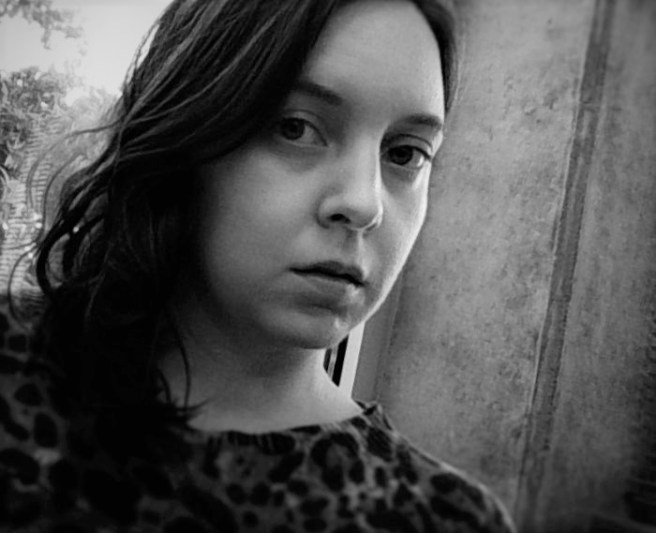
Lauren Davis is the author of Home Beneath the Church (Fernwood Press, forthcoming), and the chapbooks Each Wild Thing’s Consent (Poetry Wolf Press, 2018), and The Missing Ones (Winter texts, 2021). She holds an MFA from the Bennington College Writing Seminars, and she teaches at The Writers’ Workshoppe and Imprint Books. She is a former Editor in Residence at The Puritan’s Town Crier and has been awarded a residency at Hypatia-in-the-Woods. Davis lives on the Olympic Peninsula in a Victorian seaport community. Her work has appeared in over fifty literary publications and anthologies including Prairie Schooner, Spillway, Poet Lore, Ibbetson Street, Ninth Letter and elsewhere.
Title: The Missing Ones Author: Lauren Davis Publisher: Winter texts (first edition, limited run)
Diane Elayne Dees’s poetry has been published in many journals and anthologies. Diane is the author of the chapbook, Coronary Truth (Kelsay Books) and the forthcoming chapbook, I Can’t Recall Exactly When I Died. Diane, who lives in Covington, Louisiana, also publishes Women Who Serve, a blog that delivers news and commentary on women’s professional tennis throughout the world. Her author blog is Diane Elayne Dees: Poet and Writer-at-Large.
Sister poet Trish Hopkinson sent me a PDF of her very tiny chapbook (called a microchap), Reconstructed Happiness (Origami Poems Project, 2020). You know Trish from her Daily Digest posts that arrive in your inbox, chock-full of information vital to poets; and if you don’t, you should the join the other 16,000 people who do.
I want to tell you about Trish’s book, but first I have to give a shout-out to the Origami Poems Project, whose motto is: Helping the world, one Free microchap at a time!.
The project was established in 2009 and seeks to publish free e-versions of microchap books that you self-assemble, using origami technique. This is brilliant. Learn to fold! (Another motto of this group.) At the website you’ll find this explanation: A microchap presents poems on a single sheet of paper. The paper folds origami-style into palm-sized booklets containing 6 pages of text. Below is a view of the folded microchap printed on Landscape setting:
These little books are designed and published in PDF form, with full-color covers, and with folding directions included. Submissions are free through Submittable, and will re-open in September. They graciously accept donations to keep the “always free” spirit alive.
Back to Trish Hopkinson’s microchap, with the sheepish admission that I didn’t fold it correctly, but I loved it anyway. Reconstructed Happinessenfolds three poems. In “My Matter,” the word matter is bisected into its concrete meaning (as in, “anything that has mass and volume”) and its use in the abstract-concrete sense (bear with me here) of to be relevant or important, sometimes referred to as “material.” The poem reaches for the concept of “we are stardust,” in many forms: dust, pollen, “a dove’s blurred wing,” or dirt “caked beneath toenails.” It ends with string theory:
Pressure peels threads from my skin, unravels
Into streams of floating string.
The title poem is an “erasure in reverse of Ferlinghetti’s “I Am Waiting.”” It is an anaphora of “I am’s” that includes “I am my typewriter” (of course), along with “I am anarchy.”
The final poem in this series is “Offspring.” I read it as an ode, but it may be interpreted in a number of ways, as a good poem often can be. These lines drew me in,
My tendrils pull me taut tether me heavy to the dirt
where I can’t pull free from root or worm.
You can download Trish’s microchap (and many others) and try your hand at origami. If you decide to submit your work, read their instructions carefully first. Not every chapbook earns the right to be a microchap!
Trish Hopkinson is a poet, blogger, and advocate for the literary arts. You can find her online at SelfishPoet.com and provisionally in Utah, where she runs the regional poetry group Rock Canyon Poets and folds poems to fill Poemball machines for Provo Poetry. Her poetry has been published in several lit mags and journals, including Tinderbox, Glass Poetry Press, and The Penn Review; her third chapbook Footnote was published by Lithic Press in 2017, and her most recent e-chapbook Almost Famous was published by Yavanika Press in 2019. Hopkinson will happily answer to labels such as atheist, feminist, and empty nester; and enjoys traveling, live music, and craft beer.













 The Poetry Cafe