Qasida for When I Became a Woman

Qasida for When I Became a Woman, by Huma Sheikh

Published by Finishing Line Press, 2026
Reviewed by Kubra Nazir

Our Homeland, Kashmir, has a peculiarity about silences. Tales and tragedies rarely culminate there; they return in memories, in flashbacks, in whispers. Among those screaming silences, I once heard the story that lies at the heart of Huma Sheikh’s life, the loss of her father, the tragedy that shaped her becoming. While I was reading Qasida for When I Became a Woman, it felt like stepping into a realm where long-kept silences resurrected as an elegy of endurance. The poems, like a phoenix, emerge from the crevices of memory, transforming grief into poetry and memory into resistance.

As a fellow Kashmiri, I understood how she carried that ache all these years— an ache of a homeland that teaches its daughters to speak through absence. She doesn’t mourn alone, rather she crafts word by word what the past tried to blanket. Qasida, a classical Arabic poetic form of praise or elegy, has been turned into an instrument of invocation here, an unburdening where womanhood emerges through memory and silence.

The title of the poetry collection suggests a transformation of what it means to be a woman, and a reclamation against the silencing of women’s voices. It shows what it truly means to inherit both language and silence.

Each line is layered with so much depth and feels like a threshold between the personal and the collective. It reminded me of how writing poetry becomes the very act of witness not only of suffering but of survival. In the poem, “For Kashmiris, war an everyday meal,” she writes,

How to rebuild
a sense of refuge when hope beans spill and death blooms
for the kin of the slain, memories of dear ones, the
endless crackle of a flesh storm?

In Sheikh’s hands, the Qasida becomes an instrument of dialogue between what was taken and what refuses to be silenced. Throughout the poems, she goes back and forth to that memory of her father that changed the entire course of her life. She remembers her father, not as a figure lost to time but as a presence that still inhabits her silences. Her father, a renowned singer of Kashmir, somehow lives in the cadence of her lines as she pays tribute to him and his memories, echoing his songs through the collection like refrains. In the poem, “Qasida for a woman on a train,” she writes,

A Brooklyn subway’s screech like Father’s last Ghazal
Kam yaar sapidh khwaab jammed into a cassette
recorder.

Throughout the poetry collection, the past peeks into the present, drifting between temporal planes; moments of childhood arise in her present voice, showing how a woman’s silence is the loudest cry. The inheritance of silence is portrayed as imagery that fuses the domestic with the divine. Sheikh’s silence becomes a prayer; her body becomes a landscape of remembrance. Each line is an instrument of reclamation, showing the way for women to respond. Every word feels earned and every pause deliberate.

As I read through the poems, I could sense a quiet ache in the depths of each line. Her poems are a reminder of how survival sometimes lives quietly in long-kept silences. These poems are more of a collective elegy, a shared act of remembrance, where one woman is speaking on behalf of a those who are still in the journey to find a voice.

In this quiet act of gathering sorrows of many, the solitary transforms into a wound others can feel too. A gathering of voices of those who have endured, remembered, and kept speaking even when the world turned away.


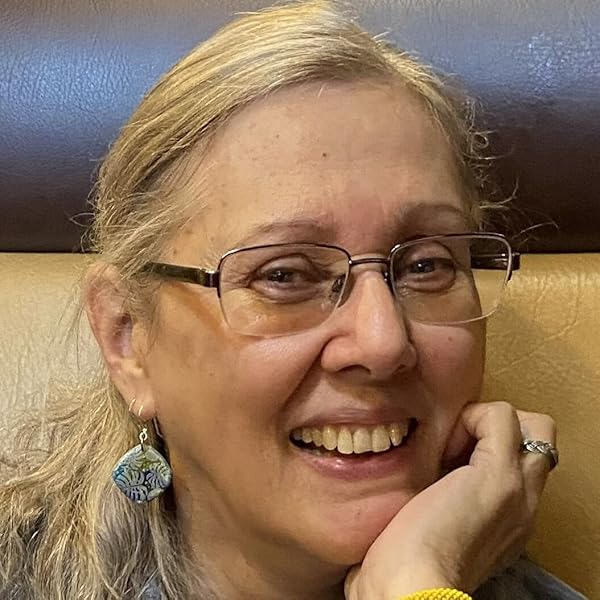
Huma Sheikh is an author, poet, and scholar. Drawing from her Kashmiri roots, her work blends personal narrative with political history. Her writing has appeared in Kenyon Review, The Journal, Consequence Magazine, Cincinnati Review, and Prism International, among others. A finalist for multiple literary prizes, she holds a PhD in English (Creative Nonfiction) and teaches writing at George Mason University. Her poetry chapbook, Qasida for When I Became a Woman, was a finalist for the New Women’s Voices Chapbook Competition (Finishing Line Press) and shortlisted for the Own Voices Chapbook Prize by Radix Media.


Qasida for When I Became a Woman, by Huma Sheikh
Forthcoming from Finishing Line press in January 2026

Price: $17.99


Kubra Nazir, a seeker of stories, has completed her Bachelor’s and Master’s in English Language and Literature from Kashmir University. Her work across corporate and teaching spaces has enriched the clarity with which she reads and writes. She has taught English Literature at the postgraduate level and contributed to research and editorial projects. In addition, leading a team of creative writers, gave her the fulfilling experience of guiding a diverse group of writers from across the world. Rooted in Kashmir and deeply in love with writing, she dreams of crafting a book someday—one that carries her voice, her memories, and the stories that have shaped her.


Risa Denenberg is the curator at The Poetry Cafe Online.

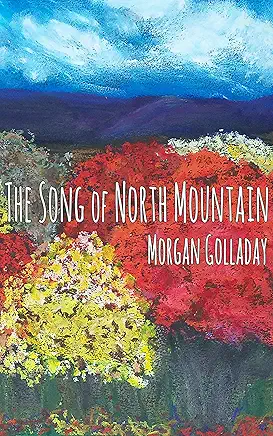
Song of North Mountain

Song of North Mountain by Morgan Golladay
Published by Old Scratch Press, 2024
Reviewed by Nadja Maril

Writers begin their journey towards publication at very different times in their lives, some in high school, others after retirement. Is there a right time to begin sharing one’s poems with the world? Perhaps the answer can be found in the quality of a writer’s first poetry collection.

The Song of North Mountain, a debut chapbook by Morgan Golladay, demonstrates the combination of wisdom and excitement of a new guest at the literary dinner table. Golladay takes us on a journey through seasons and times of her childhood home in Virginia, located between the Blue Ridge and North Mountains in the Shenandoah Valley.  Golladay’s poems transport us to the foothills of Appalachia, a region that is rapidly changing as our planet warms.  Her poems capture the stark beauty and breathtaking colors of the valleys, meadows, rivers, and ridges, as seen in the poem “Spring on the Mountainside.”

Out on the Devil’s Throne
careful briars show green,
warming, like me, in the heat of the sun. Redbuds languish,
eagerly waiting to erupt,
to be first, to show true color
to this mountain.
I trust in their uncompromising cycles, that spring follows winter
as night follows day.
The redbuds beckon me up the mountain.

Black and white images found throughout the book are original drawings by Golladay, who began the formal study of art in her fifties, preceding her launch as a poet. Expressing oneself in more than one art form is not unusual for poets; her work makes me think immediately of William Blake who so skillfully combined art and poetry in his nature-focused work. 

Recently, I had the opportunity to interview Golladay who expressed great enthusiasm for trying new artistic practices. She described an experiment she conducted ten years ago with a friend she met in an acrylics workshop.  Both artists had completed seventy-five black and white sketches in seventy-five days and they challenged each other to add poetry to those sketches. Golladay said she decided to combine the two art forms to learn whether the sketch informed the poem or vice versa. “Black and white sketches require a lot of different elements to be effective,” she explained. “Think of the illustrations of Rockwell Kent, the engravings of Durer, sketches of Michelangelo, Picasso, Mayer. For me, it was a steep learning curve.”

The Song of North Mountain is divided into four sections each aligned with one of the four elements: Fire, Air, Water, and Earth. In the fifth century BC, the Greek philosopher Empedocles proposed that the opposing forces of love and conflict upon these four elements create the diversity found in nature. Golladay has chosen these elements as the structure for her poems, highlighting these opposing forces rather than the seasons, which are more typical in nature poetry. Here, the cycle begins with Fire where most of the poems have a connection to light, brightness, and sometimes drought. This section is followed by Air, Water, and Earth.

The home of her ancestors, Golladay’s North Mountain is rich with history and memories. Many of the poems are informed by the changes wrought by time and aging. This poem, found in the Earth section and titled “Family Lines,” begins:

The lots are overgrown with weeds, brambles, saplings jutting through loose stones
that mark lost foundations.
Someone once lived here.

Someone planted those surviving daffodils, that stray lilac.

Sunday dinners, visitations, funerals,
jam-making, weddings, and scrubbed floors celebrated the families that lived here.
(Their footprints are found
when the yard is tidier.)
But the rubble remembers the sweat and the labor, the daffodils recall the hands that planted them.

“Under the Locusts,” found in the Air section, zeroes in on a particular farm. The sense of loss and resignation in this poem is poignant as it documents how the land changes as small farms begin to disappear.

Long after the farm was abandoned,
the evidence of thousands of hoof-falls showed among the locusts. Roots
stood stark and barren, surrounding dirt worn and blown away. Strange shapes, mystical and druidic in their formation,
reared from the dirt, submerging, reappearing several feet away.

There are many poems here about animals, some include humans as well. The poem, “Little Swimmer,” found in the Water section, portrays a venomous snake; another poem in this section is about a stodgy turtle. In our world of cellphones, computers, fast moving cars, and technologies that link global industries and people within seconds, I enjoyed the opportunity to retreat to basic relationships between a harmless reptile and a human.  The poem, “A Moment of Grace,” is one of my favorites. It ends with the lines:

We spoke in silence,
thanking each other for dappled sunlight, ripe berries, and a moment of grace.

When writing about the loss of her own ability to climb a tree or the cutback of train service to the region, Golladay accepts her changing world with pensive resignation. She more often focuses on wonders that still exist and can still be found if you closely watch, smell, touch, and listen. Song of North Mountain conveys the rhythm of place that is clearly close to the poet’s heart, a sense she ably shares with her readers.


Artist and poet Morgan Golladay’s first published poem was awarded Third Prize in the 2021 Delaware Press Association Communications Contest. Much of her work is reminiscent of her native Shenandoah Valley, its people and places. A graduate of the University of Mary Washington, Golladay’s career included almost 40 years as a volunteer and staff member for several non-profit organizations. In 2024, the Delaware Press Association awarded her the first and second prize for short stories and an honorable mention for poetry. Her first book of poetry, The Song of North Mountain, is a National Book Award nominee. Golladay currently resides in Milford, Delaware. She is tall, left-handed, and blue of eye. Everything else is subject to change.

The Song of North Mountain
Morgan Golladay
Published by Old Scratch Press, 2024


Nadja Maril’s chapbook Recipes from My Garden, a compendium of poems and short essays centered around herbs, a kitchen garden, and family memories, was published by Old Scratch Press, in September (2024). Maril’s prose and poetry has been published in literary magazines that include, Lunch Ticket, Spry Literary Review and Across the Margin. A former journalist and editor, Nadja has an MFA from Stonecoast at the University of Southern Maine. To read more of her work and follow her weekly blog posts, visit https://nadjamaril.com/


Risa Denenberg is the curator at The Poetry Cafe Online.
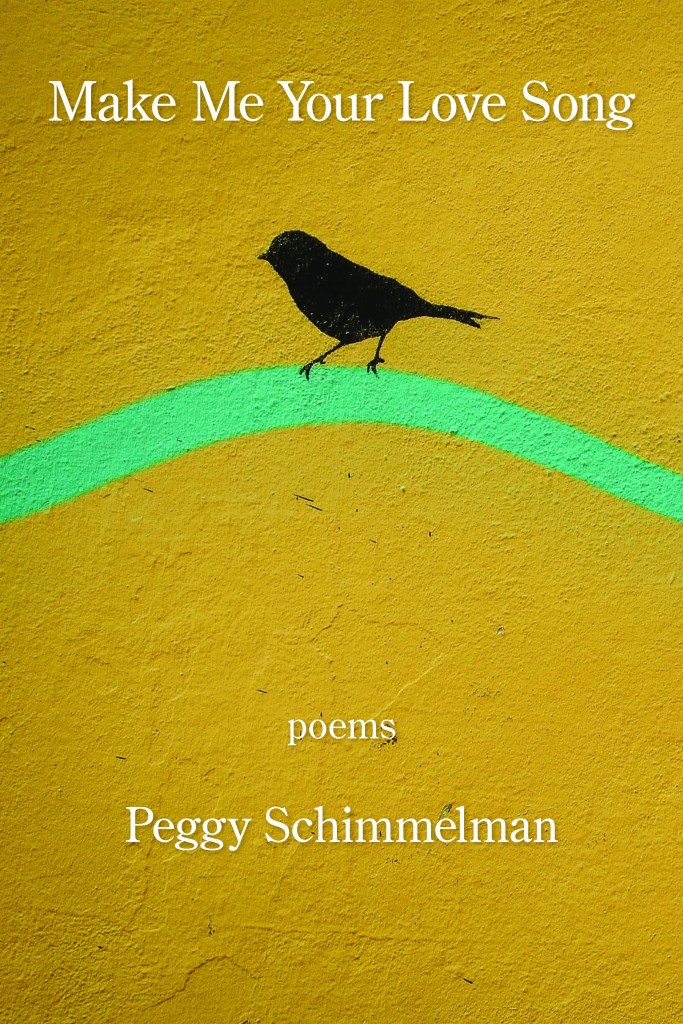
Make Me Your Love Song

by Peggy Schimmelman
Published by Kelsay Books
Review by Julie Orvis

I have been a fan of Peggy Schimmelman’s poetry since we took a writing class together many years ago. I have loved and followed her work as she has grown as a poet and has become the local poet laureate of Livermore, CA.

Peggy Schimmelman’s chapbook, Make Me Your Love Song, is a collection of finely crafted poems that offer impactful reflections on life. Peggy’s work shows intelligence, depth, and accessibility in each poem, exploring the range of human emotions from loss and regret to the joy of living and loving deeply. These poems bear witness to the fact that love is about being human: sometimes romantic, sometimes two people simply connecting, sometimes enduring, other times fleeting. Peggy’s employment of language, line breaks, musicality, and the use of white space are consistently elegant. What I love most about the poems is the feeling that they are paying tribute to that which is human in all of us.

The poem, “Cozumel Moon” captures memories of youth:

… in one of those memories, I wonder, a girl
green-eyed and wild, just this side of crazy
Corona-tipsy and starlight-stoned.

“The Last Lullaby” explores the political realities of our time:

Selam and Adonay, hush now and sleep.
Boat man don’t like it when little ones weep.
Ahead, Europe waits to shelter and feed us—
to welcome us. Children, now listen to me

“Push Through the Night” is a story of facing challenges:

Soon dawn will arrive
in a river of light.
Float into the morning.
Push through this night.

“A Poem in Three” is a romantic ditty that starts with the book’s title:

Make me your love song
in three-quarter time
conjure me, count me in
one-two-three-one-two-three
whisper me whistle me
dance me romance me
woo me infuse me
with rhythm and rhyme.


Peggy Schimmelman is the poet laureate of Livermore, CA. Her work includes the poetry chapbooks Make Me Your Love Song, Crazytown, and Tick-Tock, as well as the novels Insomniacs, Inc. and Whippoorwills. Her poetry and short fiction, heavily influenced by her musical interests and her Ozark roots, have appeared in the North American ReviewNaugatuck River Review, Peregrine, WinningWriters.com, the Aleola Journal of Poetry and Art, Pacific Review, Comstock Review, Wild Musette, 100wordstories.organd other journals and anthologies.


Available at Kelsay Books Website and Amazon.com
Kelsay Books (August 16, 2024) ‎ 68 pages
ISBN-13 ‏ : ‎ 978-1639806126
$20.00


Reviewer Julie Orvis says: “While I have many interests in life, reading and writing have been favorites. I belong to a local writing group, Wild Vine Writers, and have enjoyed writing and contributing to their publications Long Stories Short and Two Truths and a Lie. I’ve also received award recognition for short prose pieces at Pleasanton Poetry and Prose.”

Risa Denenberg is the curator at The Poetry Cafe Online.
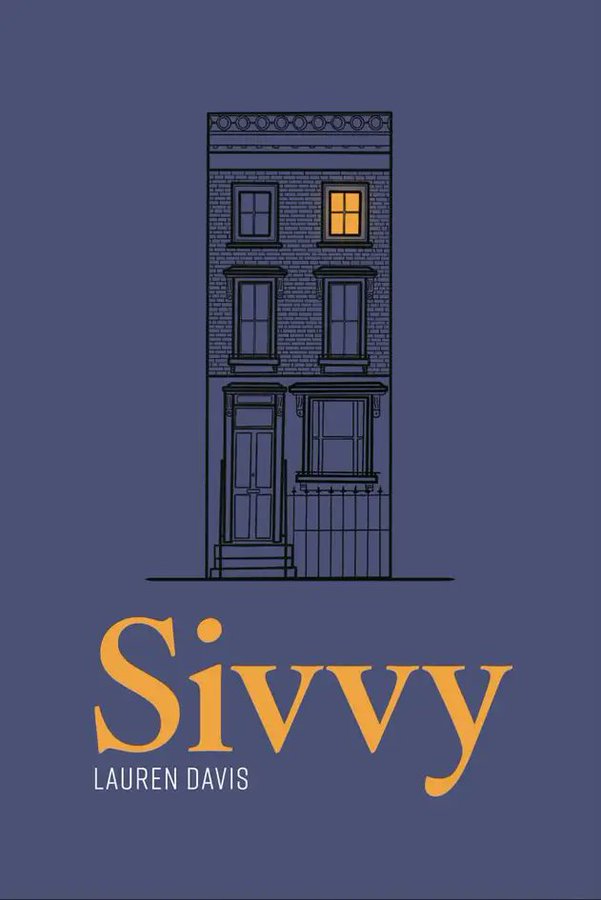
SIVVY

Sivvy, by Lauren Davis
Published by Whittle Micro-Press

Review by Risa Denenberg

In her newly released and vividly imagined chapbook, Sivvy, Lauren Davis interrogates Sylvia Plath’s state of mind in the days leading up to her death by suicide in 1963 (with footnotes to 1940 and 1956) by distilling letters she wrote into anagrams of her deepest feelings through erasures. In her note on the text Davis says, “These are erasures of the letters of Sylvia Plath” to which “I have not altered her word order.” Her sources are the two volumes of “The Letters of Sylvia Plath,” published posthumously in 2017 and 2018. This small volume is that rare combination of both the scholarly and the dazzlingly innovative.

Sylvia Plath is and will continue to be a touchstone for so many. I entered her work, and her inescapable and tragic life story as a poet and feminist, but also as a mother. In my case, as a mother who lost custody of her son when he was six. Naturally, I’ve always viewed Plath’s work as a poet who was also a mother.

In fact, Plath has a lot to say about being a being a mother, in both poems and prose. In her poem, “Morning Song,” she describes her newborn as a “fat gold watch” while comparing herself to a biologic function.

One cry, and I stumble from bed, cow-heavy and floral
In my Victorian nightgown.
Your mouth opens clean as a cat’s.
–from “Morning Song” Sylvia Plath

This image is echoed in a letter dated February 4, 1964 in Davis’s Sivvy: “The upheaval—I see the finality, / From cowlike happiness into loneliness.” Could I help thinking of how new mothers so often feel abjectly alone following childbirth?

Another of Plath’s poems points to a newly post-partum mother’s dilemma at the moment of accepting or renouncing responsibility for another human being.

I wasn’t ready. The white clouds rearing
Aside were dragging me in four directions.
I wasn’t ready.
I had no reverence.
I thought I could deny the consequence–
But it was too late for that. It was too late, and the face
Went on shaping itself with love, as if I was ready.
from “Three Women,” Sylvia Plath

In her auto-fictional novel, The Bell Jar, Plath describes a college-aged girl who makes a suicide attempt. The protagonist recognizes that her ambitions and dreams will be constrained by the cultural expectations that always seem to privilege marriage and motherhood over career and creativity. There is still strong societal pressure on women to have children, despite the lack of support for raising them or the cost to a woman’s personal goals for herself.

“I saw my life branching out before me like the green fig-tree in the story. From the tip of every branch, like a fat purple fig, a wonderful future beckoned and winked. One fig was a husband and a happy home and children, and another fig was a famous poet and another fig was a brilliant professor. … I saw myself sitting in the crotch of this fig-tree, starving to death, just because I couldn’t make up my mind which of the figs I would choose. I wanted each and every one of them, but choosing one meant losing all the rest.” –-The Bell Jar, Sylvia Plath

Having to choose—or more often, having no choice—between raising children and having a fulfilling career is a quandary faced by many women. Was Plath uncertain if she wanted children at all, knowing it would be at the cost of her writing life? It might seem unfair to question her motives or desires; but such questioning is quite familiar to women, if not always voiced. It seems clear, however, that being a single mother with two young children was an enormous challenge for her. For me, this broadens the too-easy interpretation that Plath committed suicide due to mental illness.

In a letter dated, February 4, 1963, Davis allows Plath (whose death occurred seven days later) to give a nod to her earlier suicide attempt (“I fought my way back—”) in a conflagration of language that perfectly reflects the undoing of Plath’s enormously rich inner life.

I fought my way back—
I wanted to get it over with—God is a wish—
maybe—I would go—I have been alone
I need a tonic—I am dying.

I’m using my entry point into Plath’s work, as well as my entry point into Davis’ Sivvy, to acknowledge how thoroughly and intimately Plath enters the imagination of her readers. One of many ways that Davis expands my way of knowing Plath is how entirely in love she was with Ted Hughes from the beginning (“I can’t be with people // that aren’t you.” … “I don’t want to eat until I taste / your mouth again.” Dated October 1, 1956) to the end (“My husband— // he is beautiful. / The whole world // now has him.” Dated January 22, 1963).

I highly recommend this book to you, reader, that you may enter Plath again and anew.


Lauren Davis is the author of the forthcoming short story collection The Nothing (YesYes Books), the poetry collection Home Beneath the Church (Fernwood Press), the Eric Hoffer Grand Prize short-listed When I Drowned (Kelsay Books), and the chapbooks Each Wild Thing’s Consent (Poetry Wolf Press), The Missing Ones (Winter Texts), and Sivvy (Whittle Micro-Press). She holds an MFA from the Bennington College Writing Seminars. She is a former Editor in Residence at The Puritan’s Town Crier, and she is the winner of the Landing Zone Magazine’s Flash Fiction Contest. Her stories, essays, poetry, interviews, and reviews have appeared in numerous literary publications and anthologies including Prairie SchoonerSpillwayPoet LoreIbbetson Street, Ninth Letter and elsewhere. Davis lives with her husband and two black cats on the Olympic Peninsula in a Victorian seaport community.

Sivvy by Lauren Davis
Published June 2024
PDF Micro-chapbook

Risa Denenberg lives on the Olympic peninsula in Washington state where she works as a nurse practitioner. She is a co-founder of Headmistress Press and curator at The Poetry Café Online. She has published eight collections of poetry, most recently, Rain/Dweller (MoonPath Press, 2023). She is currently working on a memoir-in-progress: Mother, Interrupted.


Taking Leave

Taking Leave by Mary Ellen Talley (Kelsay Books, 2024)
Review by Sylvia Byrne Pollack


I have appreciated Mary Ellen Talley’s poetry since I reviewed her first chapbook, the memoir Postcards from the Lilac City, for The Poetry Café in 2021. Her new chapbook, Taking Leave, is a never-maudlin farewell to her older sister Katherine. This collection—also a memoir—shimmers with two fundamental facets of being human: familial love and death. Yet there is humor and joy in these poems. A variety of forms (villanelle, haibun, palindrome, golden shovel, list), internal rhyme, and unconventional word usage are employed in a fearless and compassionate celebration of the lives of her family members. Talley does not avoid the word death or the circumstances surrounding it.

We first meet Katherine in “You Are From,” an overview of Katherine’s life that concludes with the declaration “You are leaving vital signs.” More details of Katherine’s life flesh out the “Interview.” The spareness of that title contrasts with vivid details as we move back in time from 2023, her final year, to 1937, when she was a fetus in her girdle-wearing Mom. “Call it the cramped circle of my early start.”

This is neither a saccharine nor sentimental description of the relationship between these sisters, twelve years apart in age. “Villanelle to De-Escalate” begins with “affection and grace” but devolves into a question: “Will family ties find harmony that discord can’t erase?”

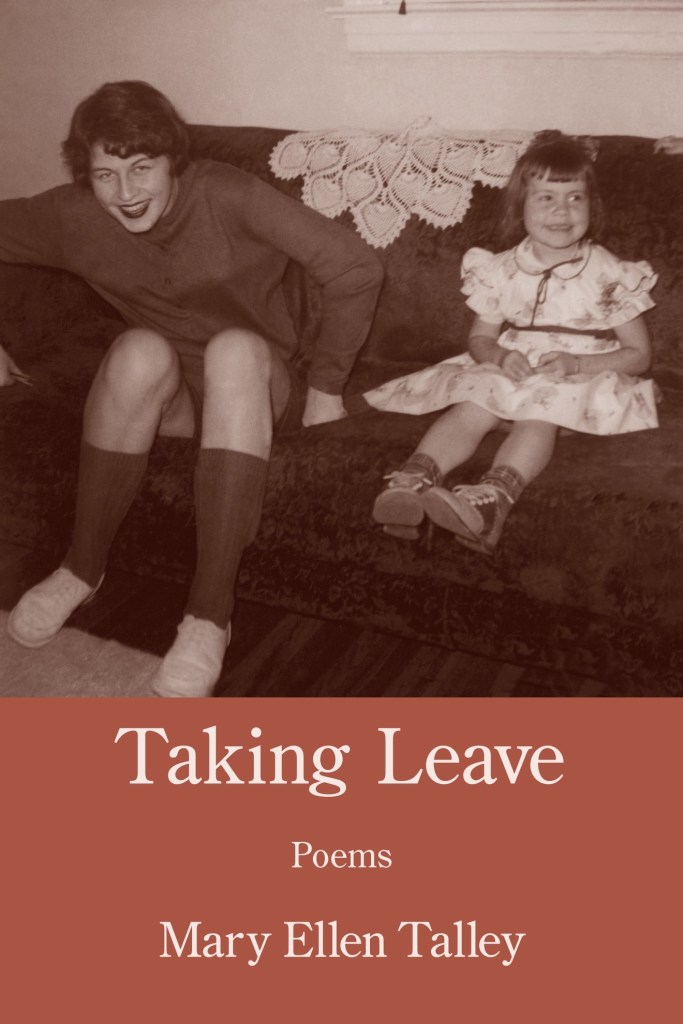
The cover deserves a special mention–a photo of teen-aged, lipstick-wearing Katherine poised to leap up from a sofa where four-year-old Mary Ellen is perched in a frilly dress. The clothes, the embroidered doily on the sofa back, the girls’ faces capture both bygone days and a lasting vibrancy.

The twelve-year age difference may have meant “We Had Two Different Mothers,” but many shared experiences thread through the poems. In “Glitz,” the sisters agree “we’re like our mother. // This hoarding of desire, this preoccupation with enough.”

In “Ghazal: Unbuckled Shoes” we see an older Katherine whose arthritis prevents her from buckling her shoes and the kindnesses that get those shoes buckled and unbuckled for her. After reading these poems, I think I also would have been glad to give Katherine a hand.

The focus segues from Katherine to her daughter Erin in a series of funny, irreverent, and witty poems dealing with Erin’s cancer diagnosis. From “Erin in Walking Wallenda Mode” to Erin letting her cancer know what she thinks about it in “Texting Cancer” to Athena holding the morphine drip in “Legend of the Fates,” we experience Erin as a feisty, laughter-filled woman. Which makes her death in “Messenger Under Arizona Moon” even more poignant. In the sorrow of a mother–Katherine–losing an adult daughter, Talley deals with her death with a deft hand.

A poem with a 24-word title that starts with “One Billion Years Ago . . .” salutes the magma that cooled to form a dome and the poets own “chilled ears and fears,” namely: feldspar, fairy shrimp, and her sister’s “oxygen tether,” in a sweeping paean. The penultimate line, “Oh, the raindrops on my face.”, evokes both the natural world and tears of grief.

A poem I return to again and again is “Stairway to Hospice Heaven.” It captures so much about the sisters’ relationship while looking unflinchingly at death. It begins and ends with phone calls:

My sister calls to ask if I know about the flight arrangements
her son has made, how she tried to call him but his phone
went to message. She needs to know how she’ll get to the airport,
and whether to bring more than a carry-on bag.

In a few minutes I realize she’s confusing flight time
with when she’ll depart this earth – logic blurred by morphine.


 What follows in an interplay of Talley’s everyday life with husband and grandkids and asking Katherine if she is afraid of dying. “Well of course, I am. Wouldn’t you be?” In a second phone call Talley reassures Katherine that she’s headed to heaven. A third call is almost not answered – Talley is busy – but she picks up:

I answer to hear Katherine thank me for our prior conversation.
And say a quick good night as I stand gobsmacked
by the generosity of the dying.

I invite you to be gobsmacked by this bighearted, moving collection. 


Mary Ellen Talley has published poems in numerous journals and anthologies. Finishing Line Press published her first chapbook, “Postcards from the Lilac City,” (2020) and Kelsay Books published her second chapbook, “Taking Leave,” (2024). She spent many years working with words and children as a speech-language pathologist (SLP) in Washington state public schools and now devotes herself to poetry endeavors. Visit her website at maryellentalley.com.


Available at https://kelsaybooks.com/products/taking-leave https://open-books-a-poem-emporium.myshopify.com/products/talley-mary-ellen-taking-leapb


Sylvia Byrne Pollack, a hard-of-hearing poet and retired scientist, has published in Floating Bridge ReviewQuartet, Crab Creek Review, The Stillwater Review and other print and online journals. A two-time Pushcart nominee, she won the 2013 Mason’s Road Literary Award, was a 2019 Jack Straw Writer, and a 2021 Mineral School Resident. Both her debut full-length collection Risking It (2021) and her new collection, What Lasts (2023) were published by Red Mountain Press. Visit her at www.sylviabyrnepollack.com


The Poetry Cafe Online is curated by Risa Denenberg.

The Optimist Shelters in Place

The Optimist Shelters in Place, by Kimberly Ann Priest

Published by Small Harbor Publishing, Harbor Editions, 2022
Review by Maria McLeod

The significance of bearing witness

The Optimist Shelters in Place, a poetry chapbook by Kimberly Ann Priest, is an account of survival during a plague. The mundanity of daily routine provides a setting for existential angst which appears to the reader as universally familiar. Published during the ongoing Coronavirus pandemic, Priest’s chapbook chronicles the early days of isolation as if intent on creating a public and personal record of our adaption to a previously unfathomable circumstance.

The reader can imagine a future historian turning to Priest’s writing to learn the scope of the pandemic’s impact, as it reads as a reliable narrative, an unembellished account. Priest records this new and unwelcome homebound existencebeginning in March of 2020 as a quarantine of unknown durationin order to signal her intent to the reader through the construction of 24 themed poems, all written from third person point of view, each title beginning with “The optimist” followed by an action taken by the optimist (or someone in her life). For example:

“The Optimist Scrambles Four Eggs for Breakfast”
“The Optimist Cuts a New Plant”
“The Optimist Takes a Personality Test”

Opening with a scene of a woman (the “optimist”) talking to her plants, Priest places us in that moment—pre-vaccine —when it seemed the only way to survive an isolated present was to hope for an “inhabited future”:

The plants feel it too.

She tells them to think about new sills to adorn
in some inhabited future,
not to imagine this will be their final resting place. She tells them

what her daughter told her before leaving was deemed essential:
this is all temporal.

Although confronting and combating loneliness rides the surface of these poems, the more salient theme expressed is the significance of bearing witness. Evidence is presented to the reader in the form of the book’s dedication, “for the spider,” a reference to the tenth poem in the collection, “The Optimist Leaves a Dead Spider Dead on the Carpet.” Here, the spider serves as a metaphor for our existence as measured by our significance, or insignificance, to others:

From underneath her coffee table a lone spider
plans a route of escape.

Quarantine is difficult for all sorts of creatures.

At dusk, when shadows brush the carpet a semi-cloudy grey,
he leaps out from under swimming over its follicles,
but not fast enough.
His smushed dot remains on the carpet for over three days.

The choice of third person point-of-view provides readers with both a comfortable perch and an active part. If one is to transcend loneliness and the resulting feelings of insignificance, one’s existence requires recognition. The reader takes the witness chair.

Amidst the details of daily life—the grocery shopping, the scrolling through Facebook, the phone calls, the tending to (or ignoring) domestic chores—the pandemic facts and stats are placed throughout the book. These are actual news items. Their inclusion provides both a reality check and a foil to the “optimist” whose survival tactics include moments of personal indulgence that allow a form of escape: a glass of expensive wine, a walk on the beach, a hand in the sand.

In North Carolina the Death Toll is 507.
But no one is talking much about North Carolina,
and she wonders what it’s like not to be talked about so much.

Again, it’s being talked about, being recognized, that Priest asks her readers to consider; this comes not as a directive, but an emphasized remark. It’s as if she’s raising her eyebrows at the end of sentence, inserting a pregnant pause. Descriptions of being seen represent moments that serve to buoy the speaker: the interested glance of a grocery store worker; her daughter’s brief but pleasant visit. But there is also a concern expressed over the opposite, to be unseen, unrecognized:

Not essential, no one has called her in weeks;
she’d rather die somewhere else than right here, alone.

Perhaps the most pointed lines in the collection come from the poem, “The Optimist Remembers What is Needed to Feel Essential.” Here the reader learns that a contributing factor to the optimist’s isolation is divorce, the dynamics of which are indicted by the following two lines, “The last thing her husband said to her is no one will want you / after this. Maybe he was right.” It is the words the poet sets in italics, representing the now ex-husband’s stark remark, that lift off the page like a slap, followed not by a refutation but a deflated concession by an omniscient narrator, “Maybe he was right.” These lines double the impact of the loneliness and isolation presented by this collection, an existential crisis expressed in the need to be seen, heard, loved and recognized in order to feel human and present in this world—needs that were challenged during the pandemic. 

It makes sense, then, that the last poem, “The Optimist Sleeps Through the Night,” is about survival, focusing on the act of breathing as recognition of one’s existence. The poem’s subject is someone apparently unknown to the “optimist,” someone ailing and hospitalized. The speaker imagines the patient’s revival after what we can only assume has been a harrowing hospital stay, a near-death experience. In doing so, she uses her omniscience as a means of harnessing the power of positive thinking, as if her ability to see him helps bring him to life. Here Priest ends, as an optimist would, on a positive note:

… Somewhere/a fever has broken

Somewhere a young man wakes
to discover the sounds of his own breathing—how much like love it is.

An exhale of carbon monoxide
and hope.


Kimberly Ann Priest is the author of Slaughter the One Bird, the American Best Book Awards finalist. She is also the author of four chapbooks: The Optimist Shelters in Place, Parrot Flower, Still Life and White Goat, Black Sheep. She is winner of the Heartland Poetry Prize 2019 from New American Press. She teaches writing as an assistant professor for Michigan State University. She also serves as associate poetry editor for the Nimrod International Journal of Prose and Poetry.


The Optimist Shelters in Place
Author: Kimberly Ann Priest
Publisher: Small Harbor Publishing, Harbor Editions, 2022
ISBN: 9781957248011  |   43 pages  |  $12.00


Maria McLeod is the author of two poetry chapbooks, Mother Want and Skin. Hair. Bones. She’s won the WaterSedge Chapbook Contest, Indiana Review Poetry Prize and the Robert J. DeMott Short Prose Prize. She works as a professor of journalism for Western Washington University.


Risa Denenberg is the curator of The Poetry Cafe Online.


Real Rhyming Poems

Real Rhyming Poems, by J.M. Allen

Published by Kelsay Books, 2022
Reviewed by Nikki Gonzalez

If you’ve ever held a poetry chapbook in your hands, you know their comparative lightness. They don’t have the physical heft of a novel or even most magazines. Yet their brevity–the majority no more than 50 poems–is what gives them their very weighty punch. The strength of a chapbook is in the concentrated emotion they deliver. And it can be quite a wallop.

J.M. Allen, with his collection, Real Rhyming Poems, delivers his strike in smart, witty rhyme. One could easily underestimate the impact of this style, brush it aside as just an observational comedian in couplets or Seinfeld-in-verse.  But I invite you to look beyond the humor and see the compilation that, while not taking itself so seriously, profoundly allows for connections. I don’t, for example, need to live in Minnesota to imagine just how cold my ears would be in winter and who wouldn’t laugh, albeit with a knowing little ache, at the experience of typing out a heated email. In “An Email Never Sent,” Allen rhymes:

I wrote an e-mail; it was how I reacted.
I was about to hit Send, but a text got me distracted.
The content came to me fast, as my anger slowly rose.
I just kept on typing, with the sharp words that I chose.

The email, of course, isn’t sent after an interruption forces him to re-read his words (and it’s probably for the best!), as Allen concludes, “And so after the delay/ my draft e-mail I re-read,/ And then it struck me–I should just call him instead!”

The poem “Acknowledgement” is perhaps the best example of Allen’s ability to share in the human experience as he writes specifically of the impact of connecting with others through smiles. This poem, a mere four lines in length, creates the emotional encounter of a simple nod or wave in passing–“a feeling that is priceless”:

If you smile and say hi, it might just brighten my day.
Or nod to me in passing, nothing you need to say.
When I’m driving my route, a wave to me would be niceness.
And you may make me smile, a feeling that is priceless.

Reading the poems in Real Rhyming Poems feels like taking a walk with J.M. Allen through his neighborhood, through the seasons, through various terrains–from beaches to hiking trails to the prairie, and through his daily routine as he points out all the details you might otherwise miss. As you synchronize your pace with his, page by page, learning his stride, becoming accustomed to his style, you begin to develop a sense of anticipation, knowing a smart twist will come at the end of each of his pieces. You expect it. You ready yourself for it. You’re giddy with the promise of a knowing, connecting laugh or “aha!” moment.

But the walk Allen takes us on, though it begins easy and fun and playful, begins a climb into observations of more adult issues. The poems go from airy Shel Silverstein-esque read-alouds and move gradually to weighty reflections.  I began to feel the gradation change in the poem “The Lawnkeeper” (published in my own literary publication, The Parliament Literary Journal), a reflection on “that” neighbor–the one who sprays chemicals on the lawn or whose landscaping machinery is loud and annoying and used way too early on a Sunday morning.

Chemicals are often sprayed on it,
and I think ants get it the worst.
No insects at all are tolerated,
even though they lived there first.

Many of us will relate; we laugh knowingly; we connect. But this time when we laugh along, there’s a slight sting. It’s not just disrupted weekend sleep that Allen’s rhymes go after; he also swings a pointed jab at the ignorance and ego that prefers an immaculate lawn over the damage it causes to the environment. We climb higher as Allen goes on to reflect on micro-managing bosses (who end up getting the promotions, incompetent as they are!) in “Eruption”; gun ownership in “Why I Bought a Gun”; and health issues in “Living at the Hospital”, a poem that begins:

I’m mostly living at the hospital,
sure wish I could be done.
I keep needing to give my birth date,
my life should be more fun.

Most likely, we’ve been there too, have given our birth dates over and over to nurses, and technicians, and doctors as well. It feels like an absurdity. And we also understand that, to be in that situation, something serious underlies.

Allen concludes with “Dragons,” perhaps the most serious poem in the collection. Masked in fairy-tale metaphor and layered with his trademark wit, this concluding piece closes our walk together with an undeniable parting squeeze. The final couplet unites all his strengths–the smart rhyme, the unique perspective, the ability to connect to us:  “To calm my nerves, a drink from my flagon / And I promise this time to slay my dragon.”

With each of the poems in the chapbook, we can find connections–with Allen and with each other, sharing common experiences of life that unite, and enjoying a little chuckle about them. These poems are seemingly simple, but impactful indeed.


J. M. Allen is an electrical engineer and parent, who enjoys writing rhyming poems. He is a graduate of the University of Michigan, and has been a longtime resident of Rochester, Minnesota.


Real Rhyming Poems, J.M. Allen
Kelsay Books, 2022
ISBN 978-1-63980-128-2
40 pages, $16.50


Nikki Gonzalez lives in New Jersey where she is a professor of Psychology and publishes The Parliament Literary Journal.


Risa Denenberg is the Curator at The Poetry Cafe Online.

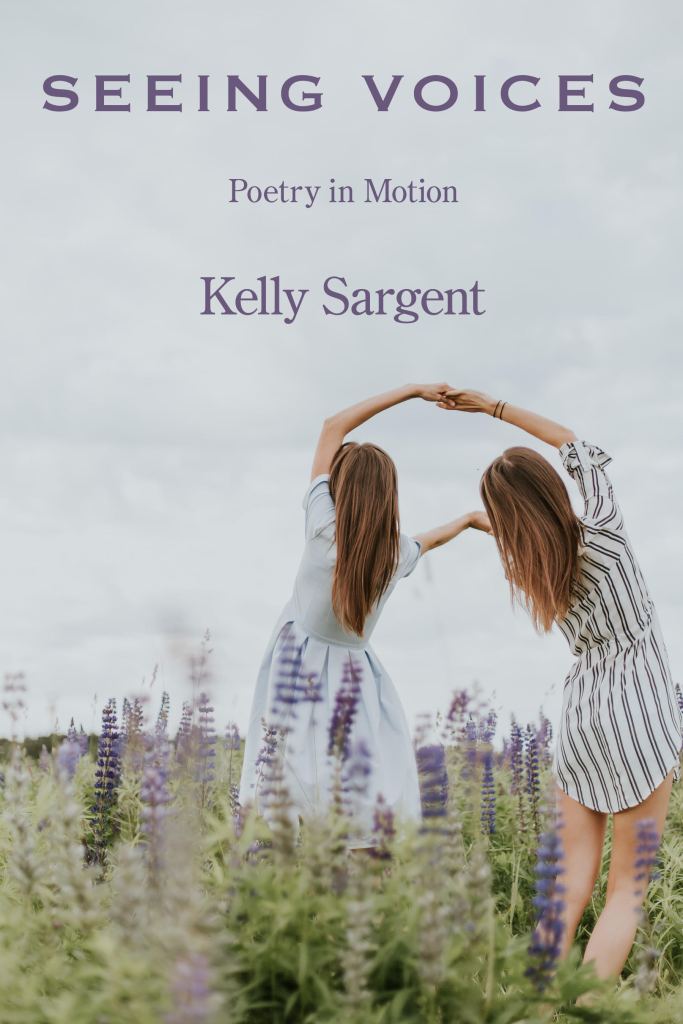
Seeing Voices: Poetry in Motion

Seeing Voices: Poetry in Motion, by Kelly Sargent

Published by Kelsay Books, 2022
Review by Sharon Waller Knutson

Kelly Sargent’s powerful memoir in verse, Seeing Voices: Poetry in Motion is a profound love story of twin sisters, Kelly, hard of hearing, and Renée, deaf, born in a world they didn’t understand and that didn’t understand them, and the loss felt when they separated at the age of twelve.

I met Kelly when she made her debut on Verse-Virtual in February with two poems about her twin sister and I emailed her to tell her how much I enjoyed the poems. She sent me a copy of the manuscript and I was charmed and impressed with her wonderful writing.


Abandoned at birth in Luxembourg and adopted at age three months by an Air Force couple, Sargent writes about deep feelings of responsibility for her younger, smaller twin who cannot hear her own cries because she is born deaf. Kelly takes on the roles of teacher and sign language interpreter.

With exquisite imagery, striking symbolism, and spellbinding storytelling, Sargent expresses a range of emotions, from helplessness, frustration, and sorrow to delight, pride, and joy as the twins become mirrors and learn to rely on each other. When Renée enters the Austine School for the Deaf in Vermont when they are twelve, Kelly feels a loss as deeply as a death and must search for her own identity.

Each poem is powerful and poignant with lines as sharp as a slingshot that propelled me into each one, beginning with “Seeing Voices”:

My twin sister used to shut her eyes
to shut me up when we argued.
Born deaf, she held the advantage in any girlhood fight.
I had no choice but to be instantly
muted;
her eyelids,
a remote control when static sounded like me.

I was mesmerized by an introduction to another form of communication in “Her Voice”:

One day, she would hear
with the nut-brown eyes, then lidded shut,
and speak a language that was already foreign to them.
foreign because they had four ears that weren’t broken,
    or because
they had four ears
that were broken
.

In “Fruits of Labor,” I was fascinated by Sargent’s demonstration of how she taught her deaf twin to form speech:

I wrap your tiny hand around my throat,
size identical to your own,
for you to feel the sounds vibrating within.

blue-ber-ry
ba-nan-a
straw-ber-ry

In “Rumors of Spring,” there is the bittersweet letting go and pride as Sargent watches her deaf twin find her place by attending a special school for the Deaf:

Sunlight illuminated you
and struck you
luminescent.

I watched you play in teal-tinted rains
and marveled as your auburn hair
absorbed autumn’s last dusk.

“Kissing the Horizon” tantalizes with exquisite imagery as Sargent experiences separating from her twin:

Barefoot on the beach swings,
we used to watch the horizon bob —
where sunset unfolds in sleepy, dusty-rose hues
and sunrise yawns,
stretching golden limbs to greet the day.

Cradled in wispy silver threads
cast by a spool of smattered stars, we were
wrapped securely in a vast, uninterrupted galaxy.

Rich in symbolism, “The Quaking Aspen” powerfully speaks to Sargent’s mourning the loss of her twin and beginning her journey of self-discovery:

Dawn curtsies, and I weave the woods, recalling the ghost of my twin sister
by my side, gauzy fingers fluttering in a brittle breeze
.

I shuffle at stubborn crabgrass long covering trails
once carved by four leather sandal soles.
She always wore red.
Parents too easily hoodwinked by identical, ten-year-old imps
had colored me blue.

I seek her still.
My mirror.
I seek it, still. 

“My Voice” is stunning as Sargent shows the beauty in deaf self-expression:

I am Deaf.
My fingers speak

A coiffed paintbrush in my grasp,
my voice streaks turquoise and magenta
across a parched canvas.

In her swan song, “Poetry in Motion,” Sargent reveals the utter joy and excitement of the twins’ reunion and reveling in each other’s company:

Sipping from crystals imbibed
with rosé for me and white for you,
we grow giddy between samples of moonlight,
creamy and smooth on crisp linen.

Fingers spin tales before firelight
as silver-bangled spools unwind syllables
and pastel-polished nails paint on invisible canvases
.

Seeing Voices: Poetry in Motion enlightens on the profound power of love, what it means to hear and be heard, and the mirrors through which we see, lose, and find ourselves again. I didn’t want to put the book down, and will be begging for the sequel.


Born hard of hearing and adopted in Luxembourg, Kelly Sargent grew up with a deaf twin sister in Europe and the U.S., and worked with deaf students in educational settings. She also wrote for SIGNews, a national newspaper for the Deaf. She is currently a Vermont writer and artist whose works, including a 2021 Best of the Net nominee, have appeared in more than fifty literary publications. She is the author of Seeing Voices: Poetry in Motion (Kelsay Books, 2022), also a finalist in the Cordella Press Poetry Chapbook Contest. She also authored Lilacs & Teacups (Cyberwit, 2022), a book of modern haiku, and a poem recognized in the international 2022 Golden Haiku competition was on display in Washington, D.C.  She serves as Creative Nonfiction Editor of The Bookends Review, as well as a reviewer for an organization whose mission is to make visible the artistic expression of sexual violence survivors. Visit at http://www.kellysargent.com.


Title: Seeing Voices: Poetry in Motion
Author: Kelly Sargent
Publisher: Kelsay Books, 2022
Price: $17.00
Also available in Kindle format


Sharon Waller Knutson is a retired journalist who lives in Arizona. She has published several poetry books, including My Grandmother Smokes Chesterfields (Flutter Press, 2014), What the Clairvoyant Doesn’t Say and Trials & Tribulations of Sports Bob (Kelsay Books, 2021), and Survivors, Saints and Sinners (Cyberwit, 2022). Her work has also appeared in Black Coffee Review, Terror House Review, Trouvaille Review, One Art, Mad Swirl, The Drabble, Gleam, Spillwords, Muddy River Review, Verse-Virtual, Your Daily Poem, Red Eft Review, The Five-Two and The Song Is…


Risa Denenberg is the curator at The Poetry Cafe.

Phoenix Song

Phoenix Song, by LD Green

Published by Nomadic Press
Reviewed by Ruth Crossman

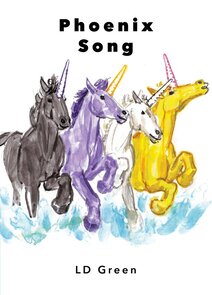
LD Green’s chapbook may be called Phoenix Song, but the reason the cover is adorned with unicorns is discovered in the book’s foreword. Green spent their childhood watching and re-watching the animated adaptation of Peter S. Beagle’s novel The Last Unicorn. With its lush, haunting animation and its decidedly adult, existentialist flavor, it’s easy to understand why Green jokes that they saw this movie so often its themes imprinted into their psyche.

Beagle’s unicorn is a perfect symbol for genderfluid identity. She’s not allowed to remain a unicorn; she spends the middle of the movie unhappily trapped in a female body before breaking a spell and returning to her preferred form. It also turns out that she’s not really the last of her kind. At the end of the movie, it’s revealed that her community has been literally forced underground, driven into the ocean by a violent, menacing creature known as the Red Bull.

Green concludes the foreword by reflecting on how, as an adult, they  came to identify this bull as the symbol of cis-hetero-patriarchy. “He wants the unicorns (marginalized genders) trapped forever for his amusement and under his control in the ocean near his tower,” they explain. But in the end the Bull’s plan is thwarted by an act of solidarity. Green describes how, in the movie’s climax, the titular unicorn does battle with the bull and frees her kin from his control, allowing them to rise from the ocean and return to the land. This vision of the unicorns surging together is one that Green has carried into adulthood as the defining image of the movie.

Reflecting on the lived experiences Green shares in the collection, I understood why they connect so strongly with this image. Their poems describe what it’s like to live in a body that battles to take up space in the world in its true form because of the forces of patriarchy, ableism, and homophobia. And yet, like the unicorn surging through the waves in triumph, Green also writes of the times their body has known joy and been in communion with the bodies of others. Their work does not pull punches when it comes to describing trauma, but it also finds space to celebrate love and joy.

The collection begins with a series of meditations on queer and bi+ sexuality. In “Apples and Oranges” they describe the confusion of having teenage desire for both boys and girls and the journey towards accepting that they have a taste for both. “Event Horizons” is a set of prose poems about their changing gender identity. They are heckled for using the women’s bathroom because of their male presentation. They are asked to help with Women’s History Month and squirm at reading the Vagina Monologues:

Remember when I suspended my misgivings with suspenders?
Remember when I uttered ‘cunt’ but it exploded like a bizarre supernova?

When told about an event open to anyone who identifies and presents as a woman, they contemplate their options:

Neither, no
Yes, both, if it means I get to speak

Then, in “Lady Macbeth to Octomom” they give Shakespeare’s most maligned villainess a one-sided conversation with a tabloid fixture of the early aughts in a riff on murder and fertility that weaves high culture, pop culture, and gender critique together skillfully. “Neither of us can escape,” they conclude.“Our body counts will not make up / for the power we lack.”

 With “Body to Machine” the theme of embodiment goes even deeper, as Green compares traveling around in a body that has been molested to driving a car that doesn’t always start and describes the loss of control and unpredictability of response which both states provoke. This loss of control escalates in “Sometimes I Slip,” where Green describes the loss of bodily autonomy they experienced when they were institutionalized after being molested.

In the center of the book, Green points us towards the origin of their phoenix’s fire with memories of abuse and their struggle to make meaning from it. “I Forgot I Remembered” captures the chaotic, dissociative nature of trauma memory, while “Phoenix Song” documents their process of taking the shards of this trauma and using them to heal through writing. Positioned after this sequence of poems is a pair of essays, “The Mental Health System Fails, Mutual Aid Transforms” and “Not Confused, Not Crazy: On Being a Nonbinary Radical Mental Health Advocate,” in which Green mixes the personal and the political to describe how the medical system dehumanizes people with mental health diagnoses as well as people with marginalized gender identities. The pairing of essays with poems has the effect of giving multiple perspectives on the same series of events. We see Green-the-poet, a wounded unicorn trapped in the hospital, and also Green-the-intellectual, weaving their own lived experience into a damning argument about the roots of social injustice.

But there is a happy ending of sorts. The phoenix that rises from Green’s ashes is a dapper, enthusiastic, and decidedly sexy beast who has built a way of seeing and loving out of the pain of its past. The last pieces of the collection celebrate sexuality as a multiplicity of desires which can encompass genders of many kinds, and springs forth from multiple bodies overlapping in space.  “A Letter to My Dildo,” describes this as “a body that goes in with you / and will take you in too.” 

This is a book of multitudes: from shades of pain to shades of love to expressions of gender, and Green mixes genres skillfully to make meaning of their lived experience. Taken together it’s a collection of work that invites the reader to go beyond the binary of either/or and embrace a both/and which can hold dual, and even contradictory impulses and labels within the same space. It is collectivity and inclusivity which offers mutual healing to all who have been marginalized and victimized. As Green states in “Benediction,” the final piece in the book,

I am not alone
You are not alone


LD Green (they/them) is a non-binary writer, performer, college educator, and mental health advocate living in Richmond, California.  They co-edited and contributed to the anthology We’ve Been Too Patient: Voices from Radical Mental Health, with Kelechi Ubozoh, published by North Atlantic Books in 2019.  Their first solo book, Phoenix Song, was published by Nomadic Press in February 2022. Their work has been published on Salon, The Body is Not an Apology, Sinister Wisdom, PULP, Foglifter, sPARKLE + bLINK, on truth-out.org and elsewhere.  They have been featured at dozens of reading series, slams, showcases, and workshops in schools, colleges, and open mics locally and across the country.  They were heavily involved in the national poetry slam scene for several years.  As a playwright and writer/performer, they have had their work performed at multiple local and national theater festivals.  They were runner-up for the Princess Grace Fellowship in Playwriting.  LD received their BA from Vassar College and their MFA from Mills College in Creative Writing.  They have received fellowships for their writing from Lambda Literary, Tin House, and Catwalk Artists’ Colony.  LD is a tenured professor of English at Los Medanos College in Pittsburg, California where they teach composition, creative writing, literature, and LGBTQ+ Studies.  They are developing a portfolio of screenplays with their writing partner Salaams, and also adapting a script into a graphic novel. 


Title: Phoenix Song
Author: LD Green
Publisher: Nomadic Press
Publication date:02/05/2022
ISBN:9781955239202
pp 119  $13


Ruth Crossman is a Pushcart-nominated writer whose work has appeared in publications including Litro, Flash Fiction, sPARKLE + bLINK, The Fabulist, and Maximum Rock n Roll. Her auto-fiction collection All the Wrong Places was published by Naked Bulb Press in 2022.


Risa Denenberg is the curator at The Poetry Cafe Online.
Slow Dark Film

Slow Dark Film, by Lynn Strongin

Review by Risa Denenberg

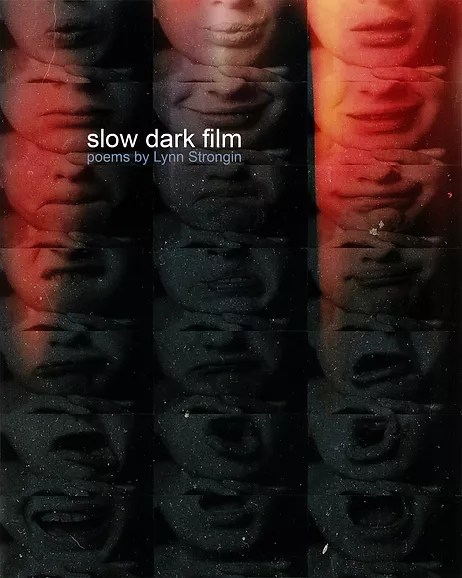
I’ve been a fan of Lynn Strongin’s work since 2014 when she submitted a manuscript to my press, Headmistress Press. I immediately fell in love with her poetry. In fact, Headmistress has published two of her poetry collections: The Burn Poems in 2015 and A Bracelet of Honeybees in 2016. So I was interested in reading her newly released chapbook, Slow Dark Film (right hand pointing, 2021). I’m happy to report that it has the same powerful, idiosyncratic, playful language and fascinating narrative that is found in the poetry and prose she has been publishing for decades.

Strongin’s work is often autobiographical, ranging from childhood when she was hospitalized with polio, to in-between years when she traveled extensively, and on to present day, where she suffers the debilitating late effects polio. Similar to other collections, Slow Dark Film follows a narrative line comprised of the poet’s lived experience. Also similar to other works, her lesbian lover is right by her side.

In the first poem, “LUMINOUS,” Strongin provides a map of the territory the reader is entering, when she reports, “Asylum, forever mine.” This is an artifact persistently embedded in the poems.

The slow dark film of the title is both a recollection from childhood and a gauzy scrim that forms a backdrop through which the poet’s story is shaded. The memory is of the “slow dark painterly-grained film[s]” that were shown to “Children twelve & under” who were “Wheeled in/ to our asylum.” Years exist in this metaphor of so few words—the excruciatingly slow movement of time and the bleak darkness of her surroundings.

The charm in the writing is how Strongin can travel from asylum to Elysium using her vivid imagination and agility with language. In the poem, “IT INTERRUPTS,” Elysium is paradise, but also a harbinger of death:

Stamen & pistil, flowering,
The earth is procreation:
Creation. In a cradle, the bee cups honey
            The longed for, the filmed over, a deep caress
            The last word is always loneliness.

Images—such as the dark film—repeat throughout these poems, conferring a dream-like effect. In “YOUR WORDS,” there is an image of a ladder which repeats in later poems:

I am going through a life-change
            that has ladders                   of grieving

I think of the biblical story of Jacob’s ladder when I read this, one of so many associations Strongin’s words invite me to imagine.  In “I KNEW I WAS,” the ladder reappears:

I comfort myself
With castles
Teeth-eaten by wind
Like raggy lace. These ladders, they do not lead
Out of the flesh.

Another repeated narrative is found in poems addressed to “YOU”—the delicately unnamed lover, as seen in “WHAT IS THIS”:

Many tiny upheavals in our lives
Have made them remote: yet what is this, you
            coming toward me with an embrace lowered eyes,
            sorrowing El                 Greco face?

Or this, in “GHOST OF DAWN”: “By the time you bathe me/ Morning’s gone.”

In Slow Dark Film there are many weighty metaphors of illness and death, such as in “DEFEAT”:

I make my dark nest,
I lay my bright dress
To rest.

And in the last poem in the book, Strongin returns to the original image of the film:

IF LIFE is a sadness that unspools, a slow dark grain
My rising up is my bending
Down in a dancer’s position.

Slow Dark Film unspools a quiet narrative, leaving me with much to wrestle with, and reminding me of the Dickinson poem, “After great pain, a formal feeling comes.”


Lynn Strongin’s homeland is America. Her adopted country Canada. She has twelve books, work in over forty anthologies, and has been nominated for a Lambda Award and the Pulitzer Prize in literature.


Title: Slow Dark Film
Author: Lynn Strongin
Publisher: right hand pointing
, 2021


Risa Denenberg lives on the Olympic Peninsula where she works as a nurse practitioner. She is a co-founder of Headmistress Press and the curator at The Poetry Cafe Online. Recent publications include slight faith (MoonPath Press, 2018), and Posthuman, finalist for the 2020 Floating Bridge Chapbook Prize.


Risa Denenberg is the curator at The Poetry Cafe.