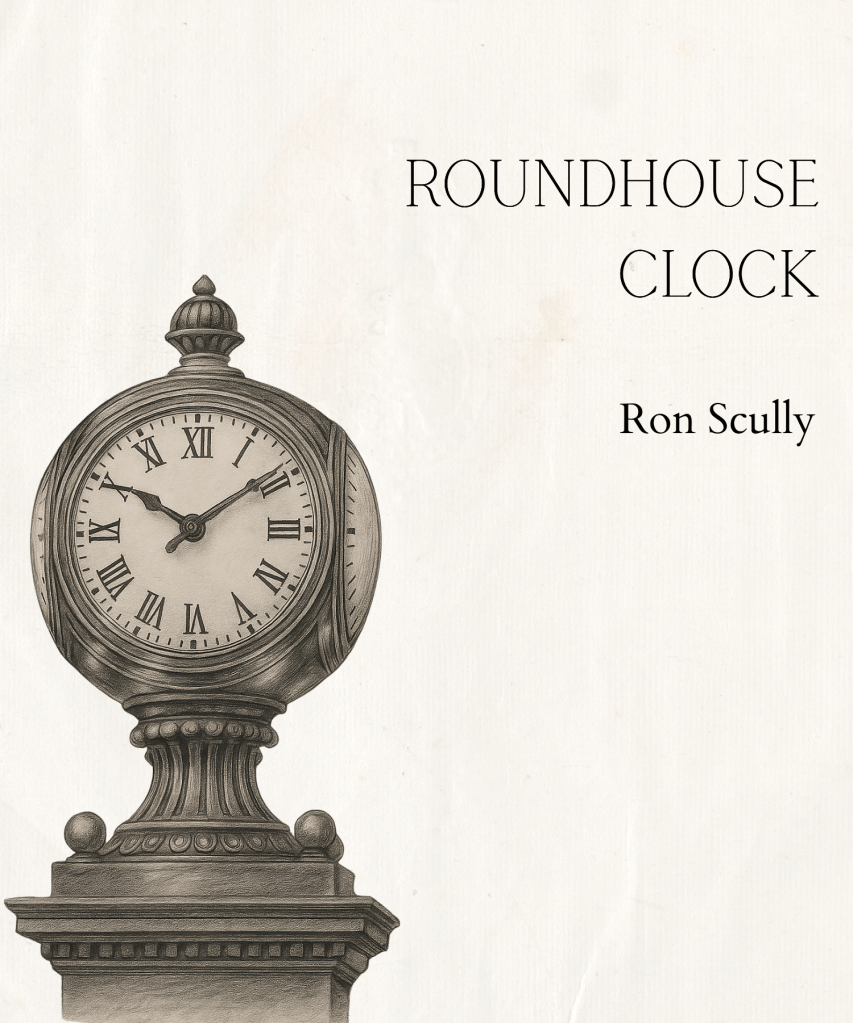
ROUNDHOUSE CLOCK, by Ronald Scully Yavanika Press, 2025 Review by Lisa Hall Brownell
Whenever my brain is on overload, I crave simplicity – a new pathway of words to follow. That path could be down a river, along a garden path, or through Grand Central Station, as in the poems of Roundhouse Clock.
Ron Scully has found a way to be heard above the chaos and noise of our lives. He builds his short form poems with the lightest, almost airy structures, yet they are strong enough to support the heaviest meditations about time and space. Their simplicity is a ruse, however. They are complex puzzles, weighty but never static; sometimes they split in half or tumble down a page, as in this poem, titled, “Grand Central.”
in the concourse’s opal glass clock
it is a roundhouse
of the mind where space/time arrives/departs
the early/late trains on track where endtime starts
I crossed paths with the poet many years ago when he was a bookseller in New England and also a scholar of philosophy. A few decades later, I discovered his recent poetry and chapbooks published online. I was intrigued by the variety of his chosen subjects, and the many forms his poems take, including haiku, haiga, origami poems, micro-poems, and even an homage to Wallace Stevens’ “Thirteen Ways of Looking at a Blackbird.”
it takes the river to keep the rocks quiet time’s sluice
Although Scully distills many complex ideas and loves Latin phrases, his poems are certainly accessible. Many are also free to download online or available for a nominal fee, such as his recent chapbook about chess, master pieces, with witty illustrations that underline that this poet likes to play with words — seriously.
With Roundhouse Clock, Scully appears to be a clockmaker at work, a mechanic of momentum. In the spirit of wordplay, I’d say that Roundhouse Clock strikes the right note. If you’re looking for a reset or a rewind, it just might tick all the boxes.
Ron Scully is a very retired bookseller. After half a lifetime on the road, an authentic Willy Loman only funnier, he relocated from New England and settled in the Pacific Northwest to read and write. He practices haiku daily and has published widely in short form journals. He is the author of over half a dozen chapbooks, most recently needful things (Buttonhook Press, 2024), bureau of weights and measures (Half Day Moon Press, 2024), and the river: a suite of micropoems (Origami Poems Project, 2025). Currently, he is working on the play of his lifetime and researching the possibility of a sports literature anthology. Otherwise, his grandchildren help keep the neurons firing.
Lisa Hall Brownell is a writer and editor. Her novel “Gallows Road” was published by Elm Grove Press in 2022 and has been featured in Kirkus Review, the Historical Novel Review,Connecticut Magazine, and elsewhere. She is finishing her second novel Vee’s Bracelet and a collection of short stories, Sidetracks. Lisa earned an M.A. in English with a concentration in creative writing from San Francisco State University and edited SFSU’s literary magazine Transfer. She is a graduate of Brown University where she wrote poetry and plays and worked in the university bookstore.
Risa Denenberg is the curator at The Poetry Cafe Online.
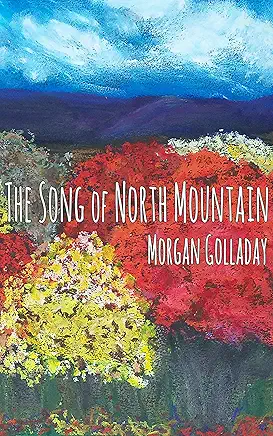
Song of North Mountain by Morgan Golladay Published by Old Scratch Press, 2024 Reviewed by Nadja Maril
Writers begin their journey towards publication at very different times in their lives, some in high school, others after retirement. Is there a right time to begin sharing one’s poems with the world? Perhaps the answer can be found in the quality of a writer’s first poetry collection.
The Song of North Mountain, a debut chapbook by Morgan Golladay, demonstrates the combination of wisdom and excitement of a new guest at the literary dinner table. Golladay takes us on a journey through seasons and times of her childhood home in Virginia, located between the Blue Ridge and North Mountains in the Shenandoah Valley. Golladay’s poems transport us to the foothills of Appalachia, a region that is rapidly changing as our planet warms. Her poems capture the stark beauty and breathtaking colors of the valleys, meadows, rivers, and ridges, as seen in the poem “Spring on the Mountainside.”
Out on the Devil’s Throne careful briars show green, warming, like me, in the heat of the sun. Redbuds languish, eagerly waiting to erupt, to be first, to show true color to this mountain. I trust in their uncompromising cycles, that spring follows winter as night follows day. The redbuds beckon me up the mountain.
Black and white images found throughout the book are original drawings by Golladay, who began the formal study of art in her fifties, preceding her launch as a poet. Expressing oneself in more than one art form is not unusual for poets; her work makes me think immediately of William Blake who so skillfully combined art and poetry in his nature-focused work.
Recently, I had the opportunity to interview Golladay who expressed great enthusiasm for trying new artistic practices. She described an experiment she conducted ten years ago with a friend she met in an acrylics workshop. Both artists had completed seventy-five black and white sketches in seventy-five days and they challenged each other to add poetry to those sketches. Golladay said she decided to combine the two art forms to learn whether the sketch informed the poem or vice versa. “Black and white sketches require a lot of different elements to be effective,” she explained. “Think of the illustrations of Rockwell Kent, the engravings of Durer, sketches of Michelangelo, Picasso, Mayer. For me, it was a steep learning curve.”
The Song of North Mountain is divided into four sections each aligned with one of the four elements: Fire, Air, Water, and Earth. In the fifth century BC, the Greek philosopher Empedocles proposed that the opposing forces of love and conflict upon these four elements create the diversity found in nature. Golladay has chosen these elements as the structure for her poems, highlighting these opposing forces rather than the seasons, which are more typical in nature poetry. Here, the cycle begins with Fire where most of the poems have a connection to light, brightness, and sometimes drought. This section is followed by Air, Water, and Earth.
The home of her ancestors, Golladay’s North Mountain is rich with history and memories. Many of the poems are informed by the changes wrought by time and aging. This poem, found in the Earth section and titled “Family Lines,” begins:
The lots are overgrown with weeds, brambles, saplings jutting through loose stones that mark lost foundations. Someone once lived here.
Someone planted those surviving daffodils, that stray lilac.
Sunday dinners, visitations, funerals, jam-making, weddings, and scrubbed floors celebrated the families that lived here. (Their footprints are found when the yard is tidier.) But the rubble remembers the sweat and the labor, the daffodils recall the hands that planted them.
“Under the Locusts,” found in the Air section, zeroes in on a particular farm. The sense of loss and resignation in this poem is poignant as it documents how the land changes as small farms begin to disappear.
Long after the farm was abandoned, the evidence of thousands of hoof-falls showed among the locusts. Roots stood stark and barren, surrounding dirt worn and blown away. Strange shapes, mystical and druidic in their formation, reared from the dirt, submerging, reappearing several feet away.
There are many poems here about animals, some include humans as well. The poem, “Little Swimmer,” found in the Water section, portrays a venomous snake; another poem in this section is about a stodgy turtle. In our world of cellphones, computers, fast moving cars, and technologies that link global industries and people within seconds, I enjoyed the opportunity to retreat to basic relationships between a harmless reptile and a human. The poem, “A Moment of Grace,” is one of my favorites. It ends with the lines:
We spoke in silence, thanking each other for dappled sunlight, ripe berries, and a moment of grace.
When writing about the loss of her own ability to climb a tree or the cutback of train service to the region, Golladay accepts her changing world with pensive resignation. She more often focuses on wonders that still exist and can still be found if you closely watch, smell, touch, and listen. Song of North Mountain conveys the rhythm of place that is clearly close to the poet’s heart, a sense she ably shares with her readers.
Artist and poet Morgan Golladay’s first published poem was awarded Third Prize in the 2021 Delaware Press Association Communications Contest. Much of her work is reminiscent of her native Shenandoah Valley, its people and places. A graduate of the University of Mary Washington, Golladay’s career included almost 40 years as a volunteer and staff member for several non-profit organizations. In 2024, the Delaware Press Association awarded her the first and second prize for short stories and an honorable mention for poetry. Her first book of poetry, The Song of North Mountain, is a National Book Award nominee. Golladay currently resides in Milford, Delaware. She is tall, left-handed, and blue of eye. Everything else is subject to change.
Nadja Maril’s chapbook Recipes from My Garden, a compendium of poems and short essays centered around herbs, a kitchen garden, and family memories, was published by Old Scratch Press, in September (2024). Maril’s prose and poetry has been published in literary magazines that include, Lunch Ticket, Spry Literary Review and Across the Margin. A former journalist and editor, Nadja has an MFA from Stonecoast at the University of Southern Maine. To read more of her work and follow her weekly blog posts, visit https://nadjamaril.com/
Risa Denenberg is the curator at The Poetry Cafe Online.
Taking Leave by Mary Ellen Talley (Kelsay Books, 2024) Review by Sylvia Byrne Pollack
I have appreciated Mary Ellen Talley’s poetry since I reviewed her first chapbook, the memoir Postcards from the Lilac City, for The Poetry Café in 2021. Her new chapbook, Taking Leave, is a never-maudlin farewell to her older sister Katherine. This collection—also a memoir—shimmers with two fundamental facets of being human: familial love and death. Yet there is humor and joy in these poems. A variety of forms (villanelle, haibun, palindrome, golden shovel, list), internal rhyme, and unconventional word usage are employed in a fearless and compassionate celebration of the lives of her family members. Talley does not avoid the word death or the circumstances surrounding it.
We first meet Katherine in “You Are From,” an overview of Katherine’s life that concludes with the declaration “You are leaving vital signs.” More details of Katherine’s life flesh out the “Interview.” The spareness of that title contrasts with vivid details as we move back in time from 2023, her final year, to 1937, when she was a fetus in her girdle-wearing Mom. “Call it the cramped circle of my early start.”
This is neither a saccharine nor sentimental description of the relationship between these sisters, twelve years apart in age. “Villanelle to De-Escalate” begins with “affection and grace” but devolves into a question: “Will family ties find harmony that discord can’t erase?”
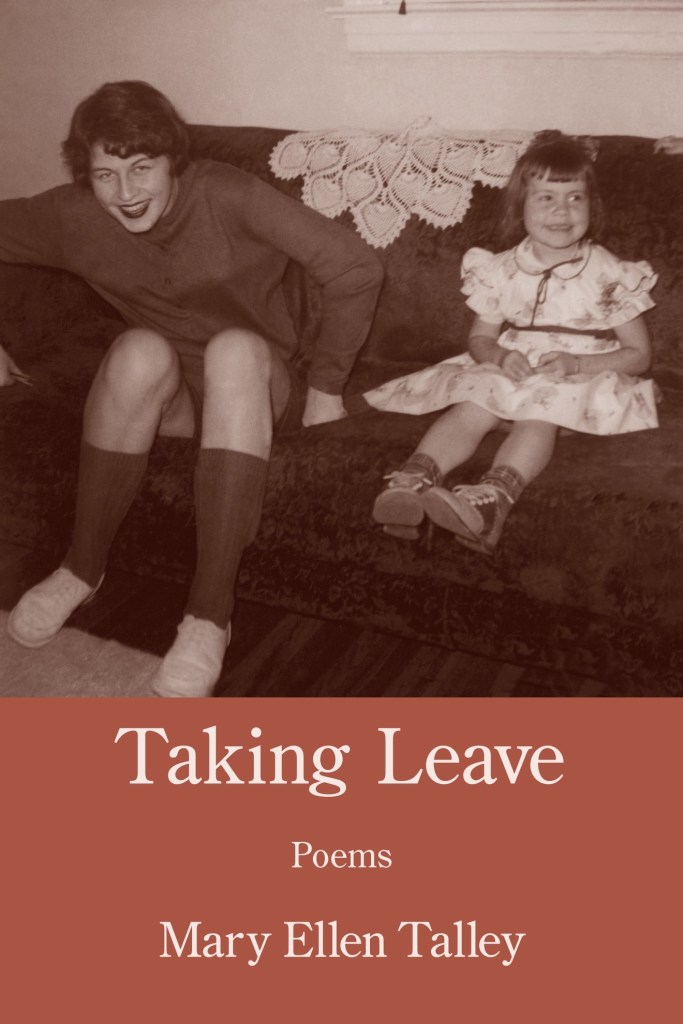
The cover deserves a special mention–a photo of teen-aged, lipstick-wearing Katherine poised to leap up from a sofa where four-year-old Mary Ellen is perched in a frilly dress. The clothes, the embroidered doily on the sofa back, the girls’ faces capture both bygone days and a lasting vibrancy.
The twelve-year age difference may have meant “We Had Two Different Mothers,” but many shared experiences thread through the poems. In “Glitz,” the sisters agree “we’re like our mother. // This hoarding of desire, this preoccupation with enough.”
In “Ghazal: Unbuckled Shoes” we see an older Katherine whose arthritis prevents her from buckling her shoes and the kindnesses that get those shoes buckled and unbuckled for her. After reading these poems, I think I also would have been glad to give Katherine a hand.
The focus segues from Katherine to her daughter Erin in a series of funny, irreverent, and witty poems dealing with Erin’s cancer diagnosis. From “Erin in Walking Wallenda Mode” to Erin letting her cancer know what she thinks about it in “Texting Cancer” to Athena holding the morphine drip in “Legend of the Fates,” we experience Erin as a feisty, laughter-filled woman. Which makes her death in “Messenger Under Arizona Moon” even more poignant. In the sorrow of a mother–Katherine–losing an adult daughter, Talley deals with her death with a deft hand.
A poem I return to again and again is “Stairway to Hospice Heaven.” It captures so much about the sisters’ relationship while looking unflinchingly at death. It begins and ends with phone calls:
My sister calls to ask if I know about the flight arrangements her son has made, how she tried to call him but his phone went to message. She needs to know how she’ll get to the airport, and whether to bring more than a carry-on bag.
In a few minutes I realize she’s confusing flight time with when she’ll depart this earth – logic blurred by morphine.
What follows in an interplay of Talley’s everyday life with husband and grandkids and asking Katherine if she is afraid of dying. “Well of course, I am. Wouldn’t you be?” In a second phone call Talley reassures Katherine that she’s headed to heaven. A third call is almost not answered – Talley is busy – but she picks up:
I answer to hear Katherine thank me for our prior conversation. And say a quick good night as I stand gobsmacked by the generosity of the dying.
I invite you to be gobsmacked by this bighearted, moving collection.
Mary Ellen Talley has published poems in numerous journals and anthologies. Finishing Line Press published her first chapbook, “Postcards from the Lilac City,” (2020) and Kelsay Books published her second chapbook, “Taking Leave,” (2024). She spent many years working with words and children as a speech-language pathologist (SLP) in Washington state public schools and now devotes herself to poetry endeavors. Visit her website at maryellentalley.com.
Sylvia Byrne Pollack, a hard-of-hearing poet and retired scientist, has published in Floating Bridge Review, Quartet, Crab Creek Review,The Stillwater Review and other print and online journals. A two-time Pushcart nominee, she won the 2013 Mason’s Road Literary Award, was a 2019 Jack Straw Writer, and a 2021 Mineral School Resident. Both her debut full-length collection Risking It (2021) and her new collection, What Lasts (2023) were published by Red Mountain Press. Visit her at www.sylviabyrnepollack.com
The Poetry Cafe Online is curated by Risa Denenberg.
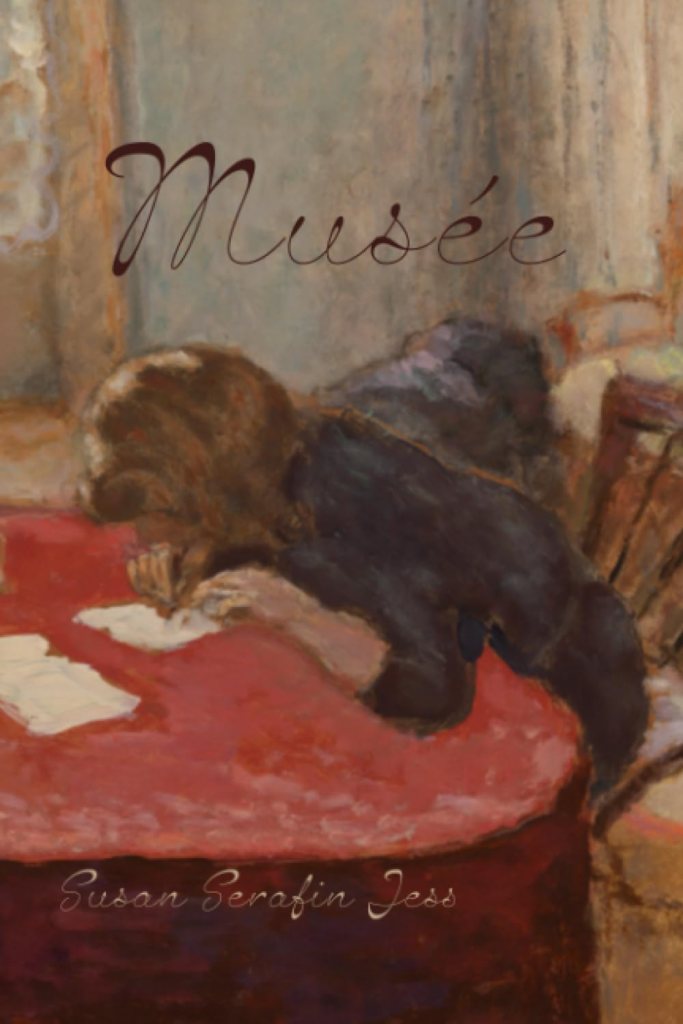
Musée by Susan Serafin Jess Review by Cheryl Caesar
Artifacts beckon to us. They’re visible on the top of the culture iceberg, along with Behaviors and Language, while Values and Beliefs lurk beneath the surface. So writing teachers, like Susan Serafin Jess and me, often call on artifacts in class, as a means to revelation. In her latest poetry collection, Musée, Susan volunteers, like a good teacher, “I’ll go first.” And then opens for us her cabinet of curiosities.
It’s a strong and workable trope. Events, people, and places can be overwhelming and hopelessly complex. But the smell of a fountain-pen nib, the swoop of cursive, the “rather pretty” coffee stain on a student paper (“the color of mourning doves, and heart-shaped”) will fit in our cupped hands. The first six poems read like a bit of memoir—the writer’s life reified through her tools of pen, pencil and paper.
Next the writer turns her gaze to other paper relics: a paycheck, a ticket stub, a telephone directory for the city of Battle Creek. Seeing family from the outside offers a new perspective, and each directory entry is followed by an invocation to the subjects of the listing. Locating the two people who would become her parents, she writes,
My father, Robert L. Mowery, pharmacist, mixes potions and elixirs at Alexander Pharmacy.
My mother, Bettie, teaches home economics at Southwestern Junior High. She describes her students as half man and half child. half tame and half wild.
Oh, domestic goddess and martini shaker, aiming to please, failing to please, how deeply you must regret that tipsy blind date. Already you are pregnant with twins.
Other objects from a Boomer life follow: a spun bottle, a bar of Neutrogena, a transistor, part of the author’s “quest to lead a more analog life.” “Mom’s iron” appears, and Susan’s own “unemployed” iron. Small globes feature fog and rice, instead of snow. Now it is 2023 and the poet lifts a Mason jar, wondering how to fill it, what to take to give pleasure to our friend Rosalie, who died of cancer last summer.
As readers, we too feel the craving for a life that is not a “Second Life”: for solid objects, weighted in the hand. In her final poem, Susan empties her purse for us, like a kindly aunt entertaining us in a waiting room. Although she laments, “Whatever you need most urgently will sink to the bottom,” we are delighted with her finds, feeling that she has indeed found “the pen for the perfect line in the poem.” Like a good museum exhibit, this collection has satisfied our senses, our minds and our imaginations.
Susan Serafin Jess taught writing for many years at Lansing Community College before retiring. She has published four other collections of poetry, and a true-crime/memoir mélange, Wild Horses. Of this most recent collection, she writes of being inspired to follow the theme of artifact by a 2019 exhibit at the Library of Michigan, The Secret Lives of Michigan Objects, and by Pablo Neruda’s Odes to Common Things.
Cheryl Caesar is a writer, teacher of writing and visual artist living in Lansing. She is an associate professor at Michigan State University, and does research and advocacy for culturally responsive pedagogy. Cheryl’s chapbook of protest poetry Flatman is available from Amazon, and some of her Michigan poems, watercolors and charcoal sketches appear in Words Across the Water, volumes 1 and 2, a collaboration between the Lansing and Chicago poetry clubs. In summer 2023, she won first prize for prose in the tri-county My Secret Lansing contest. Cheryl is president of the Michigan College English Association and secretary of the Lansing Poetry Club.
Risa Denenberg is the curator at The Poetry Cafe Online
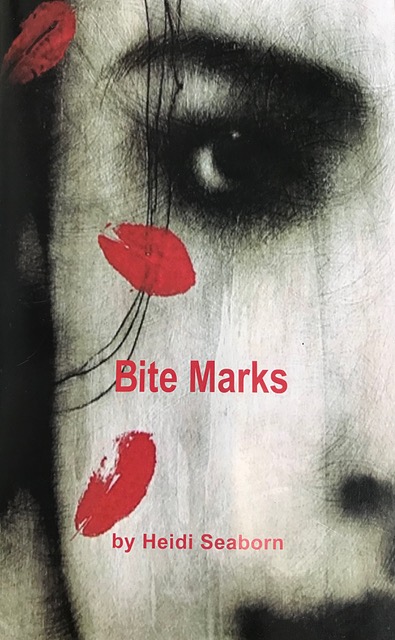
Bite Marks, by Heidi Seaborn Winner of The Comstock Review Chapbook Award, 2020
Review by Deborah Bacharach, Christine Dooley Ellis, Geri Mendoza Gutwein, and Olivia Loftis
Heidi Seaborn wrote poetry as a teenager, stopped after college, and then came back to it just where Bite Marks is set, in mid-life where, as she writes in “In Menopause I Lose My Sense of Direction,” it’s “Such a muddle this middle this road failing to fork or cloverleaf.” The speaker may feel lost, but Seaborn has been rushing forward with two full-length collections and three chapbooks, this one winning The 2020 Comstock Review Chapbook Award. In Bite Marks, Seaborn is not afraid to plunge straight into the taboo, whether it is menopause, women’s relationship to their beauty, or death looming, and she does so with a delightful cheekiness.
Many taboo subjects get air time in these poems—vaginas, affairs with married men, violence against women—but Seaborn focuses in on menopause. “That was menopause the butcher said” begins the first untitled poem. It’s a forced menopause brought on by a hysterectomy, and clearly the word choice “butcher” instead of “surgeon” lets the reader know the speaker feels attacked and dehumanized.
Seaborn returns in several poems to the dehumanization surrounding menopause and how it ties to women losing their beauty. In “In the Mirror” she writes:
I blanket my body in bedclothes, in the tall meadow grass. Come look! I’ve already disappeared.
The speaker who flaunted her gorgeous body as a young person, now, post-menopause, hides herself. Seaborn provides a double meaning: the speaker both protects herself and yet internalizes what happens to women as they age—they disappear. Meadow grass is alive, so this is not a condemnation of wrapping up; more so, it’s an acceptance. The speaker provides some beneficence to herself in the softness, but ironically, she is still juxtaposing this body in a blanket with the body in a bikini, earlier. She recognizes that she has internalized becoming a disappeared one. Her work speaks to our impermanence.
These poems look at impermanence, our impending death, with a sense of hopelessness and wonder. They remind us “we all grow long and tired” (“Cresting Bone”) and that we are as perishable as a radish (“The Perishable Nature of a French Breakfast Radish”).
In a poem titled “To Do Before You Die,” the speaker is riding a bike up a mountain:
where deer nibble long grass where now I climb slowly asking nothing of the trees or of this dog day in August
but everything of me pedaling Mt. Constitution 2399′
to its peak where I arrive thirsty for the glittering expanse of the Salish Sea and hungry for the knuckle ride down.
The poem is rich with detail of the natural world “where deer nibble long grass,” so the first thing the speaker is telling us to do before we die is notice the world around us. The tone also tells us to approach death full of confidence and joy, “hungry for the knuckle ride down.”
Seaborn captures the tonal range of late mid-life. From great confidence, like above, to the heartbroken, like when the speaker carries “severed / lilacs by the armful / as if an injured / child” (“The Neighbors Request a Tree Removal”), to the intimate “I need to sound you, know / your fathoms. Know we’re truly sisters” (in, “I’m in Conversation with the Sea”), to the most surprising and delightful—cheeky self-mocking. When the speaker says, “Recently I asked my oldest son and his wife about baby names. / They are not pregnant,” I laughed out loud. I appreciate how much fun Seaborn has making fun of herself. In “When the Stars Align,” she writes:
In my dreams, I am leaping off a star and then I’m a starfish sparkling in a turquoise sea— a celestial cleansing for a woman who just wanted to have sex most of the time. Skirt hiked over my hips. My ass, mooning the universe.
The poem integrates three tones: the dreamy, lovely lyric with the gentle floating imagery of a starfish in a turquoise sea—so perfect as to be almost too much; the blunt frankness of “just wanted to have sex most of the time,” a voice that calmly wades into the taboo; and then the delightful self-mocking of a speaker who sees herself now not as that dreamy starfish but as the ridiculous, the mooning ass. As Seaborn takes on menopause and women enjoying their beauty, she brings the reader with her with this wink and a nod at her fallibility.
Heidi Seaborn is the author of [PANK] 2020 Poetry Award winner An Insomniac’s Slumber Party with Marilyn Monroe (2021), Give a Girl Chaos (C&R Press/Mastodon Books, 2019) as well as chapbooks, Finding My Way Home and Once a Diva. Her work has recently appeared in American Poetry Journal, Beloit Poetry Journal, and Copper Nickel. She is Executive Editor of The Adroit Journal. www.heidiseabornpoet.com.
Reviewers’ Note: This review was written collaboratively by the International Women’s Writing Guild book review course, taught by Deborah Bacharach, Spring 2022. I picked Bite Marks for our class project because I have reviewed Seaborn’s two full-length collections and expected this chapbook to be just as fulfilling in theme, structure, and craft. Seaborn was kind enough to donate electronic copies of her book to our class.
Deborah Bacharach is the author of Shake & Tremor (Grayson Books, 2021) and After I Stop Lying (Cherry Grove Collections, 2015). Her poems, book reviews and essays have been published in Poetry Ireland Review, New Letters and Poet Lore among others. Find out more about her at DeborahBacharach.com
Olivia Loftisstudied Writing, Literature, & Publishing at Emerson College. They appreciate the value that a strong author-editor relationship brings to the creative process. Olivia enjoys live music, trying new recipes, visiting local landmarks with friends, and doing their best not to fall off their Chicago Manual of Style–branded skateboard.
Christine Dooley Ellis is a writer living in South County, Rhode Island, lands of the Narragansett. She writes with Grace Farrell’s Writing on Ninigret Pond and is a Muse and the Marketplace Literary Idol finalist.
Geri Mendoza Gutwein, Ph.D., professor emerita of English at HACC, Central Pennsylvania’s Community College taught English, creative writing, and Native American Literature there for many years. A Pushcart Prize nominee, she is the author of three chapbooks of poetry: Every Orbit of the Circle, The Story She Told, and An Utterance of Small Truths.
Risa Denenberg is the curator at The Poetry Cafe Online.
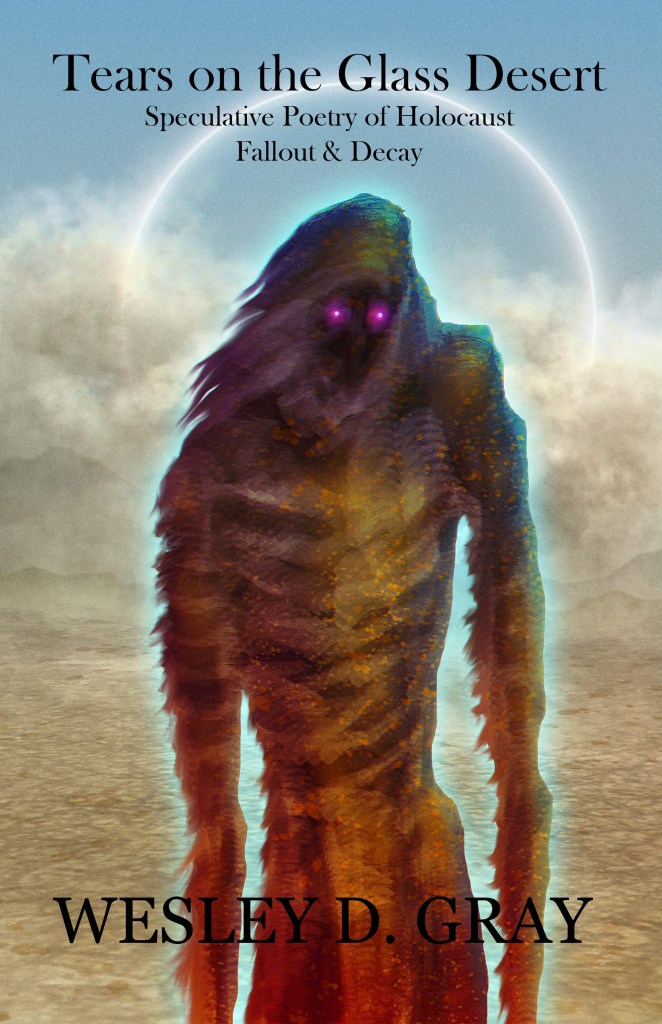
Tears on the Glass Desert: Speculative Poetry of Holocaust Fallout & Decay by Wesley D. Gray
Review by Don Beukes
As a secret childhood reader of horror—books such as The Rats, by James Herbert or It by Stephen King—and glued to the television watching films like The Birds or Carrie, I knew I was hooked on this genre from an early age.
In Tears on the Glass Desert (Marrowroot Press, 2021), Wesley D. Gray both establishes and earns the subtitle Speculative Poetry of Holocaust, Fallout and Decay. In his own description of the book, Gray invites us to “savor the final three seconds before Doomsday” and to “step through the shattered glass door leading beyond The End and walk through the veil of an apocalyptic dreamscape” in his chapbook of twenty-four poems that “speculate on both the inevitabilities and the impossibilities of nuclear holocaust, the fallout it brings, and the aftermath of its Decay.”
We witness an actual “countdown” over three sequences packed with astonishing and realistic poetic acumen in this cinematic literary journey, taking us to what we might fear the most—the end of this world as we know it.
In the first sequence, “Three to Ignition,”we are immediately plunged into the last three seconds of humanity in the first poem, “23:59:57.” We are lulled into an almost hypnotic state by clever use of melodic near-rhymes such as chime/shine. Gray continues to lull us in the poem “Mushroom State,” in phrases such as igniting the nighttime, where assonance may conceal our awareness of the subject matter. This is also seen in this unique tug-of-words,
our bodies flail within the flames waving like an ocean of enraged kelp
In the second sequence, I found unique cinematic scenes in the poem, “From Corn to Sea” with each stanza using the first person, I see, I fear, I run, I sail, I feel, I fade, I wake, I pull, I shudder, I rise, I hear. This leaves us with a strange and effective sensory overload, willing us to also see, feel, shudder, run, fear and fade. This line reminds me of the Alien films,
I pull and my cheeks peel from the muscle, shreds from bone
A revelatory moment comes upon the insight that perhaps the haunting figure on the cover might actually be the narrator. This awareness arrives in the poem, “Burning on re-entry,”
I was everything. I was the gravity of a black hole in the icy chars of a comet. // I hit the blue-domed atmosphere, ready to split, ready to shatter. // I am ash, a char upon the glass desert.
This collection is not for the fainthearted; it displays gore, guts and grime, while at the same time displaying the beauty of language. This sensory narrative gives an almost tactile impression of a nuclear fallout and the aftermath of decay. We see this in the poem, “Covet,”
When our bones were crushed into the asphalt dream,
as I watched you turn to liquid and your marrow soak into earth,
Other equally chilling lines include, ash caskets rain from Eden’s Skyline, in “Prisoner Zero.” And in “Witness to a Schoolyard Burial” we find, Atomic children stir below the grasses, / continuing education in soil spit. And in “Impressions,”
gullies filled with flakes of flesh, their fodder-formed whispers curdled, weaved in dust.
In the last poem, “A Final Visitation to our Monumental Glass Desert,” Gray holds our attention with lines such as, bone canyons with web-nested eyes / spilling regret from cavernous sockets, and continues the spell to these very last lines,
Blood and tears are encased within like swirls inside a marble, mixed with all that liquid skin, curled in slithers of flesh-resin tongues.
Gray’s thoughts go beyond the poems, as we find in his own description of the book’s lingering questions: Let us witness the horrors of an apocalyptic dreamscape. Let us witness the horrors that await these lucky ones called survivors . . .What will become of our Children of the Fallout? Will they live beyond Death’s second coming, or are they simply doomed to fade away?
In his first chapbook, Come Fly with Death – Poems Inspired by the Artwork of Zdzislaw Beksinski (Marrowroot Press), and in his horror novel, Feeding Lazarus (Jaded Books Publishing), Gray displays equally gruesome language and his great skill at writing horror. His work reminds me of Stephen King. In all of these books, he poses existential questions for humanity.
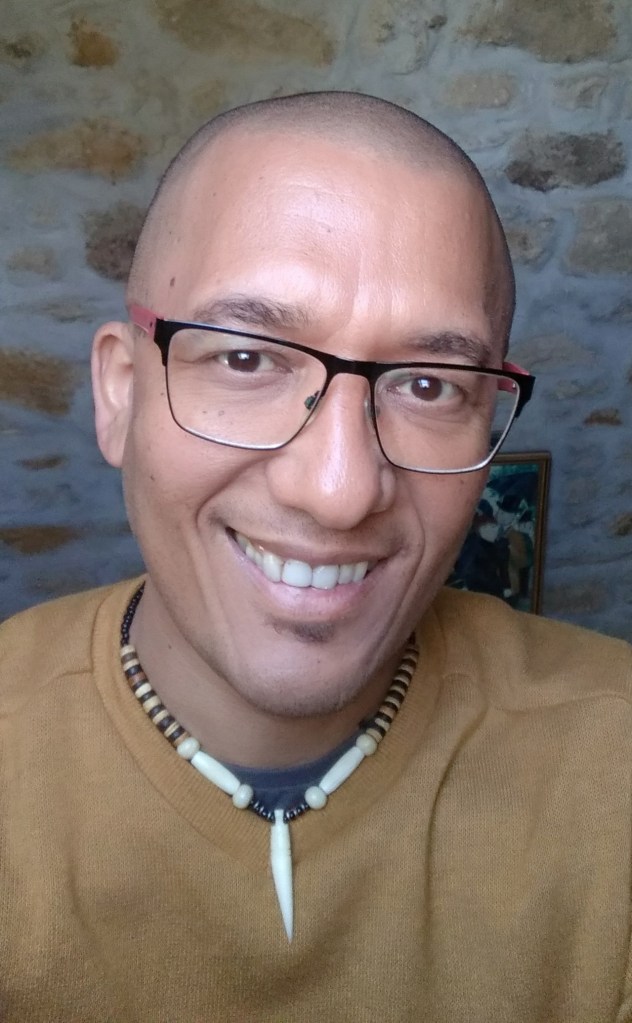
As an author of fiction and a poet, Wesley D. Gray is a writer of things that are mostly strange. He is an Active member of the Horror Writers Association, as well as a member of the Science Fiction and Fantasy Poetry Association. His other books include Come Fly with Death: Poems Inspired by the Artwork of Zdzislaw Beksinski, and the horror novel, Feeding Lazarus (originally published as Rafe Grayson). When he isn’t writing, Wesley enjoys geek status while claiming to be: a tabletop gamer, a reader, a dreamer, a veteran, a Trekkie, a Whovian, an amateur photographer, a radiographer, nature-lover, coffeeholic, boxed wine enthusiast, and an all-around nice guy, among other things. He resides in Florida with his wife and two children. Learn more at the author’s website: WesDGray.com.
Don Beukes is a South African, British and EU writer. He has written Ekphrastic Poetry since 2015 collaborating with artists internationally. He is the author of The Salamander Chronicles, Icarus Rising-Volume 1 (ABP), an ekphrastic collection and Sic Transit Gloria Mundi (Concrete Mist Press). He taught English and Geography in both South Africa and the UK. His poetry has been anthologized in numerous collections and translated into Afrikaans, Persian, French, Kreole (Mauritius) and Albanian. He was nominated by Roxana Nastase, editor of Scarlet Leaf Review for the Best of the Net in 2017 as well as the Pushcart Poetry Prize (USA) in 2016. He was published in his first SA Anthology In Pursuit of Poetic Perfection in 2018 (Libbo Publishers) and his second Cape Sounds in 2019 (Gavin Joachims Publishing, Cape Town). He is also an amateur photographer and his debut Photographic publication appeared in Spirit Fire Review in June 2019.
Risa Denenberg is the curator at The Poetry Cafe Online.
Memoirs of a Witness Tree by Randal Burd was reviewed at The Poetry Cafe by Diane Elayne Dees, and, in turn, Dees’s chapbook, Coronary Truth, was reviewed by Burd. These two poets found that they had much in common, as you will see in this interview between them.
[M]y love of formal poetry—which I often write—is probably somewhat inspired by some of the poets, especially the Victorian poets, I studied in school.
Diane Elayne Dees
Randal Burd: I was recently privileged to have the opportunity to interview Diane Elayne Dees via email regarding her latest poetry collection, Coronary Truth (Kelsay Books, 2020). That conversation informed a review of her chapbook, but her answers to my questions are illuminating in their own right.
RB: What inspired you to become a poet; to decide to write poetry and have it published?
Diane Elayne Dees: I always enjoyed writing, but didn’t start doing it seriously until later in life. I did political and tennis writing, and I wrote and published a lot of creative nonfiction and short fiction. Then, suddenly, I went dry—I ran out of story ideas. I began to write poetry because I was frustrated and wanted to write something creative. To my surprise, I took to it almost immediately and have written little else, in terms of creative writing, for several years now. And since I was already a published nonfiction and fiction author, it didn’t even occur to me not to seek publication of my poetry.
RB: Who are some of your favorite poets? Which poets have inspired your writing?
DED: My very favorite poet is Edna St. Vincent Millay. I also like reading Rumi, Emily Dickinson, Matthew Arnold, and Mary Oliver. Two of my favorite contemporary poets are Jennifer Reeser and Allison Joseph. I’m not aware of my own poetry having been directly inspired by any poet in particular, but I think that my love of formal poetry—which I often write—is probably somewhat inspired by some of the poets, especially the Victorian poets, I studied in school.
RB: What is your process for writing poems? Is it deliberate and scheduled or as the inspiration comes?
DED: It’s generally as the inspiration comes. However, I recently participated in two projects which required the scheduled writing of poems, and I was amazed at what that bit of pressure produced. I’ve no doubt that scheduling writing time would be a good idea—I just need to find the discipline.
RB: I notice you draw a lot of inspiration from nature. Do you spend a lot of time outdoors?
DED: I grew up near a lake, with woods right beyond my back yard, and I now live in a natural setting. Just about every day, I go outside to observe the birds and insects and other creatures, and to photograph them. I don’t garden as much as I used to, but I still tend to a number of plants. Also, my house is filled with images of the natural world.
RB: Is the reader wrong to assume many of these poems have an autobiographical element to them?
DED: Many of them are indeed autobiographical.
RB: Do you personally find writing poetry to be a cathartic process?
DED: I do! I find several different kinds of writing cathartic, but the poem—by virtue of its distillation of thought, melded with sound and rhythm—creates a total body experience of satisfaction/relief that is hard to explain to someone who has never created a poem. My hope is that the reader will also experience some of that.
RB: You have published a “progressive” blog, written for Mother Jones, and authored political essays, yet your poetry does not seem to be overtly political. What do you think of politics as poetic muse?
DED: I write and publish a lot of political poetry, but none of it appears in this chapbook. For me, social/political issues provide an endless supply of topics for poems, and writing about topics important to me is now my way of contributing to the conversation. However, those topics about which I’m the most passionate remain difficult poetic subjects for me to write about; my emotions get in the way. And—to return to the last question—writing poetry about social issues is quite cathartic.
Diane Elayne Dees’s poetry has been published in many journals and anthologies. Diane is the author of the chapbook, Coronary Truth (Kelsay Books) and the forthcoming chapbook, I Can’t Recall Exactly When I Died. Diane, who lives in Covington, Louisiana, also publishes Women Who Serve, a blog that delivers news and commentary on women’s professional tennis throughout the world. Her author blog is Diane Elayne Dees: Poet and Writer-at-Large.
Randal A. Burd, Jr. is an educator and the Editor-in-Chief of the online literary magazine, Sparks of Calliope. His poetry has received multiple awards and has been featured in numerous literary journals, both online and in print. Randal’s 2nd poetry book, Memoirs of a Witness Tree, is now available from Kelsay Books and on Amazon.
A whole body of literature exists that focuses on the body. Indeed, one might make the assertion that all literature does so, in one way or another— enraptured body, dying body, panicked body, betrayed body, and, as in the case of Life, One Not Attached to Conditionals by Laura Cesarco Eglin (Thirty West Publishing House, 2020), body as betrayer.
Because I, too, have gone through, and written about “the cancer experience,” I was particularly drawn to this chapbook. I was curious to see how cancer could be the subject of a collection of poems without it spreading into all aspects of what makes a book cohesive and alive, i.e., a sense of tension between themes, linguistic risks, and tone (to name a few). Cesarco Eglin contrasts her subject matter’s doom and gloom with the urge to live her still-young life despite the ever-present shadows. The dark humor infused in these poems also underscores the seriousness of their themes. For example, in “Articulating the Changes in My Body,” Cesarco Eglin, a fine translator herself, compares her scars to Morse code:
I’m thinking about the Morse code as a possible alphabet to get through, to get by, to translate.
She then gives a graphic representation of Morse-code-as-scar.
It’s easy for poems about illness to veer off into sentimentality or self-absorption, but Cesarco Eglin masterfully negotiates the geography of living an unconditional life, despite her multiple bouts with melanoma, and despite the need “to guard [each] new spot ‘like a hawk.’” In this pandemic year, many of us are directly experiencing the need to be extra-vigilant to avoid contracting the virus, which makes this new chapbook of poems particularly relevant. Cesarco Eglin can never escape “the doctor’s voice in [her] head: it will come back.” She reminds us that “there is no vacation from being alert.” Indeed, in an existential stance to confront the absurdity of the human condition, she instructs us on how to take control of the uncontrollable, and writing is her chosen strategy. She offers us this wisdom:
One scar, then another; that’s two lines already: a couplet written in five months, a couplet that promises to be the beginning of a lifetime of poetry.
Melanoma, her muse, has provided her with the motivation to be “aware of any little change in color, shape, texture, dimension, state, mode or mood of any mole or stain or spot on [my] body.” Cesarco Eglin, who was born in Uruguay and is fluent in Spanish and English as well as other languages, is open to melanoma teaching her the language of the body—learning it well enough to eventually call herself “a native speaker.” She’s trying to learn to embrace her scars, and compares them to bridges, as she brilliantly transforms the threatening juxtaposition of “bridge” and “attempt” to a life-affirming choice:
Many bridges, an attempt to keep me in one piece; an attempt to keep me alive long enough to cross them all.
In these days of COVID-19, we could all use something to help us cross these bridges—something to remind us to keep believing there are still “skies and wonders.”
The Reviewer posed some questions to the author about her book:
Nancy Naomi Carlson: What about Life, One Not Attached To Conditionals is uniquely suited to the chapbook form?
Laura Cesarco Eglin: I felt that a shorter form would suit Life, One Not Attached to Conditionals as a way to, at least in language, be able to finish the cycle, end the struggle psychologically, intellectually, and emotionally. Intense, short, and move on to life, one not attached to conditionals.
NMC: I notice that “translation” is one of the themes of Life. How did your work as a translator (and an author who is translated) impact your writing this chapbook?
LCE: Experience translated into language. Poetry as a means to question, challenge, and rearrange thoughts and experiences. Translation as a form of reading deeply, analyzing.
NMC: Writing about illness seems to be a tried-and-true genre, but is also an emerging one, as the landscape of disease is ever-shifting. Were you influenced by other writings on this topic?
LCE: More than influenced on writings on this particular topic for this particular chapbook, I would say that I am always influenced by all the books I read. I think that goes without saying. But there are two books in particular that I’d like to highlight. They deal with overcoming a loved one’s death or suicide: Ghost of by Diana Khoi Nguyen and Instead of Dying by Lauren Haldeman.
NMC: Can you say something about your wonderful title (e.g., how it came about; when, in the process of writing, it came to you…)
LCE: The title comes from a line in “Recovery,” a poem in Life, One Not Attached to Conditionals. I did not set out to write a poetry collection about having melanoma and skin cancer repeatedly and what that meant. I was writing poems and they, understandably, had that focus. The process of editing, rereading, changing, rewriting brings new perspectives, and when I read that line I perceived that it encapsulates the compass, as well as the power I think language has.
Laura Cesarco Eglin is a poet and translator. She is the author of three collections of poetry: Calling Water by Its Name, translated by Scott Spanbauer (Mouthfeel Press, 2016), Sastrería (Yaugurú, 2011), and Reborn in Ink,translated by Catherine Jagoe and Jesse Lee Kercheval (The Word Works, 2019). She has also published three chapbooks: Life, One Not Attached to Conditionals (Thirty West Publishing House, 2020), Occasions to Call Miracles Appropriate (The Lune, 2015) and Tailor Shop: Threads, co-translated with Teresa Williams (Finishing Line Press, 2013). Her poems, as well as her translations (from the Spanish, Portuguese, Portuñol, and Galician), have appeared in a variety of journals, including Asymptote, Modern Poetry in Translation, Eleven Eleven, Puerto del Sol, Copper Nickel, Spoon River Poetry Review, Arsenic Lobster, International Poetry Review, Tupelo Quarterly, Columbia Poetry Review, Blood Orange Review, Timber, Pretty Owl Poetry, Pilgrimage, Periódico de Poesía, and more. Cesarco Eglin is the translator of Of Death. Minimal Odes by the Brazilian author Hilda Hilst (co•im•press), winner of the 2019 Best Translated Book Award in Poetry. She co-translated from the Portuñol Fabián Severo’s Night in the North (EulaliaBooks, 2020). She is the co-founding editor and publisher of Veliz Books.
Nancy Naomi Carlson, poet, translator, essayist, and editor, has authored 10 titles (six translated). An Infusion of Violets (Seagull Books, 2019), her second full-length collection of poetry, was named “New & Noteworthy” by the New York Times. A recipient of two NEA literature translation fellowships, she was a finalist for the Best Translated Book Award, and the CLMP Firecracker Poetry Award. An associate editor for Tupelo Press, her work has appeared in such journals as APR, The Georgia Review, The Paris Review, and Poetry. www.nancynaomicarlson.com
Risa Denenberg is the curator at The Poetry Cafe Online.
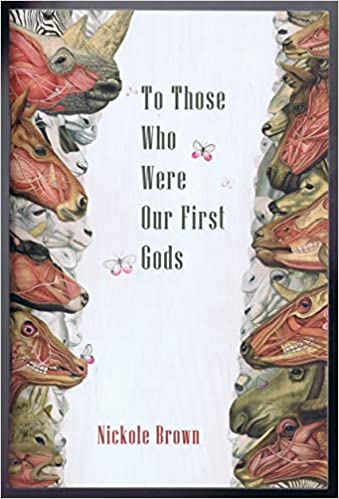
It’s fitting that I needed to sit outdoors amid squirrels and finches and summer humidity, to sweat a little, as I embarked on this review of Nickole Brown’s chapbook, To Those Who Were Our First Gods, a prayer, praise song, and plea that calls on readers to recognize our connection with and responsibility to “the animals with whom [we] share this land.” *
It’s perhaps fitting as well that I would sketch its trajectory while eating potato chips and sipping Sweet Baby Jesus porter. Nickole, who first discovered poetry in a summer workshop midway through high school, describes the surfeit of verse in her childhood this way: “I was raised on the literary equivalent of grease and plastic—if you don’t count the King James, there wasn’t anything to read in the house but Cosmo or maybe a potato chip bag or two.”* That early absence hasn’t stopped her from becoming an accomplished poet, editor, and teacher; her Southern, often hardscrabble childhood providing a wellspring of experiences and insights integral to her success.
I first learned about Nickole’s poetry from poet Laure-Anne Bosselaar Brown who suggested I read Sister, back then in its original edition from Red Hen Press (2007). In this first collection, Nickole navigates the terrain of childhood sexual abuse through a conversation in poems that she’s been unable to have directly with her sister due to the distance between them. It’s a journey she describes as a novel-in-poems but that reads more like a collective memoir-in-poems.
To Those Who Were Our First Gods reflects several stylistic throughlines from Sister and Nickole’s subsequent book, Fanny Says, a biography-in-poems about her grandmother. As was true in those poems, the speaker in First Gods is in constant conversation—with the Lord, with Samson, with Mary Oliver, with the animals she yearns to hear speak to her, and with the readers themselves. This is illustrated in these opening lines of the chapbook’s longest poem, “Against Despair, The Kid Goat,”
Reader, meet the two women who sunk everything they had into taking in broken animals—
This poem combines Brown’s engaging practice of embodiment with what she refers to as “an oral culture of bossy, storytelling women who always had something to tell you or something to tell you to do,” * her speaker leading the reader through the sacrament of imagining their own bodies in the motions of these two women.
Thus the reader is directed “to be / those two,” and “to try, / to always try, despite the odds.” The poem continues, “Reader, I want you tired, every joint / in your body stiff and worn.” And after the kid goat has a seizure, it directs, “Now, use your arms” then “push together the furred slits / of his lids,” and later, “Now, get on your knees”, say his name (Peanut) while you “stroke his scrawny / goat neck.”
The yearning, so much a part of Brown’s poetry and often amplified by repetition, is also here, as it is at the end of the first poem, “A Prayer to Talk to Animals”:
Fork my tongue, Lord. There is a sorrow on the air I taste but cannot name. I want to open my mouth and know the exact flavor of what’s to come. I want to open my mouth and sound a language that calls all language home.
The concept of home is another throughline that persists from Brown’s earlier work. “But now [she’s] writing about animals, who, because of us, increasingly either don’t have a home left or find that home spoiled. *
My favorite poem, the one that made me grin and blush, then stop reading so I could call friends to read it to them, is the middle poem of the nine in the chapbook: “Self Portrait as Land Snail.” As the speaker describes the options the land snail has for both solitary and companion procreation (the latter being the better option, the speaker asserts), Brown’s distinctive voice rises from the page:
I couldn’t make this shit up if I tried—this is no metaphor but scientific fact—a telum amoris—literally, aweapon of love—
[…]
Cupid’s got nothing on this mollusk congress, and because you know how snails go, the foreplay is slow— slow, slow, slow—my kind of sex—
This poem is deftly placed at the fulcrum of the manuscript.
To Those Who Were Our First Gods also provides plenty to study in terms of structural elements. There’s the effective and moving narrative arc, the first poem expressing a yearning to speak to animals book-ended by the last poem which asks instead to understand animals and speak for them.
There are a range of forms, from poems in a single verse, familiar vessels for the prayer and elegy they convey, to ones organized in sections, and a poem in couplets. This latter form is perhaps symbolic of the contrasting styles of the two lesbian poets in conversation within its stanzas: Mary Oliver with her quiet reverence of nature and Nickole who “speak[s] in a queer, Southern trash-talking kind of way about nature beautiful, damaged, and in desperate need of saving.” *
But don’t let me mislead you into thinking that To Those Who Were Our First Gods offers only more of the same distinct voice and accessible, engaging poetry you’ll find in her previous books—although that would be reason enough to click “Add to Cart.” There is something new here too: a heightened sense of immediacy, an urgency that pulses from the lines. With this work, Nickole Brown has moved from subjects long known—her sister and grandmother, her Southern upbringing— to a territory she was warned against when she was growing up, that of the animal and wild.
When sharing this chapbook’s origin story with Jen Sammons at Oxford American, * Brown explained that soon after she revealed a long-held wish to have “gone into environmental conservation and worked to save animals,” her wife, poet Jessica Jacobs, pointed out that it wasn’t too late for her to fulfill that wish. Nickole started her study by reading books and observing animals at a nearby zoo “from a comfortable remove that’s not too unlike reading”—this from “a girl who left behind her body and became a book, and never had . . . gone outside much until [she] was forty.”
It was not until she immersed herself in the sweaty, smelly, mucky, heart-wrenching, yet rewarding work of volunteering at animal sanctuaries and wildlife rehabilitation centers that these poems surfaced. I suspect that an earlier Nickole Brown, before coming into her sexual identity and fully into her own body—gifted poet though she already was—would not have written these poems with the same intensity she achieves in To Those Who Were Our First Gods. I’m glad she wrote this chapbook when she did and can’t wait to read her related essay-in-poems, The Donkey Elegies—and whatever comes next.
Nickole Brown received her MFA from the Vermont College, studied literature at Oxford University, and was the editorial assistant for the late Hunter S. Thompson. She worked at Sarabande Books for ten years. Her first collection, Sister, a novel-in-poems, was published in 2007 with a new edition reissued in 2018. Her second book, a biography-in-poems about her grandmother called Fanny Says, came out from BOA Editions in 2015 and won the Weatherford Award for Appalachian Poetry. She has received grants from the National Endowment for the Arts, the Kentucky Foundation for Women, and the Kentucky Arts Council. She was an Assistant Professor at the University of Arkansas at Little Rock for four years. Currently, she teaches periodically at a number of places, including the Sewanee School of Letters MFA Program, the Great Smokies Writing Program at UNCA, and the Hindman Settlement School. She lives with her wife, poet Jessica Jacobs, in Asheville where she periodically volunteers at a three different animal sanctuaries. Since 2016, she’s been writing about these animals, resisting the kind of pastorals that made her (and many of the working-class folks from the Kentucky that raised her) feel shut out of nature and the writing about it. To Those Who Were Our First Gods, a chapbook of these first nine poems, won the 2018 Rattle Prize, and her essay-in-poems, The Donkey Elegies, was published by Sibling Rivalry Press in 2020.
Title: To Those Who Were Our First Gods Author: Nickole Brown Winner of the 2018 Rattle Chapbook Prize 2018 Finalist for the Julie Suk Award ISBN 978-1-931307-39-0
Wendy DeGroat is the author of Beautiful Machinery (Headmistress Press) and is currently revising a documentary poetry manuscript about Grace Arents, a Progressive-era philanthropist and educator, and Grace’s companion, Mary Garland Smith. Wendy’s poetry has appeared in Cider Press Review, Commonplace, the museum of americana, Rogue Agent,Rust + Moth, The Wild Word, and elsewhere.She is a librarian and mindfulness teacher in Richmond, Virginia, where she also curates poetryriver.org (a resource site for documentary poetry and for diversifying the poetry taught in high school and undergraduate classrooms), encourages writers to find inspiration in quirky historical artifacts found in libraries and archives, and serves as a small-group facilitator for Living the Richmond Pledge, a workshop that empowers participants to take an active role in ending racism in their communities.
Issam Zineh is a Los Angeles-born, Palestinian-American poet and scientist. He is author of the forthcoming chapbook “The Moment of Greatest Alienation” (Ethel Press, Spring 2021). His poems appear or are forthcoming in Clockhouse, Fjords Review, Glass: A Journal of Poetry (Poets Resist), Nimrod, Poet Lore, The Seattle Review, and elsewhere. He also reviews for The Poetry Café (https://thepoetrycafe.online). Find him on Twitter @izineh.


















 The Poetry Cafe