Thanks so much to Trish Hopkinson for publishing an interview with me about The Poetry Cafe! You can read it here:
Since it was published, I have heard from more than 20 poets who wish to send me copies of their books! Whew!
Later today I will be publishing my next review: Refugia, by Kristin Berger and onboard is Feed, by Emily Mohn-Slate. I am working on adding all of the books I have received to the list under “Drumroll, Please” and will be linking each book to the place where it can be purchased. I will be adding cover pictures in the future, and perhaps, interviews with chapbook poets.
I am looking for writers who are interested in writing reviews for this website, as I have more books already than I can review alone. If you are interested, send me an email at the address below. Anyone associated with an MFA program who wants to send students my way, I would be happy to connect with them and discuss guidelines for chapbook reviews. If you want to give them credit for writing a review, even better! And, I will send them a book to review!
Rena Priest’s first book, “Patriarchy Blues” (MoonPath Press, 2017) won an American Book award. Her new chapbook, “Sublime Subliminal” (Floating Bridge Press, 2018) was a finalist for the Floating Bridge Chapbook Award. In an interview posted at the Mineral School’s blog conducted during her fellowship residency there in October 2017, Priest had this to say about her writing:
[T]he poems don’t always make sense, but I want to give my reader the feeling that there is some underlying formula involved, and I want to anchor them with images.
When reading Priest, it would be wise to take her guidance to heart. To look for the clues that emerge from the images she offers. To consider how her poems’ underlying structures, like subduction plates, may be moving even as they anchor. Be alert to the subliminal messages that are strewn throughout “Sublime Subliminal.” Some of these messages are found standing on their heads in tiny italics at the bottoms of pages on the outside or inside edges. That you don’t notice them right away is your first subliminal cue of what you are in store for as a reader. Will you figure out that the sideways messages are actually the translations of phrases within the poems themselves? There is much craft to envy in these poems. So dig in!
Priest notes that poems in the collection “were inspired by Jim Simmerman’s invented form ‘20 Little Poetry Projects,’” (published in The Practice ofPoetry, Robin Behn and Chase Twitchell, eds.). The poems are eloquent even without knowing about this special sauce, but I found it informative to review the exercise. And be prepared to Google any number of references within the poems. That said, the poems are a pleasure on first read and then sneak up on you with more sinister notes on closer reading.
The first poem in the collection, “Sublime Subliminal Liminal” showcases Priest’s extraordinary talent for sounds:
            The bridge is cerebral and phrenic—
            a mysterious reflex.
            When you put it to your lips,
            it is lexical.
Now listen to the music in these lines in “The Coined Phrase:
            and a denouement that feels
            like krill on your skin—the silk
            of a half mill, in life
            and a whale’s meal made null.
Priest also dreams up some of the most interesting metaphors. An example is this surprising—and very funny–comparison in “Sublime Subliminal Liminal,”
           You convulse.
           The bitterness is extra,
           like an impulse
           to discuss politics at length.
And then this extended metaphor, which takes the poem to a different level of meaning:
           But between you and me,
           a tunnel is also a bridge.
           Each maintains a position
           on both sides of a threshold.
My favorite poem in the collection is “Super-sacred” which is an acerbic tour de force. Priest is introducing the reader to Native cultural appropriation from the first lines, “the super-sacred ceremony / is a portal to pre-contact.”
Parenthetically she advises her nonnative readers,
            (This is my real Indian poem,
           the one the admissions board
           and a certain readership
           have been waiting for.)
And then she forgives us conditionally,
           The super-sacredness of this,
           my real Indian poem
           is going to absolve all white guilt,
           but only if you buy my book
Each of the poems in Sublime Subliminal is at once partly amusing, partly ironic, partly musical, and partly a deep reflection on the current state of the world. Or the eternal state of love, as in “Canadian Tuxedo” (which we learn is denim-on-denim),
The drunken monkey of truth
says, “It’s too late for you
to never tell me you love me.”
But I’ve already tasted in your kiss,
the pixels of lightning
you keep in your lips.
In the interview referenced earlier, Priest also said:
Just enjoy it for the way it sounds or feels.
I say: stop, look, and listenfor Rena Priest. She is likely to surprise us again and again with her poetry.
Rena Priest is a Lummi tribal member and a writer. Her work draws on history, science, and culture to tell stories and seek truths. Her debut book, Patriarchy Blues, was released on MoonPath Press and garnered an American Book Award. Her most recent collection, Sublime Subliminal, is available from Floating Bridge Press. Her work can be found in literary journals and anthologies including: Diagram, Sweet Tree Review, Cosmonauts Avenue, and Collateral Journal. She is the recipient of a 2018 National Geographic Explorers Grant, to write about regional efforts to repatriate an endangered Southern Resident orca from an amusement park in Florida. She holds an MFA in Writing from Sarah Lawrence College.
Risa Denenberg is the curator at The Poetry Cafe.
She is a co-founder and editor at Headmistress Press and has published three full length collections of poetry, most recently, “slight faith” (MoonPath Press, 2018).
I was able to meet some of my favorite poets last week at AWPfrom my perch behind the Headmistress Press booth.
I am back home now and re-energized to move forward with this project of reviewing chapbooks. It’s all about the chapbooks! Here is information for interested chapbook writers, readers, lovers and reviewers.
Headmistress Press, publisher of lesbian/bi/trans poetry, is holding our 5th annual Charlotte Mew Chapbook Contest, from May 4th through July 4th. See details here. You can see (and buy!) our chapbooks at our online store.
If you wish to review a Headmistress Press chapbook, on this site or another, please contact me and tell me which book you are interested in, and I will send you a review copy.
If your press is having a chapbook contest, please let me know and I will announce it at The Poetry Cafe.
I have recieived several chapbooks in the mail. Thank you! I am now open to receiving your chapbooks. I don’t promise to review every chapbook, but I will list all of them (see “Drumroll, please”) and I do promise to read every one I am sent. Please mail a copy to The Poetry Cafe at the address below.
If you wish to submit a chapbook review, please query me first, and I will send you the reviewers’ guidelines.
The next chapbook review will be up soon! Sublime Subliminal, by Rena Priest (Floating Bridge Press, 2018).
Contact me on the contact page or via email at: risa@thepoetrycafe.online
Mail chapbooks to: The Poetry Cafe 60 Shipview Ln Sequim, WA 98382
When Lauren Davis read from her chapbook, Each Wild Thing’s Consent (Poetry Wolf Press, 2018), at Imprint Books in Port Townsend WA, where she works as a bookseller, I understood why she chose to read the less risky poems in this very daring chapbook, but I’ll admit I was disappointed. When the first poem in a Table of Contents is titled “Vulvodynia,” you’d really have to trust your audience. But to her crafty credit, Davis intersperses poems about sexual encumbrance with gorgeous, very Pacific Northwest nature poems. And it renders everything enticing, as it should be. For what is sexuality if not nature?
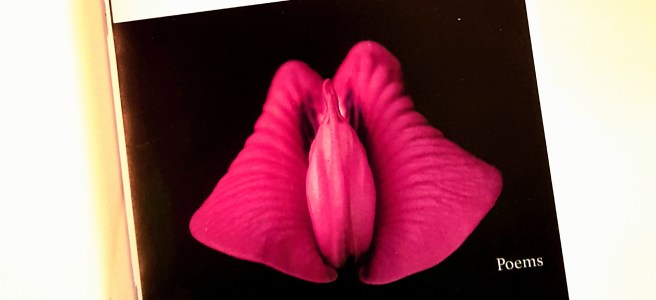
On the other hand, you can’t look at the book’s cover (a photo with the understated title “Red Petaled Flower in Selective-color Photography,” credit: Donald Tong) without thinking of vulva. As with a Georgia O’Keefe painting, you can’t look without gazing, or gaze without longing. And here is where the marriage of wild life and the external female genitalia is clinched.
But I’m teasing you intentionally. Of course, you want a review to tell you about the poems. Simply stated, they are about a woman’s life, her partnership with a compassionate man, their wildlife treks, and her physical inability to have sex without pain. In these poems, there is something very natural, very sad, and very beautiful about the woman’s plight, a tango of words and their meanings:
Vulvodynia, vulvar vestibulitis, vaginismus— they sound like the names of flowers, beautiful ones.
Davis’ imagination leans towards the outdoors, where of course, there is often danger, but always grandeur. She names the vagina ‘cave’ and makes a spider web of the body. In “Cave Study,” she begs the question:
What exhausted spider slogs along inside my body, assembling her last home?
If you come for me, love, you will catch at my cave’s mouth, rip her long assignment.
Overwhelm the web—I am full of faith. Silk sticky, seek my grotto’s fingertips.
The craft in Davis’ descriptive lyricism is remarkable. Her gift to us in these poems is to not linger in gloom, but to transform it. The poems are mostly in couplets—Davis’ nod (more than a nod, really) to the partner who accepts the problem as spouse cares for spouse, as mother nurses infant—with affection, humor and patience. In “Vaginismus” Davis offers this lament,
What is this body if I cannot— when full of desire—join with a man. I have waited so long to find you.
I told the sky prayers. And the sky listened. When I fell out of the trees strangers showed me
where you dwelled. Now that I have brought myself to you I cannot bring myself to you, fully.
Then, in “I am a New Caledonian Owlet-Nightjar,” there is this benediction,
No one has heard my voice but you— a different genus of bird who sought and discovered me
I beat my wings against yours unable to mate but look
how groomed my semiplumes
Creating lyricism from chronic pain is a remarkable feat. Davis’s exploration is deep and wide; it includes forays into the woods and travels to basilicas. It notices death as an arbiter of what is truly important. “In the Forest by the Bay,” Davis informs us,
Grey beard, furrows, arthritic feet. I know enough to know I must imagine
you dead, that every day has its own grief, understanding we cannot go on this way— living
While writing this review, I happened upon a superb poem titled Vulvodyniaby Ellie White online at Foundry. What a rare coincidence! In fact, the popular and medical literature of vulvodynia is hardly inspired. There exists a National Vulvodynia Association (the you-are-not-alone source for women with the condition); numerous vulvodynia products and self-help books for sale on Amazon; a heavy metal band with the name; studies in peer-reviewed medical journals; a vulvodynia Pinterest page; and, of course, personal-journey blogs.
What distinguishes poetry from information is what we call lyricism. Davis’ poems have the softness of a featherbed and the sharp edges of quills. You will have to read through this short set of poems at least twice, to really take in what she is doing here. Each Wild Thing’s Consent is a transformative work. If I may be excused for trying to paraphrase a “take-home message” in these lush poems, it’s that a poet with her skill can make you think twice about everything you find on the plate you call your life. Everything. And then some.
Yes, my love, we belong, but on soil stained knees, asking for each wild thing’s consent to stand.
Lauren Davis is the author of Each Wild Thing’s Consent (Poetry Wolf Press). She holds an MFA from the Bennington Writing Seminars, and her poetry, essays, and stories can be found in publications such as Prairie Schooner, Automata Review, and Empty Mirror. Davis teaches at The Writers’ Workshoppe in Port Townsend, WA, and she works as an editor at The Tishman Review.
Risa Denenberg is the curator at The Poetry Cafe. She is a co-founder and editor at Headmistress Press and has published three full length collections of poetry, most recently, “slight faith” (MoonPath Press, 2018).




 The Poetry Cafe