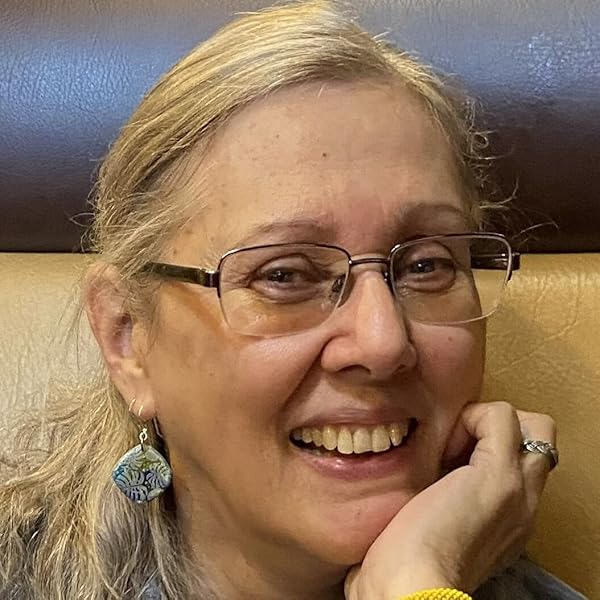
Ellen Miller-Mack is a poet, nurse practitioner, & blues lover. “Hot Tamale Blues” can be heard Tuesday afternoons at WMUA 91.1 FM (www.wmua.org.) Ellen has an MFA in Poetry from Drew University. Her reviews and poems can be found in Lavender Review, Lily Review, Rattle, Rumpus, MER, Affilia, Valparaiso Poetry Review and others. She co-authored The Real Cost of Prisons (PM Press). She co-hosts “Poet Talk” which is broadcast live from WMUA on Thursday evenings . “Poet Talk” is also a podcast on Spotify. Ellen lives in Western Massachusetts.
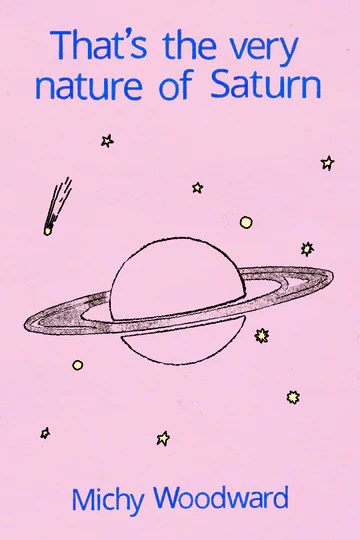
That’s the very nature of Saturn, by Michy Woodward
Published by Bottlecap Press Review by Ellen Miller-Mack
Welcome, Michy Woodward, on behalf of women poets from the ‘70s who wrote poems about their lives and sexualities with honesty and clarity. The energy of That’s the very nature of Saturn got me thinking about a poem by Pat Parker (1944-1989) titled “For Willyce” and the poetry of feminist poets Diane Wakoski (b. 1937) and Alta (1942-2024).
The chapbook opens with “We used to be a society,” a litany of well-crafted arrows aimed at Tesla, Ozempic (“America’s least politicized needle”), and targeted direct-to-consumer botox ads, interspersed organically with ideas that are more interior, serving the poem with moments of acute self-awareness and wry humor, stating, for example, that lesbian dating is so fraught with “… the fallacy of the top shortage [it’s] as if I don’t exist.”
There are many deft leaps and delightful surprises in this collection. The poems are trustworthy and left me wanting to know where they were going. In both “monday and then tuesday” and “it’s 2 am on a Wednesday,” I catch a whiff of Joanne Kyger (1934-2017) who wrote wonderfully quotidian poems that may appear at first to be journal entries. Woodward offers a kindred poem beginning with “and I don’t have health insurance/but I feel lucky to be alive “ and ending with,
kissing the morning with laziness the gorgeous possibilities of tomorrow which is already today.
I am enchanted by “your blue subaru,” a tender love poem in which Subaru rhymes with (the singer) Erykah Badu. It’s a small poem, nine short lines, beautifully crafted.
Woodward’s poem “hot girls” appears in the June 2024 issue of Lavender Review. It led me, with great enthusiasm, to this chapbook. In “hot girls,” Woodward laments “ i just keep trusting hot girls who are hot enough to make me trust them.” The hot girls are ravishing and ravaging stand-ins for the perils of love and lust. This poem is expansive, honest and funny, the kind of funny where you know the goddesses are laughing at you so you have to laugh along. It’s a love poem to our susceptible selves. It’s also a young lesbian poem. I wonder if young lesbians would be surprised to know that the longing, lust, love, and desire dip into unrequitedness and even kaleidoscopic sex as they grow older. Lesbian or not, follow Michy Woodward; she is a talented and sure-footed poet.
Curator’s note: Ellen Miller-Mack compares Woodward’s poems with past work of important lesbian and feminist poets. You may not have heard of these poets, and links are included to encourage you to check out their work. –Risa Denenberg
Michy Woodward (she/her) is a queer, mixed-race, Asian American Brooklyn-based writer and artist from Miami. She loves exploring intimacy, sensation, and the relationship between interiority/exteriority through her writing. Her work largely indulges in the softness of everyday life. Her poetry has been published in Bullshit Lit, Queerlings, Lavender Review, Roi Faineant Press, Silly Goose and The Amazine. You can find her on instagram @michywoodward. She loves Sundays, her cat Kimi, and being near bodies of water.
Ellen Miller-Mack is a poet, nurse practitioner, & blues lover. “Hot Tamale Blues” can be heard Tuesday afternoons at WMUA 91.1 FM (www.wmua.org) Ellen has an MFA in Poetry from Drew University. Her reviews and poems can be found in Lavender Review, Lily Review, Rattle, Rumpus, MER, Affilia, Valparaiso Poetry Review, and others. She co-authored The Real Cost of Prisons (PM Press). She co-hosts “Poet Talk” which is broadcast live from WMUA on Thursday evenings . “Poet Talk” is also a podcast on Spotify. Ellen lives in Western Massachusetts.
Risa Denenberg is the curator at The Poetry Cafe Online.
Nadja Maril’s chapbook Recipes from My Garden, a compendium of poems and short essays centered around herbs, a kitchen garden, and family memories, was published by Old Scratch Press, in September (2024). Maril’s prose and poetry has been published in literary magazines that include, Lunch Ticket, Spry Literary Review and Across the Margin. A former journalist and editor, Nadja has an MFA from Stonecoast at the University of Southern Maine. To read more of her work and follow her weekly blog posts, visit Nadjamaril.com. https://nadjamaril.com/
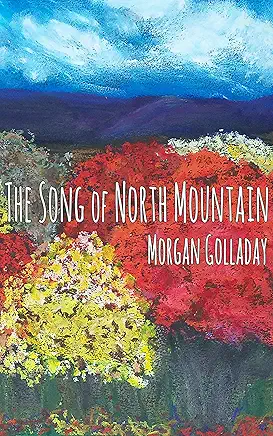
Song of North Mountain by Morgan Golladay Published by Old Scratch Press, 2024 Reviewed by Nadja Maril
Writers begin their journey towards publication at very different times in their lives, some in high school, others after retirement. Is there a right time to begin sharing one’s poems with the world? Perhaps the answer can be found in the quality of a writer’s first poetry collection.
The Song of North Mountain, a debut chapbook by Morgan Golladay, demonstrates the combination of wisdom and excitement of a new guest at the literary dinner table. Golladay takes us on a journey through seasons and times of her childhood home in Virginia, located between the Blue Ridge and North Mountains in the Shenandoah Valley. Golladay’s poems transport us to the foothills of Appalachia, a region that is rapidly changing as our planet warms. Her poems capture the stark beauty and breathtaking colors of the valleys, meadows, rivers, and ridges, as seen in the poem “Spring on the Mountainside.”
Out on the Devil’s Throne careful briars show green, warming, like me, in the heat of the sun. Redbuds languish, eagerly waiting to erupt, to be first, to show true color to this mountain. I trust in their uncompromising cycles, that spring follows winter as night follows day. The redbuds beckon me up the mountain.
Black and white images found throughout the book are original drawings by Golladay, who began the formal study of art in her fifties, preceding her launch as a poet. Expressing oneself in more than one art form is not unusual for poets; her work makes me think immediately of William Blake who so skillfully combined art and poetry in his nature-focused work.
Recently, I had the opportunity to interview Golladay who expressed great enthusiasm for trying new artistic practices. She described an experiment she conducted ten years ago with a friend she met in an acrylics workshop. Both artists had completed seventy-five black and white sketches in seventy-five days and they challenged each other to add poetry to those sketches. Golladay said she decided to combine the two art forms to learn whether the sketch informed the poem or vice versa. “Black and white sketches require a lot of different elements to be effective,” she explained. “Think of the illustrations of Rockwell Kent, the engravings of Durer, sketches of Michelangelo, Picasso, Mayer. For me, it was a steep learning curve.”
The Song of North Mountain is divided into four sections each aligned with one of the four elements: Fire, Air, Water, and Earth. In the fifth century BC, the Greek philosopher Empedocles proposed that the opposing forces of love and conflict upon these four elements create the diversity found in nature. Golladay has chosen these elements as the structure for her poems, highlighting these opposing forces rather than the seasons, which are more typical in nature poetry. Here, the cycle begins with Fire where most of the poems have a connection to light, brightness, and sometimes drought. This section is followed by Air, Water, and Earth.
The home of her ancestors, Golladay’s North Mountain is rich with history and memories. Many of the poems are informed by the changes wrought by time and aging. This poem, found in the Earth section and titled “Family Lines,” begins:
The lots are overgrown with weeds, brambles, saplings jutting through loose stones that mark lost foundations. Someone once lived here.
Someone planted those surviving daffodils, that stray lilac.
Sunday dinners, visitations, funerals, jam-making, weddings, and scrubbed floors celebrated the families that lived here. (Their footprints are found when the yard is tidier.) But the rubble remembers the sweat and the labor, the daffodils recall the hands that planted them.
“Under the Locusts,” found in the Air section, zeroes in on a particular farm. The sense of loss and resignation in this poem is poignant as it documents how the land changes as small farms begin to disappear.
Long after the farm was abandoned, the evidence of thousands of hoof-falls showed among the locusts. Roots stood stark and barren, surrounding dirt worn and blown away. Strange shapes, mystical and druidic in their formation, reared from the dirt, submerging, reappearing several feet away.
There are many poems here about animals, some include humans as well. The poem, “Little Swimmer,” found in the Water section, portrays a venomous snake; another poem in this section is about a stodgy turtle. In our world of cellphones, computers, fast moving cars, and technologies that link global industries and people within seconds, I enjoyed the opportunity to retreat to basic relationships between a harmless reptile and a human. The poem, “A Moment of Grace,” is one of my favorites. It ends with the lines:
We spoke in silence, thanking each other for dappled sunlight, ripe berries, and a moment of grace.
When writing about the loss of her own ability to climb a tree or the cutback of train service to the region, Golladay accepts her changing world with pensive resignation. She more often focuses on wonders that still exist and can still be found if you closely watch, smell, touch, and listen. Song of North Mountain conveys the rhythm of place that is clearly close to the poet’s heart, a sense she ably shares with her readers.
Artist and poet Morgan Golladay’s first published poem was awarded Third Prize in the 2021 Delaware Press Association Communications Contest. Much of her work is reminiscent of her native Shenandoah Valley, its people and places. A graduate of the University of Mary Washington, Golladay’s career included almost 40 years as a volunteer and staff member for several non-profit organizations. In 2024, the Delaware Press Association awarded her the first and second prize for short stories and an honorable mention for poetry. Her first book of poetry, The Song of North Mountain, is a National Book Award nominee. Golladay currently resides in Milford, Delaware. She is tall, left-handed, and blue of eye. Everything else is subject to change.
Nadja Maril’s chapbook Recipes from My Garden, a compendium of poems and short essays centered around herbs, a kitchen garden, and family memories, was published by Old Scratch Press, in September (2024). Maril’s prose and poetry has been published in literary magazines that include, Lunch Ticket, Spry Literary Review and Across the Margin. A former journalist and editor, Nadja has an MFA from Stonecoast at the University of Southern Maine. To read more of her work and follow her weekly blog posts, visit https://nadjamaril.com/
Risa Denenberg is the curator at The Poetry Cafe Online.
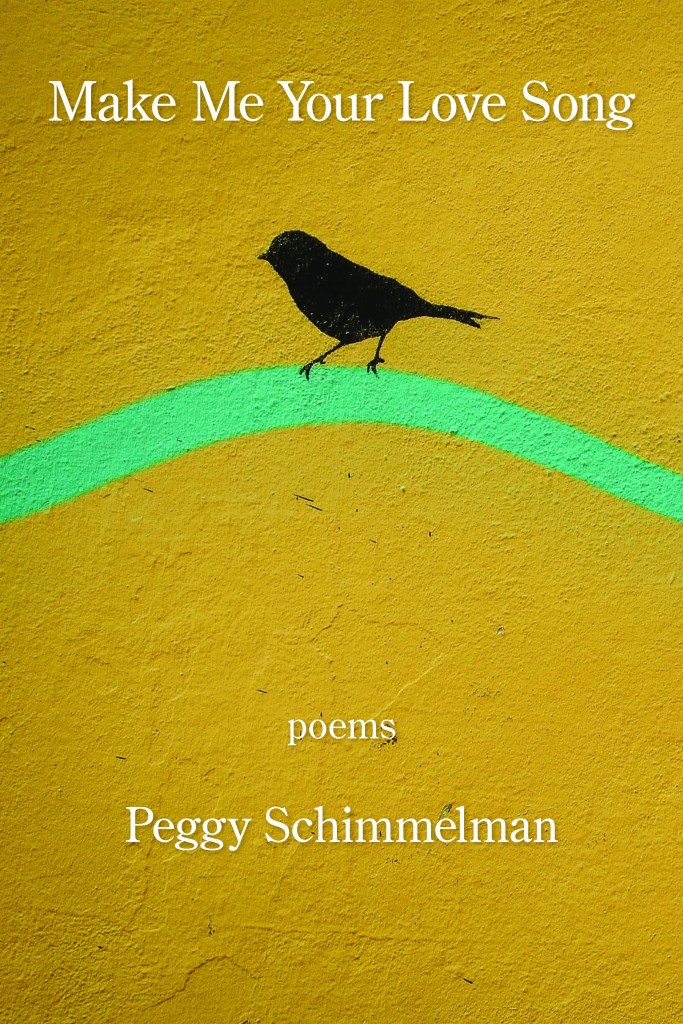
by Peggy Schimmelman Published by Kelsay Books Review by Julie Orvis
I have been a fan of Peggy Schimmelman’s poetry since we took a writing class together many years ago. I have loved and followed her work as she has grown as a poet and has become the local poet laureate of Livermore, CA.
Peggy Schimmelman’s chapbook, Make Me Your Love Song, is a collection of finely crafted poems that offer impactful reflections on life. Peggy’s work shows intelligence, depth, and accessibility in each poem, exploring the range of human emotions from loss and regret to the joy of living and loving deeply. These poems bear witness to the fact that love is about being human: sometimes romantic, sometimes two people simply connecting, sometimes enduring, other times fleeting. Peggy’s employment of language, line breaks, musicality, and the use of white space are consistently elegant. What I love most about the poems is the feeling that they are paying tribute to that which is human in all of us.
The poem, “Cozumel Moon” captures memories of youth:
… in one of those memories, I wonder, a girl green-eyed and wild, just this side of crazy Corona-tipsy and starlight-stoned.
“The Last Lullaby” explores the political realities of our time:
Selam and Adonay, hush now and sleep. Boat man don’t like it when little ones weep. Ahead, Europe waits to shelter and feed us— to welcome us. Children, now listen to me
“Push Through the Night” is a story of facing challenges:
Soon dawn will arrive in a river of light. Float into the morning. Push through this night.
“A Poem in Three” is a romantic ditty that starts with the book’s title:
Make me your love song in three-quarter time conjure me, count me in one-two-three-one-two-three whisper me whistle me dance me romance me woo me infuse me with rhythm and rhyme.
Peggy Schimmelman is the poet laureate of Livermore, CA. Her work includes the poetry chapbooks Make Me Your Love Song,Crazytown, and Tick-Tock, as well as the novels Insomniacs, Inc. and Whippoorwills. Her poetry and short fiction, heavily influenced by her musical interests and her Ozark roots, have appeared in the North American Review, Naugatuck River Review, Peregrine, WinningWriters.com, the Aleola Journal of Poetry and Art, Pacific Review, Comstock Review, Wild Musette, 100wordstories.org, and other journals and anthologies.
Available at Kelsay Books Website and Amazon.com Kelsay Books (August 16, 2024) 68 pages ISBN-13 : 978-1639806126 $20.00
Reviewer Julie Orvis says: “While I have many interests in life, reading and writing have been favorites. I belong to a local writing group, Wild Vine Writers, and have enjoyed writing and contributing to their publications Long Stories Short and Two Truths and a Lie. I’ve also received award recognition for short prose pieces at Pleasanton Poetry and Prose.”
Risa Denenberg is the curator at The Poetry Cafe Online.
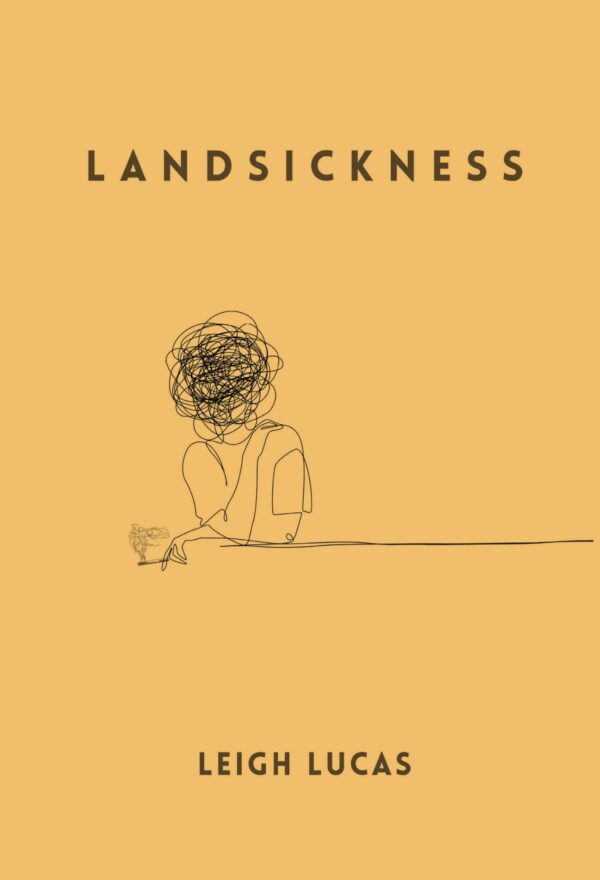
Landsickness, by Leigh Lucas Published by Tupelo Press, 2024 Winner of the Sunken Garden Chapbook Prize Selected by Chen Chen
Reviewed by Risa Denenberg
Your pain is the breaking of the shell that encloses your understanding. –Kahlil Gibran
Leigh Lucas, in her chapbook Landsickness, embodies these words of Kahlil Gibran in her response to the death of a lover by suicide. Her world breaks open and makes no sense to her. She shuts down; refuses to change clothes or bathe; crawls under covers; dreams and fantasizes about her lover; and hoards small keepsakes and details about him. None of these behaviors are unusual in someone newly bereaved; but the intensity of anguish in these poems feels urgent and disquieting. The first line in the first of these untitled poems is: “In my new life, I must learn everything again.” There is no going back, no living with the reality of the death. Everything is undone.
There is a certain mood of unreality in the face of any death (“how can the world go on as if …”), but in some situations, there is no capacity for resolution, for moving on. Lucas dwells in a space that is sometimes referred to as “complicated grief,” i.e., grieving that continues to be intense, persistent and debilitating. To offset the collapse of faith caused by the death, Lucas lands in a deeply creative place: in poems.
I seasick between: I knew this would happen (rock). And how could it have (rock). Between: I knew him as well as I could know someone. And I didn’t know him at all. (Rock, rock.)
I identify with Lucas’ predicament, both as a poet and as a woman who has lost her best friend. Grief can be endless; if it ends, the relationship with the deceased is entirely broken. Lucas says, “The final note I hold’s unending.” It changes with time, but the nature of the loss colors the grief forever. There are so many unanswerable questions. In this case, the never-to-be answered question is: Why? And, could I have done something? Lucas gets no certain answers from a grief therapist.
Q: Can suicide be prevented? A: It depends.
Q: Should suicide be prevented? A: It depends.
And yet, she fears that in fact, she will forget: “Here’s the rub. Fickle memory, swirling time, debilitating seasickness.” This leads to obsessive behaviors, “My own complex system of ordering his belongings and memorizing minutia […] mental tests of recalling exact details of his poems, drawings and letters, of his feet, palms, and the curve of his back.”
Lucas searches deeply for answers, for comfort, for a way to understand if not accept. She digs deep searching for some explanation, some theory to account for the loss. She reports findings from a study of rats that offers an eerily cogent explanation:
Scientists study depression in rats.
How we tell they have it and how bad they have it:
we drop them into a bucket of water and see how long they paddle.
This only circles the question of why wasn’t this death prevented? And how was I to know the depth of his depression?
Does facing fact help? Lucas mulls over the raw facts:
The man I love
Jumped off a bridge on September 30th at 4 in the afternoon.
//
The man I love
taught poetry
to college students and kids at the Y.
And then she distances from the facts with the tiniest of minutiae: “The object // descends // leaving air in its wake.” And, “Kerplop.”
Finally, Lucas adds details from the funeral: “Sitting in front of me, and behind me, and also to both sides, are more former girlfriends.” Readers, I never thought of Lucas as a former girlfriend, despite this addendum. She is all in from the moment of his death, to the end of time with her promise (threat): “The world will be unsettled. // I will unsettle them.”
Leigh Lucas is a writer in San Francisco. Her chapbook Landsickness (Tupelo Press, 2024) was selected by Chen Chen for the 2023 Sunken Garden Poetry Chapbook Award. She has been awarded residencies at Tin House, Community of Writers, and Kenyon, and has been recognized with AWP’s Kurt Brown Prize, as well as with a Best New Poet nomination, Best of Net nomination, and multiple Pushcart Prize nominations. Leigh’s poems can be found in Academy of American Poets’Poem-a-Day, Poet Lore, Smartish Pace, and elsewhere. She holds a BA from Stanford and an MFA from Warren Wilson.
Risa Denenberg lives on the Olympic peninsula in Washington state where she works as a nurse practitioner. She is a co-founder of Headmistress Press and curator at The Poetry Café Online. She has published eight collections of poetry, most recently, Rain/Dweller (MoonPath Press, 2023). She is currently working on a memoir-in-progress: Mother, Interrupted.
Risa Denenberg is the curator at The Poetry Cafe Online.
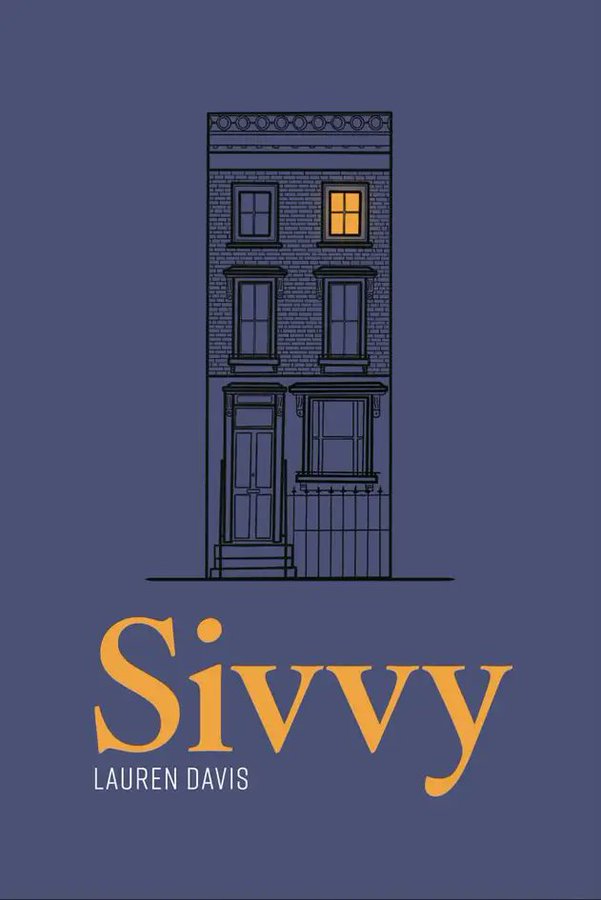
Sivvy, by Lauren Davis Published by Whittle Micro-Press Review by Risa Denenberg
In her newly released and vividly imagined chapbook, Sivvy, Lauren Davis interrogates Sylvia Plath’s state of mind in the days leading up to her death by suicide in 1963 (with footnotes to 1940 and 1956) by distilling letters she wrote into anagrams of her deepest feelings through erasures. In her note on the text Davis says, “These are erasures of the letters of Sylvia Plath” to which “I have not altered her word order.” Her sources are the two volumes of “The Letters of Sylvia Plath,” published posthumously in 2017 and 2018. This small volume is that rare combination of both the scholarly and the dazzlingly innovative.
Sylvia Plath is and will continue to be a touchstone for so many. I entered her work, and her inescapable and tragic life story as a poet and feminist, but also as a mother. In my case, as a mother who lost custody of her son when he was six. Naturally, I’ve always viewed Plath’s work as a poet who was also a mother.
In fact, Plath has a lot to say about being a being a mother, in both poems and prose. In her poem, “Morning Song,” she describes her newborn as a “fat gold watch” while comparing herself to a biologic function.
One cry, and I stumble from bed, cow-heavy and floral In my Victorian nightgown. Your mouth opens clean as a cat’s. –from “Morning Song” Sylvia Plath
This image is echoed in a letter dated February 4, 1964 in Davis’s Sivvy: “The upheaval—I see the finality, / From cowlike happiness into loneliness.” Could I help thinking of how new mothers so often feel abjectly alone following childbirth?
Another of Plath’s poems points to a newly post-partum mother’s dilemma at the moment of accepting or renouncing responsibility for another human being.
I wasn’t ready. The white clouds rearing Aside were dragging me in four directions. I wasn’t ready. I had no reverence. I thought I could deny the consequence– But it was too late for that. It was too late, and the face Went on shaping itself with love, as if I was ready. from “Three Women,” Sylvia Plath
In her auto-fictional novel, The Bell Jar, Plath describes a college-aged girl who makes a suicide attempt. The protagonist recognizes that her ambitions and dreams will be constrained by the cultural expectations that always seem to privilege marriage and motherhood over career and creativity. There is still strong societal pressure on women to have children, despite the lack of support for raising them or the cost to a woman’s personal goals for herself.
“I saw my life branching out before me like the green fig-tree in the story. From the tip of every branch, like a fat purple fig, a wonderful future beckoned and winked. One fig was a husband and a happy home and children, and another fig was a famous poet and another fig was a brilliant professor. … I saw myself sitting in the crotch of this fig-tree, starving to death, just because I couldn’t make up my mind which of the figs I would choose. I wanted each and every one of them, but choosing one meant losing all the rest.” –-The Bell Jar, Sylvia Plath
Having to choose—or more often, having no choice—between raising children and having a fulfilling career is a quandary faced by many women. Was Plath uncertain if she wanted children at all, knowing it would be at the cost of her writing life? It might seem unfair to question her motives or desires; but such questioning is quite familiar to women, if not always voiced. It seems clear, however, that being a single mother with two young children was an enormous challenge for her. For me, this broadens the too-easy interpretation that Plath committed suicide due to mental illness.
In a letter dated, February 4, 1963, Davis allows Plath (whose death occurred seven days later) to give a nod to her earlier suicide attempt (“I fought my way back—”) in a conflagration of language that perfectly reflects the undoing of Plath’s enormously rich inner life.
I fought my way back— I wanted to get it over with—God is a wish— maybe—I would go—I have been alone I need a tonic—I am dying.
I’m using my entry point into Plath’s work, as well as my entry point into Davis’ Sivvy, to acknowledge how thoroughly and intimately Plath enters the imagination of her readers. One of many ways that Davis expands my way of knowing Plath is how entirely in love she was with Ted Hughes from the beginning (“I can’t be with people // that aren’t you.” … “I don’t want to eat until I taste / your mouth again.” Dated October 1, 1956) to the end (“My husband— // he is beautiful. / The whole world // now has him.” Dated January 22, 1963).
I highly recommend this book to you, reader, that you may enter Plath again and anew.
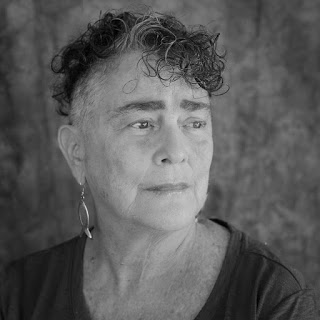
Lauren Davis is the author of the forthcoming short story collection The Nothing (YesYes Books), the poetry collection Home Beneath the Church (Fernwood Press), the Eric Hoffer Grand Prize short-listed When I Drowned (Kelsay Books), and the chapbooks Each Wild Thing’s Consent (Poetry Wolf Press), The Missing Ones (Winter Texts), and Sivvy (Whittle Micro-Press). She holds an MFA from the Bennington College Writing Seminars. She is a former Editor in Residence at The Puritan’s Town Crier, and she is the winner of the Landing Zone Magazine’s Flash Fiction Contest. Her stories, essays, poetry, interviews, and reviews have appeared in numerous literary publications and anthologies including Prairie Schooner, Spillway, Poet Lore, Ibbetson Street, Ninth Letter and elsewhere. Davis lives with her husband and two black cats on the Olympic Peninsula in a Victorian seaport community.
Risa Denenberglives on the Olympic peninsula in Washington state where she works as a nurse practitioner. She is a co-founder of Headmistress Press and curator at The Poetry Café Online. She has published eight collections of poetry, most recently, Rain/Dweller (MoonPath Press, 2023). She is currently working on a memoir-in-progress: Mother, Interrupted.
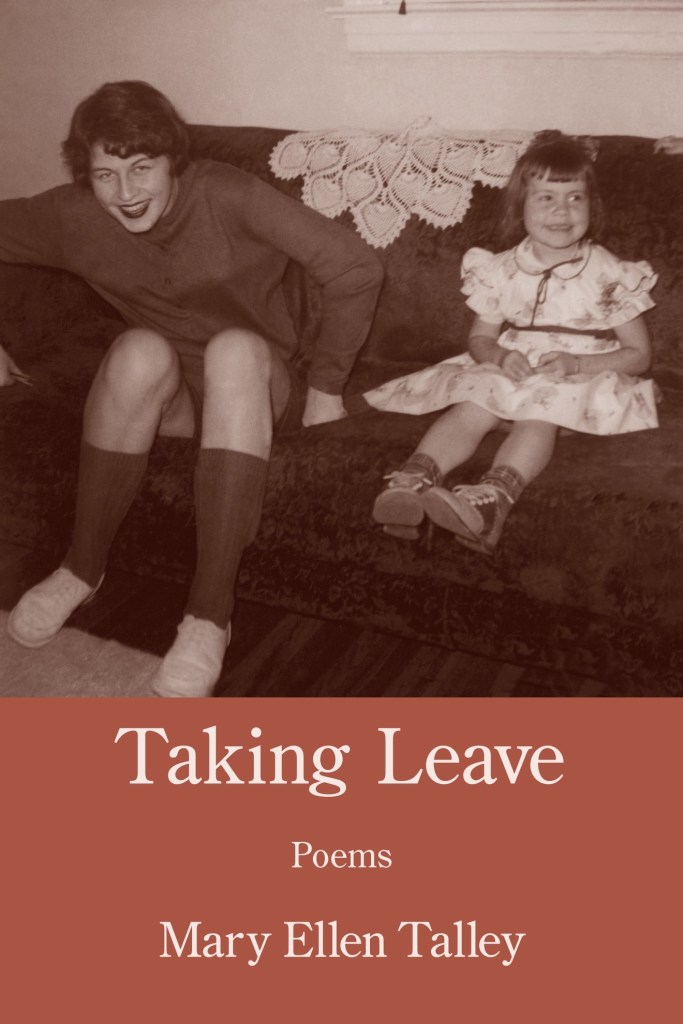
Taking Leave by Mary Ellen Talley (Kelsay Books, 2024) Review by Sylvia Byrne Pollack
I have appreciated Mary Ellen Talley’s poetry since I reviewed her first chapbook, the memoir Postcards from the Lilac City, for The Poetry Café in 2021. Her new chapbook, Taking Leave, is a never-maudlin farewell to her older sister Katherine. This collection—also a memoir—shimmers with two fundamental facets of being human: familial love and death. Yet there is humor and joy in these poems. A variety of forms (villanelle, haibun, palindrome, golden shovel, list), internal rhyme, and unconventional word usage are employed in a fearless and compassionate celebration of the lives of her family members. Talley does not avoid the word death or the circumstances surrounding it.
We first meet Katherine in “You Are From,” an overview of Katherine’s life that concludes with the declaration “You are leaving vital signs.” More details of Katherine’s life flesh out the “Interview.” The spareness of that title contrasts with vivid details as we move back in time from 2023, her final year, to 1937, when she was a fetus in her girdle-wearing Mom. “Call it the cramped circle of my early start.”
This is neither a saccharine nor sentimental description of the relationship between these sisters, twelve years apart in age. “Villanelle to De-Escalate” begins with “affection and grace” but devolves into a question: “Will family ties find harmony that discord can’t erase?”
The cover deserves a special mention–a photo of teen-aged, lipstick-wearing Katherine poised to leap up from a sofa where four-year-old Mary Ellen is perched in a frilly dress. The clothes, the embroidered doily on the sofa back, the girls’ faces capture both bygone days and a lasting vibrancy.
The twelve-year age difference may have meant “We Had Two Different Mothers,” but many shared experiences thread through the poems. In “Glitz,” the sisters agree “we’re like our mother. // This hoarding of desire, this preoccupation with enough.”
In “Ghazal: Unbuckled Shoes” we see an older Katherine whose arthritis prevents her from buckling her shoes and the kindnesses that get those shoes buckled and unbuckled for her. After reading these poems, I think I also would have been glad to give Katherine a hand.
The focus segues from Katherine to her daughter Erin in a series of funny, irreverent, and witty poems dealing with Erin’s cancer diagnosis. From “Erin in Walking Wallenda Mode” to Erin letting her cancer know what she thinks about it in “Texting Cancer” to Athena holding the morphine drip in “Legend of the Fates,” we experience Erin as a feisty, laughter-filled woman. Which makes her death in “Messenger Under Arizona Moon” even more poignant. In the sorrow of a mother–Katherine–losing an adult daughter, Talley deals with her death with a deft hand.
A poem I return to again and again is “Stairway to Hospice Heaven.” It captures so much about the sisters’ relationship while looking unflinchingly at death. It begins and ends with phone calls:
My sister calls to ask if I know about the flight arrangements her son has made, how she tried to call him but his phone went to message. She needs to know how she’ll get to the airport, and whether to bring more than a carry-on bag.
In a few minutes I realize she’s confusing flight time with when she’ll depart this earth – logic blurred by morphine.
What follows in an interplay of Talley’s everyday life with husband and grandkids and asking Katherine if she is afraid of dying. “Well of course, I am. Wouldn’t you be?” In a second phone call Talley reassures Katherine that she’s headed to heaven. A third call is almost not answered – Talley is busy – but she picks up:
I answer to hear Katherine thank me for our prior conversation. And say a quick good night as I stand gobsmacked by the generosity of the dying.
I invite you to be gobsmacked by this bighearted, moving collection.
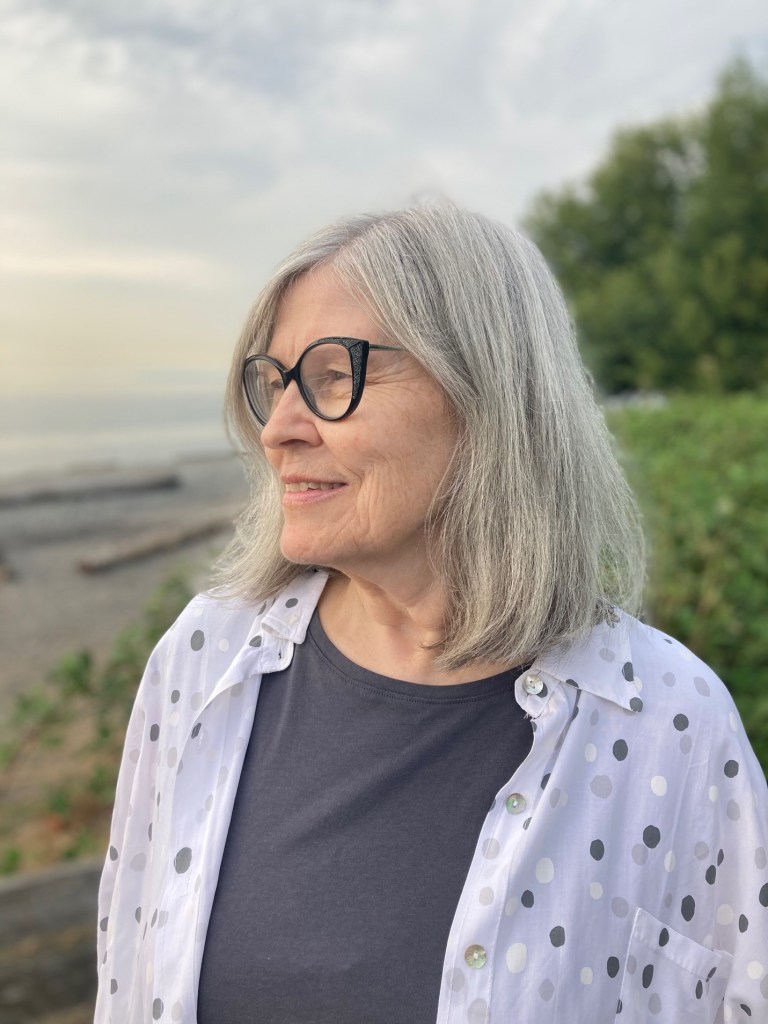
Mary Ellen Talley has published poems in numerous journals and anthologies. Finishing Line Press published her first chapbook, “Postcards from the Lilac City,” (2020) and Kelsay Books published her second chapbook, “Taking Leave,” (2024). She spent many years working with words and children as a speech-language pathologist (SLP) in Washington state public schools and now devotes herself to poetry endeavors. Visit her website at maryellentalley.com.
Sylvia Byrne Pollack, a hard-of-hearing poet and retired scientist, has published in Floating Bridge Review, Quartet, Crab Creek Review,The Stillwater Review and other print and online journals. A two-time Pushcart nominee, she won the 2013 Mason’s Road Literary Award, was a 2019 Jack Straw Writer, and a 2021 Mineral School Resident. Both her debut full-length collection Risking It (2021) and her new collection, What Lasts (2023) were published by Red Mountain Press. Visit her at www.sylviabyrnepollack.com
The Poetry Cafe Online is curated by Risa Denenberg.
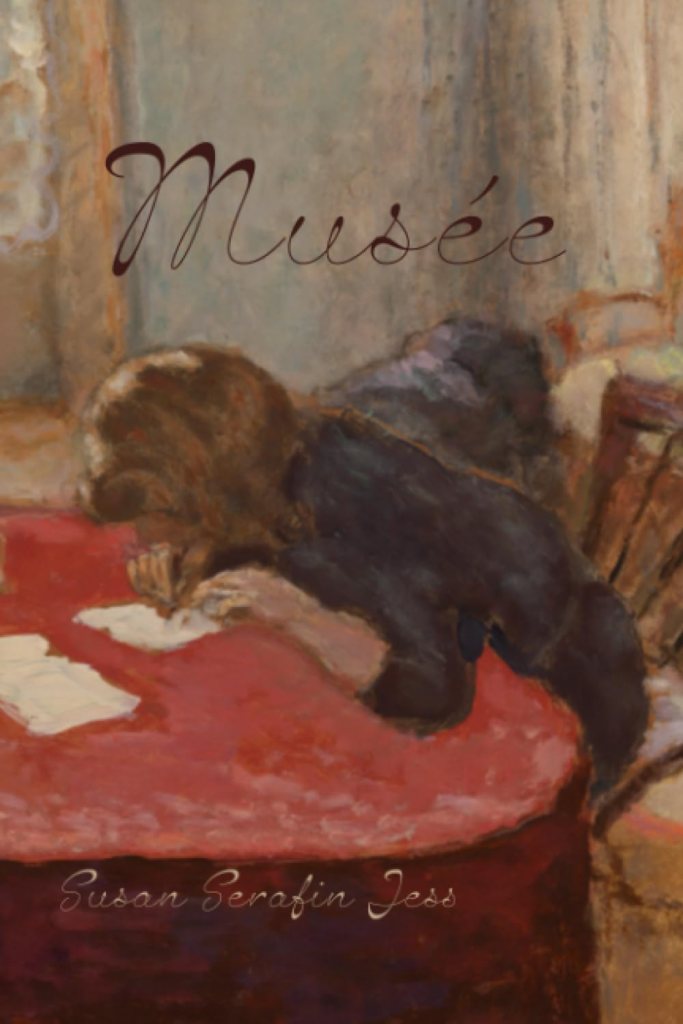
Musée by Susan Serafin Jess Review by Cheryl Caesar
Artifacts beckon to us. They’re visible on the top of the culture iceberg, along with Behaviors and Language, while Values and Beliefs lurk beneath the surface. So writing teachers, like Susan Serafin Jess and me, often call on artifacts in class, as a means to revelation. In her latest poetry collection, Musée, Susan volunteers, like a good teacher, “I’ll go first.” And then opens for us her cabinet of curiosities.
It’s a strong and workable trope. Events, people, and places can be overwhelming and hopelessly complex. But the smell of a fountain-pen nib, the swoop of cursive, the “rather pretty” coffee stain on a student paper (“the color of mourning doves, and heart-shaped”) will fit in our cupped hands. The first six poems read like a bit of memoir—the writer’s life reified through her tools of pen, pencil and paper.
Next the writer turns her gaze to other paper relics: a paycheck, a ticket stub, a telephone directory for the city of Battle Creek. Seeing family from the outside offers a new perspective, and each directory entry is followed by an invocation to the subjects of the listing. Locating the two people who would become her parents, she writes,
My father, Robert L. Mowery, pharmacist, mixes potions and elixirs at Alexander Pharmacy.
My mother, Bettie, teaches home economics at Southwestern Junior High. She describes her students as half man and half child. half tame and half wild.
Oh, domestic goddess and martini shaker, aiming to please, failing to please, how deeply you must regret that tipsy blind date. Already you are pregnant with twins.
Other objects from a Boomer life follow: a spun bottle, a bar of Neutrogena, a transistor, part of the author’s “quest to lead a more analog life.” “Mom’s iron” appears, and Susan’s own “unemployed” iron. Small globes feature fog and rice, instead of snow. Now it is 2023 and the poet lifts a Mason jar, wondering how to fill it, what to take to give pleasure to our friend Rosalie, who died of cancer last summer.
As readers, we too feel the craving for a life that is not a “Second Life”: for solid objects, weighted in the hand. In her final poem, Susan empties her purse for us, like a kindly aunt entertaining us in a waiting room. Although she laments, “Whatever you need most urgently will sink to the bottom,” we are delighted with her finds, feeling that she has indeed found “the pen for the perfect line in the poem.” Like a good museum exhibit, this collection has satisfied our senses, our minds and our imaginations.
Susan Serafin Jess taught writing for many years at Lansing Community College before retiring. She has published four other collections of poetry, and a true-crime/memoir mélange, Wild Horses. Of this most recent collection, she writes of being inspired to follow the theme of artifact by a 2019 exhibit at the Library of Michigan, The Secret Lives of Michigan Objects, and by Pablo Neruda’s Odes to Common Things.
Cheryl Caesar is a writer, teacher of writing and visual artist living in Lansing. She is an associate professor at Michigan State University, and does research and advocacy for culturally responsive pedagogy. Cheryl’s chapbook of protest poetry Flatman is available from Amazon, and some of her Michigan poems, watercolors and charcoal sketches appear in Words Across the Water, volumes 1 and 2, a collaboration between the Lansing and Chicago poetry clubs. In summer 2023, she won first prize for prose in the tri-county My Secret Lansing contest. Cheryl is president of the Michigan College English Association and secretary of the Lansing Poetry Club.
Risa Denenberg is the curator at The Poetry Cafe Online
Mary Warren Foulk has been published in Fjords Review, The Hollins Critic, Pine Hills Review, Palette Poetry, Silkworm, and Steam Ticket, among other publications. Her work also has appeared in Who’s Your Mama? The Unsung Voices of Women and Mothers (Soft Skull Press), (M)othering Anthology (Inanna Publications), and My Loves: A Digital Anthology of Queer Love Poems (Ghost City Press). Her chapbook, If I Could Write You a Happier Ending, was selected by dancing girl press (2021) for their annual series featuring women poets. Her manuscript Erasures of My Coming Out (Letter) won first place in The Poetry Box’s 2021 chapbook contest. Her manuscript Self-Portrait with Erosion was a finalist for the 2021 Gival Press Poetry Award, and the Inlandia Institute’s 2022 Hillary Gravendyk Prize.