Dangerous Women

Dangerous Women, by Jesi Bender
Published by Dancing Girl Press

Review by Jennifer Saunders

Patriarchy can transform nearly anything about a woman into a threat. Representative Alexandria Ocasio-Cortez is frequently criticized for paying too much attention to her wardrobe, but when Janet Yellen—secretary of the Department of the Treasury—appeared before Congress wearing a suit she had worn in public five weeks previously, she was criticized for that. Meanwhile, in 2014, Australian TV host Karl Stefanovic wore the same suit on air every day for a year as an experiment, and nobody noticed. Hillary Clinton was regularly criticized for being “shrill” but when she softened one debate appearance with a laugh and a shoulder shake, she was deemed unserious. It’s the classic double-bind: damned if you do and damned if you don’t. Which is why, in Jesi Bender’s poetry chapbook Dangerous Women, the “Married Woman” and the “Unmarried Woman” can both be declared dangerous. The “Young Woman” is a threat, but so is the “Old Woman.” There is either the “Beautiful Woman” or the “Unseen Woman.” The “Woman Apart” is suspect, but so are the “Women Together.” Why, it’s almost as if it’s the fact of womanhood rather than any particular behavior that’s considered threatening under patriarchy.

Too smart dumb blond too pretty what a dog too loud too pushy too bitchy too much. Who does she think she is?

The poems in Dangerous Women pair these archetypal threats with poems inspired by literary and historical figures ranging from Jezebel to Georgia O’Keeffe (who, it should be noted, once said, “The men like to put me down as the best woman painter. I think I’m one of the best painters.”). Bender lays the foundation in her opening poem “Womb Wounds” (archetype, The First Woman) which traces misogyny back to the story of Eve. “All daughters of the same black Eve / she in us birthed sin,” Bender writes. What could have been a source of power—the birthing womb—is reduced to pain, leaving those giving birth to “[b]ear this burden with a grin” and to become “broken bones.”

The line “Now—where is her heart, the core of her flesh” from “JesiBelle Waits For the Hounds” (archetype, The Faithful Woman) strikes me as the guiding thread of this collection. What has happened to these women’s stories? What has become of the core of them? The women in Dangerous Women have either been forgotten, like Maria Sibylla Merian, the German naturalist and scientific illustrator, or flattened into stereotype like Jezebel who is remembered as a harlot rather than as a woman remaining true to her native religion. The core of her gone, all that remains are:

her arms, her legs and her head.
They wanted it this way,
As far as I can tell,
So no one would ever be able to say;
“This, this was Jesi Belle.”

Bender writes this of Merian in the prose poem “Soft Egg” (archetype, The Independent Woman):

That was what she wanted to show the world—that deep down where things crawled and clambered, there were insides so beautiful, so delicate and bright, that they mirrored the infinite ecology of the human heart.

Here we see the heart again, the core.

I do feel compelled to mention my discomfort with one of Bender’s poem, “The Portrait My Mother Made,” (archetype, The Strongest Woman) dedicated to Mamie Till-Mobley and written in Emmett Till’s ghost-voice. This image troubled me:

Cradled by silt I came out
clean as cotton from the gin
released

Is that image one the murdered Till would have used? Coming from Chicago as he did and having been raised by a woman who herself left the South as a very young child, it would not likely have been a natural linguistic reference point of his. More importantly, the cotton gin was the invention that solidified chattel slavery in the South by making large-scale cotton production profitable. In a way, it was contributory to Till’s murder. Placing the image of ginned cotton in Emmett Till’s mouth struck me as a questionable choice.

Bender is on more solid ground when she is shining light on historical figures who should be better known such as the naturalist Merian or Sor Juana Inés de la Cruz, the Mexican writer, philosopher and Hieronymite nun who is considered the first published feminist in the Americas. I was unfamiliar with both these women, and Bender’s poems inspired me to learn more about them. Dangerous Women is at its best when recovering such stories in Bender’s lyrical language. In the “Tenth Muse” (archetype, The Unmarried Woman) she writes in the voice of de la Cruz:

Who
promised you      Salvation
The sky quells and
light     vibrates against skin

Women fly and fall in this collection, become or give birth to birds. “Last night, I dreamt / I birthed three dead birds,” Bender writes in “Shalosh” (archetype, The Childless Woman) while in “A Poem For Emily” (archetype, The Quiet Woman) Emily Dickinson is described as a “little red wren.” Ada Lovelace, considered the first computer programmer, imagines herself flying in “The Bird Machine,” one of the collection’s prose pieces (archetype, The Intelligent Woman): “In her mind, when she closed her eyes, she pictured that as she spread her arms and pushed the wings against the air, there would be a trail of exultant leaves in her wake. {gold} “ In Three Steps on the Ladder of Writing, Hélène Cixous writes, “What is interesting is that birds, writing, and many women are considered abominable, threatening, and are rejected.” The repeated appearance of birds and bird imagery in a collection about how women are constructed as dangerous and threatening taps into this deep root, but Bender’s poems reject rejection. They reclaim and retell. They restore the core.

Jesi Bender is an artist from upstate New York. She is the author of the play Kinderkrankenhaus (Sagging Meniscus) and the novel The Book of the Last Word (Whiskey Tit). Her shorter work has appeared in Fence, Split Lip, and Vol. 1 Brooklyn, among other places. http://www.jesibender.com

photo credit: Sarah Tinsley

Dangerous Women by Jesi Bender
dancing girl press, 2022
32 pages, $8.00
available here:


Jennifer Saunders is the author of Self-Portrait with Housewife (Tebot Bach, 2019), winner of the Clockwise Chapbook Competition. Her poem “Crosswalk” won the 2020 Gregory O’Donoghue International Poetry Prize and appeared in Southword. Her work has appeared in The Georgia Review, Grist, Ninth Letter, San Pedro River Review, and other publications. Jennifer holds an MFA from Pacific University and lives in German-speaking Switzerland.
photo credit: Denise O’Gorman


Risa Denenberg is the curator at The Poetry Cafe Online.

Jennifer Saunders

Jennifer Saunders is the author of Self-Portrait with Housewife (Tebot Bach, 2019), winner of the Clockwise Chapbook Competition. Her poem “Crosswalk” won the 2020 Gregory O’Donoghue International Poetry Prize and appeared in Southword. Her work has appeared in The Georgia Review, Grist, Ninth Letter, San Pedro River Review, and other publications. Jennifer holds an MFA from Pacific University and lives in German-speaking Switzerland.

photo credit: Denise O’Gorman

Real Rhyming Poems

Real Rhyming Poems, by J.M. Allen

Published by Kelsay Books, 2022
Reviewed by Nikki Gonzalez

If you’ve ever held a poetry chapbook in your hands, you know their comparative lightness. They don’t have the physical heft of a novel or even most magazines. Yet their brevity–the majority no more than 50 poems–is what gives them their very weighty punch. The strength of a chapbook is in the concentrated emotion they deliver. And it can be quite a wallop.

J.M. Allen, with his collection, Real Rhyming Poems, delivers his strike in smart, witty rhyme. One could easily underestimate the impact of this style, brush it aside as just an observational comedian in couplets or Seinfeld-in-verse.  But I invite you to look beyond the humor and see the compilation that, while not taking itself so seriously, profoundly allows for connections. I don’t, for example, need to live in Minnesota to imagine just how cold my ears would be in winter and who wouldn’t laugh, albeit with a knowing little ache, at the experience of typing out a heated email. In “An Email Never Sent,” Allen rhymes:

I wrote an e-mail; it was how I reacted.
I was about to hit Send, but a text got me distracted.
The content came to me fast, as my anger slowly rose.
I just kept on typing, with the sharp words that I chose.

The email, of course, isn’t sent after an interruption forces him to re-read his words (and it’s probably for the best!), as Allen concludes, “And so after the delay/ my draft e-mail I re-read,/ And then it struck me–I should just call him instead!”

The poem “Acknowledgement” is perhaps the best example of Allen’s ability to share in the human experience as he writes specifically of the impact of connecting with others through smiles. This poem, a mere four lines in length, creates the emotional encounter of a simple nod or wave in passing–“a feeling that is priceless”:

If you smile and say hi, it might just brighten my day.
Or nod to me in passing, nothing you need to say.
When I’m driving my route, a wave to me would be niceness.
And you may make me smile, a feeling that is priceless.

Reading the poems in Real Rhyming Poems feels like taking a walk with J.M. Allen through his neighborhood, through the seasons, through various terrains–from beaches to hiking trails to the prairie, and through his daily routine as he points out all the details you might otherwise miss. As you synchronize your pace with his, page by page, learning his stride, becoming accustomed to his style, you begin to develop a sense of anticipation, knowing a smart twist will come at the end of each of his pieces. You expect it. You ready yourself for it. You’re giddy with the promise of a knowing, connecting laugh or “aha!” moment.

But the walk Allen takes us on, though it begins easy and fun and playful, begins a climb into observations of more adult issues. The poems go from airy Shel Silverstein-esque read-alouds and move gradually to weighty reflections.  I began to feel the gradation change in the poem “The Lawnkeeper” (published in my own literary publication, The Parliament Literary Journal), a reflection on “that” neighbor–the one who sprays chemicals on the lawn or whose landscaping machinery is loud and annoying and used way too early on a Sunday morning.

Chemicals are often sprayed on it,
and I think ants get it the worst.
No insects at all are tolerated,
even though they lived there first.

Many of us will relate; we laugh knowingly; we connect. But this time when we laugh along, there’s a slight sting. It’s not just disrupted weekend sleep that Allen’s rhymes go after; he also swings a pointed jab at the ignorance and ego that prefers an immaculate lawn over the damage it causes to the environment. We climb higher as Allen goes on to reflect on micro-managing bosses (who end up getting the promotions, incompetent as they are!) in “Eruption”; gun ownership in “Why I Bought a Gun”; and health issues in “Living at the Hospital”, a poem that begins:

I’m mostly living at the hospital,
sure wish I could be done.
I keep needing to give my birth date,
my life should be more fun.

Most likely, we’ve been there too, have given our birth dates over and over to nurses, and technicians, and doctors as well. It feels like an absurdity. And we also understand that, to be in that situation, something serious underlies.

Allen concludes with “Dragons,” perhaps the most serious poem in the collection. Masked in fairy-tale metaphor and layered with his trademark wit, this concluding piece closes our walk together with an undeniable parting squeeze. The final couplet unites all his strengths–the smart rhyme, the unique perspective, the ability to connect to us:  “To calm my nerves, a drink from my flagon / And I promise this time to slay my dragon.”

With each of the poems in the chapbook, we can find connections–with Allen and with each other, sharing common experiences of life that unite, and enjoying a little chuckle about them. These poems are seemingly simple, but impactful indeed.


J. M. Allen is an electrical engineer and parent, who enjoys writing rhyming poems. He is a graduate of the University of Michigan, and has been a longtime resident of Rochester, Minnesota.


Real Rhyming Poems, J.M. Allen
Kelsay Books, 2022
ISBN 978-1-63980-128-2
40 pages, $16.50


Nikki Gonzalez lives in New Jersey where she is a professor of Psychology and publishes The Parliament Literary Journal.


Risa Denenberg is the Curator at The Poetry Cafe Online.

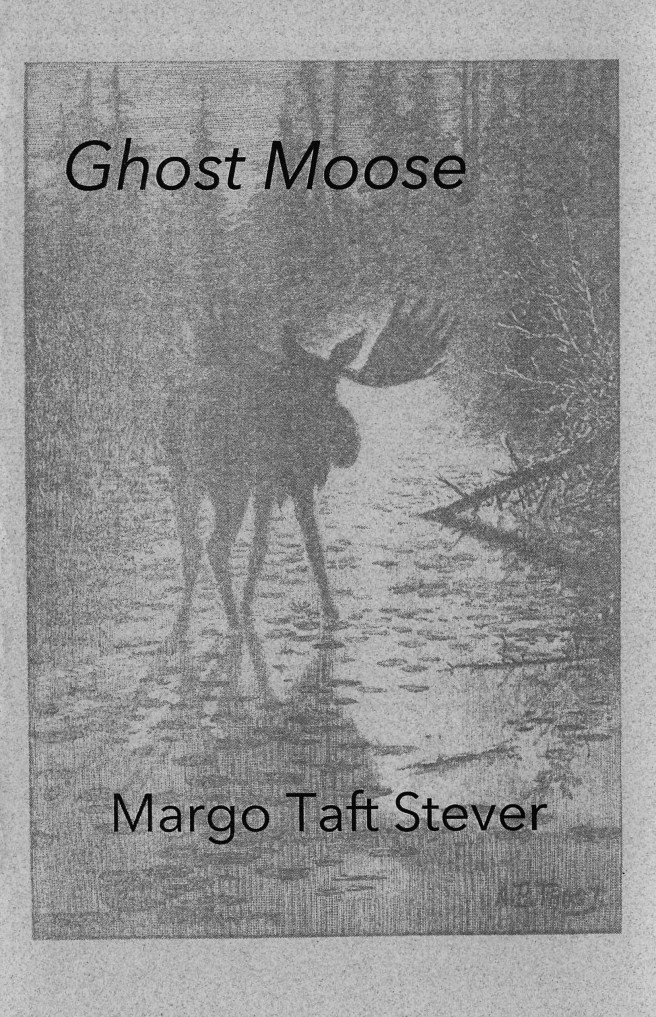
Ghost Moose

Ghost Moose, by Margo Taft Stever
Published by Kattywompus Press

Reviewed by Mary Ellen Talley

Margo Taft Stever’s poems in “Ghost Moose” are beautifully written even as they illustrate the cruel conditions to which humans often subject animals. These poems offer a window into current ecological concerns about the reduction of biodiversity among and within species as well as how deeply this poet values the lives of all creatures.

Some poems combine warning and lament. This poet writes both lyrically and precisely describing human-inflicted animal cruelty. However, when Stever’s poems refer to people within her circle, the poems suggest rather than recount personal details.

Stever sets the thematic stage in her first poem, “Three Ravens’ Watch,” a poem written from the perspective of ravens watching skaters in the painting, “Winter Landscape with Skaters and Bird Traps,” by Peter Bruegel. Such a poem reminds readers that there has always been human folly. With an air of superiority, representatives of the animal kingdom castigate humans of an earlier era, admonishing them about ongoing calamities:

This harshest winter attracts you to skate, to forget
your misery, scrawling icy patterns. Ravens,
three of us, stand sentinel, noticing
your slow-witted motions, your ugly sprawls.

//
You who now skate, do not forget that you will return
to your endless winter, bread riots, witch
hunts, old widowed women targeted, and frozen birds
falling from the sky. We know that you want to eat us.

In an easy transition from the first poem to the title poem, “Ghost Moose,” once again we see children at a river, this time during a mild winter when ticks multiply and afflict moose calves, as “their mothers / witness starvation from blood loss.” Such poignant description calls to this reader’s mind assorted contemporary news photos of mothers hovering near their own children dying of starvation and disease in impoverished or war-torn countries. Stever’s poems call for respect of all sentient beings as she sets animals’ survival and well-being on par with that of humans .

Stever’s poems stand alone as well as share themes and images that glide smoothly from page to page. We know the name of the mental hospital and the names of drugs in Stever’s “Locked Ward” poems. However, we don’t know names of the people confined. It seems intriguing that the first “Locked Ward” poem abuts one about a mother’s death in “Calling Mother After She Died.”

These and other poems abound with images from nature. Stever expands the meanings of her poems by interjecting intimate commentary. For example, in the midst of the above poem, Stever asserts “I have forgotten what bound // us together, mother to daughter.”

Confinement of humans and animals is a through line in this chapbook, as with the three “Locked Ward” poems arranged within the chapbook. In addition, the poem, “Birds at the Zoo,” contemplates how Inca terns appear struggling to exit captivity, whereas the double-wattled cassowary freezes as if in “multi-colored / contemplation of her lot.” This short poem may give a reader pause to reflect how such animal response tendencies inform the human condition, how humans deal with stress and conflict.

In a subsequent poem, it becomes impossible to ignore the stress and searing cruelty imposed by crate confinement of pigs in factory farms. “Litany of the Sow” juxtaposes childhood rhymes with statistics of piglets crushed by the weight of their mothers. The musical poetic devices serve both as contrast and to ease reader tension in a difficult-to-stomach poem. How to ignore the pain of:

Fourteen piglets suckle at her teats;
she shifts her body to keep from losing
limbs. Hear her moans,
                                        bones tear in her skin.

These poems combine anger, prayer, and plea. By following the poem, “Litany of the Sow,” with a poem given the title of a Christian hymn, “Agnus Dei,” Stever’s words allude to “Lamb of God” and invoke “mercy.” This poem describes encroachment of our housing and malls on animal habitat as well as how humans torment animals “just for fun.” Stever’s Biblical reference reminds us of a moral and spiritual call to be not only our brother’s keeper but to honor the lives of all sentient beings. We are called to keep them safe. Humans have inflicted “the sins of the world,” as the poem lists, such as “swamps bulldozed for sun / seekers, McMansions, / strip malls, five-acre “horse farms.’” The last verse of the poem begins lyrically as “Sunlight slants into the victim / pool, missing species, radiant / particles from the past” and ends by intoning, as in prayer, “Have mercy on us.”

This poet is not one to harangue. Let the reader intuit from powerful depiction. One of the last poems, “Beloved Child,” is composed from a letter by the poet’s great-great grandmother, as she lay dying, to her infant daughter. This poem resonates with earlier poems about the poor sow and the mother moose. Contrast this poignant epistolary poem of love with cruelty depicted in the couplets of “The Ballad of the Dolphin”:

Fishermen did not want to compete
with you, but killing you was not enough.

How they used the screams
of several to slaughter more.

Other soothing and ironic poems serve to lighten the harsh truths of this chapbook. Stever’s poems invoke concerns about loss of biodiversity, sometimes called the sixth (mass) extinction. She has written a brief elegy of the Anthropocene. Several poems speak of birthing, of motherhood, and of children. Species, even the human species, seek continuity, and we cannot live without hope and/or mercy.

The final poem of “Ghost Moose,” “End of Horses,” is written “from the end / of the time zone” when “nothing survived after // the horses were slaughtered.” Does this reference anticipate the end of the Anthropocene? One might read the poem as a cautionary premonition.

Reading this gem of a chapbook illustrates Stever’s own dictum. In an interview at The Chapbook Interview, she says, “The poet must have something to say. The poet must write out of passion and necessity rather than an attempt to showcase the latest craft trend.”

Stever’s chapbook is a moving example of ecopoetic literature that deserves wide reading. However long our civilization lasts, poems like these bear witness, inspire, and give us pause to do what we can to make a more positive impact for all species.


Margo Taft Stever’s poetry collections include Cracked Piano (CavanKerry Press, 2019); Ghost Moose (Kattywompus Press, 2019); The Lunatic Ball (Kattywompus Press, 2015); The Hudson Line (Main Street Rag, 2012); Frozen Spring (Mid-List Press First Series Award, 2002) and Reading the Night Sky (Riverstone Press Poetry Chapbook Competition, 1996). She co-authored Looking East: William Howard Taft and the 1905 U.S. Diplomatic Mission to China (Zhejiang University Press, 2012). Her poems, essays, and reviews have appeared widely in magazines and anthologies, including Verse Daily; Prairie Schooner; Connecticut Review; “poem-a-day” on poets.org, Academy of American Poets; Cincinnati Review; upstreet; Plume; and Salamander. She is founder of the Hudson Valley Writers Center and founding and current co-editor of Slapering Hol Press. She lives in Sleepy Hollow, New York. For more information: https://margotaftstever.com/.


Title: Ghost Moose
Author: Margo Taft Stever
Publisher: Katywompus Press, 2018
Price: $12


Mary Ellen Talley is a former speech-language pathologist. Her poems have appeared widely in publications including Raven Chronicles, Flatbush Review, and Banshee, as well as in several poetry anthologies. Her poems have received two Pushcart nominations. Book reviews by Talley appear online and in print journals, such as Compulsive Reader, Crab Creek Review, Entropy, Sugar House Review and Empty Mirror. Her chapbook, “Postcards from the Lilac City,” was published in 2020 by Finishing Line Press.


Risa Denenberg is the curator at The Poetry Cafe Online.

Sharon Waller Knutson

Sharon Waller Knutson is a retired journalist who lives in Arizona. She has published several poetry books, including My Grandmother Smokes Chesterfields (Flutter Press, 2014), What the Clairvoyant Doesn’t Say and Trials & Tribulations of Sports Bob (Kelsay Books, 2021), and Survivors, Saints and Sinners (Cyberwit, 2022). Her work has also appeared in Black Coffee Review, Terror House Review, Trouvaille Review, One Art, Mad Swirl, The Drabble, Gleam, Spillwords, Muddy River Review, Verse-Virtual, Your Daily Poem, Red Eft Review, The Five-Two and The Song Is…

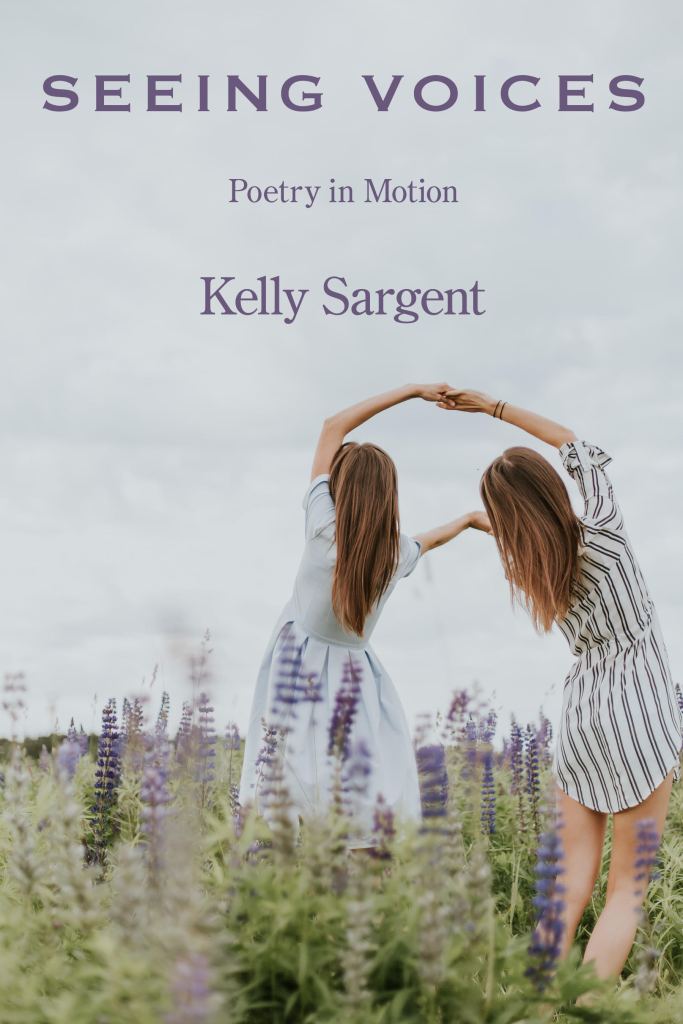
Seeing Voices: Poetry in Motion

Seeing Voices: Poetry in Motion, by Kelly Sargent

Published by Kelsay Books, 2022
Review by Sharon Waller Knutson

Kelly Sargent’s powerful memoir in verse, Seeing Voices: Poetry in Motion is a profound love story of twin sisters, Kelly, hard of hearing, and Renée, deaf, born in a world they didn’t understand and that didn’t understand them, and the loss felt when they separated at the age of twelve.

I met Kelly when she made her debut on Verse-Virtual in February with two poems about her twin sister and I emailed her to tell her how much I enjoyed the poems. She sent me a copy of the manuscript and I was charmed and impressed with her wonderful writing.


Abandoned at birth in Luxembourg and adopted at age three months by an Air Force couple, Sargent writes about deep feelings of responsibility for her younger, smaller twin who cannot hear her own cries because she is born deaf. Kelly takes on the roles of teacher and sign language interpreter.

With exquisite imagery, striking symbolism, and spellbinding storytelling, Sargent expresses a range of emotions, from helplessness, frustration, and sorrow to delight, pride, and joy as the twins become mirrors and learn to rely on each other. When Renée enters the Austine School for the Deaf in Vermont when they are twelve, Kelly feels a loss as deeply as a death and must search for her own identity.

Each poem is powerful and poignant with lines as sharp as a slingshot that propelled me into each one, beginning with “Seeing Voices”:

My twin sister used to shut her eyes
to shut me up when we argued.
Born deaf, she held the advantage in any girlhood fight.
I had no choice but to be instantly
muted;
her eyelids,
a remote control when static sounded like me.

I was mesmerized by an introduction to another form of communication in “Her Voice”:

One day, she would hear
with the nut-brown eyes, then lidded shut,
and speak a language that was already foreign to them.
foreign because they had four ears that weren’t broken,
    or because
they had four ears
that were broken
.

In “Fruits of Labor,” I was fascinated by Sargent’s demonstration of how she taught her deaf twin to form speech:

I wrap your tiny hand around my throat,
size identical to your own,
for you to feel the sounds vibrating within.

blue-ber-ry
ba-nan-a
straw-ber-ry

In “Rumors of Spring,” there is the bittersweet letting go and pride as Sargent watches her deaf twin find her place by attending a special school for the Deaf:

Sunlight illuminated you
and struck you
luminescent.

I watched you play in teal-tinted rains
and marveled as your auburn hair
absorbed autumn’s last dusk.

“Kissing the Horizon” tantalizes with exquisite imagery as Sargent experiences separating from her twin:

Barefoot on the beach swings,
we used to watch the horizon bob —
where sunset unfolds in sleepy, dusty-rose hues
and sunrise yawns,
stretching golden limbs to greet the day.

Cradled in wispy silver threads
cast by a spool of smattered stars, we were
wrapped securely in a vast, uninterrupted galaxy.

Rich in symbolism, “The Quaking Aspen” powerfully speaks to Sargent’s mourning the loss of her twin and beginning her journey of self-discovery:

Dawn curtsies, and I weave the woods, recalling the ghost of my twin sister
by my side, gauzy fingers fluttering in a brittle breeze
.

I shuffle at stubborn crabgrass long covering trails
once carved by four leather sandal soles.
She always wore red.
Parents too easily hoodwinked by identical, ten-year-old imps
had colored me blue.

I seek her still.
My mirror.
I seek it, still. 

“My Voice” is stunning as Sargent shows the beauty in deaf self-expression:

I am Deaf.
My fingers speak

A coiffed paintbrush in my grasp,
my voice streaks turquoise and magenta
across a parched canvas.

In her swan song, “Poetry in Motion,” Sargent reveals the utter joy and excitement of the twins’ reunion and reveling in each other’s company:

Sipping from crystals imbibed
with rosé for me and white for you,
we grow giddy between samples of moonlight,
creamy and smooth on crisp linen.

Fingers spin tales before firelight
as silver-bangled spools unwind syllables
and pastel-polished nails paint on invisible canvases
.

Seeing Voices: Poetry in Motion enlightens on the profound power of love, what it means to hear and be heard, and the mirrors through which we see, lose, and find ourselves again. I didn’t want to put the book down, and will be begging for the sequel.


Born hard of hearing and adopted in Luxembourg, Kelly Sargent grew up with a deaf twin sister in Europe and the U.S., and worked with deaf students in educational settings. She also wrote for SIGNews, a national newspaper for the Deaf. She is currently a Vermont writer and artist whose works, including a 2021 Best of the Net nominee, have appeared in more than fifty literary publications. She is the author of Seeing Voices: Poetry in Motion (Kelsay Books, 2022), also a finalist in the Cordella Press Poetry Chapbook Contest. She also authored Lilacs & Teacups (Cyberwit, 2022), a book of modern haiku, and a poem recognized in the international 2022 Golden Haiku competition was on display in Washington, D.C.  She serves as Creative Nonfiction Editor of The Bookends Review, as well as a reviewer for an organization whose mission is to make visible the artistic expression of sexual violence survivors. Visit at http://www.kellysargent.com.


Title: Seeing Voices: Poetry in Motion
Author: Kelly Sargent
Publisher: Kelsay Books, 2022
Price: $17.00
Also available in Kindle format


Sharon Waller Knutson is a retired journalist who lives in Arizona. She has published several poetry books, including My Grandmother Smokes Chesterfields (Flutter Press, 2014), What the Clairvoyant Doesn’t Say and Trials & Tribulations of Sports Bob (Kelsay Books, 2021), and Survivors, Saints and Sinners (Cyberwit, 2022). Her work has also appeared in Black Coffee Review, Terror House Review, Trouvaille Review, One Art, Mad Swirl, The Drabble, Gleam, Spillwords, Muddy River Review, Verse-Virtual, Your Daily Poem, Red Eft Review, The Five-Two and The Song Is…


Risa Denenberg is the curator at The Poetry Cafe.

Lori Green

Lori Green

Lori Green is a Canadian writer who has been writing poetry and dark fiction since she first picked up a pen. Her work has been accepted in various publications including Ghost Orchid Press, Dark Rose Press, Black Hare Press, and more. She studied English Literature at the University of Western Ontario and now lives along the shores of Lake Erie. She is currently working on her first novel. You can follow her on Twitter @LoriG1408 or on Facebook.

All Forgotten Now

All Forgotten Now: Poems by Jennifer Mariani

Published by Off Topic Publishing
Review by Lori Green

Home.

It is such a difficult concept for some to wrap their head around, especially if one has spent most of their life in a state of constant disconnection, untethered yet still bound to a distant time and place. In Jennifer Mariani’s All Forgotten Now, she brings us on a very personal journey as she explores the world around her, struggling to belong, unable to let go of a country that is an integral part of her soul.

I first became familiar with Jennifer’s poetry through a mutual writing group and at Off Topic Publishing, where I have served occasionally as a guest judge for their monthly contest. Jennifer has taken home their poetry prize twice, and she continues to impress with her ability to draw me right into a poem with only a few words, taking me with her on a fresh path of discovery.

The first poem in this collection “They Call Me Africa” uses vivid imagery to describe all the beauty that is Africa, bringing to life the rhythm and tribal beat of her words, especially when read aloud. The alliteration and subtle rhyme flow naturally from one stanza to the next throughout the entire poem.


“I am the savannah and the Sahara,
the Serengeti and the sun.”

I am the drumbeat and the heartbeat,
the blood that bled
upon this place.”

Jennifer then thinks back on a difficult childhood, unable to fully appreciate the intricacies of a country divided by racism and bloodshed. In “When We Were White” she recalls her love of a young boy, where she inherently knows that their friendship would be frowned upon even though she doesn’t understand it. I loved the last line, it really brings home the basic humanness that we all share, no matter the color of our skin.

I knew just because
that white girls didn’t love
a small black boy
. . . and laughter that sounded
like we were just the same.

A more biting reprove of the brutality of racism and the war in her country can be found in her poem “The Good Racist”. Her word choice is paramount here. Again, in this poem, she seeks to blur the lines between us and them, the prejudice and bigotry of this place leaving a bad taste in her mouth.

They told us of the A-T-R-O-C-I-T-I-E-S

The word swirled through my brain

I tasted it on my teeth…

The children murdered

The bodies littering the bush

no grave marker/no epitaph

No place to lay flowers for their dead. . .

Not since John McCrae has a war poem ever really affected me. Within Jennifer’s poem, I could envision this beautiful landscape bloodied by combat so clearly, so effectively. It truly speaks to her talent as a poet.

It was exceptionally difficult to choose the best piece from this collection, but I would have to include Jennifer’s title piece “All Forgotten Now” as one of my favorites. In it, she circles back to a forced exile from the only home she’s ever known. It struck me as almost lyrical in the way that Wordsworth described a deep connection with nature in his work. Lines like “the fire sun sinking behind jacarandas was etched into vivid memory / miasma of colour / We took the Kariba sky in August and msasas in September” are like brushstrokes of color forming across the page as her words morph into a resplendent canvas of flowers and trees that I can see almost perfectly in my mind’s eye.

As Jennifer leaves Zimbabwe, she is filled with nostalgia, grief, and a sense of deep sadness for leaving the country of her birth and the unknown that looms before her.

We took the pieces of home that we could not carry with us
and stuffed them into our souls. . .

We shivered in new skins and wondered
if the drums would ever beat
for us again.
We took cicadas singing grasped the sweet fragrance of thatch
and woodsmoke. . . .

The sorrow and regret are almost palpable in these lines and the sentiment is repeated throughout her work as if without Africa, she is a fish out of water. Again, in these poems, her word choice throughout drives home the fact that this place is “cleaved” into her very being. Perhaps I feel so strongly about her poems because I too, long for a place that was once my home.

So, I find in Jennifer’s poetry, she speaks to the need in all of us to belong; to something, someone or someplace. She reminds us that the true meaning of home is felt in the heart yet cautions us that though most of us are yearning to go back, we can never truly go home again.


Jennifer Mariani was born and raised in Harare, Zimbabwe. At 17, she moved to Manchester, England, to continue her ballet training. After three years, she returned to Zimbabwe, briefly working with National Ballet and Tumbuka Dance Company. In 2004, Jennifer moved to Canada. She has been a guest judge for Off Topic Publishing’s monthly poetry contest and launched The Poetry Box with editor-in-chief Marion Lougheed. Jennifer writes about Africa, both the landscape and being white in post-independent Zimbabwe. She also writes about women’s issues including domestic violence, body image and eating disorders. Jennifer currently resides in Calgary, Alberta, with one partner, two daughters, three cats and numerous volumes of Pablo Neruda’s poetry. She teaches ballet at Alberta Ballet School. Her favourite poems are written for her children.


Title: All Forgotten Now: Poems
Author: Jennifer Mariani
Publisher: Off Topic Publishing
ISBN: 9781777988821
32 pages   $12


Lori Green is a Canadian writer who has been writing poetry and dark fiction since she first picked up a pen. Her work has been accepted in various publications including Ghost Orchid Press, Dark Rose Press, Black Hare Press, and more. She studied English Literature at the University of Western Ontario and now lives along the shores of Lake Erie. She is currently working on her first novel. You can follow her on Twitter @LoriG1408 or on Facebook.


Risa Denenberg is the curator at The Poetry Cafe.

Ruth Crossman

Ruth Crossman is a Pushcart-nominated writer whose work has appeared in publications including Litro, Flash Fiction, sPARKLE + bLINK, The Fabulist, and Maximum Rock n Roll. Her auto-fiction collection All the Wrong Places was published by Naked Bulb Press in 2022.

Ruth Crossman