Jar of Plenty

Jar of Plenty, by Ruelaine Stokes

Review by Cheryl Ceasar
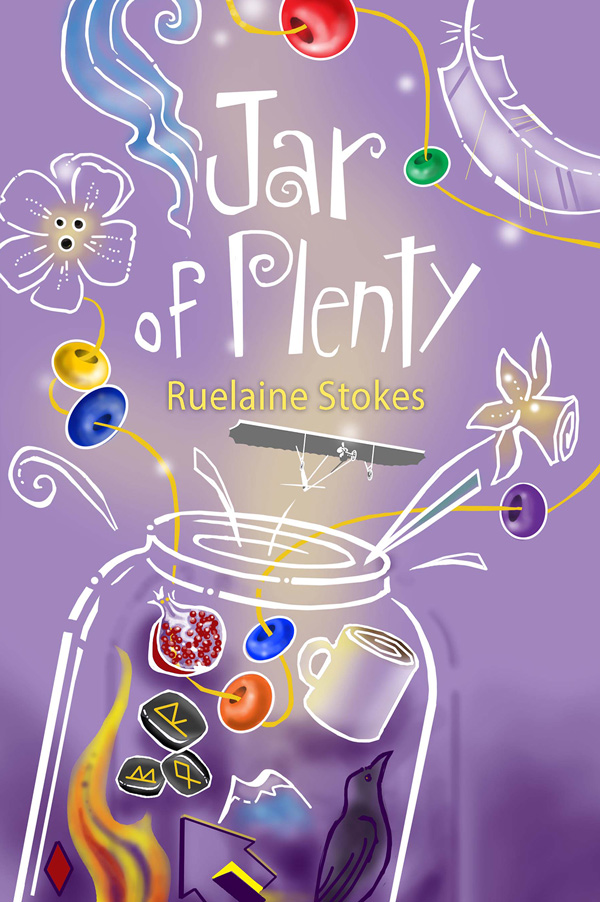
Cover Art by Barbara Hranlovich

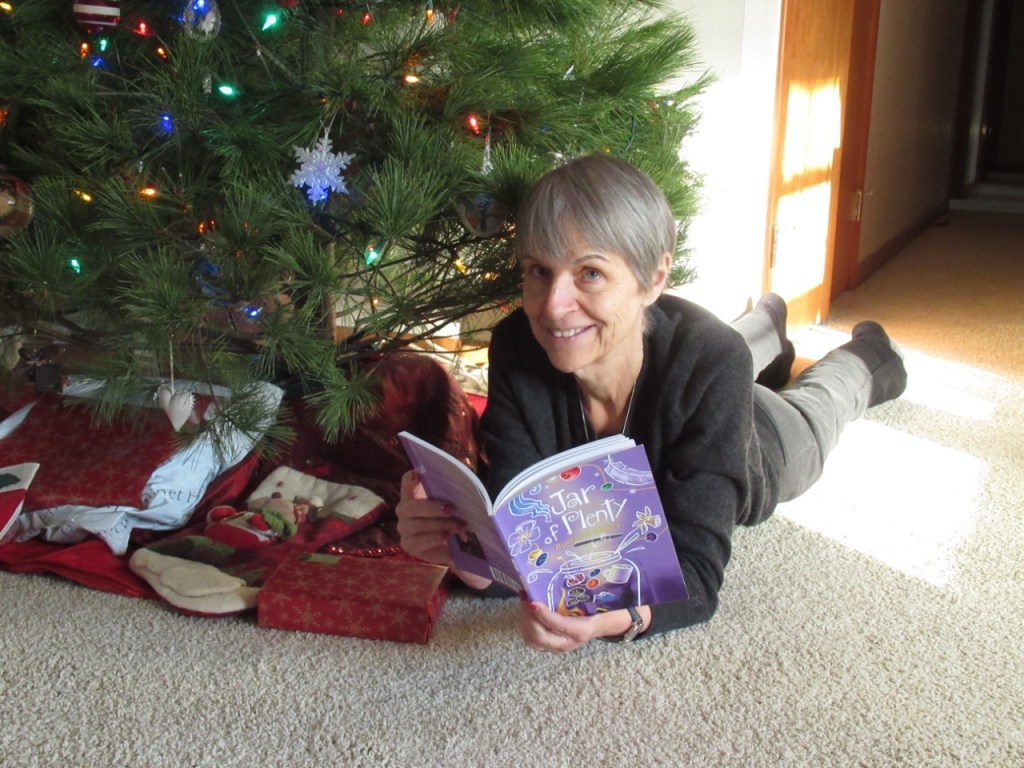
As a child, I dreamed of exploding gift boxes. Not the tame ones you see online, those which simply unfold—although they can be quite lovely. I wanted to find a box that would spray its marvelous contents into the air like the novelty cans that unleash coiled snakes, but with no danger of a chipped front tooth or a poke in the eye. When I opened a manila envelope from my friend Ruelaine Stokes a few days before Christmas, I finally got my wish. The book Jar of Plenty is not only a gift, but a reminder of what a gift can mean.

Start with the cover art by Barbara Hranlovich. On an indigo-chakra background, a white-outlined jar is releasing beads, runic stones, flowers and feathers. An opened pomegranate discloses its secret rubies. A cup of coffee in a plain white mug flourishes its artisanal swirl of foam. A wise raven lifts its beak as flames flicker and steam rises. It recalls the childhood pleasure of plunging my hand into a cookie tin full of variegated buttons.

Open the book; the gifts continue to stream out. Ruelaine draws on her own gift, her talent, to fashion these small parcels of delight. Like a smiling hostess, she guides us through the rooms of her various names, arising from her deep self.

Rue: a street or a regret
Lynne: like a brook or small pool, from her father’s friend
Stokes: from her ancestors, as in the line, “Keep the fire burning,” from her poem, “The Story of a Name”

Alongside black-and-white photos, she introduces her family: The grandfather who fell like Icarus from the sky in “Sailing through Time”; the pretty mother who fled to Tijuana with the priest in “Hard Times for Free Spirits”; the Monster who “sits by the door” and tells the writer she was “never designed to fly” in “Monster”; and then, the writer herself, out the door and flying.

Ruelaine picks up the ordinary artifacts of our lives, one by one, to show their marvels. Here is a pomegranate with its seeds: “each translucent / each bearing the fate of the world,” in “I remember the far-off sky, blue and blazing.” Here are memories of the senses, vividly evoked in “Yellowstone”:

the low moan of the wind  
the hungry grass
the gray stones

I think the gift she is sharing is this: the gift of attention. Attention to every small object, attention to our movements through the world. In “The Priest of Coffee,” the passing of the cup becomes a sacrament, reminding us that every sharing of food or drink is a potential communion.

As I read, another gift appears: a series of meditations, or perhaps a liturgy. Before the Communion comes the reading of the Lessons. “I am turning my sorrows into water,” she writes, with wisdom, in “Intangible Effects.” In “The Poet’s Prayer” is the artist’s petition to the universe: “let me cast these notes / into the wind.” And, the poem, “From the Book of Common Prayer,” grants absolution: “wash my heart and call me clean / the hard time is over.”

A real gift is a moment of connection, passed between outstretched hands. Ruelaine’s life so far has been gifted to poetry, and especially to the local poetry scene in Lansing, Michigan. For decades she has worked here as an “architect of reality”–her own phrase—building the structures, readings, and workshops that bring poets together for a moment of communion. What a joy to find a collection of such moments made tangible and lasting, an artifact of her life’s gift.
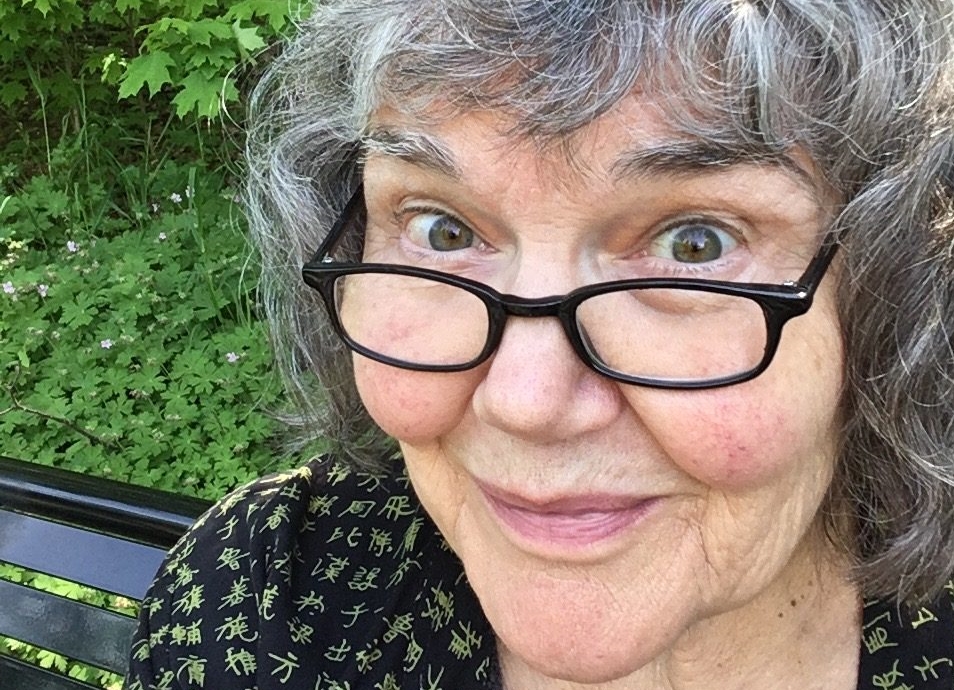

Ruelaine Stokes is a poet, spoken word artist, teacher and arts organizer based in Lansing, Michigan. She has a BA in English literature from Stanford University, an MA in English literature from Michigan State University, and an MA in Teaching from the School for International Training in Brattleboro, Vermont. She worked for many years teaching English as a Second Language at Michigan State University, Lansing Community College, and in community ESL programs. She has also taught classes in English literature, Poetry, Women’s History and Writing. For many years, she has organized poetry performances, readings, open mic events and workshops within Mid-Michigan. She is currently the president of the Lansing Poetry Club.

Title: Jar of Plenty
Author: Ruelaine Stokes
Published by Author, 2019 (Printing Services at Michigan State University Libraries)
pp. 74    $15
ISBN is 9780578339085

Cover Art: Barbara Hranlovich

Cheryl Caesar lived in Paris, Tuscany and Sligo for 25 years; she earned her doctorate in comparative literature at the Sorbonne. She teaches writing at Michigan State University. Some of her COVID-era poems appear in Rejoice Everyone! Reo Town Reading Anthology, and in The Social Gap Experiment, both available from Amazon. Her writing and artwork will appear soon in Words Across the Water, a joint anthology by the Lansing Poetry Club and the Poets’ Club of Chicago. With co-editor Ruelaine Stokes, she is gathering a volume of reminiscences of the Lansing poetry scene in the 70s and 80s.


Risa Denenberg is the curator at The Poetry Cafe.

Meg Files

Meg Files is the author of the novels Meridian 144 and The Third Law of Motion, Home Is the Hunter and Other Stories, The Love Hunter and Other Poems, Writing What You Know, a book about taking risks with writing, and a poetry chapbook, Lit Blue Sky Falling. Her novella, A Hollow, Muscular Organ, has just been published. She has been a Bread Loaf fellow and the James Thurber Writer-in-Residence at The Ohio State University. Find more at megfiles.com.

Keep the Singing

Keep the Singing by Liza Porter

Published by Finishing Line Press
Review by Meg Files

For years, in college workshops, I’ve admired Liza Porter’s poems and essays for their urgent willingness (need?) not only to face but to interrogate tough and troubling material. “To be an artist means never to avert one’s eyes,” said filmmaker Akira Kurosawa. In her new chapbook, Keep the Singing, Porter’s eyes look deeply into memory, loss, love, and grief in this elegy to her sister — even if at times those eyes must have been blurred by tears, as mine were.

The short opening poem, “Sister,” introduces the sisters’ intimacy:

Sometimes when I think of O’Keeffe
I see
rusty orange petals
and myself
at twelve
going to you in the night
when the blood came.

It also introduces us to the flower motif running through the book. In “The Vigil,” flowers are placed in her sister’s hands “as she lies on the table / after the women wash her body,” and then on the fourth day, they are gone. In “Sing a song for her leaving,” years later, the poet searches for signs of her sister’s soul in the world without her and tries to convince herself with spring, new grass, and “persimmon blossoms, bright orange / as the sun when it sets …” In “Going Home,” just after the death, the unfairness, the bitterness, and the anger (rage?) drive the imagery:

I remember my grandmother’s sweet peas along the back fence
lavender and pink and white, and the ghost-yellow lawn that never
quite thrived, you could have flamed the whole fucking thing with a
single smoking match.

Then in “Cremation,” this time the flowers are only carved on the pine box and then burned, and the poem cries out the torment of absence, with others’ false comfort when they say,

… she still lives in our hearts they say she’s in the Light they say
in the Light they say in the Light. Fuck the Light.

Near the book’s end, in “Poem for Edie on Thanksgiving,” Porter tries to console herself with an image of blue flowers in her sister’s spirit’s hands and apologizes for not letting her go “as smoke from a fireplace floats into the sky.” But no, she comes to know that she cannot, nor should she, for the work of poetry, the loss and the love require “this eternal questioning.” This mystery. In “The time you have,” the making of art is the way to “withstand / our world’s dive into darkness.”

Of course, it’s not enough for the artist to declare the willingness to look at tough material. It is the careful craft of these poems that lend them their unsentimental grace. It is imagery such as “sudden clouds rubbing the sky with charcoal shadows” in “The Therapist.” It is the symmetry of stanzas. It is the haunting anaphora of “When a sister leaves” in “Elegy in Blue.” It is the small details that are “insignificant unless we listen with more than / our ears” in “The Music.” It is Porter’s attention to details that render the poems so movingly attentive to life.

“A Sort of Sigh” brings the poet a farewell visitation. And it is the final poem in this provocative, evocative elegiac collection that move at last to “the memory of a face / as bright as that moon when darkness falls,” to a fully present sister who “will always track the light.”


Liza Porter’s chapbook Keep the Singing was published by Finishing Line Press in November 2021. Her chapbook Red Stain (Finishing Line Press 2014) was finalist for both the 2015 Arizona New Mexico Book Award and the 2015 WILLA Award (Women Writing the West). Her work is published widely in journals and anthologies. Porter received the 2009 Mary Ann Campau Memorial Poetry Fellowship from the University of Arizona Poetry Center. She was founding director of the Other Voices Women’s Reading Series at Antigone Books in Tucson, Arizona. Three of Porter’s essays have been listed as Notable Essays in Best American Essays. www.lizaporter.com


Title: Keep the Singing
Author: Liza Porter
Publisher: Finishing Line Press, 2021
ISBN: 978-1-64662-641-0
31 pages, $14.99


Meg Files is the author of the novels Meridian 144 and The Third Law of Motion, Home Is the Hunter and Other Stories, The Love Hunter and Other Poems, Writing What You Know, a book about taking risks with writing, and a poetry chapbook, Lit Blue Sky Falling. Her novella, A Hollow, Muscular Organ, has just been published. She has been a Bread Loaf fellow and the James Thurber Writer-in-Residence at The Ohio State University. Find more at megfiles.com.


Risa Denenberg is the curator at The Poetry Cafe Online.

Make for Higher Ground

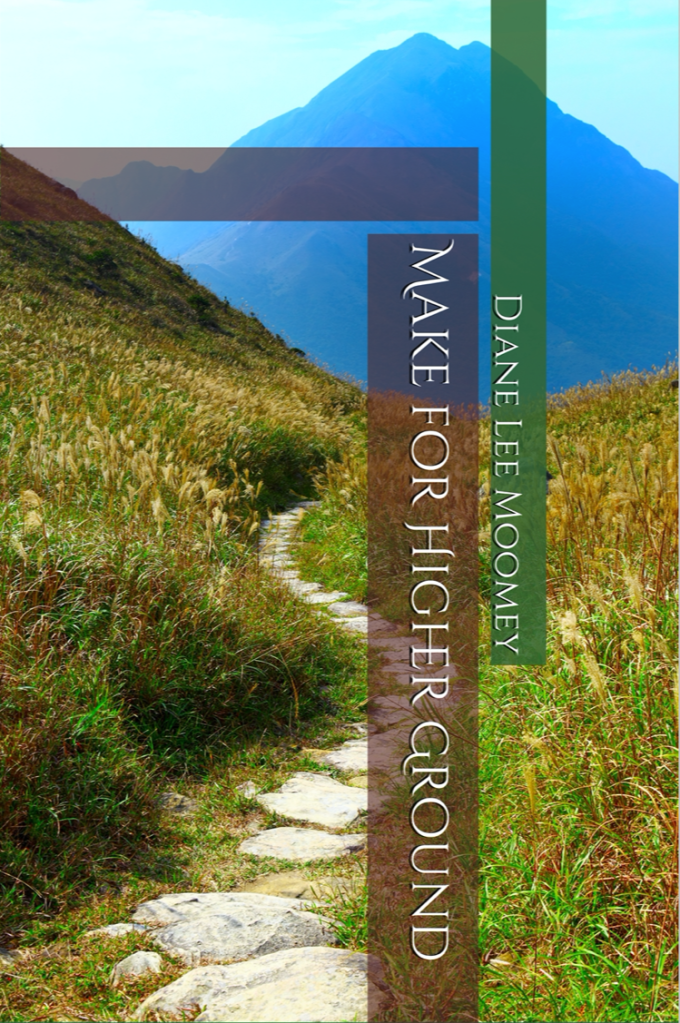
Make for Higher Ground, Diane Lee Moomey

Published by Barefoot Muse Press
Review by Laura Schulkind

Diane Moomey is one of those masterful form poets who uses structure to challenge boundaries. Her new collection, Make for Higher Ground (Barefoot Muse Press, 2021), does just that. Throughout, it is evident she has drawn on I Ching: #57, Penetrating Influence, which she speaks of in the introduction and riffs on in the opening poem, as the collection both offers a path to higher ground, and persistently urges us to take it.  

Her path begins with “Small Wild Things,” a group of poems that leads us into the high grasses that lie just beyond the road. In the poem, “in tall red grasses once,” “she finds “a nest / not far from where we’d parked the Chevy.”  She creates similar images in “Wearing Snakes,” where she finds sleek snakes, “In summer’s green beside the fence, / by long stems my father’s mower doesn’t / reach,” and in “Time Share at the Country Club,” where she imagines wild cats in the forest abutting the golf green:

So now you’ll bide your time
until the dusk, hiding in the rough.
I pack my clubs and seek the car, slam
the trunk. You hang around, shadowed. Eyes:
it’s your turn, now. You’ve waited long enough.

In juxtaposing human activity and wildness, she urges that we not forget our connection to the wild—even as we mow and drive and golf and stay indoors with the radio blaring. As she concludes in “Chaparral,”

turn up the radio,  
blot out the yucca and the sage,  
the calls
of all that’s feral. You know the wild
is out there. Sometimes
that’s all you need.

From there, she takes us to our beginnings in a section titled “Tap Roots”— suggesting we can’t get much of anywhere without understanding our origins — such as in “The Other Attic,”

I’d only need a ladder. I’d reach
and push that square aside, unseal
that other attic—not the one
that holds our bedrooms—and reveal
what must be hidden! Once inside
I’d open trunks and boxes, pry;
so certain that I’d found the place
where all the family secrets lie.

The intimate details of these poems, as in “Her Screen Porch,” also convey a loving eye.

the wicker chair with yellow chintz
that curved to fit her, cabbage roses curved
around her; mother’s mother.

This gentleness suggests we can cherish where we came from without getting trapped there.  In “Carousel,” she considers her own mother’s choices, and in so doing perhaps explains her own:

crimson wheel is spinning
‘round a center of mirrored tesserae, flashing
tails and faces, scent of cotton candy.
You could get off. You may have wanted something
else: the purple unicorn, that pearly
horn, the tail swept high across an arching
back, a gilded halter. Instead, the grey mare.  

Now grounded, the book offers us “Fractals,” a series of poems on how to navigate a dangerous world. Here we find perfectly placed at the middle of the book, “Water Above Water Below,” (a riff on I Ching “#29 —Danger”), which gives us these final lines:

The lamps are going out, dear
one by precious one and it’s for us
to choose to live in darkness or, blind
and trembling, make for higher ground
and set ourselves alight.

Then, in the last two sections she suggests a way out of the darkness. In the series called “Coming Up For Air,” the poems remind us to find delight in the world we have. In “Kiss Kiss, 2020,” dear friends embrace amid the pandemic:

Tomorrow afternoon we’ll meet outside
your house. I’ll squeeze Purell into my right
palm and gently stroke your left cheek;
you’ll do the same for me, from lip to ear.

In “Pandemic Picnics, a Proposal,” she plans: “We’ll take a fender each. I will reach across / with love and gloves / to pass you opener and Anchor Steam.”  And in “At the Dollar Bins,” she delights both in the treasures that can be found there and the fun of rummaging for them:

She’ll gather not
because she must eat crumbs or take
whatever comes, or lick the final
jelly from the jar and not
because somebody somewhere may
be starving. Gather, glean—to keep
or give away—because something  
in this skirt, that sequined vest,
those purple gloves, is still alive.  

In “Lights Above the Poles” she adds, and ends, with love.  A gorgeous series full of sky and light, these poems tell stories that remember, long for, miss, and sustain love. “Ode, with Wings,” almost soars off the page:

I loved you in the air, the air. You wore
new wings, and in your father’s plane so proudly
lent, you flew me upside down. Because
I loved you there, all skies belong to you—

Importantly, there is nothing saccharin here. The last poem, “Deciduous—ballad for Tim,” ends ominously:

Making coffee, breaking camp—
we do this well together,
but whitecaps, winds and lowered skies;
promise heavy weather.

And that’s the point. Higher ground is not a panacea; it isn’t even a place. It is a way of being in the world that Moomey gently urges in this compelling collection.

Diane Lee Moomey has lived and wandered around the US and Canada, and now dips her gardener’s hands in California dirt. She co-hosts a monthly Poetry series in Half Moon Bay. A regular reader at San Francisco Bay Area poetry venues, her work appears, or will soon appear, in Light, The MacGuffin, Mezzo Cammin, Poetry Magazine.com, California Poetry Quarterly, Caesura and Red Wheelbarrow, and has been nominated for two Pushcart prizes. She has won prizes and Honorable Mentions in the Sonnet and Creative Non-Fiction categories of the Soul Making Keats Literary Contest, and in the Ina Coolbrith Circle.


Title: Make For Higher Ground
Author: Diane Lee Moomey
Publisher: Barefoot Muse Press
ISBN-13: # 9798509619205
Page count: 62
Price: $10.95


Laura Schulkind has two chapbooks with Finishing Line Press, The Long Arc of Grief (2019) and Lost in Tall Grass (2014). Her work also appears in numerous journals, and published pieces can be found on her website, www.lauraschulkind.com.

Versions of this review have also appeared in Poetry Letter No. 4, 2021 of the California State Poetry Society and Compulsive Reader.


Risa Denenberg is the curator at The Poetry Cafe Online.

Our Lady of The Flood

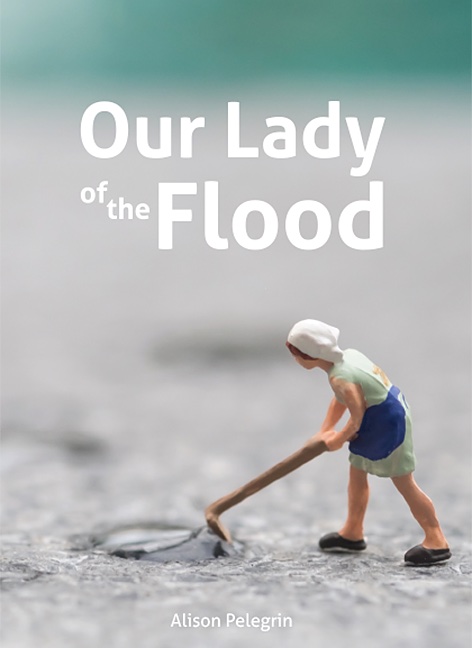
Our Lady of the Flood by Alison Pelegrin

Review by Diane Elayne Dees

The entire region around New Orleans embodies a certain sensibility, born of geography and weather and a unique heritage that is hard to define and even harder to translate. When I first moved to the city decades ago, I was both curious about and amused by the many “Our Lady” names of schools and churches. “Can you imagine what their fight song is?” an acquaintance once asked when we drove past Our Lady of Prompt Succor School.

After you’ve lived here a long time, though, Our Lady of Prompt Succor, Our Lady of Good Counsel, Our Lady of Perpetual Help, and Our Lady Star of the Sea (which we called “the tuna fish church”) all become part of the sometimes bizarre linguistic landscape of the city.

I’ve also lived through many Louisiana hurricanes and floods, so I approached reading Alison Pelegrin’s Our Lady of the Flood with relish, and I was not disappointed. In this collection, Pelegrin skillfully cuts through the difficulty of cultural translation with a collection of poems that puts the region’s eccentricity in the colorful and sometimes absurd context that it deserves. Moreover, she does it—often with delicious humor—by using language that gives new life to the tasks and customs that are part of daily life in and around New Orleans.

The collection opens with the eponymous poem, “Our Lady of the Flood”:

Some saints are untouchable behind glass,
but you ride in open boats
with mildew on the edges of your gown,
a calm commander of the Cajun Navy’s fleet.
Your devotees worship outside
in a circle of ruined pews,
no incense but bug spray

This is a perfect introduction to the parade of “Our Lady” poems that are to come, as well as the other poems in Our Lady of the Flood, which include an ode to ambrosia (“confection snubbed by food snobs as a [. . .] meringue of shame”), a meditation on local bridges, and a commentary on the removal of New Orleans’ Lee Circle statue of General Robert E. Lee.

Hurricane Katrina, as one might expect, is an ongoing theme in Pelegrin’s collection. In “Anything We Want,” she expresses the longing of all Louisianans who were displaced by the 2005 storm:

They won’t quit asking, What do you want?
I want to be somewhere besides Mississippi
with its highway that splits fields
of cotton and soy and blackbirds.
I want art supplies and to read a book
in my old bed, to ride the streetcar by myself

//

I want my mom to say something
in the Walmart, where we have gone to spend
a gift card from some church
on anything we want.

And in “Quicksilver”:

[…] quicksilver visions wrinkle
and then they vanish. But
this water is absolute. It remains,
though the hurricane is over.
I have studied from my exile
in this hotel room, witnessed
rooftop rescue, the folly
of mammoth sandbags. This water
is no silvered mirage. It clings like tar.
It swallows everything we are.

The “Our Lady” poems are a special treat. “Our Lady on the Half Shell” celebrates “Bathtub Madonna, Lily of so many gardens, Queen of Heaven in a scalloped shell [. . .]”:

White-washed, with marble chips, or pansies, at your feet,
you have many faces in New Orleans—so many incarnations—
alabaster, hand-painted Creole or coffee or midnight skin,
your ghost eyes peering out and you motionless

And then there’s “Our Lady of ‘No Regerts’ ”:

Our Lady of No Regerts, prevention of bad tattoos
must be your side hustle, a part-time ministry,
because, queen of inky heaven, with respect,

a few too many permanent atrocities
have escaped your intervention

My personal favorite is “Our Lady of Whatever,” in which the poet fantasizes about being one of the many Ladies revered in New Orleans.

So many lakes. So many Ladies of the Lakes.
Maybe I could be Lake Pontchartrain’s Lady
of the Longest Bridge, Lady of Cicada Tea Parties,
of Lighthearted Marvels, of Sand Mandalas,
Reduced to Cerulean Ash. Our Lady of Shrinky Dinks.

A special gem in this collection is Pelegrin’s “Soliloquy against a Kudzu Backdrop”:

 Audience of none, superstition dictates
that I peek through the kudzu curtain
like a starlet before making an entrance
and speaking yet again on the theme
of ignorance observed in waking life.
I would like to believe these are actors I see—
rednecks so loud in their stupidity
that rather than being frightened by their antics
I find myself waiting for the punchline

//

How can we be
so different when the same trees
rustle in all of our dreams?

It isn’t easy to move readers beyond the clichéd images of jazz bands, wrought iron balconies and roaming alligators, to the sometimes painful, sometimes hilarious, and always evocative images that represent what life is really like in New Orleans and its outlying regions. But in Our Lady of the Flood, Alison Pelegrin provides a charmingly authentic portrait of a culture that is like no other in the nation.


Alison Pelegrin’s latest collection, Our Lady of Bewilderment, is forthcoming from LSU Press in 2022. Other books include Waterlines (LSU 2016), as well as Hurricane Party (2011), and Big Muddy River of Stars (2007), both with the University of Akron Press. Pelegrin is the recipient of fellowships from the National Endowment for the Arts, the Louisiana Division of the Arts, and the Louisiana Board of Regents. She is Writer-in-Residence at Southeastern Louisiana University. 


Title: Our Lady of the Flood
Author: Alison Pelegrin
Diode Editions
ISBN: 978-1-939728-16-6
28 pages, $12.00


Diane Elayne Dees is the author of the chapbook, Coronary Truth (Kelsay Books) and two forthcoming chapbooks, I Can’t Recall Exactly When I Died, and The Last Time I Saw You. Diane, who lives in Covington, Louisiana—just across Lake Pontchartrain from New Orleans—also publishes Women Who Serve, a blog that delivers news and commentary on women’s professional tennis throughout the world. Her author blog is Diane Elayne Dees: Poet and Writer-at-Large.


ABOUT THE PRESS: Diode Editions is an independent press based in Doha, Qatar and Richmond, Virginia. Editor-in-Chief Patty Paine founded the press in 2012 as an offshoot of Diode Poetry Journal. To date, the press has published 37 titles of poetry, chapbooks and poetry-related nonfiction works and hosts yearly book and chapbook contests.

Risa Denenberg is the curator at The Poetry Cafe

Slow Dark Film

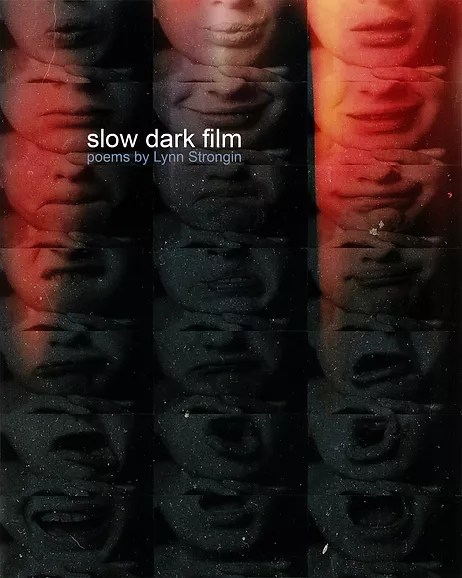
Slow Dark Film, by Lynn Strongin

Review by Risa Denenberg

I’ve been a fan of Lynn Strongin’s work since 2014 when she submitted a manuscript to my press, Headmistress Press. I immediately fell in love with her poetry. In fact, Headmistress has published two of her poetry collections: The Burn Poems in 2015 and A Bracelet of Honeybees in 2016. So I was interested in reading her newly released chapbook, Slow Dark Film (right hand pointing, 2021). I’m happy to report that it has the same powerful, idiosyncratic, playful language and fascinating narrative that is found in the poetry and prose she has been publishing for decades.

Strongin’s work is often autobiographical, ranging from childhood when she was hospitalized with polio, to in-between years when she traveled extensively, and on to present day, where she suffers the debilitating late effects polio. Similar to other collections, Slow Dark Film follows a narrative line comprised of the poet’s lived experience. Also similar to other works, her lesbian lover is right by her side.

In the first poem, “LUMINOUS,” Strongin provides a map of the territory the reader is entering, when she reports, “Asylum, forever mine.” This is an artifact persistently embedded in the poems.

The slow dark film of the title is both a recollection from childhood and a gauzy scrim that forms a backdrop through which the poet’s story is shaded. The memory is of the “slow dark painterly-grained film[s]” that were shown to “Children twelve & under” who were “Wheeled in/ to our asylum.” Years exist in this metaphor of so few words—the excruciatingly slow movement of time and the bleak darkness of her surroundings.

The charm in the writing is how Strongin can travel from asylum to Elysium using her vivid imagination and agility with language. In the poem, “IT INTERRUPTS,” Elysium is paradise, but also a harbinger of death:

Stamen & pistil, flowering,
The earth is procreation:
Creation. In a cradle, the bee cups honey
            The longed for, the filmed over, a deep caress
            The last word is always loneliness.

Images—such as the dark film—repeat throughout these poems, conferring a dream-like effect. In “YOUR WORDS,” there is an image of a ladder which repeats in later poems:

I am going through a life-change
            that has ladders                   of grieving

I think of the biblical story of Jacob’s ladder when I read this, one of so many associations Strongin’s words invite me to imagine.  In “I KNEW I WAS,” the ladder reappears:

I comfort myself
With castles
Teeth-eaten by wind
Like raggy lace. These ladders, they do not lead
Out of the flesh.

Another repeated narrative is found in poems addressed to “YOU”—the delicately unnamed lover, as seen in “WHAT IS THIS”:

Many tiny upheavals in our lives
Have made them remote: yet what is this, you
            coming toward me with an embrace lowered eyes,
            sorrowing El                 Greco face?

Or this, in “GHOST OF DAWN”: “By the time you bathe me/ Morning’s gone.”

In Slow Dark Film there are many weighty metaphors of illness and death, such as in “DEFEAT”:

I make my dark nest,
I lay my bright dress
To rest.

And in the last poem in the book, Strongin returns to the original image of the film:

IF LIFE is a sadness that unspools, a slow dark grain
My rising up is my bending
Down in a dancer’s position.

Slow Dark Film unspools a quiet narrative, leaving me with much to wrestle with, and reminding me of the Dickinson poem, “After great pain, a formal feeling comes.”


Lynn Strongin’s homeland is America. Her adopted country Canada. She has twelve books, work in over forty anthologies, and has been nominated for a Lambda Award and the Pulitzer Prize in literature.


Title: Slow Dark Film
Author: Lynn Strongin
Publisher: right hand pointing
, 2021


Risa Denenberg lives on the Olympic Peninsula where she works as a nurse practitioner. She is a co-founder of Headmistress Press and the curator at The Poetry Cafe Online. Recent publications include slight faith (MoonPath Press, 2018), and Posthuman, finalist for the 2020 Floating Bridge Chapbook Prize.


Risa Denenberg is the curator at The Poetry Cafe.
The Moment of Greatest Alienation

The Moment of Greatest Alienation, by Issam Zineh

Review by Risa Denenberg

On first glance, I couldn’t decide if the poems in Issam Zineh’s The Moment of Greatest Alienation were about sex, clothed in its many garments, or if the work uses sexual interstices as a metaphor for any number of other life-and-death matters. Of course both are true, a truth that I find delicious. Although tangling with bodily union, no important matters seem to be absent in this collection—the work is the poet’s universe revealed.

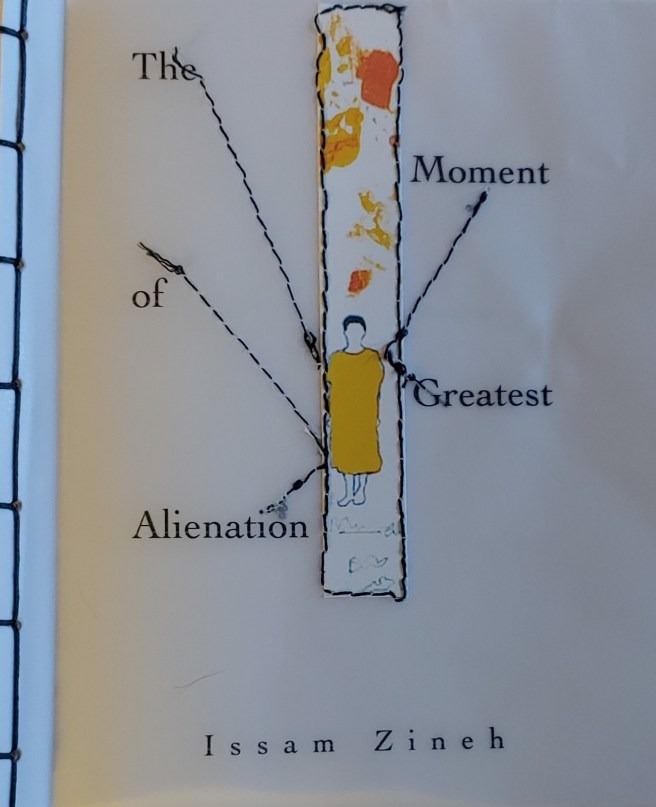
The book itself is an art object. I’ve long been impressed with these limited-edition, hand-made/hand-bound micro chapbooks designed by Sara Lefsyk for Ethel Micro Press. The Moment of Greatest Alienation is a petite six by seven inches with a hand-sewn spine and a cover embossed with art and stitches, resembling a spider web, to the words of the title. The cover invites reading.

Then there are the poems. From the first lines in this chapbook, in the poem, “Metaphor is the Momentum Between Gestures,” we find a lyrical high bar that Zineh jumps over again and again throughout this work.

Answering the poem’s title, he says,

& I am Coptic

you are Christ, my heart a slit lamb, punctured,
slick at the throat. The alchemist’s optic

obsession: stuff to gold & never back.

Later in the poem, we find the story to be about an illicit affair.

. . . proud we pulled it off, proud of our disgrace.
We will smile. There will be nothing left
to do except go home
& make love in separate beds

Because I work in the medical arena, I have a particular fondness for poet-scientists and the way poetry can be looped into a scientific description of anything. In “Coefficients of Friction,” we find measurements of friction, body against body:

The physicist in me
with polymers mated against steel thrust

washer geometry, in all my traction, grip, and desire,
is trapped in the wrong version of eternity.

You are valuable and dimensionless.
Load and velocity.

There is a rewarding effort involved in following the syntax here. And, as I did, you may need to look up a few scientific concepts in this poem, such as washer geometry. But then you have the benefit of learning something new about how volume is measured, for example, if you want to calculate the volume of your lover.

The poems in The Moment of Greatest Alienation are the work of a poet who is erudite, deeply knowledgeable in numerous fields of the arts and academy, but who also pays astute attention to the political nature of everything he comes into contact with. Much is discovered in the “Notes.” For example, here is where we learn that the poem “Adagio includes titles from compositions by Bach, Barber, Copland, and Schnittke.” And I would add, all are folded seamlessly into the poem.

There are several poems that reckon with human tragedies caused by political inequity. In the notes, we learn that, in the poem “Plastic Bag,” Zineh “hopes to memorialize Òscar Alberto Martínez Ramírez and his 23-month-old daughter, Valeria, who drowned in June 2019 trying to cross the Rio Grande.” In stark contrast with Zineh’s relative safety, the poem begins with the line, “I will tonight, god willing, sleep like a/ baby,” but goes on to describe how such horrific events affect him:

I will dream, the recurring one in
which you wrap me in your arms
and drag me to the bottom of the
lake, hold me underwater until I
either drown or wake.

In “Eight Parables to Keep You Safe, Defy Aging, & Banish Evil,” there is an amalgam of so many disparate substances, so much active and passive energy, that reading it gives me the dizzying sensation that all energy is matter and all matter is simple one version of reality pressing against another —and yet, there is an incoherent sense of order in the coupling. In the final parable, titled “8. The New Originals,” a narrative line wanders and then coheres with the line “all relationships are the same in the beginning,” –with its nod to Tolstoy’s Anna Karenina– and continuing in the next stanza:

We still miss each other sometimes. We look for things that are irretrievable in these minor folds of solitude. We fire, we flood, we famine. We don’t know much of petal or stamen, the easiest of metaphors, the easiest sounds the tongue can make. And still, God has set up its system. Proteins are synthesized and sent to correct destinations. The awfully beautiful things of the body go on happening. 

The poem “Ars Poetica” is an epithalamium—a poem in honor of a wedded couple. It starts with “I am married on a cliff,” but leads to a premonition of cracks in a marriage:

The guests have arrived. We walk down one
path at once, hating for now, everything that blooms,

knowing this is a small part of the introduction,
an even smaller part of the conclusion.

I suppose it is this sort of brutal honesty that I find so delicious in this book.


Issam Zineh is a Palestinian-American poet and scientist. He is author of Unceded Land (forthcoming, Trio House Press) which is an Editors’ Selection and finalist for the Trio Award for first or second book, and the chapbook The Moment of Greatest Alienation (Ethel Press, 2021). His poems appear or are forthcoming in AGNI, Guernica, Pleiades, Tahoma Literary Review, Tinderbox, Guesthouse, Glass (Poets Resist), Lunch Ticket, Poet Lore, and elsewhere.


Title: The Moment of Greatest Alienation
Author: Issam Zineh
Publisher: Ethel Zine & Micro Press, 2021
Book Design: Sara Lefsyk
39 pages $9.00


Risa Denenberg lives on the Olympic Peninsula where she works as a nurse practitioner. She is a co-founder of Headmistress Press and the curator at The Poetry Cafe Online. Recent publications include slight faith (MoonPath Press, 2018), and Posthuman, finalist for the 2020 Floating Bridge Chapbook Prize.


Risa Denenberg is the curator at The Poetry Cafe.

Terrain

Terrain, by Gina Hietpas (Blue Cactus Press, 2020)
Cover art by Heather Romano

Review by Risa Denenberg

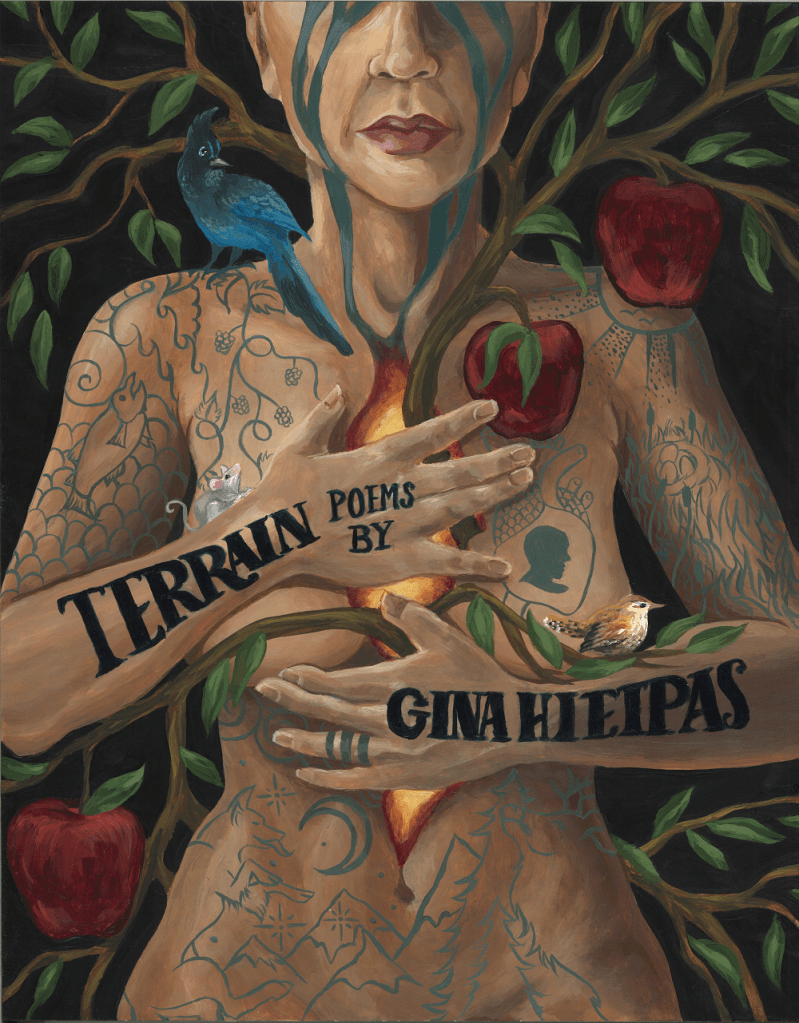
Before reading the poems in a new book, I always like to spend some time absorbing its essence in its entirety: cover art, back notes, poem titles, author’s bio, acknowledgements, blurbs. The cover art on Gina Hietpas’s “Terrain” is the remarkable work of the artist Heather Romano, who created it specifically based on “images from the text” and “the underlying themes of the poems.” In it, a naked woman is shown, mid-face to hips, tattooed with living symbols, hands at heart and solar plexus in a gesture of protecting a living landscape of vines, fruit, and birds.

Hietpas’s narrator lives up to that image— vulnerable, protective, patient. She brings the reader into her story with an invitation. In “Coyote Speaks to Me,” a coyote dares a human to accept the joys and hardships to be encountered throughout the poems in this work. It ends with coyote’s encouragement:

Stick with me!
I’ll show you persistence and the art of pounce.
Watch me shrug off disappointment.

In solitude you learn your story.
Only than can you riff on the moon.

In “What We Dreamed,” a couple buys a piece of land trusting their ability to make a life, “a reprised “go west” dream. Living the dream, they find themselves here:

Christmas Eve, drenched in the Milky Way,
we warmed ourselves with possibilities.
We assumed blessing in the winks of stars.

In “Dessert” an “After supper” . . . “walk through the orchard,” displays the abundance of life, in this case, fruits—apples, plums, blackberries.

The poems unfold the story of a marriage, early settling into “cold water living” while building a home and having children. The couple’s greatest hardship is yet to come in these early days of “Trim the wicks, light the lamps. / Feed the fire.” In the poem titled, “Coyote Chatter,” we learn that the coyote—a perfect spirit animal for this story—is “a trickster, hipster, predator, editor.”

Indeed, the “trickster” brings the unexpected; the “editor” revises the story. There is nothing sentimental in these poems, no paradise, just trust, love, and hard work. But there is also an unexpected trouble. In “Aria: We Are Introduced to Our Future,” a pain-filled night becomes:

Tomorrow, your morphine-laced body,
            splayed on steel-edged tables,
            pictured and probed,
will reveal in grainy images the seismic shift
            in our dreams.

Time passes, children grow, a home is built of “[c]edar, quarter sawn, straight grained/ layers of ancient cambium,” while a husband’s illness ties him to dialysis. Years pass, a family accepting this complication in their wake. In “The Ache of October,” the woman reflects,

I, now my mother’s age, wrap myself
in russet and gold, sit in the seen of sun.
Weep. Weep. Murmurs the nuthatch
caching bugs beneath the cherry’s bark.

These poems narrate a life, of which I’ve sketched some larger movements. Between signposts and events, the poems reflect a poet who is alive to the land, it’s foliage and wildlife. Each poem is vibrant with imagery and pays close attention to what is at hand, giving the sense of someone who lives faithful to the present moment.

In the final poem, “Credo,” Hietpas speaks of the harvest of endurance and acceptance:

Love is a stone.

It can fracture under pressure.
But yielding to wind or wave,
the sharp edges smooth.

Grain by grain, it gives of itself
to become the grit beneath your feet.


Gina Hietpas is a self-taught poet, born and raised in Tacoma, Washington state. Nowadays, she lives outside Sequim, WA, on a small farm with her husband, a few cows and a passel of chickens. Her land is a habitat for elk, deer, coyotes and an occasional bear. It is, for the most part, a peaceful coexistence. The opportunity to be a back-country ranger for several seasons shaped her connection to wilderness. Professionally she was a middle school teacher for twenty five years.  Now that she has retired, she focuses her efforts on writing. She has studied with Kelli Russell Agodon, Alice Derry, Holly Hughes, Susan Rich and Kim Stafford. Hietpas’ work has appeared in Minerva Rising, Tidepools, Spindrift and New Plains Review.


Terrain, Poems by Gina Hietpas
Blue Cactus Press, 2020
49 pages; $17
ISBN: 9781733037556


Risa Denenberg lives on the Olympic Peninsula where she works as a nurse practitioner. She is a co-founder of Headmistress Press and the curator at The Poetry Cafe Online. Recent publications include slight faith (MoonPath Press, 2018), and Posthuman, finalist for the 2020 Floating Bridge Chapbook Prize.


Risa Denenberg is the curator at The Poetry Cafe.
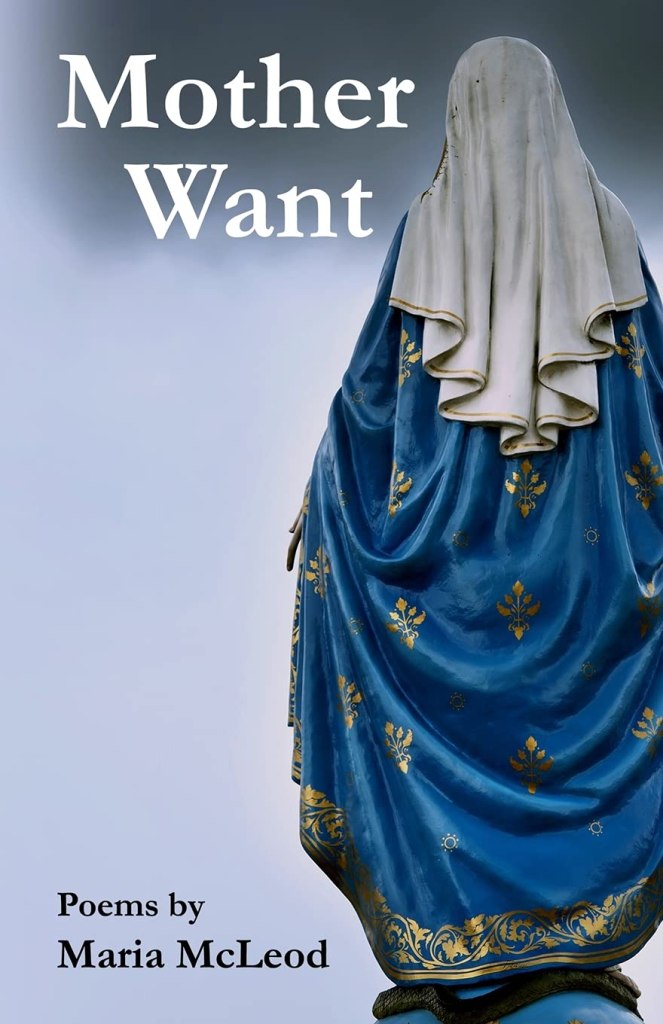
Mother Want

Mother Want, by Maria McLeod
Winner of the 2020 WaterSedge Poetry Chapbook Contest

Review by Risa Denenberg

Thank God for poetry and horses.

In her prize-winning chapbook, Mother Want, Maria McLeod narrates harrowing tales of childhood, both hers and her parents’— rendering a panorama of inter-generational wounds. Breaking the cycle involves finding a way out of the story, without disowning it. For McLeod, the poetry muse offers a pathway through the act of writing; horses heal simply by being, as she describes in “And the Sky Bloomed Pink”:

I learned about love
when working with horses.

[…] those sweet moments
mucking stalls, alone
with the horses at first light.

Still, the through-line, to the last poem, “Summer’s End, Dogs,” does not relinquish want or hide melancholy. Watching children leave the house, McLeod finds keepsakes in an ordinary life: backpacks, yellow school bus, garden weeds, plum tomatoes, and the “unrelenting loneliness/ of neighborhood dogs, announcing over and over:/ someone is missing, someone is gone.”

Inevitably, the mother looms large in Mother Want. In the title poem, the longing for a do-over is a poignant wish “to love what isn’t lovable” and “to meet my mother/ before the years of sleep.”  

I want to know her before she disappeared, before
she gave up being the mother, before she gave up
being the body of the mother, the breasts
and words, and touch of the mother.

But also “to empty her out, to ransack/ her body, to cause damage.”

In childhood, we don’t recognize our parents as beings apart from us with their own stories, and certainly not as children themselves. Aging and death of parents can be a time for reappraisal, perhaps even forgiveness, or at least acknowledgement that they did the best that they could. “Joyce, 1945,” subtitled, “fur meine Mutter,” reveals disturbing scenes of the mother’s childhood—stories McLeod was told “when I was finally old enough to hear of it.” McLeod speaks perceptively of her mother as a child, “unable to discern joy from terror.” 

In “On Sunday, Our Father,” the father is portrayed as the more functional parent in the home with an absent mother. He was portrayed as frightening: “We could hear the anger in his walk/ across the hardwood floor/ hatred of his wife.” And “Once he punched a hole/ in our bedroom door.” But also this:

He warmed bottles
of milk while my mother sleepwalked through life.
He made us pizza for dinner;
he let us drink pop. We loved
our father.

Later in “Death Defied,” we learn that the father was a “sickly boy” who was supposed to die but instead “rose out of bed, defying his doctors.” Similarly, the narrator in Mother Want defies the somber prospects of her childhood. Indeed, both parents’ backstories are sewn into the fabric of the child’s day-to-day reality.

There are other possible configurations of childhood in these pages. In “Bereft/ for Stephen,” the death of a beloved father brings forth the wisdom that,

Death has no dominion over your child self,
grieving not for the absence
of the frail father, but for the familiar
comfort of the sturdy back you mounted
before you could swim.

There are also present-day stories here, such as in “November Green/ for Mary.” November is a seen as a time of decay and decomposition as two friends walk and talk “of our work/ as professors, of love and marriage, illness, and our parents/ decline.” A cancer diagnosis is disclosed— “the wife of a friend … was dead,” while the speaker is “13 months post diagnosis,” but is “reluctant to refer to [her]self as lucky.” In this rambling friendship, there is also the story of a 10-year-old daughter’s elaborate funeral for her hamster “Creampuff,” with friends dressed in black and “some of the girls/ wearing fascinators, as if attending a British wedding.” There is a tenderness towards children in this poem that was often lacking in the poet’s childhood.

The poems in Mother Want are not only memoir, although the childhood memory pieces recounted here are indeed memorable—in the way an earworm won’t go away after the song ends. There are also poems of portraiture—ekphrastic poems of persons, so to speak—which are both memorable and gentle, a relief from traumatic memories.  In “Hammer and Nails,” a carpenter, “imagines where/ he’ll frame out windows, add a door.” As the day draws to a close,

He measures his next day’s work, makes his way
onto the dilapidated porch, faded color
he’ll need to scrape off, recoat. Make it new:
make it right.


Standing alone, this is a lovely portrait; but it is also an immensely satisfying metaphor for what might be done for a broken childhood.


Maria McLeod writes poetry and prose. Honors include the Indiana Review Poetry Prize, the Robert J. DeMott Short Prose Prize, and three Pushcart Prize nominations. She was named the 2020 WaterSedge Poetry Chapbook Contest winner, judged by then Oregon State Poet Laureate Kim Stafford, for Mother Want, published in 2021. Her second poetry chapbook, Skin. Hair. Bones., is forthcoming from Finishing Line Press in 2022. Her poetry and prose have appeared in journals such as Puerto Del Sol, The Brooklyn Rail, Painted Bride Quarterly, Crab Orchard Review, Sonora Review and others. Originally from the Detroit area, she currently resides in Bellingham, Washington where she works as a professor of journalism for Western Washington University.

Mother Want, Maria McLeod
Winner of the 2020 Water Sedge Poetry Chapbook Contest
Publisher: ‎ Independently published (May 25, 2021)
Paperback: ‎ 37 pages $10
ISBN-13: ‎ 979-8731318600


Risa Denenberg lives on the Olympic Peninsula where she works as a nurse practitioner. She is a co-founder of Headmistress Press and the curator at The Poetry Cafe Online. Recent publications include slight faith (MoonPath Press, 2018), and Posthuman, finalist for the 2020 Floating Bridge Chapbook Prize.


Risa Denenberg is the curator at The Poetry Cafe.