Terrain

Terrain, by Gina Hietpas (Blue Cactus Press, 2020)
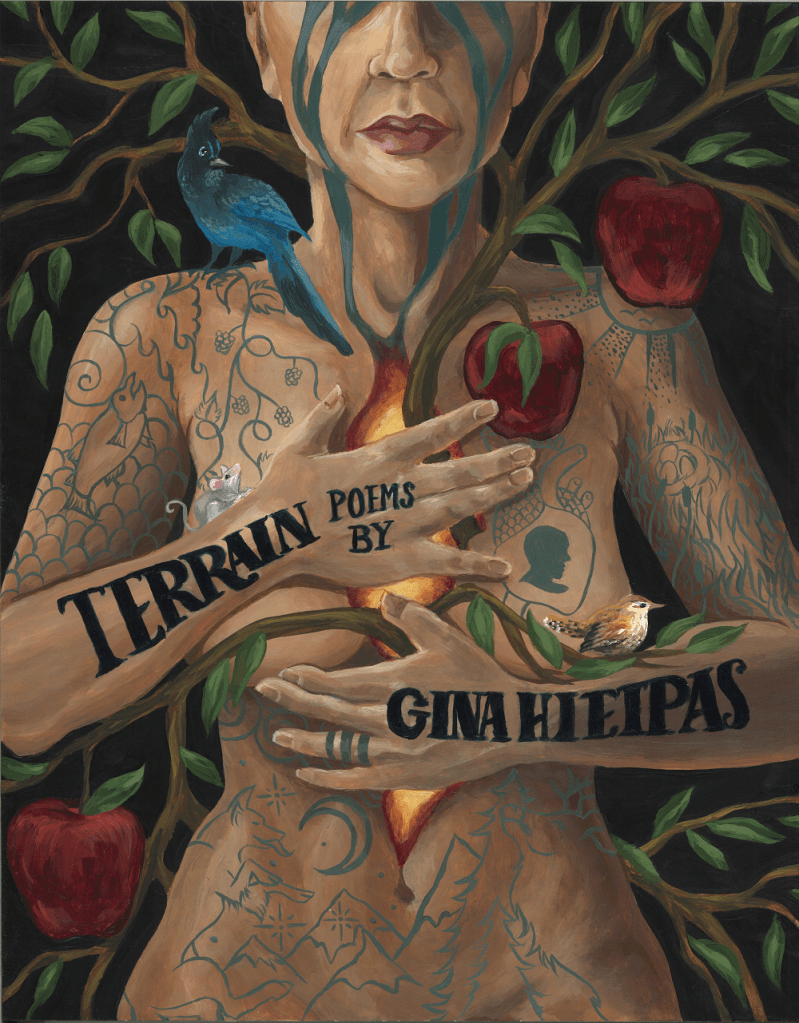
Cover art by Heather Romano

Review by Risa Denenberg

Before reading the poems in a new book, I always like to spend some time absorbing its essence in its entirety: cover art, back notes, poem titles, author’s bio, acknowledgements, blurbs. The cover art on Gina Hietpas’s “Terrain” is the remarkable work of the artist Heather Romano, who created it specifically based on “images from the text” and “the underlying themes of the poems.” In it, a naked woman is shown, mid-face to hips, tattooed with living symbols, hands at heart and solar plexus in a gesture of protecting a living landscape of vines, fruit, and birds.

Hietpas’s narrator lives up to that image— vulnerable, protective, patient. She brings the reader into her story with an invitation. In “Coyote Speaks to Me,” a coyote dares a human to accept the joys and hardships to be encountered throughout the poems in this work. It ends with coyote’s encouragement:

Stick with me!
I’ll show you persistence and the art of pounce.
Watch me shrug off disappointment.

In solitude you learn your story.
Only than can you riff on the moon.

In “What We Dreamed,” a couple buys a piece of land trusting their ability to make a life, “a reprised “go west” dream. Living the dream, they find themselves here:

Christmas Eve, drenched in the Milky Way,
we warmed ourselves with possibilities.
We assumed blessing in the winks of stars.

In “Dessert” an “After supper” . . . “walk through the orchard,” displays the abundance of life, in this case, fruits—apples, plums, blackberries.

The poems unfold the story of a marriage, early settling into “cold water living” while building a home and having children. The couple’s greatest hardship is yet to come in these early days of “Trim the wicks, light the lamps. / Feed the fire.” In the poem titled, “Coyote Chatter,” we learn that the coyote—a perfect spirit animal for this story—is “a trickster, hipster, predator, editor.”

Indeed, the “trickster” brings the unexpected; the “editor” revises the story. There is nothing sentimental in these poems, no paradise, just trust, love, and hard work. But there is also an unexpected trouble. In “Aria: We Are Introduced to Our Future,” a pain-filled night becomes:

Tomorrow, your morphine-laced body,
            splayed on steel-edged tables,
            pictured and probed,
will reveal in grainy images the seismic shift
            in our dreams.

Time passes, children grow, a home is built of “[c]edar, quarter sawn, straight grained/ layers of ancient cambium,” while a husband’s illness ties him to dialysis. Years pass, a family accepting this complication in their wake. In “The Ache of October,” the woman reflects,

I, now my mother’s age, wrap myself
in russet and gold, sit in the seen of sun.
Weep. Weep. Murmurs the nuthatch
caching bugs beneath the cherry’s bark.

These poems narrate a life, of which I’ve sketched some larger movements. Between signposts and events, the poems reflect a poet who is alive to the land, it’s foliage and wildlife. Each poem is vibrant with imagery and pays close attention to what is at hand, giving the sense of someone who lives faithful to the present moment.

In the final poem, “Credo,” Hietpas speaks of the harvest of endurance and acceptance:

Love is a stone.

It can fracture under pressure.
But yielding to wind or wave,
the sharp edges smooth.

Grain by grain, it gives of itself
to become the grit beneath your feet.


Gina Hietpas is a self-taught poet, born and raised in Tacoma, Washington state. Nowadays, she lives outside Sequim, WA, on a small farm with her husband, a few cows and a passel of chickens. Her land is a habitat for elk, deer, coyotes and an occasional bear. It is, for the most part, a peaceful coexistence. The opportunity to be a back-country ranger for several seasons shaped her connection to wilderness. Professionally she was a middle school teacher for twenty five years.  Now that she has retired, she focuses her efforts on writing. She has studied with Kelli Russell Agodon, Alice Derry, Holly Hughes, Susan Rich and Kim Stafford. Hietpas’ work has appeared in Minerva Rising, Tidepools, Spindrift and New Plains Review.


Terrain, Poems by Gina Hietpas
Blue Cactus Press, 2020
49 pages; $17
ISBN: 9781733037556


Risa Denenberg lives on the Olympic Peninsula where she works as a nurse practitioner. She is a co-founder of Headmistress Press and the curator at The Poetry Cafe Online. Recent publications include slight faith (MoonPath Press, 2018), and Posthuman, finalist for the 2020 Floating Bridge Chapbook Prize.


Risa Denenberg is the curator at The Poetry Cafe.

Mother Want

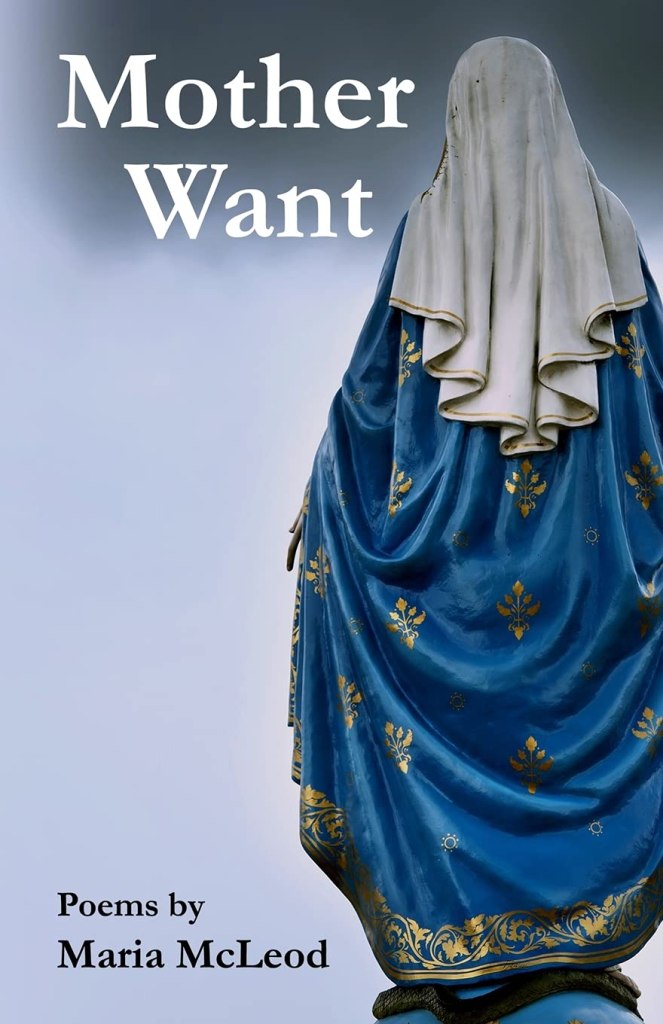
Mother Want, by Maria McLeod
Winner of the 2020 WaterSedge Poetry Chapbook Contest

Review by Risa Denenberg

Thank God for poetry and horses.

In her prize-winning chapbook, Mother Want, Maria McLeod narrates harrowing tales of childhood, both hers and her parents’— rendering a panorama of inter-generational wounds. Breaking the cycle involves finding a way out of the story, without disowning it. For McLeod, the poetry muse offers a pathway through the act of writing; horses heal simply by being, as she describes in “And the Sky Bloomed Pink”:

I learned about love
when working with horses.

[…] those sweet moments
mucking stalls, alone
with the horses at first light.

Still, the through-line, to the last poem, “Summer’s End, Dogs,” does not relinquish want or hide melancholy. Watching children leave the house, McLeod finds keepsakes in an ordinary life: backpacks, yellow school bus, garden weeds, plum tomatoes, and the “unrelenting loneliness/ of neighborhood dogs, announcing over and over:/ someone is missing, someone is gone.”

Inevitably, the mother looms large in Mother Want. In the title poem, the longing for a do-over is a poignant wish “to love what isn’t lovable” and “to meet my mother/ before the years of sleep.”  

I want to know her before she disappeared, before
she gave up being the mother, before she gave up
being the body of the mother, the breasts
and words, and touch of the mother.

But also “to empty her out, to ransack/ her body, to cause damage.”

In childhood, we don’t recognize our parents as beings apart from us with their own stories, and certainly not as children themselves. Aging and death of parents can be a time for reappraisal, perhaps even forgiveness, or at least acknowledgement that they did the best that they could. “Joyce, 1945,” subtitled, “fur meine Mutter,” reveals disturbing scenes of the mother’s childhood—stories McLeod was told “when I was finally old enough to hear of it.” McLeod speaks perceptively of her mother as a child, “unable to discern joy from terror.” 

In “On Sunday, Our Father,” the father is portrayed as the more functional parent in the home with an absent mother. He was portrayed as frightening: “We could hear the anger in his walk/ across the hardwood floor/ hatred of his wife.” And “Once he punched a hole/ in our bedroom door.” But also this:

He warmed bottles
of milk while my mother sleepwalked through life.
He made us pizza for dinner;
he let us drink pop. We loved
our father.

Later in “Death Defied,” we learn that the father was a “sickly boy” who was supposed to die but instead “rose out of bed, defying his doctors.” Similarly, the narrator in Mother Want defies the somber prospects of her childhood. Indeed, both parents’ backstories are sewn into the fabric of the child’s day-to-day reality.

There are other possible configurations of childhood in these pages. In “Bereft/ for Stephen,” the death of a beloved father brings forth the wisdom that,

Death has no dominion over your child self,
grieving not for the absence
of the frail father, but for the familiar
comfort of the sturdy back you mounted
before you could swim.

There are also present-day stories here, such as in “November Green/ for Mary.” November is a seen as a time of decay and decomposition as two friends walk and talk “of our work/ as professors, of love and marriage, illness, and our parents/ decline.” A cancer diagnosis is disclosed— “the wife of a friend … was dead,” while the speaker is “13 months post diagnosis,” but is “reluctant to refer to [her]self as lucky.” In this rambling friendship, there is also the story of a 10-year-old daughter’s elaborate funeral for her hamster “Creampuff,” with friends dressed in black and “some of the girls/ wearing fascinators, as if attending a British wedding.” There is a tenderness towards children in this poem that was often lacking in the poet’s childhood.

The poems in Mother Want are not only memoir, although the childhood memory pieces recounted here are indeed memorable—in the way an earworm won’t go away after the song ends. There are also poems of portraiture—ekphrastic poems of persons, so to speak—which are both memorable and gentle, a relief from traumatic memories.  In “Hammer and Nails,” a carpenter, “imagines where/ he’ll frame out windows, add a door.” As the day draws to a close,

He measures his next day’s work, makes his way
onto the dilapidated porch, faded color
he’ll need to scrape off, recoat. Make it new:
make it right.


Standing alone, this is a lovely portrait; but it is also an immensely satisfying metaphor for what might be done for a broken childhood.


Maria McLeod writes poetry and prose. Honors include the Indiana Review Poetry Prize, the Robert J. DeMott Short Prose Prize, and three Pushcart Prize nominations. She was named the 2020 WaterSedge Poetry Chapbook Contest winner, judged by then Oregon State Poet Laureate Kim Stafford, for Mother Want, published in 2021. Her second poetry chapbook, Skin. Hair. Bones., is forthcoming from Finishing Line Press in 2022. Her poetry and prose have appeared in journals such as Puerto Del Sol, The Brooklyn Rail, Painted Bride Quarterly, Crab Orchard Review, Sonora Review and others. Originally from the Detroit area, she currently resides in Bellingham, Washington where she works as a professor of journalism for Western Washington University.

Mother Want, Maria McLeod
Winner of the 2020 Water Sedge Poetry Chapbook Contest
Publisher: ‎ Independently published (May 25, 2021)
Paperback: ‎ 37 pages $10
ISBN-13: ‎ 979-8731318600


Risa Denenberg lives on the Olympic Peninsula where she works as a nurse practitioner. She is a co-founder of Headmistress Press and the curator at The Poetry Cafe Online. Recent publications include slight faith (MoonPath Press, 2018), and Posthuman, finalist for the 2020 Floating Bridge Chapbook Prize.


Risa Denenberg is the curator at The Poetry Cafe.

There is Still Singing in the Afterlife

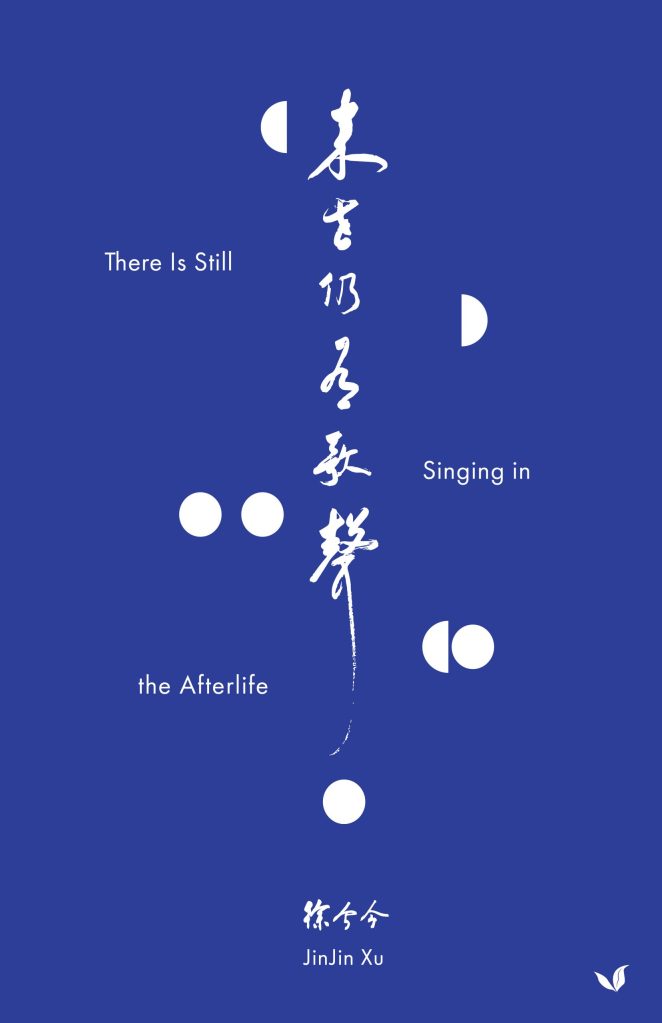
There is Still Singing in the Afterlife, by JinJin Xu (Radix Media, 2020)

Winner of the inaugural Own Voices Chapbook Prize selected by Aria Aber

Review by Jeri Frederickson

There Is Still Singing in the Afterlife drew me in through its imagery and unabashed closeness to intimate loss and historical grief. You may find yourself and echoes of your own family in this debut collection by JinJin Xu. Drawing on personal experiences, playing with language and visual poetry, these poems shine a light for readers to see our own paths in the aftermath of complex family dynamics and loss.

We are in an afterlife of our own in 2021. I imagine this collection was written and set for publication before the Covid-19 global pandemic, and yet it entered the world right in the middle of it. Fortunately for us, as the world tries to find a post-Covid, or a Covid+ world, There is Still Singing in the Afterlife lifts the burden of finding a way. Xu visualizes an afterlife of both global and personal loss, chaos, and misunderstandings. As I read, I kept asking myself how does this collection feel so alive, like a song, despite its often heavy content? Xu shows the reader a way to sing again and a way to live through play, even as we grieve.

As is often the case with a contest-winning chapbook, There Is Still Singing in the Afterlife has already received several reviews; I agree with previous reviews asserting the language’s poignancy and intimate closeness. The language draws us into the longing and hardship inside familial ties in poems like “New Year’s with my Aborted Sister,”

& my poor mother, with only a daughter to her name
             Melts her red tears into the little girl
            I have long searched for.
I am her daughter in this life, her mother in the next.
             I undress her grief, suckle cancer from her breasts

Xu’s precise language affirms and eases the weight of similar grief. Some reviews of this chapbook have pointed to the titular poem or to the “To Red Dust” poems to uplift Xu’s exploration of and confusion with familial bonds. While I find their perspective interesting and certainly relevant to poems like “New Year’s with my Aborted Sister,” I’m most interested in another aspect of this collection. Xu’s playfulness through language and the visual design of the collection includes glossy images that emboss, strike-through, or erase text, and the text moves across the page with a playfulness that first caught my attention when thumbing through the pages. Even before I entered the words as individual units of meaning, this collection took on a sense of play.

“To Red Dust” plays with the book as a physical object, and the reader gets to be part of the play. The words flow in portrait as well as landscape across the pages of this poem. The book’s need to be turned and engaged with as a physical object was a delight as Xu weaves heady ideas and complicated emotions into physical images:

As if I am not of my father’s body, I write
My name into my exhale, please
A swipe of his palm –
Do not leave us in the red dust

“Red Dust” sets the rhythmic pace of the collection, acting as the inhale and exhale while making the reader crane her neck and turns the page around and around even as Xu turns the ideas of family around and around.

At times, I didn’t understand quite what was going on in a poem, and I was surprised to find this never bothered me. Xu interweaves the senses with an emotional understanding even when the logic or narrative seemed out of reach:

unnameable mother
sat gashing fish scales
into the tremble
of a bucket
between her legs,
not yet knowing
the cost
of a bullet fired
at dawn
into the belly
of her
poem –

I didn’t understand all of what was going on in each scene of “Showing my Mother a Censored Film She Cannot Unsee, in Three Acts”, but I loved the playfulness of the poem’s styles and always felt drawn into the poem and landed with the poem’s end. Xu’s ability to play in this weaving creates a sense of trust in the reader to go along with the poem.

Xu plays with form through erasure in “The Revolution is Not a Dinner Party.” This poem of very short lines creates a melody even as it erases its source. Chairman Moa’s Little Red Book is the source material, and the poem lifts extended images such as:

Blind war
xxxxxxin thick ropes.

Ghosts,
xxxxxxa now common

Language. Not
xxxxxxliving. Paper.

We have many personal, societal, and governmental ghosts, and Xu’s deft words slide over playful rhythms and forms to give us a doorway to dance through into the afterlife of those griefs. There Is Still Singing in the Afterlife is a complex and visually compelling debut to hold. Let us look forward to more from JinJin Xu.


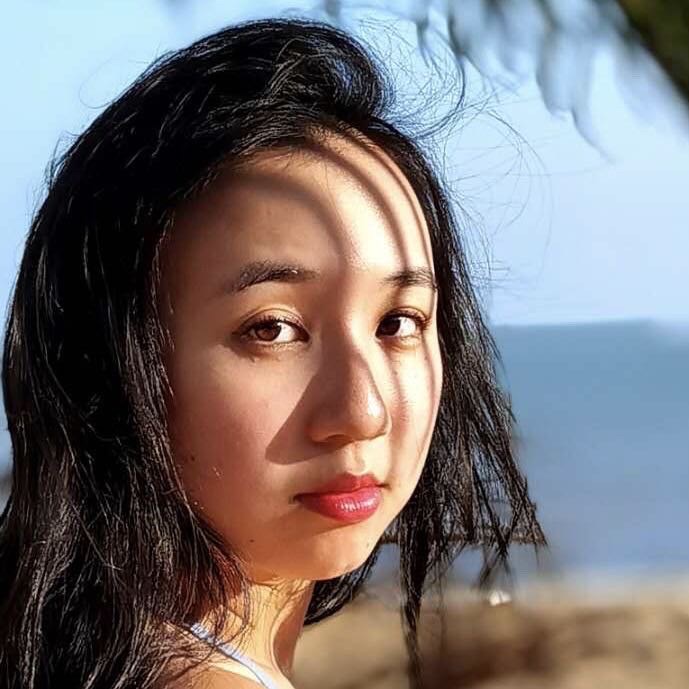
Photograph of JinJin Xu by Xu Xiao Ping.

JinJin Xu is the 2020 winner of the Poetry Society of America’s George Bogin Memorial Award. She has received honors from Southern Humanities Review, Tupelo Press, and the Thomas J. Watson Foundation. Her films have exhibited at Berlin’s Harun Farocki Institute and NYC’s The Immigrant Artist Biennial.
Born and raised in Shanghai, she received her MFA in Poetry from NYU, where was a Lillian Vernon fellow, and now teaches hybrid ballet/poetry workshops through NYU Tisch’s Art of Future Imaginations Grant, and serves as Books Editor of Washington Square Review. Her debut chapbook There Is Still Singing in the Afterlife was selected by Aria Aber for the inaugural Own Voices Chapbook Prize (Radix Media) and was published November, 2020. Her second chapbook This Is My Testimony is forthcoming Fall 2021 from Black Warrior Review. Find more of her work at jinjinxu.com.


Title: There is Still Singing in the Afterlife
Author: JinJin Xu
Publisher: Radix Media: November 20, 2020
ISBN: 978-1-7340487-2-8

$12, 48pp


Jeri calls Chicago home with her two cats and many plants. She dives into literary, visual, and performing art as a channel to nurture love and access beauty while questioning the experiences that hold people together. She graduated from Antioch University Los Angeles with an MFA in Writing. Her chapbook You Are Not Lost is published by Finishing Line Press 2021. IG: @jfredcreates


Risa Denenberg is the curator at The Poetry Cafe.
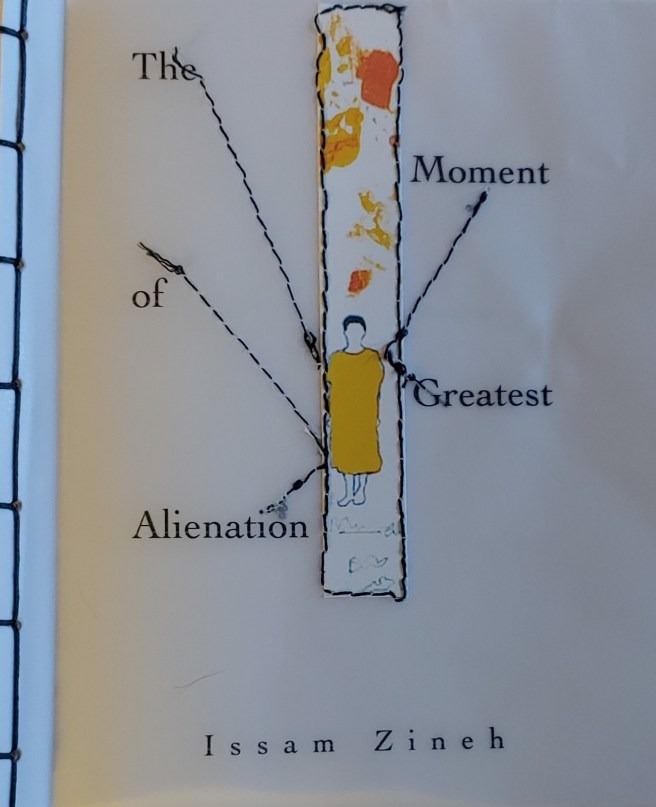
Recoveries

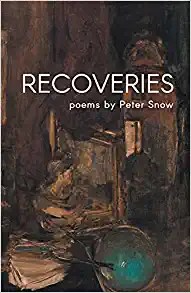
Recoveries by Peter Snow (Finishing Line Press, 2021)

Review by Carmine Dibiase

Peter Snow’s extraordinary poetry happens somewhere between consciousness and dreamland: a region rich in the imagery of desire and of human wreckage and healing. These sixteen poems, which draw from Snow’s experience as a psychiatric nurse, house a quiet, humane vision, but a first reading of this posthumous chapbook might leave one feeling unmoored. Entry into this poet’s house of words requires trust in the rhetorical and imagistic play of his mind.

In “A walk in the mountains,” for example, there is a “he,” an “I” and a “you,” but are they three separate people or are they all one and the same? A “patient” has “blistered” feet “in heavy boots,” but “I climb this rugged path to the white house at the cliff top,” and then, in a statement addressed to “you,” comes an abrupt change of scene: “Don’t be afraid of the mirror at the top of the stairs beyond the doorway.” Are there three people here, or two, or only one? All three readings are possible.

This fluidity, as we soon discover, is not only intentional but necessary. Snow’s aim is to recreate the sensation of empathy, how we move in and out of our own present and past lives, and those of other people. In “Confession,” a patient and his lover have suffered a separation; as they heal their spiritual wounds, they begin to see “the outline” of a love, not for each other but for someone else. And the listening doctor thinks, to himself, “I searched in vain for a woman,” the italics signaling his private voice.

The doctor is a recurring, melancholy, and guarded observer. In “Words of comfort,” he wonders:  

Our life in this world,
what is it like


A boat that has sailed early,
leaving no wake.

He emerges from this desolating thought and “carefully knots his necktie.”

“Allow us to speak of miracles,” a patient says to him in “An impossible thing.” The doctor “dismisses the thought like blowing out a match,” retreats behind “his large and heavy desk,” and again “touches the knot of his tie.”

That knot recalls the tie pin that immobilizes the narrator in T.S. Eliot’s “The Love Song of J. Alfred Prufrock,” “like a patient etherized upon a table.” And Prufrock’s bilious city is also evoked by Snow’s doctor, in the form of a journal entry:

“Looking back over my life, it’s like a city; I turn and walk through stinking alleys, and dingy side streets, loud with cursing, past the shebeens and brothels, past fights and grudging looks from dirty windows, or turn into broad avenues, full of noisy men.”

Like Prufrock, Snow’s doctor inhabits an ailing human world, in which, unbeknownst to his patients, he tries to feel what they feel in order to discover, and to heal, himself. That, however, requires a “fifth chamber” of the heart, something more than the observable four. One consolation along his journey—and ours?—is civility. Nurses come in, twice, with “biscuits and tea on a rattling trolley, pouring from a steel teapot, catching the sunlight.”

Peter Snow died suddenly on 12/18/19. Among his varied roles in life, Snow worked as a storyteller, teacher, poet, playwright, actor, bartender, goatherd, and psychiatric nurse. Snow taught Drama and English at Edinburgh Steiner School for 28 years (1983 – 2012), using storytelling as an integral part of the pedagogy.  He immigrated to the United States from Scotland in 2017.  Over his long career as a storyteller, he performed in diverse venues across the US and Europe, from tea shops to open fields.  He is the author of A Rosslyn Treasury and The Shifty Lad (Floris Books).


Title: Recoveries
Author: Peter Snow
Publisher: Finishing Line Press, 2021.
17 pages. $14.95
ISBN: 978-1-64662-523-9


Carmine DiBiase writes about English and Italian literature, and his poems have appeared in various journals. Last year his English translations of thirteen poems by Cesare Pavese appeared in L’anello che non tiene: Journal of Modern Italian Literature. Occasionally he reviews books for the Times Literary Supplement. He has recently retired as Distinguished Professor of English at Jacksonville State University in Alabama. His chapbook of poems, American Rondeau, is due out from Finishing Line Press in August of 2022.


Risa Denenberg is the curator at The Poetry Cafe Online.

Guilty Prayer

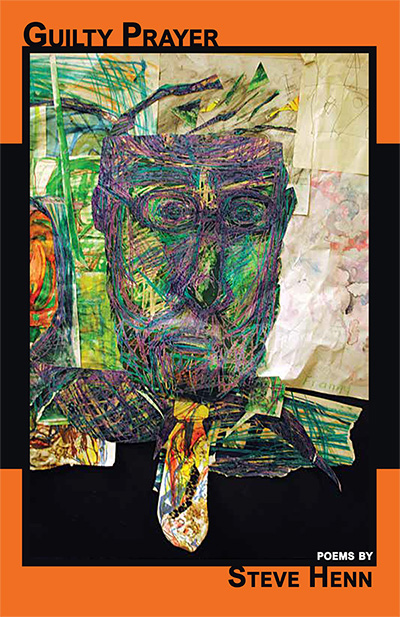
Guilty Prayer, by Steve Henn (Main Street Rag, 2021)

Review by Charles Farmer

Two years ago, I checked into a rehabilitation clinic to kick an alcohol addiction. I brought along a few changes of clothes and some books: the who’s-who anthology, The Vintage Book of Contemporary American Poetry; and some volumes about the writer-as-drinker—Charles Jackson’s harrowing The Lost Weekend; Olivia Laing’s The Trip to Echo Springs; and Leslie Jamison’s The Recovering: Intoxication and Its Aftermath. I hoped I’d have enough down time between counseling sessions to read with a clear head and conscience, something I’d been unable to do for the previous five years. I’d come to romanticize a lonely and calamitous routine of reading at my favorite bar until closing time, my head down in a book with an unspoken agreement with the bartender to refill my vodka sodas. It’d been years since I’d been sober enough to remember what I’d read the previous evening. For years, I’d told my students about literature’s power to restore, affirm, and heal, and settling into my residency, I hoped to validate my beliefs and fall in love again with living. Over time I did, and poetry remains essential to my sobriety. Reading poets—such as Raymond Carver, Nick Flynn, Hala Alyan, and Kaveh Akbar—who have made sense of and survived addiction and ruin provides me a sense of communion that I can’t find elsewhere.

Steven Henn’s latest chapbook, Guilty Prayer, offers me another instance for fellowship. Confronting his ex-wife Lydia’s addictions and eventual suicide, as well as his own drinking and depression, Henn finds life in the aftermath. Honesty is fundamental—Henn eschews the best-seller redemptive narrative arc and the platitudes typical of the language of recovery. Instead, Henn’s poems are unblinking, intimate accounts of a near-recovery. Confessional writing is a loaded term, conjuring accusations of oversharing and exploitation, but Guilty Prayer doesn’t read like an exercise in emotional manipulation. Instead, Henn delivers clear-eyed honesty, tenderness, and vulnerability.

Alcohol’s and drug’s seduction can be painless, effortless: “You can waste your whole cussed life/ Romanticizing the Dark Side,” Henn tells us in “What Darth Vadar Taught Me.” He recognizes a beloved trope: The creator fueled by substances, the artist who can access their creativity only after a few drinks or pills— their wit, sensitivity, and language sharpened by hard living. It sounds almost mystical, like Bukowski giving himself to his muse. Yet the poem ends with the reality: “Then I passed out/ of consciousness, not knowing if or when I would wake.” How do you romanticize that?

Henn doesn’t. Guilty Prayer revisits his traumas under a poetic microscope, one raw crisis, lyric after lyric. Confrontation defeats denial and deflection. In the haunting “Lydia,” Henn recounts the details of Lydia’s suicide and visiting her body with their children before cremation. There is a feeling of ownership as Henn talks to her:

Everybody knows
the trouble you put me through but nobody
says anything, not to me anyway, about how I
could be trouble for you. Nobody sees how I see
me seeing you.

Embracing the particulars in poems like “The Imperial Magisterium of Unrelenting Fortitude,” “Poem for the Mother of My Children,” and “Thank You, Lydia for Our Boy,” respectively, Henn addresses his late ex-wife. These poems aren’t chances for cheap voyeurism; they’re a means of assessing blame and responsibility, reckoning with hindsight, confronting parenthood, post-tragedy.

There’s an unrelenting, impossible wound:

Now I sleep on the lump in the middle,
As if wearing a hairshirt, or slack cloth,
Familiar like an injury that doesn’t heal

The need for explanation, the search for breaking points, reminiscent of Charles Bukowski’s  “The Shoelace”:

I wonder if it was an inability
to cope with 1000 minor disappointments
that drove you to put the belt
around your neck.

And a plea for mercy:

God forgive me for all the things
I blamed [my son’s] mother for.

Elsewhere, there are disenchantment and disappointment with a world that might offer happiness. Poems like “Dank Memes” find futility in friendships; “A Species of Creature” indicts the internet’s lack of humanity; “What I’m All About” and “The Woman Who Got Weirded Out I Wasn’t Eating” find the speaker back in the dating pool, but in a world of online mismatches and scams. Never far from children’s well-being, Henn acknowledges a world that has resigned itself to the normality of school shootings in “Role Playing Games.”

Yet there are reasons for hope. Zeb, an old acquaintance, returns in “Love Letter to an Old Friend,” whose reaching out inspires an urgency: “I want to tell you while I still can/ no gesture from a friend ever meant more to me.” Most endearing is the love letter to Henn’s students, “In the Classroom,” a poem that finds discussions of poetry fostering a community marked by empathy and an affection for the written word.   

Perhaps most hopeful are moments like those in “Still Life with Ceiling Fan and User’s Guilt,” where the speaker longs for lucidity, a release from a past dependent on “hallucinations and buzz.” This cry for clarity is profound, for it’s the recognition that the old life and its habits are unsustainable: “now all I want is to think/ quickly and clearly as possible.”

But what is there to do with newfound sobriety? Henn doesn’t fall back on wholesale redemption and “Lifetime” movie endings promising a return to innocence. The struggle is difficult and tedious, an endeavor full of monotony, down time, and unrest. “Recognition” captures the  initial apprehension of sobriety. Here, Henn is facing a Thanksgiving sober and haunted by Lydia’s presence—no small feat. Without the crutch of substance, what does one do? In this case:

They tell me the only way through it
is to feel it. When I talk to God I say
I’ll accept anything, maybe even death,
dear Lord, but please, not this immense sadness.

Guilty Prayer’s strength is in its ambivalence, its failure to promise miracles.  Yes, it’s a witness to catharsis through confession, sharing, and communion, but there’s always more work to be done. Henn writes that the stars “might be looking out for you./ Might even be editing the final cut,/ your happy ending.”

That’s a big might.


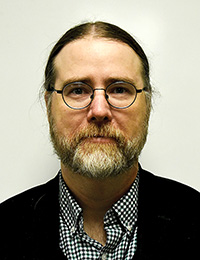
Steve Henn wrote Indiana Noble Sad Man of the Year (Wolfson 2017), And God Said: Let there be Evolution! (NYQ Books 2012), and Unacknowledged Legislations (NYQ Books 2011). For a brief 8 issues he co-edited the defunct Fight These Bastards. He is currently working on a book of overlapping essays he calls a “memoir collage.” He lives and teaches in Indiana. Find out more at therealstevehenn.com.


Title: Guilty Prayer
Author: Steve Henn
Publisher: Main Street Rag, 2021
ISBN: 978-1-59948-854-7, 44 pages, $12


Charlie Farmer is a Georgia poet and professor who loves his wife, Erin, his daughters, his friends, his cats, his students, his books, his LPs, and everything else a poet should love in life.


Risa Denenberg is the curator at The Poetry Cafe Online.

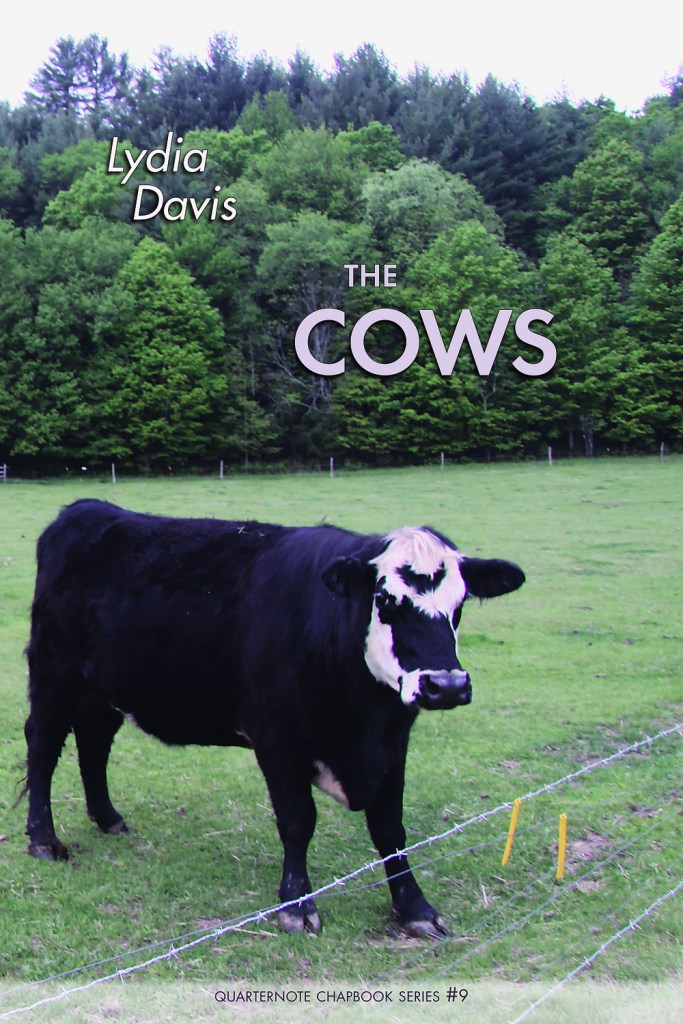
The Cows

The Cows, by Lydia Davis

Review by S.M. Tsai

One may be jealous of another being licked: she thrusts her head under the outstretched neck of the one licking, and butts upward till the licking stops.

Lydia Davis’s The Cows (Sarabande Books, 2011) brought me back to every instance in which I stared at my childhood pets wondering “what are they thinking about?” Anyone who has spent prolonged time with animals will get a familiar feeling when they read this chapbook: the desire to decipher an animal’s intentions in the absence of a common language (while sometimes projecting personalities onto them). How many of us have monologued in tandem with an animal’s mysterious actions, or held mock conversations with said creature as they went about their business?

This chapbook is not a collection of individual poems, nor does it feel exactly like a standard short story. I can only describe it as a 38-page poetic observation of bovine life—one that is interspersed with photos, taken by the author during her year-long observations.

Davis has written other stories about animals, including cats, mice, and fish. Upon comparing these stories, we see that each type of animal can provide a different viewing experience to the human voyeur, due to their varied habits and needs.

In The Cows the theme of stillness is pervasive. The various incarnations of this stillness are portrayed throughout, for example:

How often they stand still and slowly look around as though they have never been here before,

And,

[. . .] they are so still, and their legs so thin, in comparison to their bodies, that when they stand sideways to us, sometimes their legs seem like prongs, and they seem stuck to the earth.

In a lifestyle marked by stillness, what are the things that bring action to a cow’s daily routine?

As Davis demonstrates, their stillness is set against a changing landscape of seasons (white snow to green grass), disturbance of other animals (flocks of birds, snowball-throwing boys, gaping writers), and the birth of calves. Ever-analytical, Davis also itemizes their forms of play:

[. . .] head butting; mounting, either at the back or at the front; trotting away by yourself; trotting away together; going off bucking and prancing by yourself [. . .]

The Cows thus depicts an ambling, relatively tranquil (but quietly humorous) existence for these creatures, at least through Davis’s eyes. But when we read some of her other stories, we are reminded that other animals may experience a different momentum in their daily lives. In her story “Cockroaches in Autumn,” (from: The Collected Stories of Lydia Davis, Picador, 2009)  the featured critter’s activities are marked by speed rather than stillness:

[. . .] when I empty the bag, a crowd of them scatter from the heel of rye bread, like rye seeds across the counter, like raisins. [. . .] he stops short in his headlong rush and tries a few other moves almost simultaneously, a bumper car jolting in place on the white drainboard.”

While I found The Cows to be a thoroughly satisfying read on its own, it was particularly enriching to meet Davis’s cockroaches, mice, cat, and dog along with her neighbors’ cattle. I recommend The Collected Stories as companion pieces to this chapbook.


Lydia Davis is a short story writer, novelist, and translator. She is the author of six collections of short stories, including Can’t and Won’t (2014) and The Collected Stories of Lydia Davis (2009); one novel, The End of the Story (1995); and a collection of nonfiction, Essays One (2019), which was a finalist for the National Book Critics Circle Award. Davis is best known for her very short, micro- or “flash” fiction; many of her stories are a single sentence or paragraph long. She has translated novels and works of philosophy from French, including Gustave Flaubert’s Madame Bovary (2010) and Marcel Proust’s Swann’s Way (2003). Her honors and awards include fellowships from the Guggenheim Foundation and the MacArthur Foundation, as well as the Man Booker International Prize. She is a professor emerita at SUNY Albany.
https://www.poetryfoundation.org/poets/lydia-davis


Title: The Cows
Author: Lydia Davis
Publisher ‏ : ‎ Sarabande Books (March 29, 2011)
32 pages
ISBN‎ 978-1932511932
Price: $9.95


S.M. Tsai spent many years doing archival research and writing, then turned to 9-5 jobs for a new learning environment. Her poetry appears or is forthcoming in Ricepaper Magazine, Blue Unicorn, and the chapbook Bubbles and Droplets: 10 Poems of 2020. She lives in Toronto with her plants.


Risa Denenberg is the curator at The Poetry Cafe Online.

S.M. Tsai

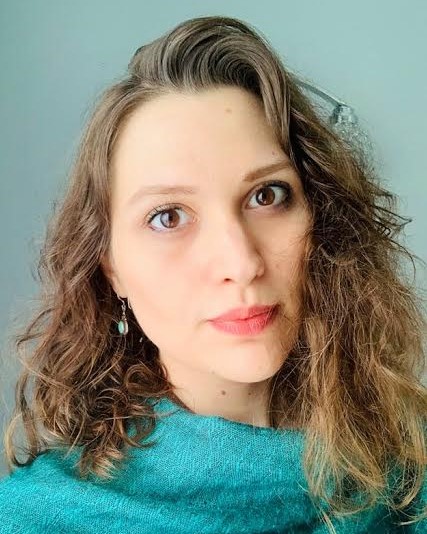
S.M. Tsai spent many years doing archival research and writing, then turned to 9-5 jobs for a new learning environment. Her poetry appears or is forthcoming in Ricepaper Magazine, Blue Unicorn, and the chapbook Bubbles and Droplets: 10 Poems of 2020. She lives in Toronto with her plants.

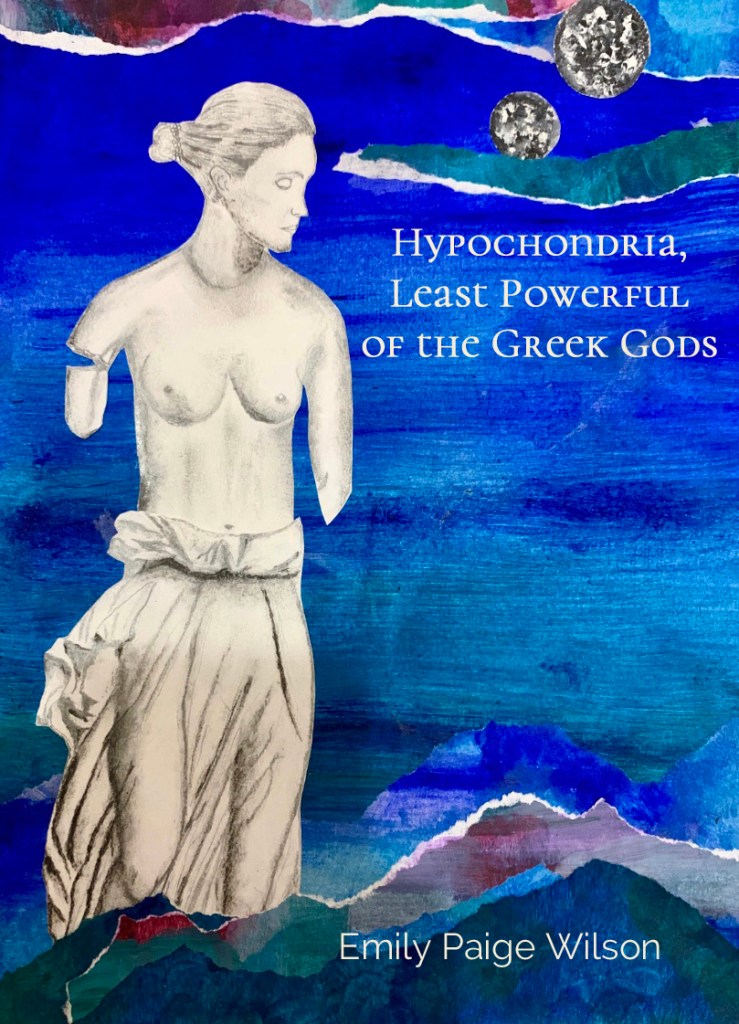
Hypochondria, Least Powerful of the Greek Gods

Hypochondria, Least Powerful of the Greek Gods by Emily Paige Wilson,
Glass Poetry Press, 2020.

Review by Emily Mohn-Slate

What if hypochondria is not about fear but rather love? In her chapbook, Hypochondria, Least Powerful of the Greek Gods (Glass Poetry Press, 2020), Emily Paige Wilson observes in harrowing yet loving detail the secret truths a body can hold. Wilson’s chapbook investigates illness anxiety disorder, also known as hypochondria, which is worrying excessively that you are or may become seriously ill. This chapbook also explores language, power, and empathy in poems that exhibit a range of formal and sonic play. As someone who has suffered from chronic migraines for most of my life, I found myself nodding and underlining while I read as Wilson articulates the weight of invisible pain—mental, emotional, and physical—and its ability to fray not only one’s sense of self, but also one’s relationships with others.

Hypochondria, Least Powerful of the Greek Gods is framed by a series of concise poems titled “A Treatise of Hypochondria.” These poems use archaic spelling and capitalization (i.e. “Vapours”), which roots the reader in a time when doctors relied on the outdated theory of the “four humours.” The first of these poems, “A Treatise of Hypochondria (i),” serves as a prologue poem, and ends, “our Ancestors / rising / to make Complaints.” These lines ground us in the stereotypical image of the hypochondriac as merely a world-class complainer, while they also nod to how we are all bound by our ancestors’ genes. This framing begs the question: how far have we really come over the last few centuries in our understanding of women’s illnesses in particular?  The next poem, “I Am Constantly Seeking Reassurance,” is a first-person lyric that introduces the anxiety of the speaker and considers the limits of others’ support in the face of her illness:

xxxxxxxxxxxxxxxxxMy boyfriend
can only xxxxxxxxxxreassure me

so many times before trees grow
in his ears,
xxxxxxxxxxxtheir roots forming his red
beard.

One of Wilson’s poetic gifts is an uncanny ability to render emotional complexities via imagery. Here, the leap from narrative into image evokes a visceral, physical limit to the boyfriend’s empathy; the trees, trunk, and roots seal his ears against the speaker’s legitimate complaints. We begin to understand the isolation and loneliness felt by the speaker—a double insult to contend with—the way even those who love her most are closed off to her reality.

            “Hypochondria, Least Powerful of the Greek Gods” is the first poem of a series that serves as a second layer of nesting dolls, which situate the human speaker’s concerns in a larger mythological framework. Wilson’s tacking back and forth between humans and the gods draws out tensions around ideas of power and agency in the world. One would think that the god-figures would be able to exercise more authority than the human speakers, but that is not always the case. In “Hypochondria, Least Powerful of the Greek Gods (i),” we see Hypochondria from a distance as the poem is narrated from a third person point of view. In these poems, Wilson gives us the god adapted for our modern time with sharply funny lines like, “Hypochondria once had lunch duty with Hades and he told her, ‘That’s some thorough grief you have.’” She is a complex, human-esque version of a god whose favorite color is beige: “She lets the other gods think it’s because she’s boring, but she loves it—this, the first color clouds turn when they finally let the light in.” Wilson’s speakers are always fighting to turn toward the light, toward connection, even in the midst of impossible odds.

One of the specters haunting this collection is the legacy of women’s pain being seen as insidious or dismissed as mere hysteria. In the second poem of the series, we see the risks of being a woman, even as a god: “Hypochondria was once called a slut by a satyr because she wears barely-there dresses drawn from river water and weeds, but she needs to see her body clearly.” She wears thin dresses in order to see her body clearly for a purpose that is her own, not to entice men; but again, her intentions and her body are misinterpreted. Hypochondria “wishes she could treat pain like a coin purse—something spare, sparse, to be exchanged for something else,” but instead she has to bear it again and again. Gender also shapes our understanding of pain and our acknowledgement of it as real. We see this in the poem, “Hypochondria and Her Estranged Half-Brother Sisyphus,” in which “Hypochondria knows he’s never taken her / symptoms seriously, the panic she’s attracted, / aches born less in the bones than the brain.” Sisyphus responds, “I hold my pain in a way others can believe. / See how it fits neatly in my hands. So visible and clean.” Boyfriends, family members, and doctors minimize and ignore her pain, as in “My Doctor Told Me There was Nothing There.” The speaker says, “They didn’t know how practiced I’d become / in distraction—deeming every discomfort / unworthy of concern.” Here, her secret pains are articulated against the forces that would silence her. And, we experience the way pain is subjective, shifting, and unknowable for others.  It takes a new doctor who had to “hold me / down while she checked the wreckage of the cysts / on my Bartholin glands,” apologized while she “milked blood / and pus from the thin skin of my labia, /gentle yet firm as if she had mouths to feed.” In the world of this book, and we are to understand, in the larger world, it is rare for the hypochondriac to be believed. What if the girl who cried wolf is telling the truth? Who will help her then?

In this collection, Wilson often lifts up the curative powers of language itself. Language is crucial to our ability to connect with others, to rise out of the murk of loneliness. But especially for the hypochondriac, language is also the locus of deep misunderstanding and damage. One of the most compelling aspects of this chapbook is the tension between the limitations of language that the speaker faces within each poem, while the language of the poem on the page is lush, precise, and exhibits transformative properties of observation and sonic beauty. In “On the Wall,” Wilson pursues a fuller understanding of language and reality: “In ancient Egypt, /only scribes were allowed to write—the belief that putting a word on paper was to summon the thing itself.” This is an argument for language’s power to create something real in the world beyond expressing an idea; this tangible power names why many fear sharing certain truths, and would prefer silence. The poem ends: “I’m not interested / in the etymology of a word, but the entire / music behind it. Not the origins, / but the tambourine.” It matters that the speaker is not interested in parsing the word; she wants to experience it—to hold it up to her ear and play each word, through the tidal waves of loss and silence.

The collection’s first epigraph, by Fleetwood Mac, is “I have no fear; I have only love.” These poems stare fear directly in the face with the gaze of love. The second epigraph, “I did not fear them until I wanted to be afraid,” by Sabrina Orah Mark, frames hypochondria in terms of wanting; the speaker has agency and has decided to feel fear. This agency is no small thing; combined with love, it amounts to the exact opposite force needed to dispel the silencing and pain caused by the dismissal of the speakers’ own pains throughout the collection. The final poem, “A Treatise of Hypochondria (iii),” lays out a bridge to another place from where we have come: “persist in all that / Pain and / Patience.” We trust that the speaker will continue carving a path forward, with god-like strength in her vulnerability, through mythology, music, and the force of her own will and love.


Emily Paige Wilson is the author of the forthcoming full-length collection Jalubí (Unsolicited Press, 2022) and two chapbooks: Hypochondria, Least Powerful of the Greek Gods (Glass Poetry Press, 2020) and I’ll Build Us a Home (Finishing Line Press, 2018). Her work has been nominated for Best New Poets, Best of the Net, and the Pushcart Prize. Connect with her at www.emilypaigewilson.com and @Emmy_Golightly.


Title: Hypochondria, Least Powerful of the Greek Gods
Author: Emily Paige Wilson
Publisher: Glass Press
ISBN: 978-1-949099-09-6
23 pages


Emily Mohn-Slate is the author of THE FALLS, winner of the 2019 New American Poetry Prize (New American Press), and FEED, winner of the 2018 Keystone Chapbook Prize (Seven Kitchens Press). Her poems and essays have appeared in AGNI, New Ohio Review, Muzzle Magazine, Tupelo Quarterly, The Adroit Journal, and elsewhere. She teaches high school English by day and poetry workshops by night for the Madwomen in the Attic at Carlow University.


Risa Denenberg is the curator at The Poetry Cafe Online

Emily Mohn-Slate

Emily Mohn-Slate is the author of THE FALLS, winner of the 2019 New American Poetry Prize (New American Press), and FEED, winner of the 2018 Keystone Chapbook Prize (Seven Kitchens Press). Her poems and essays have appeared in AGNI, New Ohio Review, Muzzle Magazine, Tupelo Quarterly, The Adroit Journal, and elsewhere. She teaches high school English by day and poetry workshops by night for the Madwomen in the Attic at Carlow University.

Pre-Posthumous Poems

Pre-Posthumous Poems, by Lawrence E. Hussman

Review by Carmine Di Biase

Luminare Press, 2021

When I first met Lawrence Hussman, in 1981, he was teaching American Literature at Wright State University in Dayton, Ohio. I was a graduate student in his seminar on the naturalists: Stephen Crane, Frank Norris and, among others, Theodore Dreiser, the writer who inspired one of Hussman’s most important books. The austere outlook of these writers, for whom the human experience is governed almost entirely by heredity and environment, suggested great courage and a fierce devotion to the truth, and for that reason they drew me into their worlds. Now, nearly forty years later, I have discovered that what drew Hussman to the naturalists was his own kindred sensibility. That sensibility informs every line of his first chapbook of poems, Last Things (Inkwater Press, 2019). And such is the case with this second chapbook, Pre-Posthumous Poems, only here the poetic voice seems more assured and, in some ways, more bracing.

The title itself is revealing of Hussman’s wry character and his enduring belief that this life, the here and now, is the only certainty we have. These thirty-four new poems—most of them in free verse, some concluding with a rhyming couplet—fall into two main groups: poems about birds, fish, earth and water; and poems about people, their longings and their losses. In his retirement on the Oregon coast, as his poetry suggests, Hussman spends his days meditating on the lives, human and otherwise, he has observed, and pondering what drives them.

As if to introduce himself to the reader, he opens this collection with a poem entitled “Encounter.” The encounter in question is with a sea lion, but the poem does introduce us to Hussman’s poetic world. The speaker walks along a beach “veiled in fog, / so solid that only memory could see / the gulls.” Then all of a sudden “an outsized shape” appears, a “guttural bark” is heard, and “the truth” is revealed: a sea lion comes into focus, at rest, and readying itself to return to its “endless / quest for fish and groups to gather with.” The walker thanks the creature for proving “that death still / waited a ways away, and life again / was willing with its wonder.”

The unabashed alliteration here is characteristic of Hussman’s verse. This trait, however, never cloys, and indeed is an expression of the poet’s reveling in language, in its ability to recover human experience and protect it from the savage claws of time. This he does with economy and precision. In “A Gift Withdrawn,” the speaker recalls a dear friend, who was also a poet, and their time together in Poland. They visit a World War II cemetery “one dark autumn afternoon” and she weeps upon seeing the writing on one tombstone: “Soldier, Fourteen.” Not long thereafter, a deep vein thrombosis takes this poet’s life. “I chose not to join the familiar funeral folly,” says the speaker, who rails instead against “the clichés of preachers and priests.”

In this way, Hussman resuscitates his dead; they are to him what they were to the Shakespeare who wrote once, in a sonnet, of his “precious friends hid in death’s dateless night.” What is it, however, that keeps the people and the other animals in Hussman’s world moving onward during their natural lives? Is it, as the naturalist writer would say, the mere instinct to survive? One answer may lie in “Homeless.” Here Hussman directs his eye at what the unhoused, and perhaps the housed as well, all have in common:

They labor up the busy highway,

burdened with their shoddy gear,

pushing purloined grocery carts,

or crude rigs of wheel and box,

moving their all from place to place.

It is the journey itself, the need to journey, that drives us on. And given the images of domesticity and society—not only the grocery cart but also “an old man in tattered top hat and tails”—the implication is that the journey promises, as the sea lion does, the occasional “wonder” and perhaps a group “to gather with.”

“A Salmon’s Journey,” which bears a resemblance to Eugenio Montale’s “The Eel,” is one of Hussman’s rawest and most beautiful poems. The etymological link between “travel” and “travail,” words which he does not use here, nevertheless comes vividly to life. The journey literally makes its mark on these fish, which are left

starved and scarred, their once sleek bodies

discolored, deformed, backs humped,

jaws hooked and fanged.

The speaker laments “pitiless Nature,” which might have chosen some “kinder game plan,” but unlike Montale’s singular eel, Hussman’s salmon are plural: theirs is not a solitary journey. Here and elsewhere, moreover, the exactness and spareness of the diction, the sheer transparency of the images, and a masterful rhythmic control, all lead to a poetic experience that is at once arresting and redemptive.

A poem called “Grief,” which serves as the coda to this excellent collection, recounts the discovery of a man found “frozen to the hill that held his little cabin.” The chatter that follows—”worry for the way he died, / the life he must have led, no family, or friends, / not anyone at all to miss him, mourn him”—is pointless. “Save your tears,” says the speaker, “for those that ache, the living.”   

Even for a scholar of naturalism, then, there is more to life’s journey than heredity and environment. There is, in short, community, the reassuring sense that one does not travel entirely alone, or at the very least, the awareness that the strangers among us are themselves on an equally arduous journey, soldiering bravely on because “mere steps ahead,” as Hussman says in “Encounter,” might just reveal, if not a sea lion, then something just as wondrous. 


Lawrence E. Hussman is professor emeritus of American literature at Wright State University. Among his seven previous books are Dreiser and His Fiction: A Twentieth-Century Quest and Desire and Disillusionment: A Guide to American Fiction Since 1890. He lives on and writes about the Oregon coast. Pre-Posthumous Poems is his second book of poetry.


Pre-Posthumous Poems, by Lawrence E. Hussman.
Eugene, OR: Luminare Press, 2021.
$9.95 49 pages.
ISBN: 9781643886619


Carmine Di Biase writes about English and Italian literature, and his poems have appeared in various journals. Last year his English translations of thirteen poems by Cesare Pavese appeared in L’anello che non tiene: Journal of Modern Italian Literature. Occasionally he reviews books for the Times Literary Supplement. He has recently retired as Distinguished Professor of English at Jacksonville State University in Alabama. His chapbook of poems, American Rondeau, is due out from Finishing Line Press in August of 2022.


Risa Denenberg is the curator at The Poetry Cafe Online.