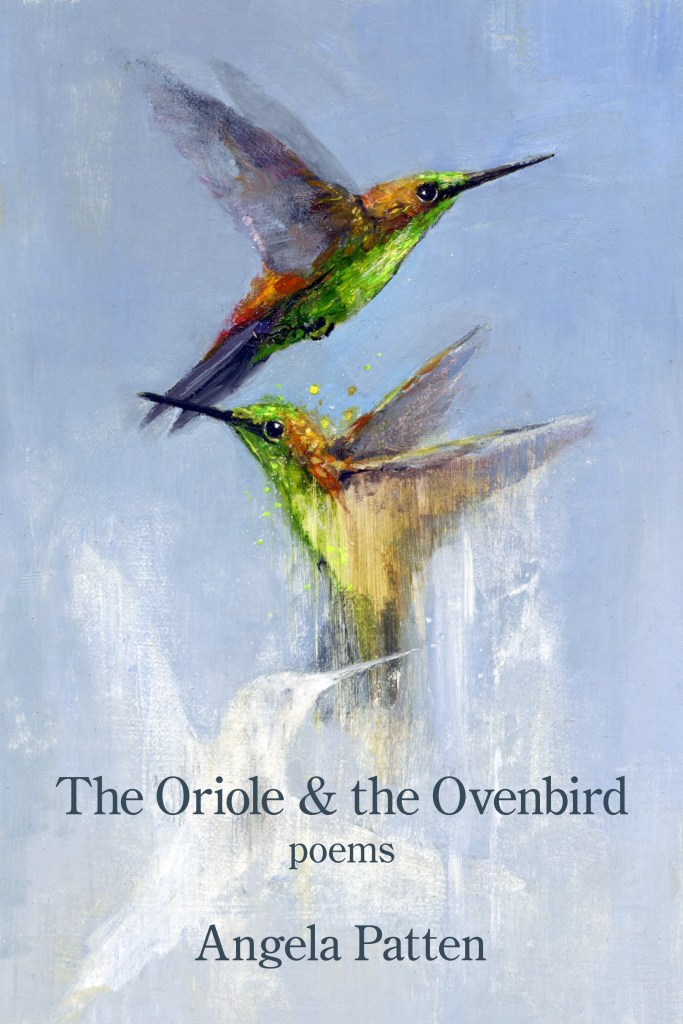
Like an experienced birder, the speaker of the poems in Angela Patten’s The Oriole & The Ovenbird (Kelsay Books, 2021), practices patience and careful observation while amassing an impressive list of species—nearly 30 in these twenty-one poems. The poet moves far beyond a lyrical description of birds, however, as she examines a human’s place in nature’s rich tapestry.
Patten delights in painterly descriptions, presenting such images as a “cardinal fully incarnadined,” in “Spring Comes to A Dying Decade”; and a swallowtail settling on a “feathery dill stalk,” in “Slow Time.” She captures the mystery of birds’ “inscrutable errands” and their music—“teacher teacher, peter peter, pretty girl” in “Evening Light at Oakledge”.
In “After Cataract Surgery” the speaker’s observations grow more metaphoric. Though she sees more clearly the “deeper yellow” goldenrod and the “tiny basket” of Queen Anne’s lace, the removal of a “gauzy cataract” also triggers a deeper understanding of her Irish father who lost an eye “to clerical brutality.” She hopes her clearer vision might restore “some crucial balance / in the universe.”
Another poem featuring the speaker’s father includes one of several references to corvids. In “Crowtime” a mass of crows gathers “into a solid-color jigsaw puzzle.” The crows’ impressive reliance on community reminds the poem’s speaker of the ritual of pub musicians, especially her father, who,
showed up night after night to take his place in an ancient ritual to play his fiddle, not by standing out but by fitting in
“Crowtime” also suggests that death is part of nature’s great “jigsaw puzzle.” By the poem’s end, the narrator’s father has settled into the “collective darkness,” echoing my own quiet settling in among the birds throughout these poems.
In “Tracks,” surgery scars on the speaker’s arm are raven tracks that lead backward to the “battlefields of childhood” and forward to “my mother’s crowsfeet / inching toward my eyes.” This poem calls to mind the twin corvids in another poem, “Ravens, with one raven “forward-thinking” and the other, “memory” looking back. The speaker places herself squarely into this continuum.
“A Cacophony of Crows” contrasts the community of crows– “the sky full of their feathered shapes”– with solitary humans who “choose condominiums” to indicate their “place in the pecking order.” “Species-ism” also shows humans keeping their distance from one another and from the natural world behind “invisible fences.” “The Thing with Feathers” offers a non-corvid image of avian community. A greedy starling at the bird feeder “ascends to almost holiness” when he joins “a murmuration of thousands.”
Full of vivid description and quiet introspection, The Oriole & The Ovenbird offers a strong message about the power of stillness and observation, awareness of the creatures around us, and above all, the importance of realizing we are already a part of nature’s “jigsaw puzzle.”
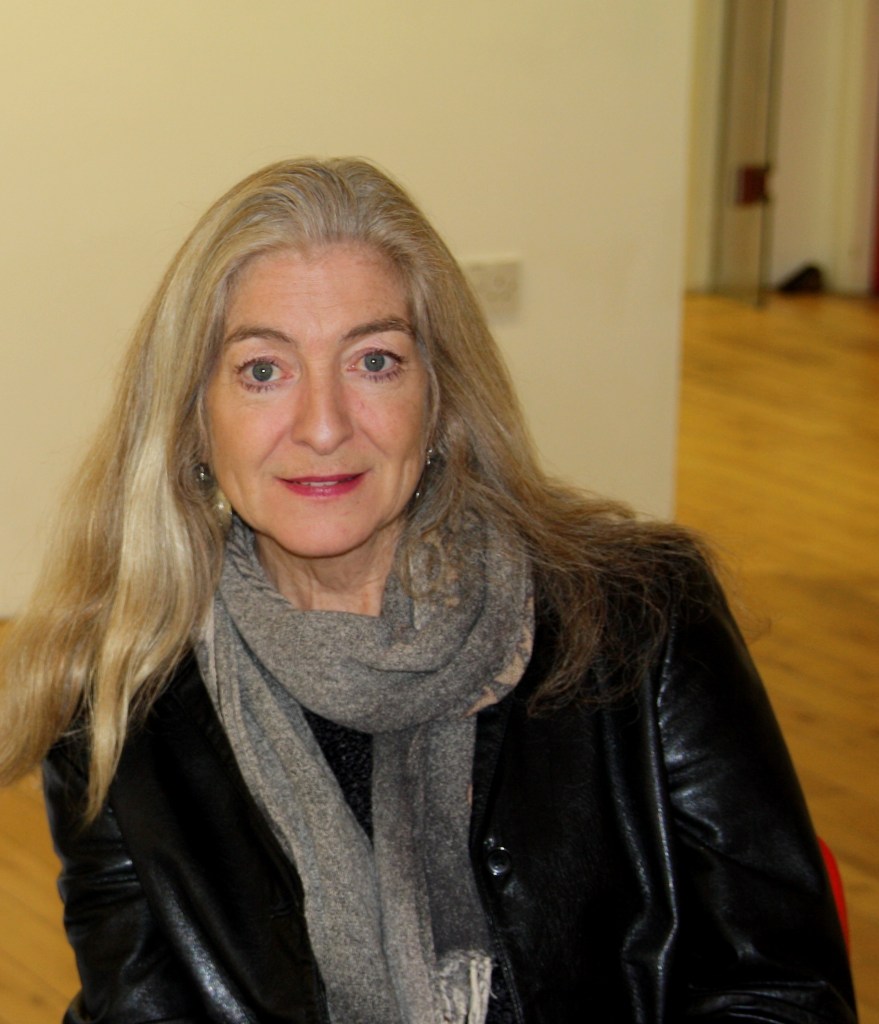
Angela Patten’s publications include four poetry collections, The Oriole & the Ovenbird (Kelsay Books), In Praise of Usefulness (Wind Ridge Books), Reliquaries (Salmon Poetry, Ireland) and Still Listening (Salmon Poetry, Ireland), and a prose memoir, High Tea at a Low Table: Stories From An Irish Childhood (Wind Ridge Books). Her work has appeared in many literary journals and anthologies. Born and raised in Dublin, Ireland, she now lives in Burlington, Vermont, where she is a Senior Lecturer in the University of Vermont English Department.
Jeri Theriault is a Maine poet. Her publications include the award-winning In the Museum of Surrender (2013) and Radost, my red (2016). Her poems have appeared in journals such as The Texas Review, The American Journal of Poetry,The Asheville Poetry Review and Poets Reading the News. She has published reviews in The Collagist,The Adirondack Review and The Rumpus, among others. She is an associate poetry editor for the Rise Up Review and a reader for Vida Review. A Fulbright recipient and three-time Pushcart Prize nominee, Jeri holds an MFA from Vermont College of Fine Arts.Her thirty-four- year teaching career included six years as English department chair at the International School of Prague. She won the 2019 Maine Literary Award for Poetry (Short Works). www.jeritheriault.com
Risa Denenberg is the curator at The Poetry Cafe online.
Jeri Theriault is a Maine poet. Her publications include the award-winning In the Museum of Surrender (2013)and Radost, my red (2016). Her poems have appeared in journals such as The Texas Review, The American Journal of Poetry,The Asheville Poetry Review and Poets Reading the News. She has published reviews in The Collagist,The Adirondack Review and The Rumpus, among others.She is an associate poetry editor for the Rise Up Review and a reader for Vida Review. A Fulbright recipient and three-time Pushcart Prize nominee, Jeri holds an MFA from Vermont College of Fine Arts.Her thirty-four- year teaching career included six years as English department chair at the International School of Prague. She won the 2019 Maine Literary Award for Poetry (Short Works). www.jeritheriault.com
Suzanne Simmons’ poems, essays and photographs have been published in the NYTimes, Fifth Wednesday, Rattle, Smartish Pace, The Baltimore Review and numerous other journals. Her chapbook In September They Draw Down the Lake was released by Alexandria Quarterly Press in 2020. She volunteers for Monarch Watch, The Center for Wildlife in Cape Neddick, and lives in Eliot, ME. Visit her at http://www.suzannesimmons.net
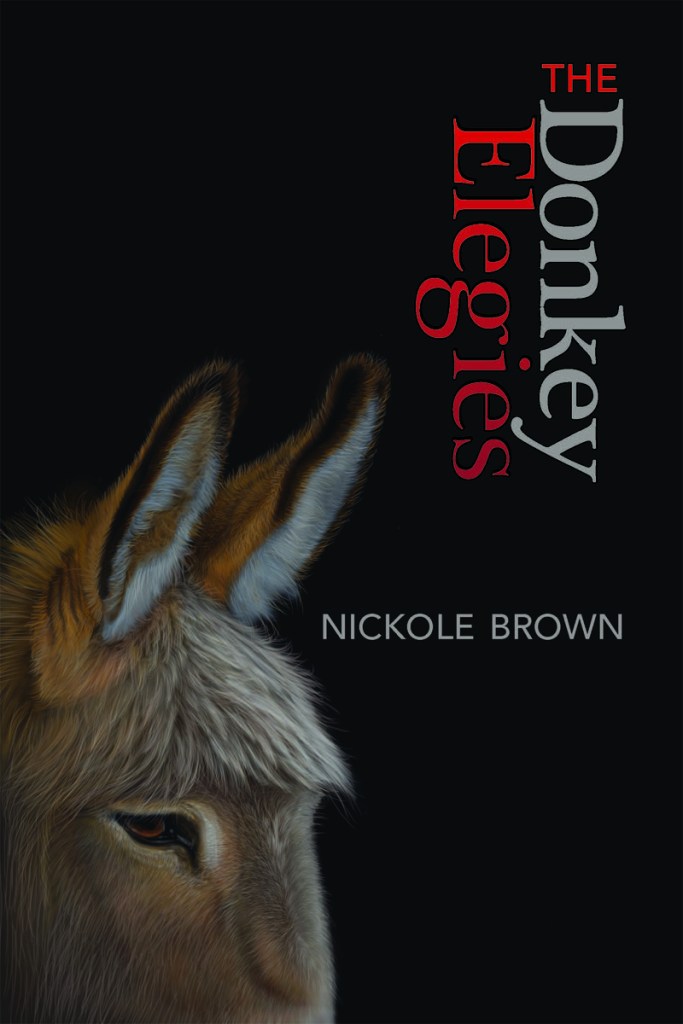
Nickole Brown’s The Donkey Elegies (Sibling Rivalry Press 2020), is a beautifully written and instructive sequence of numbered poems about donkeys, and by extension other overlooked and under-appreciated beasts of burden.
The book begins intimately, as the poet describes a particular donkey, its ears “like single petals of Dahlias at full bloom, curled, firmly upright, but always soft, always open.” It’s an apt image for a book that asks us to listen deeply as Brown lays out the history of these creatures who have served humans for thousands of years.
In the second poem, the poet is on her knees, carefully cleaning the underside of the donkey’s hoof in her role as a volunteer at an animal shelter, and in this position of humility and service, she invites us to join her. She gives us the vocabulary for a donkey’s body: “fetlock, withers, eel stripes, heel, hoof wall, sole, toe, frog,” as opposed to the language used in later poems—stereotypes and jokes about asses, because,
behind their jokes is not the animal itself but the animal they see, not the animal they know but the animal they think.
She endures the scorn of a fellow worker at the shelter:
the community service punk clocked for speeding with a rattle of beer cans on his floorboards can’t get over the fact I clean the barn for free because I want to.
She notices the “subtle flinch of visitors, their pity seeing a grown woman shovel shit.'” But, she writes, “this grunt work is the repair of my soul.”
The middle section of the book catalogues the dismal assortment of grunt work that has been assigned to donkeys over centuries. This is a fascinating and appalling history, and a reminder that seeing any living being as inherently less than and disposable dehumanizes the perpetrator. Many of the of poems in this sequence begin with the phrase: “On your back,” and so begins a long list of people and things donkeys have carried, including the laboring Mary, later her son Jesus, untold numbers of soldiers, and burdens ranging from dead deer to pallets of bricks until, finally:
your back, it sways, it bends in the middle as does a shelf that’s been asked to hold more than it possibly can, before it eventually splits
exposing spine. Overloaded, the cart tips back, suspends in the air the limp donkey.
The use of donkeys in our World Wars, something I was completely ignorant about, is particularly heartbreaking. As many as 80,000 donkeys were in the trenches during World War I, with their vocal cords cut to silence them, and in World War II donkeys outfitted with parachutes were dropped from planes only to shatter their limbs upon landing and be shot. Brown weaves scenes of her own upbringing throughout the unfolding of the the donkey’s tale so as to describe how she could,
sense the life I was born into, the one I was meant to have. . . I’d be trapped with too many babies and a shit husband to boot. . . But what they couldn’t imagine is though I escaped all that, all those years behind the desk have unstitched me from my body in another way . . .
She shows us the girl she once was, who smiled and apologized to men behaving badly, concluding that:
Fawning is one way to dodge what’s coming when you’ve no other way to fight. Tractable is one way a domestic avoids extinction. It took me decades to step into the barn and ask these questions of a donkey who learned to survive as I did, who placidly moved forward, regardless, in spite of everything, just like me.
The language throughout the book links the poet and the donkeys to hardscrabble working worlds: “The truth of my family was buried in their talk.” In one poem Brown describes Mary as “tupped by the Almighty,” in another she refers to Pooh’s donkey friend Eeyore as a “stitched-back-together low note of Prozac.” In tone, these rich phrases are the offspring of the country sayings she grew up with, such as one she quotes in poem #14: “about as good as putting a steering wheel on a mule.” My own father, a Western Pennsylvania farm kid whose education ended when he dropped out of high school to work in a steel mill, peppered his own speech with similar talk. As cliched as it may sound, rural language is indeed wise, often poetic and has an earthy humor you can practically smell. Brown’s book is infused with this language, and coupled with her intellect and keen observations she spins plenty of her own wisdom: “Do we dismiss sturdy, useful beings / because we despise what we’re afraid we’ll become?”
The last poem is a blessing that calls to these lines from Galway Kinnell’s “Saint Francis and the Sow”:
sometimes it is necessary to reteach a thing its loveliness, / / as Saint Francis put his hand on the creased forehead of the sow, and told her in words and in touch blessings of earth on the sow
Brown ends her well-researched and deeply moving book with a similar blessing:
Blessed be. You know how it goes. Inherit the. / / a plain song of persistence, of hunger met with plenty of time to chew.
Listen. Can you hear it, too?
In his dutiful mouth, the pulp and resignation, the grit and patience of every thing grown by the sun surrendered but saved, brought back by the common, low-life, baseborn, absolute
holiness that is this donkey.
I highly recommend this book. The language is often bracing and always delightful, the donkeys are as real as rain—purely themselves, intensely seen, and yet also metaphors for the suffering that happens all around us that we manage not to see.
Nickole Brown received her MFA from the Vermont College, studied literature at Oxford University, and was the editorial assistant for the late Hunter S. Thompson. She worked at Sarabande Books for ten years. Her first collection, Sister, a novel-in-poems, was first published in 2007 by Red Hen Press and a new edition was reissued by Sibling Rivalry Press in 2018. Her second book, a biography-in-poems called Fanny Says, came out from BOA Editions in 2015, and the audio book of that collection became available in 2017. She was an Assistant Professor at the University of Arkansas at Little Rock for four years until she gave up her beloved time in the classroom in hope of writing full time. Currently, she is the Editor for the Marie Alexander Poetry Series and teaches periodically at a number of places, including the Sewanee School of Letters MFA Program, the Great Smokies Writing Program at UNCA, and the Hindman Settlement School. She lives with her wife, poet Jessica Jacobs, in Asheville, NC, where she volunteers at a three different animal sanctuaries. Currently, she’s at work on a bestiary of sorts about these animals, but it won’t consist of the kind of pastorals that always made her (and most of the working-class folks she knows) feel shut out of nature and the writing about it—these poems speak in a queer, Southern-trash-talking kind of way about nature beautiful, but damaged and dangerous. The first of these new poems, To Those Who Were Our First Gods won Rattle‘s Chapbook Contest in 2018. The second chapbook from this project, an essay-in-poems called The Donkey Elegies, was published by Sibling Rivalry Press in January 2020.
Suzanne Simmons’ poems, essays and photographs have been published in the NYTimes, Fifth Wednesday, Rattle, Smartish Pace, The Baltimore Review and numerous other journals. Her chapbook In September They Draw Down the Lake was released by Alexandria Quarterly Press in 2020. She volunteers for Monarch Watch, The Center for Wildlife in Cape Neddick, and lives in Eliot, ME. Visit her at http://www.suzannesimmons.net
Risa Denenberg is the curator at The Poetry Cafe Online.
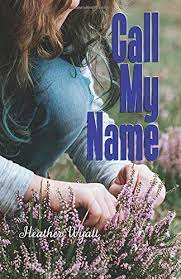
It’s hard to ignore a chapbook that includes a poem whose first line is: “I saw my ass on the news last night.” Heather Wyatt’s Call My Name (The Poetry Box, 2019) is filled with such detailed observations, often delivered with skillfully detached humor, and always presented with rich and precise imagery.
In “File Footage,” the above-referenced poem, Wyatt writes:
Almost like a heart, it bobbled, a teeter totter unaware of the camera. This isn’t good. I said to myself. I put down the cookie dough. I predicted this would happen one day.
Call My Name is part memoir, in that the author sometimes takes us back to her childhood and some of the important characters who shaped it. It is also a collection of her keen observations of everyday events and objects—things that make up a major part of our lives, but which we may tend to ignore. Wyatt pays close attention to them, and reminds us that they have meaning, even if we have sometimes been unable to find the words to convey that meaning. In “Nostalgic Scroll,” she runs through a list of sensory memories:
miniature teapot I begged my mother for after Aunt Frances died yellow crocheted purse from Great-Grandmother Maude fallen hair from Barbie on Salon day sand dunes perched on the coast of North Carolina littered with kites donning images of superheroes sixteenth century forts, lighthouses bigger than life and miles of white beaches in St. Augustine
And in “Full of Grace,” she laments the unfortunate existence of a neglected statue of the Blessed Virgin Mary:
Made of stone, she stands prim, high, cream stone against the brick wall, nailed to a black L bracket looking over the leather teal sofas, and the television that never stops running the news ticker.
I lived in New Orleans for much of my life, so I was immediately drawn to “After My Second Hurricane,” in which Wyatt perfectly captures the city’s sometimes shocking ambience:
The streets of New Orleans smell like old trash filled with aged, Creole spices. . . . . . Purple and gold beads were flying at my head.
The author’s childhood memories include finding her grandfather’s golf bag in the attic, digging “to China” in the red mud of her yard, eating canned ravioli and watching ThePrice is Right at her grandparents’ house, and losing control of her crutches and falling down twice at her great-grandmother’s funeral. In every case, these memories are enhanced by Wyatt’s keen use of imagery and her attention to detail, as they are in the poem, “The Price is Right”:
Grandpa would pluck the strings on his guitar until he heard creaking floor boards that meant Grandma was coming to tell him to stop.
I spent every summer this way, reclining, looking at the wood paneling on the walls.
One of the most poignant poems in the collection is “A Caged Bird,” in which the author describes a sick bird:
Your curled beak and nails grasp at the wires— you squawk when you can catch your breath, The latch that keeps you caged comes unhinged and the door opens.
You don’t leave.
Even more affecting is the haunting title poem, “Call My Name,” which is the first poem in the chapbook. In “Call My Name,” Wyatt describes the failing mental and physical health of her aunt, who is in a nursing home. But the poem is really about the author’s reaction to witnessing the demise of her family member:
This is not the first or last poem I will write about you. This time I am trying to decide what I want from your house that you can’t fit in your tiny room. How can I choose what I want to take with me?
We haven’t even had a funeral for you.
The poet describes the patient’s condition in painful and startling detail, such as in this passage:
The closet is your refrigerator and you are on the kitchen floor and you are in the fabrics department and you are working. You fold the same stiff, sterile sheet for hours and look desperately at the oxygen machine to give you a price for the discounted fabric.
Wyatt’s poetry is spare and focused, transporting the reader directly to the scene, and all of the emotions and sensations surrounding it. Call My Name is evocative, emotive and and often humorous. Heather Wyatt closely observes everything, including herself, in this beautifully written collection. The result is poetry that nudges our memories, validates our feelings about events large and small, and calls us to be observers of our own experiences.
Heather Wyatt is a teacher and writer by day and food TV junkie by night. Her first book, My Life Without Ranch, from 50/50 Press features that love of food, but also explores the dangerous relationship we can all have with it. She lives in Tuscaloosa, Alabama and has a slight obsession with her two dogs. She both graduated from and instructs English at the University of Alabama.
She received her MFA from Spalding University in Louisville, Kentucky in poetry. Several of her poems have been featured in a number of journals including Number One, Puff Puff Prose Poetry , The Binnacle, ETA, Writers Tribe Review and many others. Her short story “A Penny Saved” was published in Perspectives Magazine in 2018. Her essay “Self-Defense” is in The Doctor T.J. Eckleburg Review, September 2018 and her essay, “Hot AF” is in the magazine Robot Butt.
Follow her on Twitter @heathermwyatt or visit her website at heathermwyatt.com for more information.
Diane Elayne Dees’s poetry has been published in many journals and anthologies. Diane is the author of the chapbook, Coronary Truth (Kelsay Books) and the forthcoming chapbooks, I Can’t Recall Exactly When I Died, and The Last Time I Saw You. Diane, who lives in Covington, Louisiana, also publishes Women Who Serve, a blog that delivers news and commentary on women’s professional tennis throughout the world. Her author blog is Diane Elayne Dees: Poet and Writer-at-Large.
Risa Denenberg is the curator at The Poetry Cafe Online.
The US military has made a habit of using beautiful islands for target practice while also destroying animal life, fragile ecosystems, livelihoods, cultures, and even people. Bikini Atoll, part of the Marshall Islands, is one example, about which Marshallese poet Kathy Jetn̄il-Kijiner has evocatively written. Culebra, in Puerto Rico, is another.
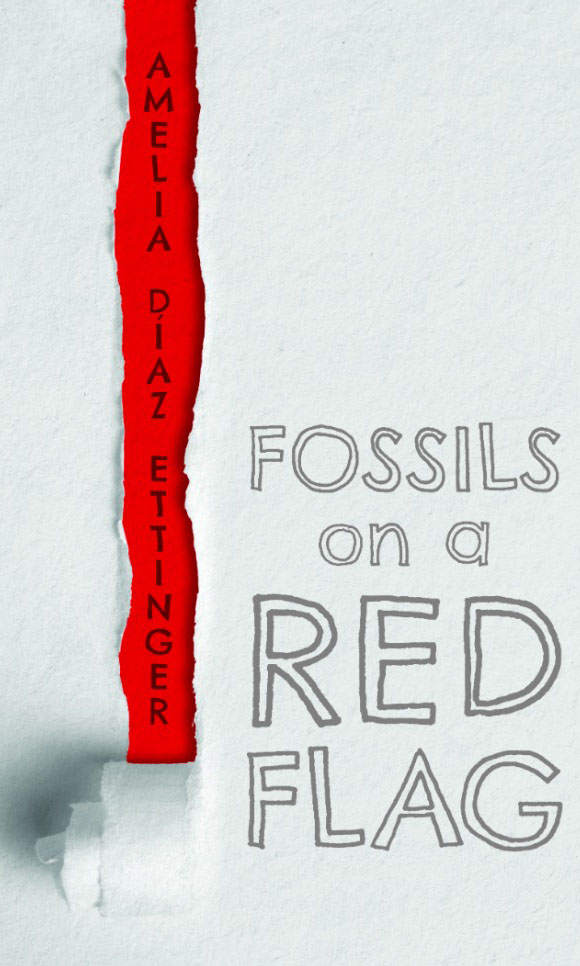
Inspired by Jetn̄il-Kijiner, Amelia Diaz Ettinger wrote her chapbook Fossils on a Red Flag (Finishing Line Press, 2021) about the Culebra Island Naval Defensive Sea Area and Naval Airspace Reservation. The Navy reserve was created in 1941 by President Franklin D. Roosevelt for training purposes. Culebra is an archipelago of 11.6 square miles with a population, according to the government website, of 1,868 people. The chapbook begins with the Executive Order 8684, establishing the naval reserve, and presents nineteen poems that move through time from 1941 to 2017, when deadly Hurricane Maria struck Puerto Rico. Born in Mexico and raised in Puerto Rico, Diaz Ettinger writes from her own experiences visiting Culebra for scientific study as a teenager in the 1970’s and from her vantage point today as a retired educator and an expatriate Puerto Rican now living in Oregon.
Echoing the protests of the culebrenses that took place in the early 1970s and resulted in the discontinuation of the Navy’s use of Culebra, Diaz Ettinger’s collection decries the extensive damage to the environment. She uses the motif of half-life, the scientific term that identifies the time it takes for a substance to decay to half its potency, to probe how long it will take for the archipelago to recover from being used as a bombing range. Among the damages done to the archipelago were destruction of bird and turtle nesting sites, destruction of coral reefs, radiation contamination of land and seafood due to leaching from munitions, and the threat of unexploded munitions. In the poem, “1968*half life,” Diaz Ettinger brings the reader right into the destruction of bird life:
They were parents here, and aunts and siblings. They knew and fed each other’s chicks. // The inferno that followed charred the anxious waiting families sitting peacefully at their nests.
The poem “*1970 half life” starts with the epigraph “I have my orders. / We will blow up some / more on Monday.” The poem depicts the detonation of missiles lodged in coral, a bombing that resulted in native fishermen’s loss of livelihood:
Two hundred feet from the explosion the coral was sliced as by a divine indifferent knife, white spots already spread, where life had been blasted. The shore filled with the glassy eyes of fish.
Diaz Ettinger’s collection also depicts the culebrenses in protest against the US military. The poem, “Claro Feliciano, a citizen of Culebra” describes how this 74-year-old man experiences the “ghost” of the Navy’s radiation poisoning in the cells of his body. It is like “skeletal fingers,” or like “fishbones / that turned to steel.” In “*1970 half life,” the culebrenses, in response, stand outside the naval base within range of “sharpshooters / poised on the occupied hill” and sound “Seventy conchs strong / singing / with the willingness of a hurricane.”
The collection reflects the history of Puerto Rico as a colonial landscape—site of displaced native populations and imported African slaves, colonized by the Spanish, won as a US territory as a spoil of war, disenfranchised in US politics, routinely mistreated and ignored by the US government, and now essentially bankrupt. On behalf of this population, Diaz Ettinger’s work demands that Americans notice the pattern of destruction, both ecological and sociological, to American lands and to fellow American citizens.
A third strand in the collection is Diaz Ettinger’s own life experience in this landscape. She recalls herself as a teen oblivious to the politics of life on Culebra. In “Queen Conch I,” she arrives as a scientist studying “birds and turtles,” “wrapped in loud youth.” A highlight of the collection is “Cebu Poem: Loggerheads and Leatherbacks,” which depicts a youthful love affair among the science crew:
Once in the Caribbean brine, away from the prying eyes of my father, lost in the blue with the smell of fish-bones on our skin I gave myself to you, soft as the inside of a mollusk.
The young people are oblivious to the destruction around them, this time other young people stealing protected eggs. The contrast between the lovers and the destroyers speaks to the irony of attempting to protect rare species in this devastating context. Here, even young love fails:
Plundered nests before the sun entered those waters, under the fading eye of Yucayu, just as you left without saying adios leaving me alone on sand, ocean, and new discovered fire.
Fossils on a Red Flag ends with a poem, “Dedication: After Hurricane Maria,” that depicts the poet looking at Puerto Rico and Culebran politics from the vantage point of years and of the Continental US. Her mourning for the people and places of her childhood is palpable in “baskets of loss.” In this poem, she calls readers to “Witness!” With this command, we are instructed to notice destruction and cruelty. We should take action in helping those who are suffering, and to have sympathy–also for the poet, safe in Oregon, watching with grief the desolation of her home.
In the poems of Diaz Ettinger, as well as those by Jetn̄il-Kijiner, the personal is political and so is the poetry. Diaz Ettinger’s chapbook is art that both delights us and motivates us to live better.
Born in Mexico and raised in Puerto Rico, Amelia Diaz Ettinger has written poems that reflect the struggle with identity often found in immigrants. She began writing poetry at age three by dictating her poems out loud to her uncles who wrote them down for her. She has continued writing poems and short stories throughout her life. Her writing took a back seat while she raised two wonderful human beings and worked as a high school teacher. Now retired, she has renewed her writing with fervor. She has published three books of poetry: SPEAKING AT A TIME (redbat books, 2015), LEARNING TO LOVE A WESTERN SKY (Airlie Press, 2020), and FOSSILS ON A RED FLAG (Finishing Line Press, 2021). She currently resides in Summerville, Oregon with her husband Chip, her dog Oso and seven unnamed chickens.
Title: Fossils on a Red Flag Author: Amelia Diaz ettinger Publisher : Finishing Line Press (February 19, 2021) ISBN-10 : 1646624424 ISBN-13 : 978-1646624423 Price: $14.99
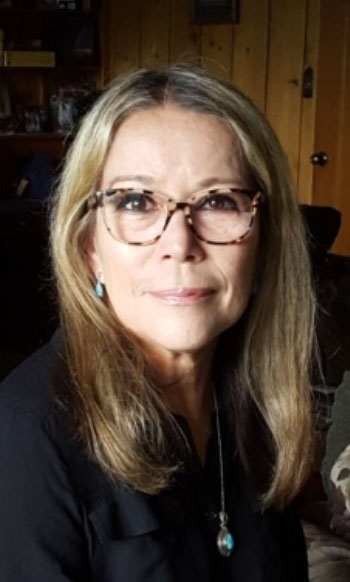
The daughter of two architects,Nancy Knowlesbegan her career in education as a school model, posing as an eager student in publicity photos for her parents’ business, which focused on designing K-8 schools. In addition to earning degrees from UCLA, Humboldt State University, and the University of Connecticut, she worked in business management in the entertainment industry and taught English at a summer camp in Japan. She has taught literature and writing at the college level for almost 30 years.
Risa Denenberg is the curator at The Poetry Cafe Online.
The daughter of two architects, Nancy Knowles began her career in education as a school model, posing as an eager student in publicity photos for her parents’ business, which focused on designing K-8 schools. In addition to earning degrees from UCLA, Humboldt State University, and the University of Connecticut, she worked in business management in the entertainment industry and taught English at a summer camp in Japan. She has taught literature and writing at the college level for almost 30 years.
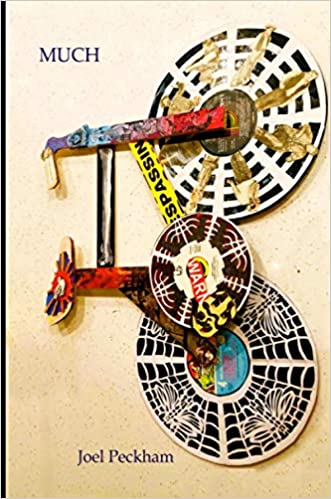
Embracing memory can be a tricky task for the artist. For some, remembrance realizes itself in the comforting gaze of nostalgia and sentimentality. For others, reminiscence belts us as a reminder of something lost, the unrecoverable better days. In his poetry chapbook, Much (UnCollected Press, 2021), Joel Peckham offers a different way to negotiate with our histories: the past as proof of our resilience. Grounded in the lucid and the circumstantial, Peckham’s autobiographical work turns past and present anxieties into narratives of focus and survival. Much confronts eventualities and catastrophes with a hard-earned durability characterized by love and empathy.
Much opens with “On Hearing a Scream Outside My Window,” a poem driven by a theme typical of Peckham’s best work –an unwavering trust in human connection fueled by recollection,
the way the mind desperately pieces things together, xxxxxtrying to follow its tracks as it bends into the woods, imposing xxxxxxpatterns, asking all the leading questions.
Peckham, a Whitman devotee, finds common ground and kinship in the everyday and the extraordinary, in this instance, a cry that functions as both bridge and catharsis. On one hand, the scream conjures the memory of a great grandmother he never met, the relative:
xxxxxxxxxxxxxxxxxxxxxx… my sisters feared, who, in her last years would spend thanksgiving screaming that xxxxxxher husband was trying to kill her, tearing at her hair and weeping in terror as xxxxxxeveryone shook their heads, staring at their drinks–
Giving purpose to the noise of agony, Peckham “imagined and reimagined the voice” and, if only briefly, finds some insight into the mind of the great grandmother who has become the stuff of family lore.
The scream also recalls Peckham’s childhood spent listening to John Lennon records, whose wails are more than rock and roll theatrics. For Peckham, they are confirmation of the human condition, at times celebrating, pleading, suffering, or “harmonizing.” Lennon’s “voice split” is vitality manifested, universal, and prophetic:
it was all for me and through me–those cries and those I hadn’t yet xxxxxxheard or would make myself in time. Years later.
In Peckham’s hands, cries are a sonic purge, “terror turned to beauty. This force / freed from the sun.”
Other recollections that sprinkle Much’s first half eclipse the typical slice-of-life narratives, exploring labor and reward, success and failure. “Redemption Center” celebrates the “simple return[s]” of youth, when heaven is an uncomplicated exchange of a day’s hard work for an afternoon at the movies. Elsewhere, the struggles of adulthood reveal themselves. A group of boys playing in the woods in “Trembling in the Water” are left to reckon with discovery of an abandoned pinstripe suit. What are the young men to make of a man who has given up? Perhaps he “walked out of / a bank or some / cubicle in one of the office parks,” or emerged, hands in the air, from a “breakdown / lane off 95,” and stripped himself of authority and responsibility. The reality of an adult’s defeat leaves the boys, “Ready / to bolt.” Other poems demonstrate a young person’s realization of class-consciousness. In “You don’t know shit about shit,” the speaker finds camaraderie with the boss’s sister. Together, they are “the dropout and the washout, and the trust fund kid,” both “starving for blood.”
The poem, “Pavement: Jack Coffey Landscaping and Tree Service, July 1989” juxtaposes “the fine, manicured green of the lawn” with a truck bed of “black tar sloughing and / calving like a glacier, the scrape of iron on iron, and curses echoing,” as a three-person crew toil during a suburban summer. The working day ends not only with the satisfaction of a job well done, but also with a “deep breath, breathing the poison in.”
Other poems find Peckham more political, but no less intimate. Peckham’s signature familiarity saves his poems from the relic status resigned to much of protest art. In “Jupiter, Desire, Hope,” he confronts the reckoning of COVID-era America. After years of “walking up the gang plank,” we are left to take shelter, “duck and cover,” and “adjust our masks.” “The debt [has] come due.” The poem continues:
Did you ever think this would happen in our lifetime Rachel asks me as we adjust our masks and xxxxxxcross the lot to the grocery store Yes I hear myself respond
The poem “#naturalselection” tackles a country that reduces the substance abuse epidemic to bad statistics, and thinks that its casualties suffer a just-deserved fate as the “other”:
But the problem is the gangs from Detroit and who cares, let those bastards xxxxxshoot each other. And let those druggies shoot themselves up until they’re gone. Load the heroin and Fentanyl and xxxxxxFuck the Narcan anyway. It’s called natural selection.
Where War-on-Drug hardliners dictate with an either/or idea of justice, Peckham writes from the front-lines, giving names and a gentle humanity to the victims. Cool Chase, one of Peckham’s former student, “was beautiful in a quiet way that takes you / by surprise. He could reach you with his eyes without speaking,”
But he had nerve pain and a limp. And maybe he was a little too thin and sometimes he shook a bit like witch xxxxxxgrass in the wind. But that was just Cool Chase, holding back And leaning in, and who knew anyone or anything xxxxxxcould take you suddenly that way before you knew what hit you.
The poem, “America: Love It or Leave It,” is Much’s most vicious piece, addressing the absurd, “You’re with us, or you’re against us” mentality that has haunted post-9/11 America. Using the metaphor of a one-sided, abusive relationship, Peckham presents the country as a bully,
Just another cracking-open-a-six-pack- feet-up-watching-football-with-potato-chip-crumbs- xxxxxxin-his-navel kind of love asking what’s for dinner
In a country that traffics in blind patriotism, “There is no out,” no rescue or retreat, just:
you and all you us and thems and either ors. And xxxxxxthat’right, I didn’t think so’s. Don’t you know by now it’s been a long, xxxxxxlong time since This thing we have, had anything to do with love.
Much’s anxieties culminate in the title piece, dedicated to Peckham’s son, Darius, at age eighteen. The poem undercuts the easy romanticism of idealized youth, presenting a litany of too-much-too-soon experiences that test the resilience of young men and women living under the canopy of near-catastrophe. Reflecting on his own youth, Peckham offers a childhood that wasn’t just baseball cards, rock and roll records, or candy bars; it was also Regan-era angst, abusive parents, coked-up teammates, suicide, AIDS, Russia, sex, and questions about sexuality. His was a world punctuated by overexposure, breaking points, and muted suffering: “How much we hid from each other and ourselves and hid ourselves from / each other.”
“Much” is poem driven by the parental instinct to nurture and protect, and while it can’t do the impossible—guarantee a child’s safety—it articulates the confusing and difficult dynamic between parents and children. Peckham understands that parents:
Didn’t know us at all. And Back then we all thought that was what they wanted. xxxxxxxxxMaybe
they were a little scared of us, how much we had to xxxxxxxxxface, and how much we needed and how confused we were, how much damage xxxxxxxxxwas being done.
In confronting the realities of youth, Peckham gives us poetry-as-survival-kit, a lived-to-tell voice of experience:
All that was coming, coming at us, all at once. That no xxxxxxone could protect us from. And maybe it was all
Too much.
Peckham concludes with the celebratory “Wow! Signal: Dredging Light.” Here, exhilaration fuels an anticipation of “Summer / when everything sings and stings with its need to be uncontained, and penetrate the skin.” A Whitmanesque kinship sends Peckham, tasked with the chore of dredging a creek, beyond the here and now, “insisting I am / not confined in … this body or this creek.” In an instant, his shovel “is not a shovel but a dish, glittering with stars that are future and past at once, sending their messages of birth and burial.” From there, a fabric of continuity reveals itself:
somewhere on the burning sand of an ever-expanding beach, unmodulated waves xxxxxxthat might have come from a light-house beacons somewhere in the xxxxxxconstellation of Sagittarius strain…
Somewhere in Ohio the astronomer shot through with wonder stares at the signal he’s been waiting for xxxxxxwithout hope and desperate with need, works out the coordinates, searching xxxxxxfor the source of what he sees.
Back at the creek, Peckham implores the Old Gods to “sing the language of the sumac” and “play the notes in any sequence.” Grappling with memory, Much could end on a down note; however, “Wow!” finds Peckham alive, hopeful, transcendent, and untranslatable, “staggering / with light and heat.”
Much, along with Peckham’s other books, channels the sweeping, out-of-breath exuberance of Whitman and Allen Ginsberg. At the same time, he deals in a reassuring tenderness that recalls Carl Sandburg. Understandably, any work published during the chaos and loss and COVID will be read as product of its circumstances. Yet Much transcends the trappings of topical art by re-imaging how we live with memory, not as a crutch, but as a resume. Here, a relationship with the past isn’t defined by what-ifs or senior yearbook superlatives; instead; it’s delicate dichotomy of thriving in the now and “letting go while holding to the line that links.”
Joel Peckham has published seven books of poetry and nonfiction, most recently God’s Bicycle and Body Memory. His newest collection, Bone bMusic, is forthcoming from SFA press in Spring 2021. His poems appeared recently in or are forthcoming in many journals, including Prairie Schooner, The Southern Review, The Sugar House Review, Cave Wall, The Beloit Poetry Journal and many others. Currently, he is editing an anthology of ecstatic poetry for New Rivers Press, titled Wild Gods: The Ecstatic in American Poetry and Prose.
Charlie Farmeris a Georgia poet and professor who loves his wife, Erin, his daughters, his friends, his cats, his students, his books, his LPs, and everything else a poet should love in life.
Risa Denenberg is the curator at The Poetry Cafe Online.
Charlie Farmer is a Georgia poet and professor who loves his wife, Erin, his daughters, his friends, his cats, his students, his books, his LPs, and everything else a poet should love in life.
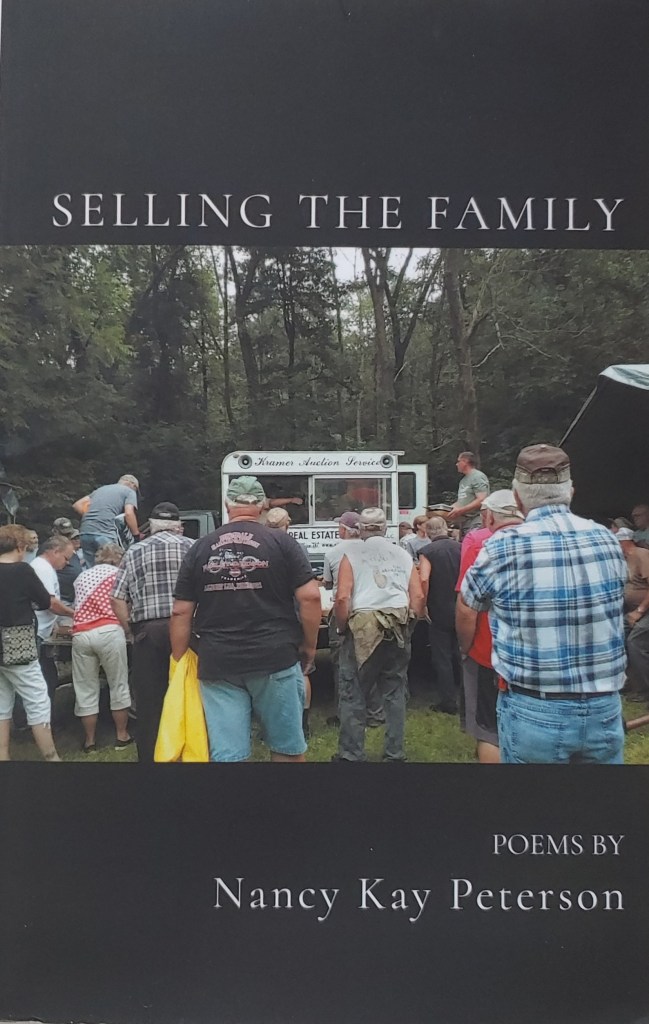
Selling the Family by Nancy Kay Peterson (Finishing Line Press, 2021) is a book you should buy and read. My review of it will be brief, reflecting Nancy Peterson’s poetry. She writes with Scandinavian sparseness about her family, which is now reduced (and simultaneously enlarged by this book) to her. The cover is a photograph of the auction, set outdoors, in a meadow, of her parents’ estate. The poems are brief and in free verse. Peterson avoids excessive self-pity in the same way she does unnecessary modifiers. She doesn’t indulge (maybe a little) the subjective bleakness of mortality. She likes objects. They are part of her family. It reminds me of the deep relationship between kin and ken.
Here’s one of the poems from the book, titled, “Being Last”:
Imagine being last. No one to call on Christmas. No packages under a fragrant pine.
Little but time to fill day after day after day.
Who will buy a coffin, make final arrangements, chance upon the writings, save them for discovery?
My heart knows the work will be simply discarded. What stranger would read them, a lifetime of poems?
Nancy Kay Peterson’s poetry has appeared in print and online in numerous publications, recently in Lost Lake Folk Opera, One Sentence Poems, Spank the Carp, Steam Ticket, and Three Line Poetry. Two of her poems were nominated for The Pushcart Prize. Her chapbook, Belated Remembrance, (Finishing Line Press, 2010) is a series of poems telling the story of her great-great uncle Arne Kulterstad (1825-1902), who was convicted of murder in Oslo, Norway, and eventually exiled to Mount Horeb, Wisconsin. Selling the Family, her second chapbook, relates her experience in auctioning off her family’s estate as the family’s sole living descendant. From 2004-2009, she was co-publisher and co-editor of Main Channel Voices: A Dam Fine Literary Magazine.
Title: Selling the Family Author: Nancy Kay Peterson Publisher: Finishing Line Press, 2021 Price: $14.95 ISBN: 978-1-64662-402-7
Bill Rector is a retired physician. He formerly edited the Yale Journal of Humanities in Medicine. His publishing credits include a full-length poetry collection entitled, bill, through Proem Press, and five chapbooks: Lost Moth, about the death of his daughter, which won the Epiphany magazine chapbook competition; Biography of a Name (Unsolicited Press), relating the death of Jimmy Hoffa to contemporary American culture; Brief Candle (Prolific Press), a series of sonnets in modern idiom about selected characters from Shakespeare; Two Worlds (White Knuckle Press), relating the transcendent to the ordinary, which the editors called one of the most beautiful collections they have published; and most recently, Hats are the Enemy of Poetry (Finishing Line Press).
Risa Denenberg is the curator at The Poetry Cafe Online.

















 The Poetry Cafe