

The Squannacook at Dawn,
by Richard Jordan (The Poetry Box, 2024)
Reviewed by Peter Mladinic
The Lines Versus the Line
“…no matter where I go from here today the river will be with me” (from, “The Squannacook at Dawn”
It’s refreshing to find a poet writing about what he loves doing and in the process, learning something new from an old situation. In these fishing poems, the poet’s father is both angler and mentor. Just as father and son cast their lines into water, the poet casts his line onto page and, like a good angler, follows through. Time and river go together in Thomas Wolfe’s novel, Of Time and the River, and also in these poems by Richard Jordan’s. While The Squannacook at Dawn is a collection of poems about fishing, its ultimate subject is time: the remote past, the past, and the present.
The remote past is childhood, and (this is only my own speculation) the river is wider, deeper to the child than to the man. Children perceive things differently from adults. Jordan evokes the breath and scope of a childhood experience in the chapbook’s first poem, “Casting Off Shore.” Its verbs are present tense, but its rhythms and images are steeped in childhood. In talking about the “small white perch,” he says, “I know they’re out there somewhere, possibly / beyond the island where lily pads / grow thick.” In a sense, the boy and the man are “out there somewhere,” in memory. The poem continues,
Hold on,
my father says. He bends to trace a cross
on my tanned forehead with his free hand, then
points skyward as I launch the bobber high,
aimed to split a cloud, the way he taught.
One line in this poem is “we’re here today.” Its verbs are present tense till the end, where he uses the past tense in “he taught,” a phrased which resonates with other poems in the chapbook. The vividness of childhood extends to “Mackerel Day,” “my father puffing his cognac pipe tobacco, me wearing his old red baseball cap,” also to “Upon Reading the Local Pages,” where “A cloud of mayflies hovered over a clear pool,” to “Happy Meals,” which begins, “Grampa once gutted the scrawny perch I netted,” to “Ice-Out,” with its depiction of “two young boys . . . on bicycles,” and continues on into the last poems. In the poems, “The Squannacook at Dawn,” (from which the opening lines of this review are taken), and “Casting from Shore,” are poems in which the speaker passes on knowledge gotten from his father: “you had to gauge / your line, the tension. If it wasn’t taut / it was dreaming.”
“Home from the River” a concise, poignant evocation of the past, begins, “dad’s ashes / smudged on mom’s cheeks.” It’s strongly suggested that the poet’s father wanted his ashes scattered into the river he loved. While this poem is terse and tactile, “Returning to Vermont” is expansive and nostalgic. “This will always be our spot, she said.” That could have been fifteen, twenty, twenty-five years ago. The speaker doesn’t say. He is busy traveling back in time.
Already north
of Stowe, I should have passed the cedar fence,
the Holsteins stretching their long tongues to taste
the other side. I’m lost, though I won’t turn
around. How to explain? Ahead, the leaves
and sky fuse burgundy with fuchsia. See,
she used to paint. She could have painted that.
Paradoxically, this poem is like a still life painting and like a road poem, with numerous enjambments from stanza to stanza. “[F]lushed out / a rainbow trout,” and “It was / early October” are lines in which the thought process continues from one stanza to the next. The speaker is “in the past” throughout and simultaneously going forward, “I won’t turn / around.” The enjambed lines reinforce that progression.
In the poem, “Exit 37 B,” Jordan writes, “But I knew a woman / who lived there twenty years ago,” and in “What Was There,” he writes “Waded another mile, at least,/ across slick stones. Once there, just me all day.” These poems are also set in the past.
The present is really the present progressive. The “you” in “The Art of Topwater Fishing” could refer to the speaker. But, just as the father taught his son to fish, the poet “is teaching” the reader to listen.
you listen to the snap of bluegills snatching
dragonflies that flutter close. Perhapsit’s warm, but no one’s mowing, and the buzz
is the work week’s murmur fading from your ears,by then soft enough that you make out
an osprey calling high above the maples.
These lines are so vivid, so near, so invigorating. Other poems are also set in the here and now. In “Old Men Fishing, with Osprey” Jordan writes “They forget what they were saying.” In “Spillage,” “Ramsdell inhales deep”; and the poem “Blackbird Through October Mist,” concludes with “This is the time to glide.”
Many eat fish, but don’t catch them. In these poems, Jordan tells how to catch fish, but without instructions. Instead, things unfold. He goes where the poem wants to go, because he’s “all wrapped up it,” with no self-indulgence. He finds the spiritual in the corporal. His rhythms reinforce physical movements of people and entities of the natural world. His poems are concrete and intimate, and stocked with living things.
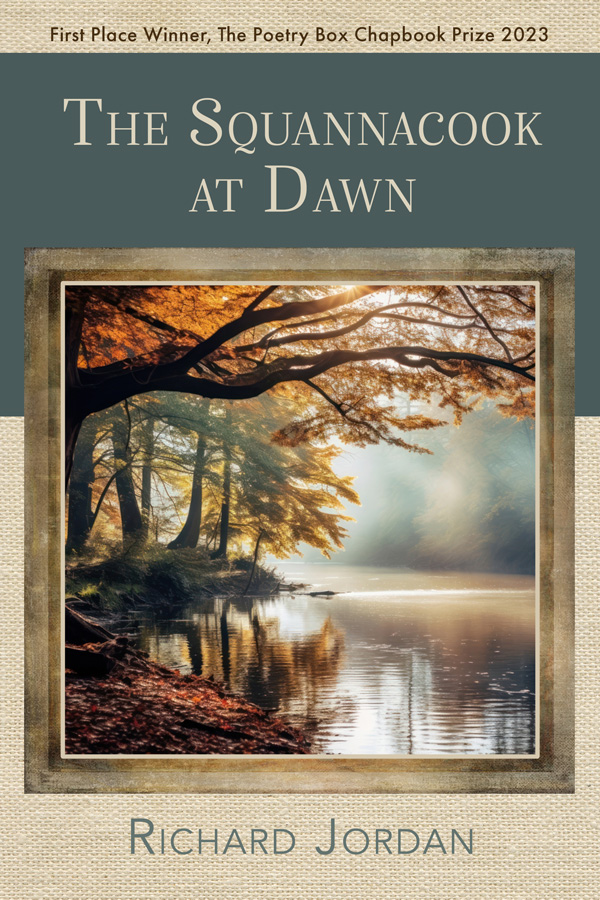
The Squannacook at Dawn by Richard Jordan
The Poetry Box. Portland, Oregon 2024. $17.66

RICHARD JORDAN’S first full-length collection will be published by Shanti Arts in 2027. Individual poems appear in Southern Poetry Review, DMQ Review, Rattle, Valparaiso Poetry Review, New York Quarterly,Tar River Poetry, South Florida Poetry Journal, and elsewhere. His chapbook, The Squannacook at Dawn, won first place in the 2023 Poetry Box Contest. Another chapbook, Spotting the Rise, is available through Rockwood Press. He serves as an associate editor for Thimble Literary Magazine.
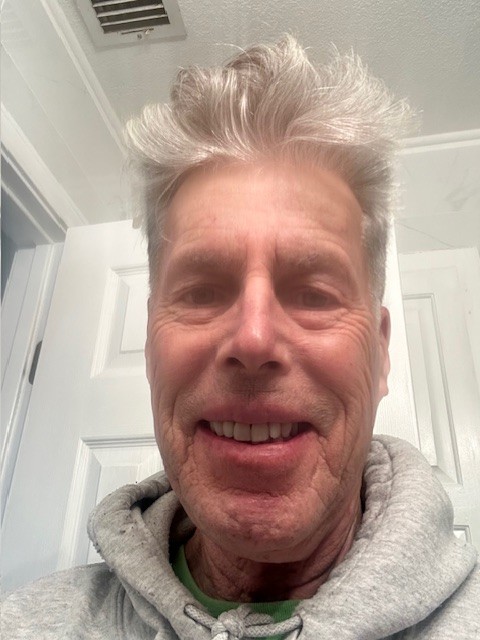
Peter Mladinic’s most recent book of poems, The Whitestone Bridge, is available from Anxiety Press. An animal rights advocate, he lives in Hobbs, New Mexico.
The Poetry Cafe Online is curated by Risa Denenberg.


Superb review Peter. Interesting and insightful analysis of Richard Jordan’s mesmerising poems in his first full-length collection. Bravo.
LikeLike