

The Heart of It By Alan Perry
Finalist, 2025 American Writing Awards and Best Book Awards by American Book Fest
Published by Kelsay Books
Review by Laura E. Garrard
Alan Perry’s touching poetry chapbook, The Heart of It, focuses on the overarching themes of time, the natural world, and the human condition. He skillfully uses couplets—and a splattering of tercets, quatrains, and free verse—to present 28 poems about relationship, loss, and the cycles of life. Related images thread through the pieces: fire, ash, chill, air, leaves, mirrors, moments, travel, and seasons. This carefully composed collection will touch a chord with readers who’ve loved and lost. In the poem, “What Uncovers Us,” he writes, “. . . I’ll always want more of— / another day to uncover // earth at its edges.”
Perry includes an epilogue, by Fyodor Dostoevsky (who survived a mock execution by the Russian Tsar):
To be human among people and to remain one forever,
no matter what the circumstances, not to grow despondent
and not to lose heart—that’s what life is about, that’s its task.
Perry opens with the tender poem, “Necessary Matter,” about a friend’s death, and draws me into “the moment before absence…when there is no loss.” He goes on to write “Depth gradually returns” after grief melts, and “rivers come alive, reservoirs re-fill.” “Flares” combines starlight, fireworks, and sonic booms that illuminate relationship: “Before I began watching stars / I looked for you in every light // that mirrored sunshine.” Several poems combine the subjects of space and love, an interesting use of metaphysical metaphor. In “Voyager,” he writes,
I want to know if you will stay
on this rock in deep space,
breathe its thin atmosphere
with me, find the next sign of life.Or will you leave the ash of us—
stone and dust of what’s come before—
and search for another distant satellite
invisible to the naked eye
but always moving, circling?
In “Flying Lessons,” the speaker leaves a love letter under an airplane seat—the very seat that their beloved will occupy a week later—and reveals the stowed missive in an email to them. However, the lover begins their reply with “I can’t.” Part ii of this poem is a fantasy born from the speaker’s desire for a different response from the beloved, with the wish that they will “take back [their] leaving.” What moves me in this poem are the details expressed about the lover’s posture in the imagined writing scene, for example: “arcing cursive,” “half-empty Perrier nearby,” and “sleek, ringless fingers.” Perry’s observations underline how well the speaker knew their lover and this drew me into the speaker’s feelings of unrequited love and loss.
Perry’s poems evoke physical sensations through imagery and by using the second person point of view. The poem, “Autumn Redux,” captures the chill of fall and the absence of a lover:
Doesn’t it feel like the lover
who leaves you alone, memories piled
at your feet, rake in your hands
trying to collect what’s scattering?
There’s little you can do except
tie the scarf she made for you
tighter against the loss.
Perry’s poems involve looking back, often in a side mirror, at a moment or a season that passes or will pass. The tenuousness of relationships is a constant companion throughout the collection. In “Some Call It a Sign,” he focuses on the uncontrollable fleeting nature of time: “Time left, like an achingly slow crawl, // now measured in minutes.”
In Part II of the book, Perry leaps from memories of a daughter to a granddaughter in “Traveling Waters.” In “Coming About,” sailboats serve as a metaphor for time measured in “. . . hand-over-hand tasks, / letting out just enough sheet / to sail away from what / might tip them over.” Then, in “At the Cemetery,” the speaker takes grandchildren to family gravesites, where they talk to their great-relatives while tending plants around the stones. There is a remaining marker not yet engraved. The speaker’s granddaughter says, “I’ll take care of this one.” This, I infer, will be the speaker’s grave someday.
Two memorable poems fall at the end of Perry’s book: “Side Door” and “Mirroring.” The side door of a home becomes a portal for activities, then memories, including,
the day you
rang the bell, asked for directions
then later coffee . . .
as you stepped through the only entrance without a key,
and stayed.
“Mirroring” contains poignant imagery; it’s a poem about packing up a partner’s things after their death. Rather than somber, this poem is hopeful. It states that “no container [is] sturdy enough to carry absence,” but concludes with the speaker noticing that their late partner’s standing mirror has turned toward them and that “one carton re-opened.” This final line extends the relationship; death doesn’t close it entirely. The mirror and re-opened carton are metaphors for the continuance of relationship in the heart and memory of the living partner.

Alan Perry is a poet and editor. His debut chapbook, Clerk of the Dead, was a finalist in the Cathy Smith Bowers Poetry Competition, and was released by Main Street Rag Publishing (2020). His poems have appeared in Tahoma Literary Review, Valparaiso Poetry Review, Third Wednesday, San Pedro River Review, ONE ART, Gyroscope Review, Stone Circle Review, and elsewhere. Founder and Co-Managing Editor of RockPaperPoem, a Senior Poetry Editor for Typehouse Magazine, and a Best of the Net nominee, Alan lives with his wife in suburban Minneapolis, MN, and Tucson, AZ.
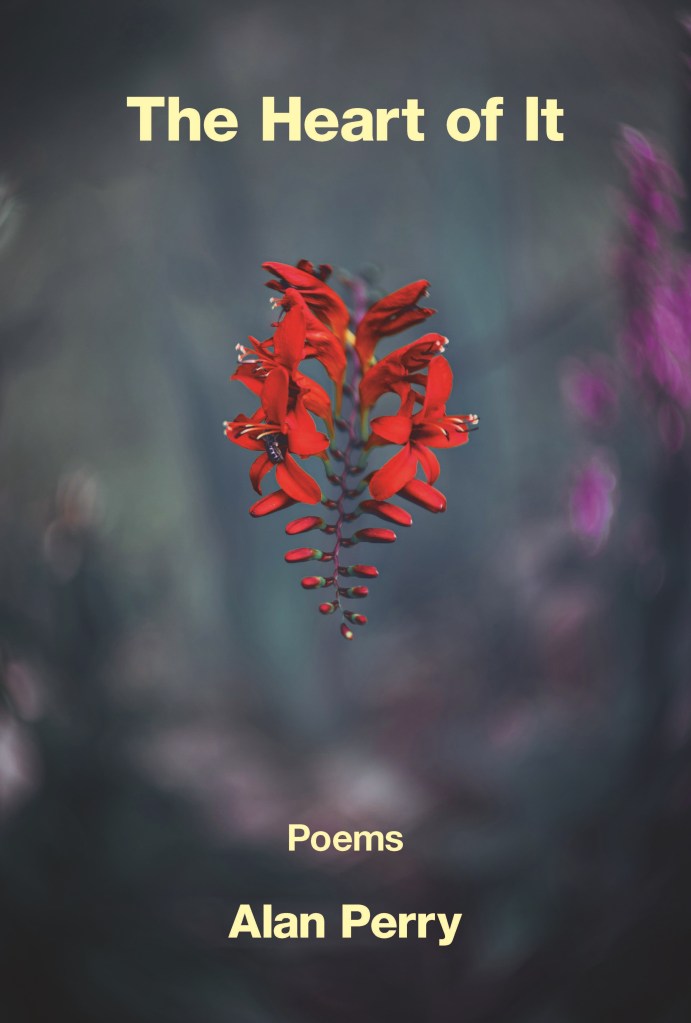
The Heart of It
By Alan Perry
Finalist, 2025 American Writing Awards (Poetry-General category)
Finalist, 2025 Best Book Awards by American Book Fest (Chapbook category)
Publisher: Kelsay Books
ISBN-13: 978-1-63980-748-2
58 pp., $20
https://kelsaybooks.com/products/the-heart-of-it

Pushcart Prize nominee Laura E. Garrard is a CranioSacral Therapist on the Olympic Peninsula. Her poetry appears in Bellevue Literary Review, the Journal of Expressive Writing, The Healing Muse, Amethyst Review, Pangryus, Silver Birch, TulipTree Review, Tidepools, and elsewhere. Her chapbook, Paddling the Sweet Spot Between Life and Death, is available through Finishing Line Press. She was a finalist in the John & Eileen Allman Prize for Poetry and won the Love Merit Prize in TulipTree Publishing’s Stories That Need to be Told Contest. She’s written a series, Poetry That Fits, on Penn Medicine’s OncoLink.org and holds a master’s in journalism. LauraEGarrard.com
Risa Denenberg is the curator at The Poetry Cafe Online.

