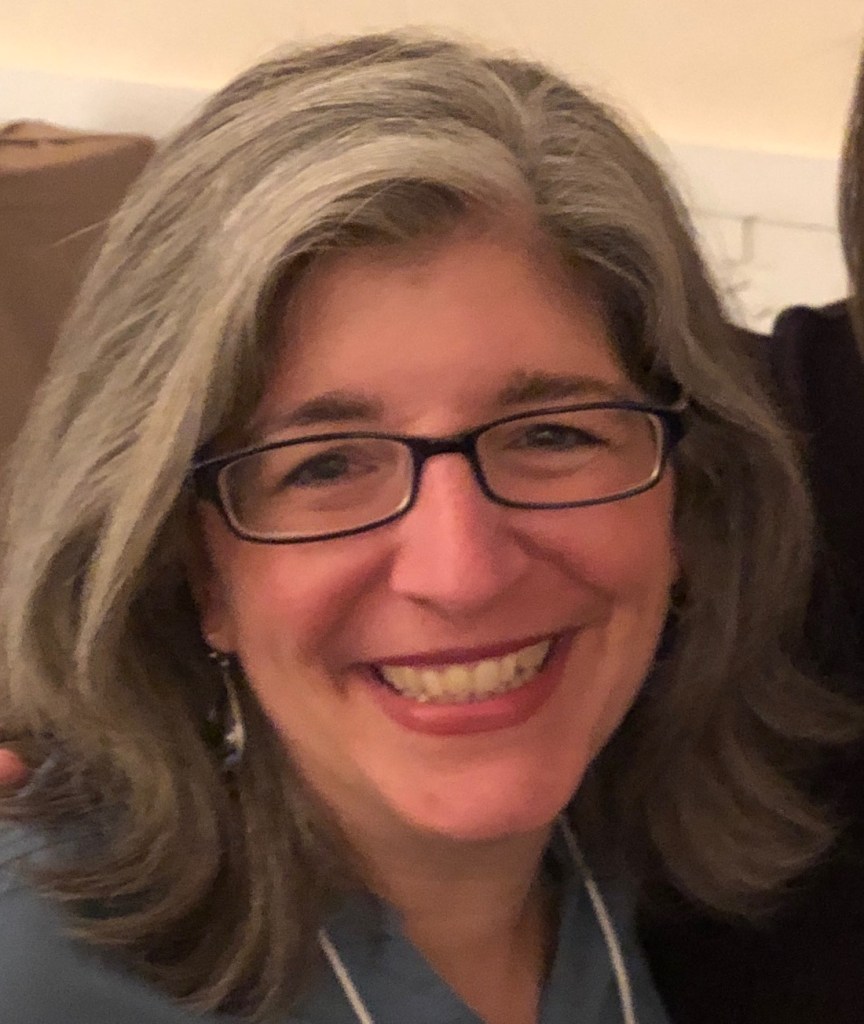
The daughter of two architects, Nancy Knowles began her career in education as a school model, posing as an eager student in publicity photos for her parents’ business, which focused on designing K-8 schools. In addition to earning degrees from UCLA, Humboldt State University, and the University of Connecticut, she worked in business management in the entertainment industry and taught English at a summer camp in Japan. She has taught literature and writing at the college level for almost 30 years.
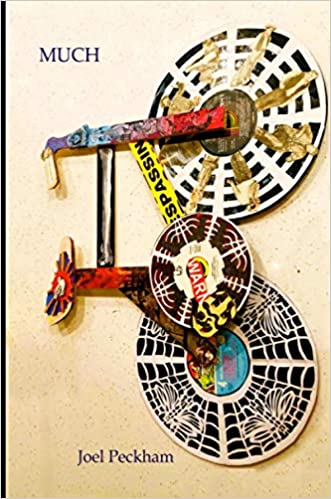
Embracing memory can be a tricky task for the artist. For some, remembrance realizes itself in the comforting gaze of nostalgia and sentimentality. For others, reminiscence belts us as a reminder of something lost, the unrecoverable better days. In his poetry chapbook, Much (UnCollected Press, 2021), Joel Peckham offers a different way to negotiate with our histories: the past as proof of our resilience. Grounded in the lucid and the circumstantial, Peckham’s autobiographical work turns past and present anxieties into narratives of focus and survival. Much confronts eventualities and catastrophes with a hard-earned durability characterized by love and empathy.
Much opens with “On Hearing a Scream Outside My Window,” a poem driven by a theme typical of Peckham’s best work –an unwavering trust in human connection fueled by recollection,
the way the mind desperately pieces things together, xxxxxtrying to follow its tracks as it bends into the woods, imposing xxxxxxpatterns, asking all the leading questions.
Peckham, a Whitman devotee, finds common ground and kinship in the everyday and the extraordinary, in this instance, a cry that functions as both bridge and catharsis. On one hand, the scream conjures the memory of a great grandmother he never met, the relative:
xxxxxxxxxxxxxxxxxxxxxx… my sisters feared, who, in her last years would spend thanksgiving screaming that xxxxxxher husband was trying to kill her, tearing at her hair and weeping in terror as xxxxxxeveryone shook their heads, staring at their drinks–
Giving purpose to the noise of agony, Peckham “imagined and reimagined the voice” and, if only briefly, finds some insight into the mind of the great grandmother who has become the stuff of family lore.
The scream also recalls Peckham’s childhood spent listening to John Lennon records, whose wails are more than rock and roll theatrics. For Peckham, they are confirmation of the human condition, at times celebrating, pleading, suffering, or “harmonizing.” Lennon’s “voice split” is vitality manifested, universal, and prophetic:
it was all for me and through me–those cries and those I hadn’t yet xxxxxxheard or would make myself in time. Years later.
In Peckham’s hands, cries are a sonic purge, “terror turned to beauty. This force / freed from the sun.”
Other recollections that sprinkle Much’s first half eclipse the typical slice-of-life narratives, exploring labor and reward, success and failure. “Redemption Center” celebrates the “simple return[s]” of youth, when heaven is an uncomplicated exchange of a day’s hard work for an afternoon at the movies. Elsewhere, the struggles of adulthood reveal themselves. A group of boys playing in the woods in “Trembling in the Water” are left to reckon with discovery of an abandoned pinstripe suit. What are the young men to make of a man who has given up? Perhaps he “walked out of / a bank or some / cubicle in one of the office parks,” or emerged, hands in the air, from a “breakdown / lane off 95,” and stripped himself of authority and responsibility. The reality of an adult’s defeat leaves the boys, “Ready / to bolt.” Other poems demonstrate a young person’s realization of class-consciousness. In “You don’t know shit about shit,” the speaker finds camaraderie with the boss’s sister. Together, they are “the dropout and the washout, and the trust fund kid,” both “starving for blood.”
The poem, “Pavement: Jack Coffey Landscaping and Tree Service, July 1989” juxtaposes “the fine, manicured green of the lawn” with a truck bed of “black tar sloughing and / calving like a glacier, the scrape of iron on iron, and curses echoing,” as a three-person crew toil during a suburban summer. The working day ends not only with the satisfaction of a job well done, but also with a “deep breath, breathing the poison in.”
Other poems find Peckham more political, but no less intimate. Peckham’s signature familiarity saves his poems from the relic status resigned to much of protest art. In “Jupiter, Desire, Hope,” he confronts the reckoning of COVID-era America. After years of “walking up the gang plank,” we are left to take shelter, “duck and cover,” and “adjust our masks.” “The debt [has] come due.” The poem continues:
Did you ever think this would happen in our lifetime Rachel asks me as we adjust our masks and xxxxxxcross the lot to the grocery store Yes I hear myself respond
The poem “#naturalselection” tackles a country that reduces the substance abuse epidemic to bad statistics, and thinks that its casualties suffer a just-deserved fate as the “other”:
But the problem is the gangs from Detroit and who cares, let those bastards xxxxxshoot each other. And let those druggies shoot themselves up until they’re gone. Load the heroin and Fentanyl and xxxxxxFuck the Narcan anyway. It’s called natural selection.
Where War-on-Drug hardliners dictate with an either/or idea of justice, Peckham writes from the front-lines, giving names and a gentle humanity to the victims. Cool Chase, one of Peckham’s former student, “was beautiful in a quiet way that takes you / by surprise. He could reach you with his eyes without speaking,”
But he had nerve pain and a limp. And maybe he was a little too thin and sometimes he shook a bit like witch xxxxxxgrass in the wind. But that was just Cool Chase, holding back And leaning in, and who knew anyone or anything xxxxxxcould take you suddenly that way before you knew what hit you.
The poem, “America: Love It or Leave It,” is Much’s most vicious piece, addressing the absurd, “You’re with us, or you’re against us” mentality that has haunted post-9/11 America. Using the metaphor of a one-sided, abusive relationship, Peckham presents the country as a bully,
Just another cracking-open-a-six-pack- feet-up-watching-football-with-potato-chip-crumbs- xxxxxxin-his-navel kind of love asking what’s for dinner
In a country that traffics in blind patriotism, “There is no out,” no rescue or retreat, just:
you and all you us and thems and either ors. And xxxxxxthat’right, I didn’t think so’s. Don’t you know by now it’s been a long, xxxxxxlong time since This thing we have, had anything to do with love.
Much’s anxieties culminate in the title piece, dedicated to Peckham’s son, Darius, at age eighteen. The poem undercuts the easy romanticism of idealized youth, presenting a litany of too-much-too-soon experiences that test the resilience of young men and women living under the canopy of near-catastrophe. Reflecting on his own youth, Peckham offers a childhood that wasn’t just baseball cards, rock and roll records, or candy bars; it was also Regan-era angst, abusive parents, coked-up teammates, suicide, AIDS, Russia, sex, and questions about sexuality. His was a world punctuated by overexposure, breaking points, and muted suffering: “How much we hid from each other and ourselves and hid ourselves from / each other.”
“Much” is poem driven by the parental instinct to nurture and protect, and while it can’t do the impossible—guarantee a child’s safety—it articulates the confusing and difficult dynamic between parents and children. Peckham understands that parents:
Didn’t know us at all. And Back then we all thought that was what they wanted. xxxxxxxxxMaybe
they were a little scared of us, how much we had to xxxxxxxxxface, and how much we needed and how confused we were, how much damage xxxxxxxxxwas being done.
In confronting the realities of youth, Peckham gives us poetry-as-survival-kit, a lived-to-tell voice of experience:
All that was coming, coming at us, all at once. That no xxxxxxone could protect us from. And maybe it was all
Too much.
Peckham concludes with the celebratory “Wow! Signal: Dredging Light.” Here, exhilaration fuels an anticipation of “Summer / when everything sings and stings with its need to be uncontained, and penetrate the skin.” A Whitmanesque kinship sends Peckham, tasked with the chore of dredging a creek, beyond the here and now, “insisting I am / not confined in … this body or this creek.” In an instant, his shovel “is not a shovel but a dish, glittering with stars that are future and past at once, sending their messages of birth and burial.” From there, a fabric of continuity reveals itself:
somewhere on the burning sand of an ever-expanding beach, unmodulated waves xxxxxxthat might have come from a light-house beacons somewhere in the xxxxxxconstellation of Sagittarius strain…
Somewhere in Ohio the astronomer shot through with wonder stares at the signal he’s been waiting for xxxxxxwithout hope and desperate with need, works out the coordinates, searching xxxxxxfor the source of what he sees.
Back at the creek, Peckham implores the Old Gods to “sing the language of the sumac” and “play the notes in any sequence.” Grappling with memory, Much could end on a down note; however, “Wow!” finds Peckham alive, hopeful, transcendent, and untranslatable, “staggering / with light and heat.”
Much, along with Peckham’s other books, channels the sweeping, out-of-breath exuberance of Whitman and Allen Ginsberg. At the same time, he deals in a reassuring tenderness that recalls Carl Sandburg. Understandably, any work published during the chaos and loss and COVID will be read as product of its circumstances. Yet Much transcends the trappings of topical art by re-imaging how we live with memory, not as a crutch, but as a resume. Here, a relationship with the past isn’t defined by what-ifs or senior yearbook superlatives; instead; it’s delicate dichotomy of thriving in the now and “letting go while holding to the line that links.”
Joel Peckham has published seven books of poetry and nonfiction, most recently God’s Bicycle and Body Memory. His newest collection, Bone bMusic, is forthcoming from SFA press in Spring 2021. His poems appeared recently in or are forthcoming in many journals, including Prairie Schooner, The Southern Review, The Sugar House Review, Cave Wall, The Beloit Poetry Journal and many others. Currently, he is editing an anthology of ecstatic poetry for New Rivers Press, titled Wild Gods: The Ecstatic in American Poetry and Prose.
Charlie Farmeris a Georgia poet and professor who loves his wife, Erin, his daughters, his friends, his cats, his students, his books, his LPs, and everything else a poet should love in life.
Risa Denenberg is the curator at The Poetry Cafe Online.
Charlie Farmer is a Georgia poet and professor who loves his wife, Erin, his daughters, his friends, his cats, his students, his books, his LPs, and everything else a poet should love in life.
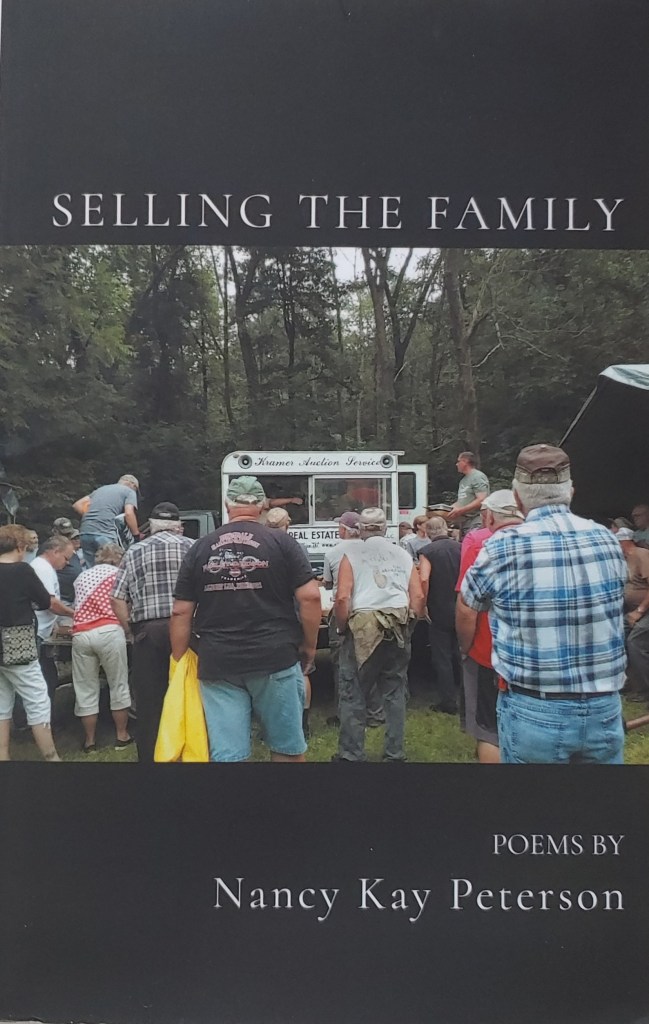
Selling the Family by Nancy Kay Peterson (Finishing Line Press, 2021) is a book you should buy and read. My review of it will be brief, reflecting Nancy Peterson’s poetry. She writes with Scandinavian sparseness about her family, which is now reduced (and simultaneously enlarged by this book) to her. The cover is a photograph of the auction, set outdoors, in a meadow, of her parents’ estate. The poems are brief and in free verse. Peterson avoids excessive self-pity in the same way she does unnecessary modifiers. She doesn’t indulge (maybe a little) the subjective bleakness of mortality. She likes objects. They are part of her family. It reminds me of the deep relationship between kin and ken.
Here’s one of the poems from the book, titled, “Being Last”:
Imagine being last. No one to call on Christmas. No packages under a fragrant pine.
Little but time to fill day after day after day.
Who will buy a coffin, make final arrangements, chance upon the writings, save them for discovery?
My heart knows the work will be simply discarded. What stranger would read them, a lifetime of poems?
Nancy Kay Peterson’s poetry has appeared in print and online in numerous publications, recently in Lost Lake Folk Opera, One Sentence Poems, Spank the Carp, Steam Ticket, and Three Line Poetry. Two of her poems were nominated for The Pushcart Prize. Her chapbook, Belated Remembrance, (Finishing Line Press, 2010) is a series of poems telling the story of her great-great uncle Arne Kulterstad (1825-1902), who was convicted of murder in Oslo, Norway, and eventually exiled to Mount Horeb, Wisconsin. Selling the Family, her second chapbook, relates her experience in auctioning off her family’s estate as the family’s sole living descendant. From 2004-2009, she was co-publisher and co-editor of Main Channel Voices: A Dam Fine Literary Magazine.
Title: Selling the Family Author: Nancy Kay Peterson Publisher: Finishing Line Press, 2021 Price: $14.95 ISBN: 978-1-64662-402-7
Bill Rector is a retired physician. He formerly edited the Yale Journal of Humanities in Medicine. His publishing credits include a full-length poetry collection entitled, bill, through Proem Press, and five chapbooks: Lost Moth, about the death of his daughter, which won the Epiphany magazine chapbook competition; Biography of a Name (Unsolicited Press), relating the death of Jimmy Hoffa to contemporary American culture; Brief Candle (Prolific Press), a series of sonnets in modern idiom about selected characters from Shakespeare; Two Worlds (White Knuckle Press), relating the transcendent to the ordinary, which the editors called one of the most beautiful collections they have published; and most recently, Hats are the Enemy of Poetry (Finishing Line Press).
Risa Denenberg is the curator at The Poetry Cafe Online.
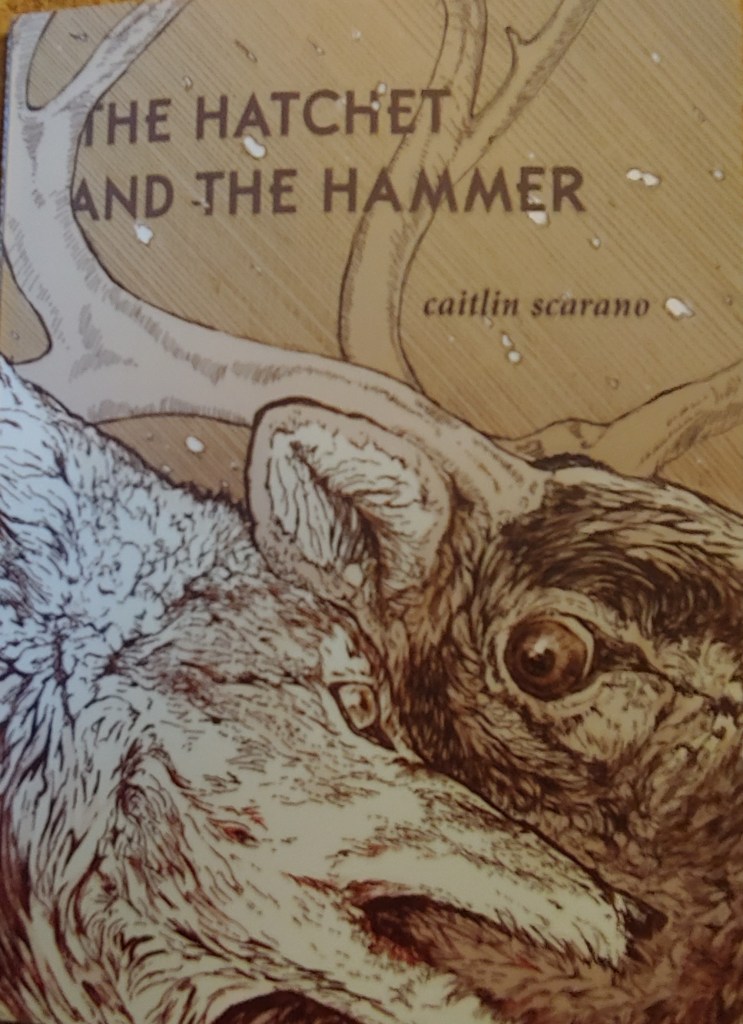
I find myself wanting to respond to every line in Caitlin Scarano’s chapbook, The Hatchet and the Hammer (Ricochet Editions, 2020). When she says, on page 2, “you can make him well, / if you simply / find the right offering,” I want to admit: “that was so true, for so much of my life.” And when the very last stanza reads,
How beautiful it will be to wake up one morning and know I am not in love with anyone but the open fields I’m crossing, the alter I’ve made. How beautiful it will be to bury this.
I think, “You will bury it as I have. When you grow old.” I think about the decades where all of my hurt stood between me and the ability to fully love or forgive myself or others. I think about how focused my attention was on sex as repair for hurt. As Scarano’s narrator puts it, “fucking is a form of healing.” My own persistent repetition of behaviors that caused harm to self and others are described perfectly in the book as “our hardwood floor kind of love.”
I don’t think this reaction is a unique affair between me and this book, or between me and the poet. I think instead that when words engage me to this deep level of exploration and memory, when the writing is clear and unencumbered with disguise, the words are true. No less true, whether or not they represent the poet’s own narrative.
Certainly, The Hatchet and the Hammer tells a woman’s story that is filled with danger, pain, and loss. One grandfather threatening a young black man with a shotgun and another hitting his wife with a hammer; an alcoholic father dying of liver failure; a partner with intrusive thoughts of violent acts.
Questioning becomes the modus operandi here for growth and healing. Movement occurs, however slowly and non-linearly, thorough questioning reality, typically with no easy answers. When on p. 14 the narrator asks, “how were we to know?” and on p. 17, “What did I really know?” the poignancy of how a child’s naivety disguises harm is striking. Scarano searches for a way out, asking on p.19, “How do I know when I have the truth about myself?” And her answer is hopeful,
I looked out over Lake Michigan one morning and thought: there must be someone
who all this won’t matter to, someone who will forgive me.
I must believe we are not the worst we’ve done.
An image of the narrator’s mother, searching “for the [lost] diamond in the garden for hours,” is analogous with the book’s excavation of a life spent digging for answers. Answers are not always forthcoming, but on p. 29, the narrator uncovers a way of acknowledging the depths and layers of her humanity, saying, “Nesting doll, remember / who found you.”
The place where healing can begin, lies with perspective: time and distance. On page 33, as if an aside, there is this parenthetical observation:
(This is to say: I see now, like how clear constellations appear when you finally move out of the city, the points where I was wrong. How they pulse with pain. Let them.)
The 34 pages of text in The Hatchet and the Hammer are organized in short stanzas, paragraphs, and information bits, separated by embellished dots that resemble colons. As if saying: this, and also this, and so forth. There are no titles, so instead, I’ve added page numbers so the reader can get a sense that there is an uneven sort of growth unfolding.
Incorporated material was referenced in an appendix of “works quoted,” from which Scarano borrowed words of Carl Phillips (In the end, courage has mattered so much less than / not spooking easily, which is all nerve is.), and Sharon Olds (“suddenly I understood his fondness for me was safe–nothing could touch it.”), alongside medical tidbits (OCD is a medical problem, / and not anyone’s fault.) Scarano also quotes from Elaine Scarry’s, The Body in Pain, a book I recall relying on to understand the meaning of illness in the nineties, during the AIDS epidemic.
There is also a line from June Jordan: Poetry means taking control of the language of your life. As The Hatchet and the Hammer suggests, writing may be an act of taking control, but it is not therapy. While I recognized myself in the narrator’s struggles, and take some solace in that act—by which I mean the act of being honest with myself about myself—I do not seek or find comfort in the battle. Healing is a goal for those who have experienced trauma, but it is not a given; at best it is a series of ever higher hills to climb, ever deeper excavations to dig. I am not one to give trigger warnings, I’d prefer to challenge others to read this book, to see what they find here, what they are willing to bear.
Caitlin Scarano is a writer based in Anacortes, Washington. She holds a PhD from the University of Wisconsin-Milwaukee, an MFA from the University of Alaska Fairbanks, and an MA from Bowling Green State University. Her second full length collection of poems, The Necessity of Wildfire, was selected by Ada Limón as the winner of the Wren Poetry Prize and will be released in spring 2022 by Blair.
Risa Denenberg lives on the Olympic peninsula in Washington state where she works as a nurse practitioner. She is a co-founder and editor at Headmistress Press and curator at The Poetry Café. She has published seven collections of poetry, most recently the full length collection, “slight faith” (MoonPath Press, 2018) and the chapbook, Posthuman, finalist in the Floating Bridge 2020 chapbook competition.
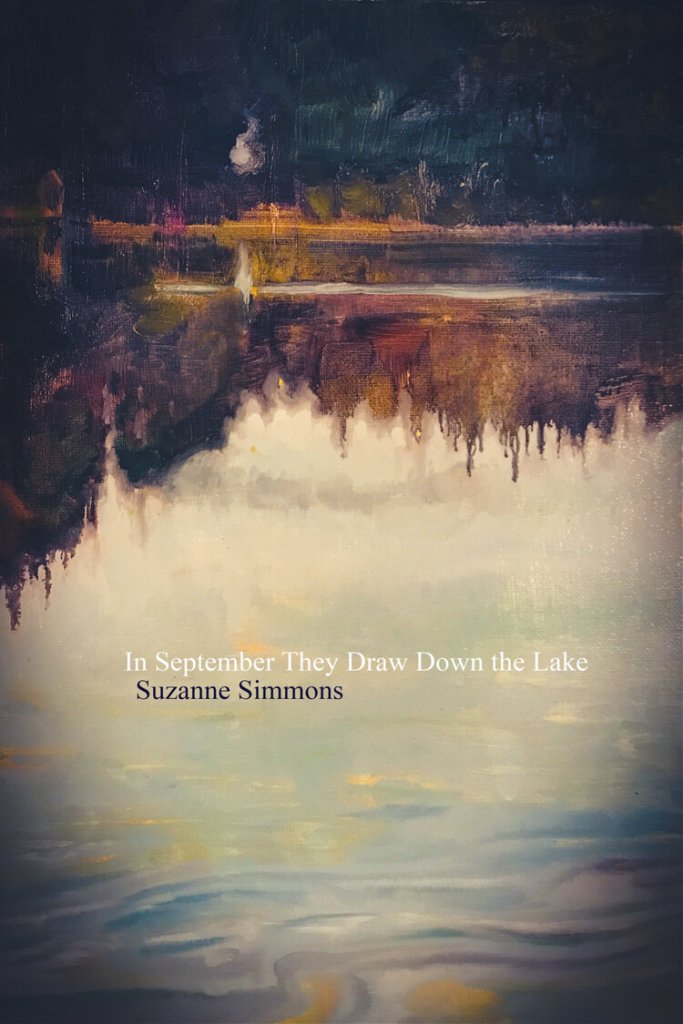
In September They Draw Down The Lake, by Suzanne Simmons
Review by Bill Rector
I do not know Suzanne Simmons, except by way of her chapbook, In September They Draw Down The Lake (Alexandria Quarterly Press, 2020). This is fitting, as her work derives its tension from the distance, emotional, physical, and temporal, that exists between herself and others.
The second poem in the book, “Commute,” concludes:
The train streaking beside us blows its whistle, years ago. We’re almost there.
Are we? The last poem in the collection is the echo she hears in the “shivery tunnels” of loons’ cries:
They cut through my dreams. Wake me. Do you hear them? You on your shore?
The book is divided into three, untitled sections. The initial section focuses on loss and its constant companion, regret. The first loss is that of her mother, who had a glass eye, in which the author sees herself disappear. In “Self Portrait,” she writes:
I fell out of you and rolled
Then, the loss of a lover/husband:
(I don’t miss you.) I miss air. (I don’t miss you.)
The second section is about her third loss, which is that of her son, who has autism. “Nursery rhyme” concludes with this wrenching sequence:
Normal health baby
At six, he asked Mommy, please kill me. Smeared feces on the dinosaur wallpaper. Came at me with teeth and eyes wild, clawing.
Rocking, rocking, rocking.
A later poem, “Coded” shows a family torn apart. The poem begins during a parent-teacher conference, in which the poet is sitting in a child-sized chair, and ends:
My husband begins crawling for the door. Seventeen years pass. I’m sitting in a child-sized chair. I’m about to speak.
The heroine of the third section of the book is the lake near which the poet lived and perhaps still does.
It was sweet when you held me up. Sweeter still when I dove to your bottom. Thanks for lapping and churning and the mornings when you lay under the mist silent. I was furious every winter when you froze.
One might expect the body of water to express, through the many forms available to metaphor, a form of reconciliation.
Not so. Here in “Long Night,” is this:
Cold stuns the lake onto glass. Portal moon.
[ … ] Hunger Moon, and one called crust.
This is the moon of the unfuckable. Between my boots and the rutted earth, a skin of ice breaks.
This book is skillfully written and worth reading for that reason alone. Its actively beating and, at times, raw and raging heart, is representative of our times.
Editor’s note: There is an introduction to In September They Draw Down the Lake, written by Ilya Kaminsky, author of Deaf Republic, which concludes with these words: “In a time of so much crisis, what a pleasure to read this kind, loving, beautiful work.”
Suzanne Simmons’ poems, essays and photographs have been published in the NYTimes, Fifth Wednesday, Rattle, Smartish Pace, The Baltimore Review and numerous other journals. Her chapbook In September They Draw Down the Lake was released by Alexandria Quarterly Press in 2020. Visit her at www.suzannesimmons.net.
Bill Rector is a retired physician. He formerly edited the Yale Journal of Humanities in Medicine. His publishing credits include a full-length poetry collection entitled, bill, through Proem Press, and five chapbooks: Lost Moth, about the death of his daughter, which won the Epiphany magazine chapbook competition; Biography of a Name (Unsolicited Press), relating the death of Jimmy Hoffa to contemporary American culture; Brief Candle (Prolific Press), a series of sonnets in modern idiom about selected characters from Shakespeare; Two Worlds (White Knuckle Press), relating the transcendent to the ordinary, which the editors called one of the most beautiful collections they have published; and most recently, Hats are the Enemy of Poetry (Finishing Line Press).
Bill Rector is a retired physician. He formerly edited the Yale Journal of Humanities in Medicine. His publishing credits include a full-length poetry collection entitled, bill, through Proem Press, and five chapbooks: Lost Moth, about the death of his daughter, which won the Epiphany magazine chapbook competition; Biography of a Name (Unsolicited Press), relating the death of Jimmy Hoffa to contemporary American culture; Brief Candle (Prolific Press), a series of sonnets in modern idiom about selected characters from Shakespeare; Two Worlds (White Knuckle Press), relating the transcendent to the ordinary, which the editors called one of the most beautiful collections they have published; and most recently, Hats are the Enemy of Poetry (Finishing Line Press).
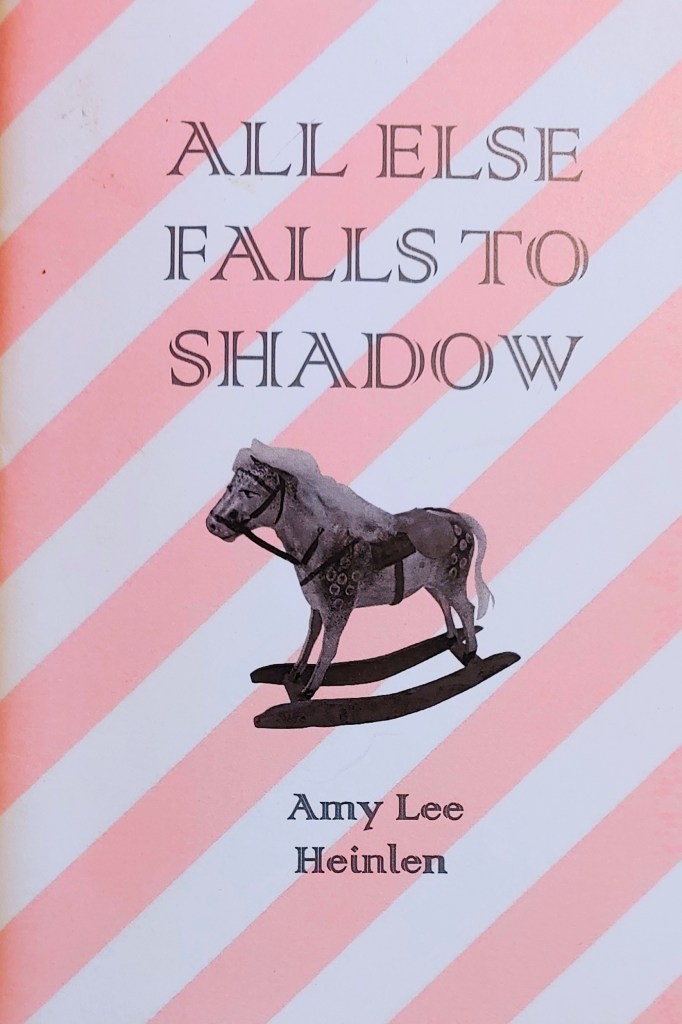
For many, motherhood conjures thoughts of gurgles and coos, tiny clothes, pastels and talcum. The cover of Amy Lee Heinlen’s chapbook, All Else Falls to Shadow (Dancing Girl Press & Studio, 2018), with its pink and white candy-cane stripes and child’s rocking horse, give it as charming and harmless an appearance as those innocent perceptions. Yet Heinlen’s poems also explore the real and darker side of motherhood many women experience after baby arrives.
Postpartum depression, and its power to overshadow the joy of life with a new baby, is all-encompassing, and too rarely discussed. As a mother who experienced post-partum depression after my second child, I couldn’t see it when it was happening—but I could see myself in the pages of this book.
In every culture dating back to biblical times, motherhood has been depicted in art, poetry, and song as a transformative experience, as natural as the tides. Fittingly, the bible and the ocean are referenced in Heinlen’s poems, like touch points for the speaker to grasp, to keep from drowning in her new reality.
The book begins with a peek of life before, when the speaker’s power lies fully within her mind. In “Self-Portrait As The Apostle Paul”, she glimpses her reflection, her hair wrapped in a towel, creating,
an image of a man in a turban, God shining through him. In the mirror, I don’t have a beard, but I could grow one if I wished, like an erection, strong and sharp as the sword of a man of God
Understanding what’s to come seeps in slowly. In “What to Expect,” the nursery is prepared. Fresh paint, alphabet flashcards, and a mural of Noah’s Ark on the wall create a peaceful setting for the coming baby. Yet we begin to sense something ominous looms, that reality will soon violently overtake the fantasy of motherhood:
I sit in the rocker, gift from the aunts. Green parrots squawk and flap
their wings but can’t warn Noah’s wife, who has fallen asleep beside the bull
below deck. Leopards lick the blood of unicorns from their lips.
In “Birth Plan,” the preparation and expectations are paralleled through repeated lines, half of which are heavily redacted. This visual depiction of fiction versus fact—literally and metaphorically in black and white—reveals how little all the preparation mattered; how little registers in a woman’s mind in the throes of labor; how little power she has when the act of childbirth fully overtakes her body until, at last, a healthy baby emerges. Finally, it would seem, all is well. But then the fall begins.
In the poem “Light, Blue”, it has only been hours since her child arrived, and the speaker has already deemed herself an unfit mother:
The first hours of your life, I fail To help you wash the yellow pigment From your body.
xxxxxxxxAt the hospital, xxxxxxxxjaundice is common.
My dumb breasts sit and stare.
Throughout the poem are all the perceived ways the mother fails her new daughter: the inability to fix her jaundiced condition; the frustration of being unable to feed her, and the helplessness of listening to her cry because she is too hungry to sleep. Reading these lines, I just want to hug her.
Doctors tell her of the jaundice, the trouble breastfeeding: this is common. But what of the mother’s mindset? Is this depressed state common as well? That this question is not explored by the doctor is the real failure.
Heinlen writes with authority and without sentimentality about what a woman is told to expect after giving birth, versus what she experiences. The speaker’s shifting condition is revealed, poem by poem, throughout the book. Through this larger picture, the reader can feel the mother’s mind changing by degrees, making it is clear how the slow descent into a seeming madness can be overlooked from the outside.
“When You Come Home” is not about the baby coming home but, rather, the mother and the changes she sees in herself:
You will mark the time by hours, minutes. The last time you…
xxxxxxslept (not you, the baby) xxxxxxate (not you, the baby) xxxxxxbathed (not you, the baby) xxxxxxcried (you and the baby).
The speaker’s physical routine is gone, so she maintains some semblance of control by instead marking when she last accomplished these simple acts. Later, she considers how her mental norms have also changed:
You love your partner. xxxxYou will hate him. He will sleep right through it.xxxxxxNot at first.xxxNot Every time. xxxxxxYou will hate him for it. xxxxxxYou will hate that you hate. xxxxxxYou will be amazed by the heat of it. xxxThe spark.
The true understanding of how her foundation has been shaken, though, is most stark in “It’s Not That.” Here, the speaker considers the horrible fates that could have befallen her baby as a result of her postpartum depression, and how close the danger came:
xxxxxxIt’s not as if she sat secured in the backseat on a hot day, overlooking a lake, the Volvo left in neutral. xxxxxxIt’s not even that I left xxxxxxfor long, never came back, never made it home. xxxxxxIt’s more that I could have, xxxxxxhow some mothers do.
When a baby joins the family, s/he becomes the sun around which the other members orbit. Because the infant’s needs are tantamount, a mother will often question whether her new struggles are real or imagined. Are they due to a larger problem with baby or merely her own inadequacies? More often than not, she will blame herself and press on. But by allowing baby’s day-to-day needs to trump her own, she unknowingly banishes herself into the darkness.
In a fitting parenthetical to the book’s first poem, a hopeful ray of light is eased into its last with the mother’s mind having righted itself, and her power finally returned. In “Considering A Second Child,” Heinlen writes, “I trade these / words for the chance to change my form once more.”
Ultimately, All Else Falls to Shadow is an introspective book about birth, both of a child and a mother. The woman births the child; the child transforms the woman into a mother. Heinlen brilliantly examines the multiple and complex threads among which the status of “mother” is tangled. By illustrating one woman’s experience—both the good and the frightening—she thoughtfully brings to light that which is too often left in the shadows.
Amy Lee Heinlen is a Pittsburgh-based poet and academic librarian. Her poems can be read at poets.org, Glass: A Journal of Poetry, Pittsburgh Poetry Houses, Wicked Alice, Rogue Agent, Pretty Owl Poetry, Nasty Women Poets: An Unapologetic Anthology of Subversive Verse, and elsewhere. In 2016, Amy Lee received an Academy of American Poets University and College prize and Best Thesis in Poetry award from Chatham University where she earned her MFA in Creative Writing for poetry and publishing. She is a mad-proud member of the Madwomen in the Attic writing workshops. You can find more about her current projects and poems at amyleeheinlen.com
Christine Orchanian Adler is a writer and editor whose poetry has appeared in Coal: A Poetry Anthology, Inkwell, Penumbra, Tipton Poetry Journal, and online at Bird and Moon, Damselfly Press, The Furnace Review, Literary Mama and elsewhere. Her chapbook, Undressing the Heart (Finishing Line Press, 2021), won an honorable mention in the Palettes & Quills 3rd Biennial Chapbook Contest. She served as a judge in the Greenburgh Arts & Culture Committee’s 35th Poetry Contest; The Harvey School’s annual Michael Lopes Poetry Recitation Contest, and as Editor and Managing Editor of Inkwell. Her articles, essays and book reviews have appeared in various publications throughout the Northeastern United States and Canada. You can read more of her work at http://christineoadler.com/.
Christine Orchanian Adler is a writer and editor whose poetry has appeared in Coal: A Poetry Anthology, Inkwell, Penumbra, Tipton Poetry Journal, and online at Bird and Moon, Damselfly Press, The Furnace Review, Literary Mama and elsewhere. Her chapbook, Undressing the Heart (Finishing Line Press, 2021), won an honorable mention in the Palettes & Quills 3rd Biennial Chapbook Contest. She served as a judge in the Greenburgh Arts & Culture Committee’s 35th Poetry Contest; The Harvey School’s annual Michael Lopes Poetry Recitation Contest, and as Editor and Managing Editor of Inkwell. Her articles, essays and book reviews have appeared in various publications throughout the Northeastern United States and Canada. You can read more of her work at http://christineoadler.com/.
John Bing has spent some of his lifetime building metaphorical bridges, but most of his time amazed at and appreciating different cultures and peoples, from a number of countries in Africa and Europe and Latin America to his years—years ago—in Afghanistan as a Peace Corps Volunteer. From these wanderings, and now from his perch in the American southwest, he has come to love both the peoples he has met and the lands that they inhabit. Just as each person and each group have their own characteristics and belief systems, so every place has its particular geography and set of living things. John Bing’s Time Signatures is forthcoming from Kelsay Press.