One may be jealous of another being licked: she thrusts her head under the outstretched neck of the one licking, and butts upward till the licking stops.
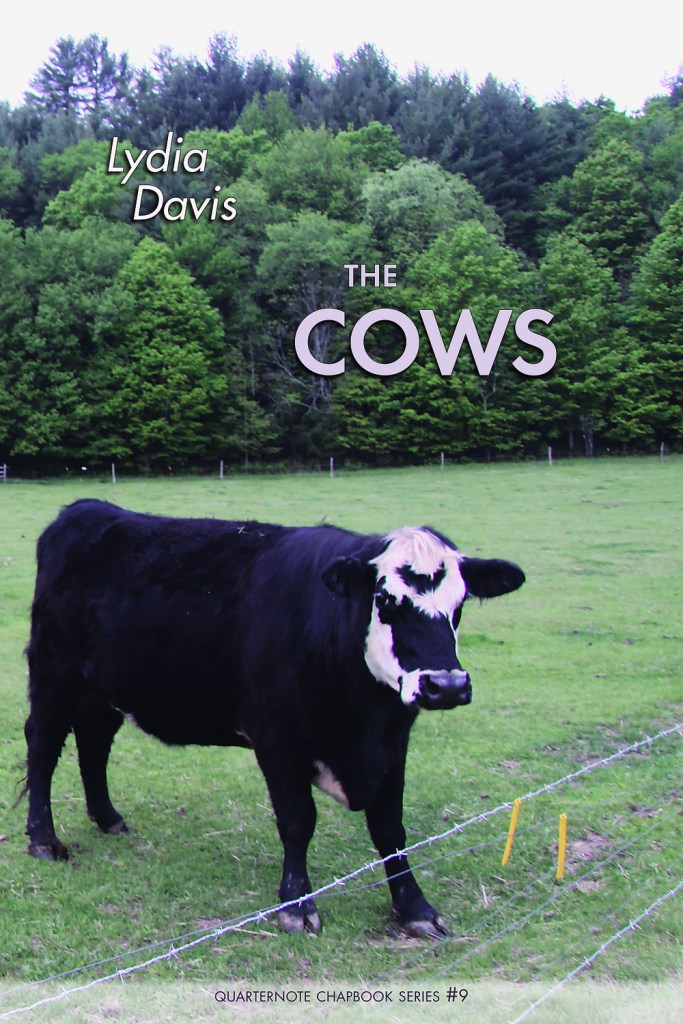
Lydia Davis’s The Cows (Sarabande Books, 2011) brought me back to every instance in which I stared at my childhood pets wondering “what are they thinking about?” Anyone who has spent prolonged time with animals will get a familiar feeling when they read this chapbook: the desire to decipher an animal’s intentions in the absence of a common language (while sometimes projecting personalities onto them). How many of us have monologued in tandem with an animal’s mysterious actions, or held mock conversations with said creature as they went about their business?
This chapbook is not a collection of individual poems, nor does it feel exactly like a standard short story. I can only describe it as a 38-page poetic observation of bovine life—one that is interspersed with photos, taken by the author during her year-long observations.
Davis has written other stories about animals, including cats, mice, and fish. Upon comparing these stories, we see that each type of animal can provide a different viewing experience to the human voyeur, due to their varied habits and needs.
In The Cows the theme of stillness is pervasive. The various incarnations of this stillness are portrayed throughout, for example:
How often they stand still and slowly look around as though they have never been here before,
And,
[. . .] they are so still, and their legs so thin, in comparison to their bodies, that when they stand sideways to us, sometimes their legs seem like prongs, and they seem stuck to the earth.
In a lifestyle marked by stillness, what are the things that bring action to a cow’s daily routine?
As Davis demonstrates, their stillness is set against a changing landscape of seasons (white snow to green grass), disturbance of other animals (flocks of birds, snowball-throwing boys, gaping writers), and the birth of calves. Ever-analytical, Davis also itemizes their forms of play:
[. . .] head butting; mounting, either at the back or at the front; trotting away by yourself; trotting away together; going off bucking and prancing by yourself [. . .]
The Cows thus depicts an ambling, relatively tranquil (but quietly humorous) existence for these creatures, at least through Davis’s eyes. But when we read some of her other stories, we are reminded that other animals may experience a different momentum in their daily lives. In her story “Cockroaches in Autumn,” (from: The Collected Stories of Lydia Davis, Picador, 2009) the featured critter’s activities are marked by speed rather than stillness:
[. . .] when I empty the bag, a crowd of them scatter from the heel of rye bread, like rye seeds across the counter, like raisins. [. . .] he stops short in his headlong rush and tries a few other moves almost simultaneously, a bumper car jolting in place on the white drainboard.”
While I found The Cows to be a thoroughly satisfying read on its own, it was particularly enriching to meet Davis’s cockroaches, mice, cat, and dog along with her neighbors’ cattle. I recommend The Collected Stories as companion pieces to this chapbook.
Lydia Davis is a short story writer, novelist, and translator. She is the author of six collections of short stories, including Can’t and Won’t (2014) and The Collected Stories of Lydia Davis (2009); one novel, The End of the Story (1995); and a collection of nonfiction, Essays One (2019), which was a finalist for the National Book Critics Circle Award. Davis is best known for her very short, micro- or “flash” fiction; many of her stories are a single sentence or paragraph long. She has translated novels and works of philosophy from French, including Gustave Flaubert’s Madame Bovary (2010) and Marcel Proust’s Swann’s Way (2003). Her honors and awards include fellowships from the Guggenheim Foundation and the MacArthur Foundation, as well as the Man Booker International Prize. She is a professor emerita at SUNY Albany. https://www.poetryfoundation.org/poets/lydia-davis
S.M. Tsai spent many years doing archival research and writing, then turned to 9-5 jobs for a new learning environment. Her poetry appears or is forthcoming in Ricepaper Magazine,Blue Unicorn, and the chapbook Bubbles and Droplets: 10 Poems of 2020. She lives in Toronto with her plants.
Risa Denenberg is the curator at The Poetry Cafe Online.
Postcards from the Lilac City, by Mary Ellen Talley
Review by Sylvia Byrne Pollack
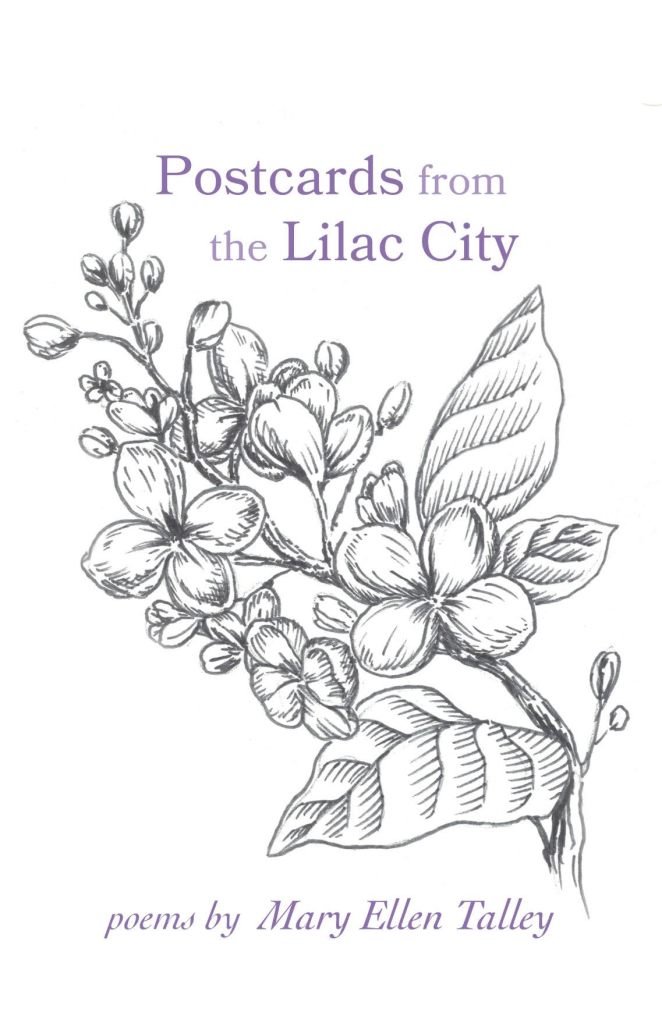
Mary Ellen Talley and I have attended many of the same workshops over the past decade, and I was already familiar with her work when I learned of the publication of her chapbook, Postcards from the Lilac City (Finishing Line Press, 2021). I’ve heard her describe this chapbook as “nostalgia-based,” but if nostalgia/memory is the seed from which this collection of poems sprouted and thrived, then I say keep on tending this tree. The fruit is delicious.
I also was drawn to this book because my mother loved lilacs. When I was growing up in Western New York, we drove to Rochester, NY each spring to the Lilac Festival in Highland Park. That park was the source of the lilacs that now flourish in Talley’s birthplace of Spokane!
Postcards from the Lilac City is an homage to place and era. However, it is not limited to Spokane, WA, known officially as The Lilac City, or to Talley’s school years. There’s a wide range of topics, from eating yak butter while traveling to baking shamrock cookies for the family.
The book is prefaced with a poem describing Pan’s infatuation with the wood nymph, Syringa, whose name is the genus name for lilacs. Three sections follow: “Bike Riding Before Helmets,” “Spokane Postcards,” and “After Vietnam.”
“Bike Riding Before Helmets” focuses on the poet’s early life. In “End of the Trolley Park,” we encounter the carousel where her parents first met. Strong sounds and dense details such as “two Chinese dragon benches / breathe fire” enhance the visual effects. They pick up the reader, carry us to another time, but by the end of the first section of the poem “The stallions are sleeping” and “The cemeteries are full / of riders.” The rebirth of the carousel in 1975, is told in declarative voice, rich with physical and emotional details, “as memories glisten spinning counterclockwise.”
The memories are mixed. For example, there is the contrast of a bomb shelter vs. the protection provided by the presence of the Poor Clare Monastery in “faith in the lilac city” –with the all lowercase title adding an ironic twist. A sometimes-troubled relationship with her father resolves into understanding in “As I Pursue You”:
what I most recall is your steady hand grasping the back of my bicycle
and running beside me until I could not fall.
Talley uses various poetic forms—even a duplex. In a Jericho Brown-inspired poem, “Duplex: We Had a Real Fred and Ethel in the Lilac City,” we meet Talley’s parents, the real Fred and Ethel, to whom the book is dedicated.
The final two poems recounting the speaker’s childhood relive teenage years. A Stone Man on a festival float brims with not-so-latent adolescent sexuality. My favorite of this group is “Butterfly” which captures teenage brio in the speaker’s casual description of herself:
I, in my herringbone pleated skirt, blue anklets and white Peter Pan collar, history and French books tossed in the back seat.
The poem includes the maneuvers required to start her hand-me-down car: opening the hood, flipping up the butterfly hinge, getting into the car to turn on the ignition, getting back out to flip down the butterfly, then idling in PARK while listening to the radio and watching her classmates head off to the bus. She then has an hour to spend with her boyfriend under a lilac (where else?) before picking up her mother. So much of a teenage life is captured in 34 lines.
The poems in “Spokane Postcards” contain the eponymous postcard poems. The first stanza of each is a description of place, the postcard image, followed by a message, generally from Mary Ellen but sometimes from her grandma. They have the feel of a flipped over haibun. The descriptions include place, season and senses. The messages use the casual voice of postcards to family and friends.
“Shadle Park” extends the teenage romancing of “Butterfly” with brief declarative and imperative lines: “Kiss the space between his teeth.” And, later, skin evokes the omnipresent lilacs:
pull petal soft sheer layers from burnt skin. Drop it all on an ant hill.
Probably the funniest line in the book is in the poem “Wandemere” in a message to a friend about experiences while traveling in Asia: “I am still so Spokane.”
The final section, “After Vietnam,” includes poems of marriage and maturity. In “The Things We Carry,” memorable lines, such as “you and I carried desire / like youth’s cranking jump rope” are juxtaposed with dense descriptive passages. Later in “Fabric of Worry,” we find Talley’s judicious use of white space.
An homage to Gertrude Stein, “Occupation of Lilacs,” overwhelms the senses with the sight and smell of lilacs, in true Stein fashion. The lilting “Prism” delights with its nursery rhyme rhythms and nonsense, e.g., “Old onions cry out once pumpkin seeds twinkle.”
The poem, “Since you ask how do we love a sibling (enough)” uses a clever device. Lines are divided into two columns and lines in the right hand column in each stanza begin successively with H,E,L,I,X. The poem further explores and pulls together family stories we heard about earlier in the book. It is a moving tribute to family and the DNA ties that bind.
In the final poem, Talley considers “the movie of my life” in a taut, beautiful series of images of a tapestry,
ripped in those years of hanging beside a stone staircase.
There is much to savor in this eclectic collection of poems. Talley takes us on a carousel ride through time and space and in her quiet voice returns us a little more grounded, more appreciative of family, more aware of the beauty that leavens life.
Mary Ellen Talley was born and raised in Spokane, Washington, the Lilac City, and then migrated to Seattle where she and her husband raised their two children. She earned degrees at the University of Washington and worked for many years as a speech-language pathologist (SLP) in Seattle area public schools. Her poems have been published in numerous journals including Raven Chronicles, Banshee, What Rough Beast, Flatbush Review, and Ekphrastic Review, as well as in six anthologies, among which are All We Can Hold and Raising Lilly Ledbetter: Women Poets Occupy the Workplace. Her poetry has received two Pushcart Nominations. She reviews for several journals including Compulsive Reader and Asheville Poetry Review.
Sylvia Byrne Pollack, a scientist turned poet, has published in Floating Bridge Review, Crab Creek Review and Clover, among other print and online journals. A two-time Pushcart nominee, she won the 2013 Mason’s Road Literary Award, was a 2019 Jack Straw Writer and will be a 2021 Mineral School Resident. Her debut full-length collection Risking It is published by Red Mountain Press (2021.)
Risa Denenberg is the curator at The Poetry Cafe Online.
Memoirs of a Witness Tree by Randal Burd was reviewed at The Poetry Cafe by Diane Elayne Dees, and, in turn, Dees’s chapbook, Coronary Truth, was reviewed by Burd. These two poets found that they had much in common, as you will see in this interview between them.
[M]y love of formal poetry—which I often write—is probably somewhat inspired by some of the poets, especially the Victorian poets, I studied in school.
Diane Elayne Dees
Randal Burd: I was recently privileged to have the opportunity to interview Diane Elayne Dees via email regarding her latest poetry collection, Coronary Truth (Kelsay Books, 2020). That conversation informed a review of her chapbook, but her answers to my questions are illuminating in their own right.
RB: What inspired you to become a poet; to decide to write poetry and have it published?
Diane Elayne Dees: I always enjoyed writing, but didn’t start doing it seriously until later in life. I did political and tennis writing, and I wrote and published a lot of creative nonfiction and short fiction. Then, suddenly, I went dry—I ran out of story ideas. I began to write poetry because I was frustrated and wanted to write something creative. To my surprise, I took to it almost immediately and have written little else, in terms of creative writing, for several years now. And since I was already a published nonfiction and fiction author, it didn’t even occur to me not to seek publication of my poetry.
RB: Who are some of your favorite poets? Which poets have inspired your writing?
DED: My very favorite poet is Edna St. Vincent Millay. I also like reading Rumi, Emily Dickinson, Matthew Arnold, and Mary Oliver. Two of my favorite contemporary poets are Jennifer Reeser and Allison Joseph. I’m not aware of my own poetry having been directly inspired by any poet in particular, but I think that my love of formal poetry—which I often write—is probably somewhat inspired by some of the poets, especially the Victorian poets, I studied in school.
RB: What is your process for writing poems? Is it deliberate and scheduled or as the inspiration comes?
DED: It’s generally as the inspiration comes. However, I recently participated in two projects which required the scheduled writing of poems, and I was amazed at what that bit of pressure produced. I’ve no doubt that scheduling writing time would be a good idea—I just need to find the discipline.
RB: I notice you draw a lot of inspiration from nature. Do you spend a lot of time outdoors?
DED: I grew up near a lake, with woods right beyond my back yard, and I now live in a natural setting. Just about every day, I go outside to observe the birds and insects and other creatures, and to photograph them. I don’t garden as much as I used to, but I still tend to a number of plants. Also, my house is filled with images of the natural world.
RB: Is the reader wrong to assume many of these poems have an autobiographical element to them?
DED: Many of them are indeed autobiographical.
RB: Do you personally find writing poetry to be a cathartic process?
DED: I do! I find several different kinds of writing cathartic, but the poem—by virtue of its distillation of thought, melded with sound and rhythm—creates a total body experience of satisfaction/relief that is hard to explain to someone who has never created a poem. My hope is that the reader will also experience some of that.
RB: You have published a “progressive” blog, written for Mother Jones, and authored political essays, yet your poetry does not seem to be overtly political. What do you think of politics as poetic muse?
DED: I write and publish a lot of political poetry, but none of it appears in this chapbook. For me, social/political issues provide an endless supply of topics for poems, and writing about topics important to me is now my way of contributing to the conversation. However, those topics about which I’m the most passionate remain difficult poetic subjects for me to write about; my emotions get in the way. And—to return to the last question—writing poetry about social issues is quite cathartic.
Diane Elayne Dees’s poetry has been published in many journals and anthologies. Diane is the author of the chapbook, Coronary Truth (Kelsay Books) and the forthcoming chapbook, I Can’t Recall Exactly When I Died. Diane, who lives in Covington, Louisiana, also publishes Women Who Serve, a blog that delivers news and commentary on women’s professional tennis throughout the world. Her author blog is Diane Elayne Dees: Poet and Writer-at-Large.
Randal A. Burd, Jr. is an educator and the Editor-in-Chief of the online literary magazine, Sparks of Calliope. His poetry has received multiple awards and has been featured in numerous literary journals, both online and in print. Randal’s 2nd poetry book, Memoirs of a Witness Tree, is now available from Kelsay Books and on Amazon.
A whole body of literature exists that focuses on the body. Indeed, one might make the assertion that all literature does so, in one way or another— enraptured body, dying body, panicked body, betrayed body, and, as in the case of Life, One Not Attached to Conditionals by Laura Cesarco Eglin (Thirty West Publishing House, 2020), body as betrayer.
Because I, too, have gone through, and written about “the cancer experience,” I was particularly drawn to this chapbook. I was curious to see how cancer could be the subject of a collection of poems without it spreading into all aspects of what makes a book cohesive and alive, i.e., a sense of tension between themes, linguistic risks, and tone (to name a few). Cesarco Eglin contrasts her subject matter’s doom and gloom with the urge to live her still-young life despite the ever-present shadows. The dark humor infused in these poems also underscores the seriousness of their themes. For example, in “Articulating the Changes in My Body,” Cesarco Eglin, a fine translator herself, compares her scars to Morse code:
I’m thinking about the Morse code as a possible alphabet to get through, to get by, to translate.
She then gives a graphic representation of Morse-code-as-scar.
It’s easy for poems about illness to veer off into sentimentality or self-absorption, but Cesarco Eglin masterfully negotiates the geography of living an unconditional life, despite her multiple bouts with melanoma, and despite the need “to guard [each] new spot ‘like a hawk.’” In this pandemic year, many of us are directly experiencing the need to be extra-vigilant to avoid contracting the virus, which makes this new chapbook of poems particularly relevant. Cesarco Eglin can never escape “the doctor’s voice in [her] head: it will come back.” She reminds us that “there is no vacation from being alert.” Indeed, in an existential stance to confront the absurdity of the human condition, she instructs us on how to take control of the uncontrollable, and writing is her chosen strategy. She offers us this wisdom:
One scar, then another; that’s two lines already: a couplet written in five months, a couplet that promises to be the beginning of a lifetime of poetry.
Melanoma, her muse, has provided her with the motivation to be “aware of any little change in color, shape, texture, dimension, state, mode or mood of any mole or stain or spot on [my] body.” Cesarco Eglin, who was born in Uruguay and is fluent in Spanish and English as well as other languages, is open to melanoma teaching her the language of the body—learning it well enough to eventually call herself “a native speaker.” She’s trying to learn to embrace her scars, and compares them to bridges, as she brilliantly transforms the threatening juxtaposition of “bridge” and “attempt” to a life-affirming choice:
Many bridges, an attempt to keep me in one piece; an attempt to keep me alive long enough to cross them all.
In these days of COVID-19, we could all use something to help us cross these bridges—something to remind us to keep believing there are still “skies and wonders.”
The Reviewer posed some questions to the author about her book:
Nancy Naomi Carlson: What about Life, One Not Attached To Conditionals is uniquely suited to the chapbook form?
Laura Cesarco Eglin: I felt that a shorter form would suit Life, One Not Attached to Conditionals as a way to, at least in language, be able to finish the cycle, end the struggle psychologically, intellectually, and emotionally. Intense, short, and move on to life, one not attached to conditionals.
NMC: I notice that “translation” is one of the themes of Life. How did your work as a translator (and an author who is translated) impact your writing this chapbook?
LCE: Experience translated into language. Poetry as a means to question, challenge, and rearrange thoughts and experiences. Translation as a form of reading deeply, analyzing.
NMC: Writing about illness seems to be a tried-and-true genre, but is also an emerging one, as the landscape of disease is ever-shifting. Were you influenced by other writings on this topic?
LCE: More than influenced on writings on this particular topic for this particular chapbook, I would say that I am always influenced by all the books I read. I think that goes without saying. But there are two books in particular that I’d like to highlight. They deal with overcoming a loved one’s death or suicide: Ghost of by Diana Khoi Nguyen and Instead of Dying by Lauren Haldeman.
NMC: Can you say something about your wonderful title (e.g., how it came about; when, in the process of writing, it came to you…)
LCE: The title comes from a line in “Recovery,” a poem in Life, One Not Attached to Conditionals. I did not set out to write a poetry collection about having melanoma and skin cancer repeatedly and what that meant. I was writing poems and they, understandably, had that focus. The process of editing, rereading, changing, rewriting brings new perspectives, and when I read that line I perceived that it encapsulates the compass, as well as the power I think language has.
Laura Cesarco Eglin is a poet and translator. She is the author of three collections of poetry: Calling Water by Its Name, translated by Scott Spanbauer (Mouthfeel Press, 2016), Sastrería (Yaugurú, 2011), and Reborn in Ink,translated by Catherine Jagoe and Jesse Lee Kercheval (The Word Works, 2019). She has also published three chapbooks: Life, One Not Attached to Conditionals (Thirty West Publishing House, 2020), Occasions to Call Miracles Appropriate (The Lune, 2015) and Tailor Shop: Threads, co-translated with Teresa Williams (Finishing Line Press, 2013). Her poems, as well as her translations (from the Spanish, Portuguese, Portuñol, and Galician), have appeared in a variety of journals, including Asymptote, Modern Poetry in Translation, Eleven Eleven, Puerto del Sol, Copper Nickel, Spoon River Poetry Review, Arsenic Lobster, International Poetry Review, Tupelo Quarterly, Columbia Poetry Review, Blood Orange Review, Timber, Pretty Owl Poetry, Pilgrimage, Periódico de Poesía, and more. Cesarco Eglin is the translator of Of Death. Minimal Odes by the Brazilian author Hilda Hilst (co•im•press), winner of the 2019 Best Translated Book Award in Poetry. She co-translated from the Portuñol Fabián Severo’s Night in the North (EulaliaBooks, 2020). She is the co-founding editor and publisher of Veliz Books.
Nancy Naomi Carlson, poet, translator, essayist, and editor, has authored 10 titles (six translated). An Infusion of Violets (Seagull Books, 2019), her second full-length collection of poetry, was named “New & Noteworthy” by the New York Times. A recipient of two NEA literature translation fellowships, she was a finalist for the Best Translated Book Award, and the CLMP Firecracker Poetry Award. An associate editor for Tupelo Press, her work has appeared in such journals as APR, The Georgia Review, The Paris Review, and Poetry. www.nancynaomicarlson.com
Risa Denenberg is the curator at The Poetry Cafe Online.
Jayne Moore Waldrop came late to writing, in mid-life, and has much to say about her life and past in her strong first chapbook of poetry, Retracing My Steps, which was a finalist in the 2018 New Women’s Voices Chapbook Series Contest. The narrative poems hark to the hardworking legacy of her Appalachian forebears who farmed, and of women, especially the women in her family. One has the sense when finishing this collection of having completed several journeys, that of the poet and of other members of her family: mother, father, great grandmothers.
Intimate themes—what we feel and what has formed us as human beings—have always informed the writing of women. In much recent poetry by women, one sees the pull to reach back and plumb the past to get a sense of the self in the present. The work of Waldrop and other poets such as Cynthia Atkins seems to say that we are at a juncture in which learning from the past and recognizing mistakes become a key to help us heal and move forward. The great danger lies in separating ourselves from history, both familial and collective, and from one another and the earth, to which we are all rooted and belong.
In “The Other Side,” the narrator speaks to the loss of a sense of identity and origin that comes with displacement: “I am from the other side, / hybrid native and alien, / neither us nor them.” A loss of roots can threaten the sense of self, but so can divides imposed by those who need to create boundaries between people. In “The Wall: Haiku from a Gated Community,” the poet rues the idea of a fence having become a brick wall of defense: “Is the ten-foot fence / not enough to protect you / from those outsiders?”
Separation, displacement, and the longing for home are themes that run throughout this poignant collection. Waldrop ponders them and offers them up to the reader, often in the form of questions. In “What Am I to Do Now?” the narrator wonders, “How hard it must be / when one’s work is over / and there’s nothing left to do.” It is something Waldrop, who is also a mother of grown children and a lawyer, has surely also asked herself.
In the following email interview exchange Waldrop discusses her journey as a writer and the themes that drive her poetry.
Arya F. Jenkins: You came to writing late. What launched your journey into poetry? What have been the pitfalls and high points of that journey?
Jayne Moore Waldrop: I guess I’ve always been a writer, but I’ve taken a long path to get to poetry. In college I studied English literature and journalism. At the time journalism seemed to be the way to make a living as a writer. I worked as a newspaper reporter and editor for four years then went to law school. Language is important in law practice, too. Lawyers need to be effective communicators to advocate for their clients.
I practiced law for several years. After taking time off when our younger son was born, I knew I didn’t want to go back to practicing law. I wanted to write, but I never seemed to make time for it. I didn’t know where to start or how to build a writing life. I had a few creative nonfiction magazine pieces published, and at age 55 decided to apply for a low-residency MFA in fiction. I wanted to learn but needed the discipline that comes with deadlines and assignments. And even though it was daunting to go back to school and join an incoming MFA class of writers mostly the age of my own kids, I loved it. I like change. I like to think of life in seasons that provide different opportunities throughout a lifetime. And periods of change are particularly creative times, I’ve found.
I finished my MFA in 2014. My journey into poetry came later, inspired by time spent at the 2016 Appalachian Writers Workshop, where I listened to several acclaimed prose writers read their poetry. It was eye opening. I wanted to try poetry. I was especially interested in poetry by writers like Wendell Berry, Gurney Norman, bell hooks, Ron Rash, and Silas House, all of whom I knew primarily as prose writers. Their poems have great narrative power.
During a residency at Rivendell Writers Colony, I read a lot of poetry, studied several craft books, and started writing. At the time I felt like a switch had been flipped in my brain. Writing poetry felt like writing distilled short scenes, like trying to capture a closely observed moment. A common theme appeared in some of the poems, one of reflection on the different seasons in life and paths chosen over generations of time. A line from All About Love by bell hooks really spoke to me: “Mindful remembering lets us put the broken bits and pieces of our hearts together again.” I used it as my book’s epigraph.
After I had a stack of poems written, I learned of a writing competition called New Women’s Voices Chapbook Contest sponsored by Finishing Line Press. I assembled the poems and submitted the manuscript called Retracing My Steps. To my great surprise it was a finalist in the 2018 contest and was selected for publication. To me the book is the high point so far in my writing journey and tangible proof of the old saying, “It’s never too late.”
AFJ: From the outset of Retracing My Steps, you stress the importance of an observed life, knowing from where you came—I would imagine in order to know where you are headed in life. When did you first decide you wanted to write about Kentucky and your family? Did you have to do research, or did you grow up knowing the stories of your ancestors?
JMW: Writing what I know always includes Kentucky. My family came through Cumberland Gap more than 200 years ago, but I hope the poems reflect a more expansive view than the story of one family’s journey. Many families share the story of coming to a new, unknown place and trying to find a better life, whether that was 200 years ago or last week. The search for home is a human condition that connects us all.
I grew up hearing family stories – both of my parents were wonderful storytellers – and I’ve done my own research, including hiking the Wilderness Road through Cumberland Gap to retrace my ancestors’ steps.
AFJ: Another theme in Retracing My Steps is that of impending invisibility, the struggles of women as they let go—in birth and middle age, for example. “Mantle of Invisibility” is a powerful poem about the progress toward anonymity women face as they age: “She transformed into Invisible Woman and reset / her filters to block earworms like “Anti-aging,”/ “granny arms,” and “looking good for her age.” How does that struggle impact your life now, if at all?
JMW: Thank you for your kind words about “Mantle of Invisibility.” For years my best friend and I have laughingly talked about becoming invisible. It stings when you realize how our society diminishes people as they age, especially women. We don’t respect the wisdom that comes with experience as many cultures do. In fact we’re expected to fight getting older with everything we can throw at it from artificial hair color to wrinkle injections to plastic surgery to remake ourselves into something that lives up to societal expectations. It seems like such a superficial way of judging people and their worth, and it’s such a waste of precious time. The flip side of that looming redundancy is that there is power that comes with letting go of societal expectations. In the poem I decided to turn it into a superpower.
AFJ: In “Coming Through Cumberland Gap” you relay the fragile self-consciousness of modernity with all its privileges, and in “Pie Plate,” refer to your mother as made-from-scratch / woman, a farm-to-table / cook before that was a thing,” and to yourself growing up as wanting “to live the processed American dream.” As a woman and writer, in what ways have junctures between your mother’s life and your childhood dreams severed further, or healed?
JMW: I think many of us see our parents differently when we reach adulthood. As a child I just wanted to be like everyone else living that “processed American dream.” I wanted to fit in. I wanted to live in cookie-cutter tract housing like most of my friends and eat frozen TV dinners like the ones advertised in commercials. I wanted to fit in. But my parents didn’t automatically fit in. They had moved from Appalachia. They were different than most people in the small western Kentucky town where I grew up, a boomtown that grew exponentially in the 1950s when a uranium enrichment plant was built. They had made their own journey to make a new home in a new land. As displaced Appalachians, they were like refugees looking for a better life than the cyclical poverty in the coalfields of eastern Kentucky. They had to have land to have a garden and livestock. They couldn’t have survived in a subdivision or separated from the land. As an adult I’m very proud that they maintained their mountain identity. They kept the culture alive for us with stories, music, and tables laden with fresh food from the garden instead of those lousy TV dinners. What was I thinking?
My mother didn’t have the opportunity to get a college education, but she worked hard to make sure her children did, especially her daughters. I’m also grateful to her for passing along her love of nature and being outdoors. She noticed the beauty of the natural world until the day she died.
AFJ: You also mourn the loss of dignity in the American dream, the building of walls, the sense of displacement and simultaneously the need for a sense of home. Can you expand on this concern?
JMW: Home is an important theme in my writing, both poetry and prose, and I think that relates to my family’s experience as displaced Appalachians. I’m intrigued by how people are connected to a place, even if that place no longer exists. Edward Abbey wrote in Desert Solitaire that “Every man, every woman, carries in heart and mind the image of the ideal place, the right place, the one true home, known or unknown, actual or visionary.” I’m fascinated by that idea. I’ve seen the force of this “one true home” in my family and others. After they left the mountains, my parents lived in their adopted city for fifty-plus years and built a good life, yet when they spoke of “home” they always meant the mountains. And when they visited the mountains, it seemed like they were forever disappointed that the place they remembered no longer existed. I’m working on a linked story collection based on a similar theme but in a different setting.
Jayne Moore Waldrop is a writer, attorney and author of Retracing My Steps (Finishing Line Press 2019), a finalist in the New Women’s Voices Chapbook Contest.Her prose and poetry has appeared in the Anthology of Appalachian Writers, Still: The Journal, New Madrid Journal, Appalachian Heritage, Minerva Rising, New Limestone Review, The Paddock Review, Sequestrum, Heartland Review, Luna Station Quarterly, Kudzu, and Deep South Magazine. Her stories have been selected as Judge’s Choice in the 2016 Still Journal Fiction Contest; finalists for the 2015 International Literary Awards Reynolds Price Short Fiction Prize, the 2016 Tillie Olsen Fiction Award, and 2017 Still Journal Fiction Contest; and honorable mention in the 2014 AWP Intro Journals Project. A 2014 graduate of the Murray State University MFA in Creative Writing Program, she served as literary arts liaison for the Carnegie Center for Literacy & Learning in Lexington, Kentucky, and book columnist for the Louisville Courier-Journal.
Title: Retracing My Steps Author: Jayne Moore Waldrop Series: New Women’s Voices Series (Book 144) Paperback: 40 pages Publisher: Finishing Line Press (April 5, 2019) ISBN-10: 1635348463 ISBN-13: 978-1635348460
Arya F. Jenkins is a Colombian-American poet and writer whose work has been published in numerous journals and zines, most recently, IO Literary Journal, Rag-Queen Periodical, and The Ekphrastic Review. Her poetry and fiction have been nominated for the Pushcart Prize. Poetry is forthcoming in Poetica Review. Her poetry chapbooks are: JewelFire (AllBook Books, 2011), Silence Has A Name (Finishing Line Press, 2016), and Love & Poison (Prolific Press, 2019). Her short story collection Blue Songs in an Open Key (Fomite Press, 2018) is available here: www.aryafjenkins.com.
Francine Witte has published four poetry chapbooks, among many other accomplishments. The Poetry Cafe introduces Witte in conversation with poet and writer Arya F. Jenkins, who joins our guest reviewers with this interview.
I’ve always thought that it’s the small details that connect the writer to the reader. –Francine Witte
Arya F. Jenkins: You write poetry, flash and fiction. As a poet, you have authored several poetry chapbooks and a couple of full-length poetry collections. How did you come to be a poet?
Francine Witte: I started writing poetry in second grade. Rewriting song lyrics. And then when I was about 13, I started writing poetry for real. It was about playing with words and expressing ideas. I’ve always enjoyed language and writing.
AFJ: Your ability to write about lost love, grief, and aging with such particularity and universality is a rare gift. Are you sometimes surprised at the level of honesty and truth your poems are able to plumb?
FW: I’ve always thought that it’s the small details that connect the writer to the reader. Everyone has experienced love, grief, and on some level, the discomfort of getting older (I never have felt as old as the day I turned 20, by the way.) It’s the focus of a tiny detail that either makes the reader say, “yes, that happened to me,” or “oh yes, I can see what you mean.” Finding these small moments is actually one of the most fun parts of writing for me.
AFJ: Are your chapbooks held together by certain themes? If so, what are they?
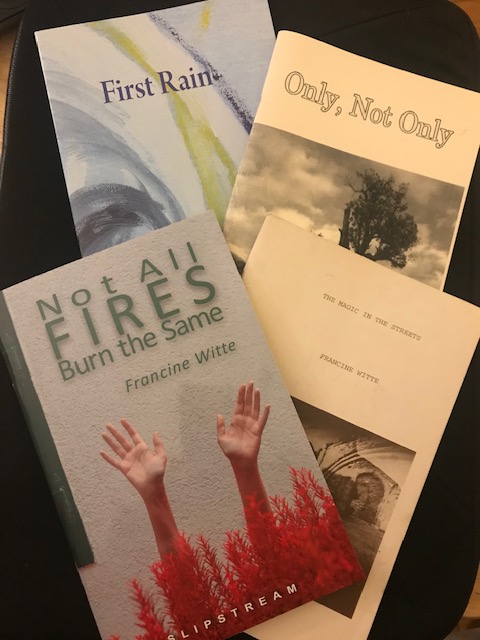
FW: My chapbooks seem to be unintentionally themed as a result of what I was writing about at that particular time. For example, in First Rain, I have a good amount of the poems focusing on child/parent relationships, while Only, Not Only, deals more with a grown narrator who has been hurt by romantic love. And the theme of Not All Fires Burnthe Same, is really more or less a collection of mother/daughter, love gone wrong and environment.
AFJ: How has your relationship to the big themes of love and loss in your writing changed over the years? Have you abandoned any topics? If so, which? And why?
I’m still pretty focused on love and loss. I don’t see that changing.
FW: I’m still pretty focused on love and loss. I don’t see that changing. I am also fascinated by the theme of people and their history on this planet. I’ve always been interested in weather and the natural world. In Theory of Flesh, I find myself looking back to cave people and thinking that they were the same as us in terms of their basic emotional makeup.
AFJ: I am intrigued by your deconstruction of “self” in some of your poems. In your collection, The Theory of Flesh, the narrator asks who the poet is and how she can be distinguished from the other selves that inhabit her daily life? Does this focus have precedence in your chapbooks?
FW: I think you are referring to my poem “How Many Me’s are There?” which talks about the different people we are in different situations. It asks the question of the me’s occurring at the same time in a person’s life. But there are also different me’s that span time. There’s childhood me, grown-up me, married me, etc. I do think my chapbooks reflect these different times in the speaker’s life.
AFJ: Lately I’ve encountered artists and poets who revere animals, the dog especially, and have done beautiful justice to them in their work. Some of the poems in your full-length collection, The Theory of Flesh examine links between the animal and human kingdoms. What do animals have to teach humans? How do they “speak to” what is higher in us?
FW: Animals seem to live in the moment. They go on instinct and need. They don’t seem to have hidden agendas. They love the person who feeds them. They are grateful for that. Simple. That’s what we can learn from them.
They speak to the need in us to be needed, to care for someone else. That part, the part that cares beyond our own comfort, really is our higher self.
AFJ: Do you feel you have any obligations as a poet? If so, to what or whom?
FW: My obligation as a poet is to give the reader or listener a great experience for having taken the time to read or listen to my poem. I need to say something that the reader has never heard in a way they have never heard it. I have to create something, make them feel something, or at least make their few minutes of reading worthwhile. That’s my obligation.
AFJ: What if anything would you like to impart to those poets new to poetry who would like to publish a chapbook?
When putting together a chapbook, or any book, make sure every poem is a 10.
FW: I would tell all poets to become your own best editor and listen to that voice that tells you a line or a stanza isn’t as good as it could be, or to take it out, etc.
When putting together a chapbook, or any book, make sure every poem is a 10 (at least in your opinion.) There is no room for filler even if it’s on theme. I think the quality of the poems is more important than any superimposed connective tissue.
Francine Witte is the author of four poetry chapbooks and two full-length collections, Café Crazy and The Theory of Flesh from Kelsay Books. Her flash fiction has appeared in numerous journals and anthologized in the most recent New Micro (W.W. Norton) Her novella-in-flash, The Way of the Wind has just been published by Ad Hoc Fiction, and her full-length collection of flash fiction, Dressed All Wrong for This was recently published by Blue Light Press. She lives in New York City.
The Magic in the Streets (Owl Creek Press, 1994) first prize contest winner First Rain (Pecan Grove Press, 2009) First prize contest winner Only, Not Only (Finishing Line Press, 2012) Not All Fires Burn the Same (Slipstream Press, 2016) first prize contest winner
Arya F. Jenkins is a Colombian-American poet and writer whose work has been published in numerous journals and zines, most recently, IO Literary Journal, Rag-Queen Periodical, and The Ekphrastic Review. Her poetry and fiction have been nominated for the Pushcart Prize. Poetry is forthcoming in Poetica Review. Her poetry chapbooks are: JewelFire (AllBook Books, 2011), Silence Has A Name (Finishing Line Press, 2016), and Love & Poison (Prolific Press, 2019). Her short story collection Blue Songs in an Open Key (Fomite Press, 2018) is available here: www.aryafjenkins.com.
Risa Denenberg is the curator at The Poetry Cafe. She is a co-founder and editor at Headmistress Press and has published three full length collections of poetry, most recently, “slight faith” (MoonPath Press, 2018).
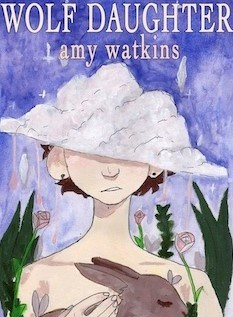
Pink roses reach up and around the unclothed body of a girl, her eyes hidden by a thick, tilted cloud. The hare she holds has closed its eyes. It’s a striking image for Wolf Daughter, the latest chapbook by Amy Watkins, and fittingly, the illustrator is Watkins’ daughter, Alice Copeland. The alluring, muted colors may lead you to believe you are entering a realm where young women lack necessary rage. Think again.
The dedication, “for Alice,” is a whisper, and the book is a battle cry. These eighteen poems, neatly numbered, are nothing less than a mother’s love made palatable and exposed for the reader.
The chapbook opens with, “My daughter says, ‘I don’t remember how / not to be a wolf.’” And here we are immediately thrown into the raw extended metaphor where girls grow fangs. The clash of mother/daughter, of animal/social creature, of child becoming an adolescent—this clash tangles throughout lines grounded again and again in the material world of malls and school dances. As a reader, I am brought back to my own struggle as a young girl, when I felt primal and weak and full of an anger I could not name. When the speaker says, “‘I think it’s hard being alive in this world’” there is no explanation needed. I receive the wisdom when Watkins writes, that if all else fails, “Find a mind for violence.”
Watkins is no stranger to the concentrated energy a chapbook creates. Her two previous chapbooks have found publication at the presses Bottlecap Press and Yellow Flag. She has also lectured at Full Sail University on creating and publishing chapbooks. Wolf Daughter proves the ability of a chapbook to construct an entire world. Watkins has distilled and expanded her subject matter simultaneously. We are never lost in her hands.
Wolf Daughter does not apologize for its animal nature. Instead, it ends with, “She comes and goes with such confidence. / Even her long teeth gleam.” Which is what we need—a society where girls can wear their rage proudly, openly. Watkins has given voice to the young girls’ war song. May it be heeded.
Amy Watkins is the author of three poetry chapbooks (Milk & Water, Lucky, and Wolf Daughter), a graduate of the Spalding University MFA in Writing, and a parent of a human girl. Find her online at RedLionSq.com or @amykwatkins on Twitter. She lives in Orlando, Florida.
Risa Denenberg is the curator at The Poetry Cafe. She is a co-founder and editor at Headmistress Press and has published three full length collections of poetry, most recently,slight faith(MoonPath Press, 2018).